Happy Party Gremlins Liquor Decanters
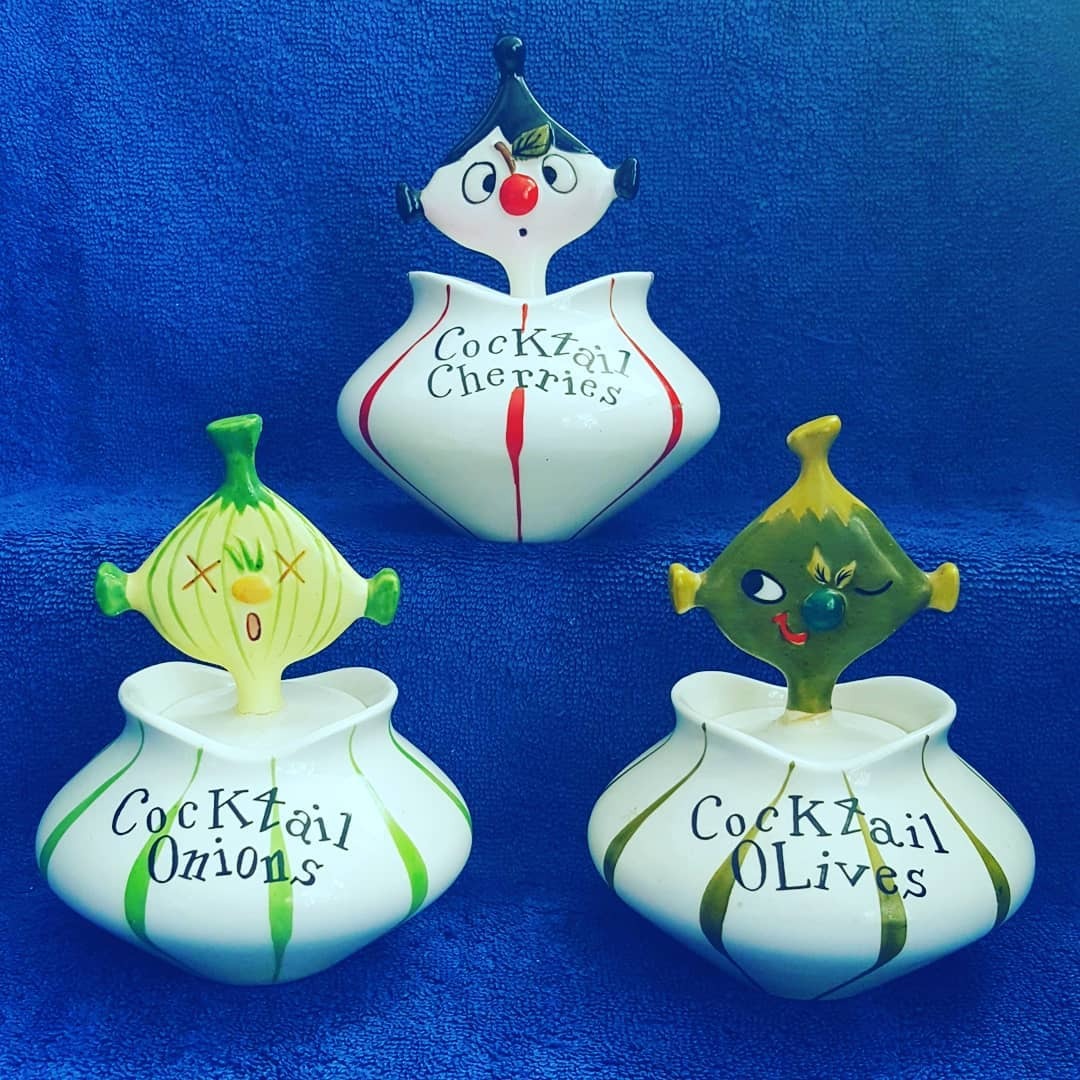
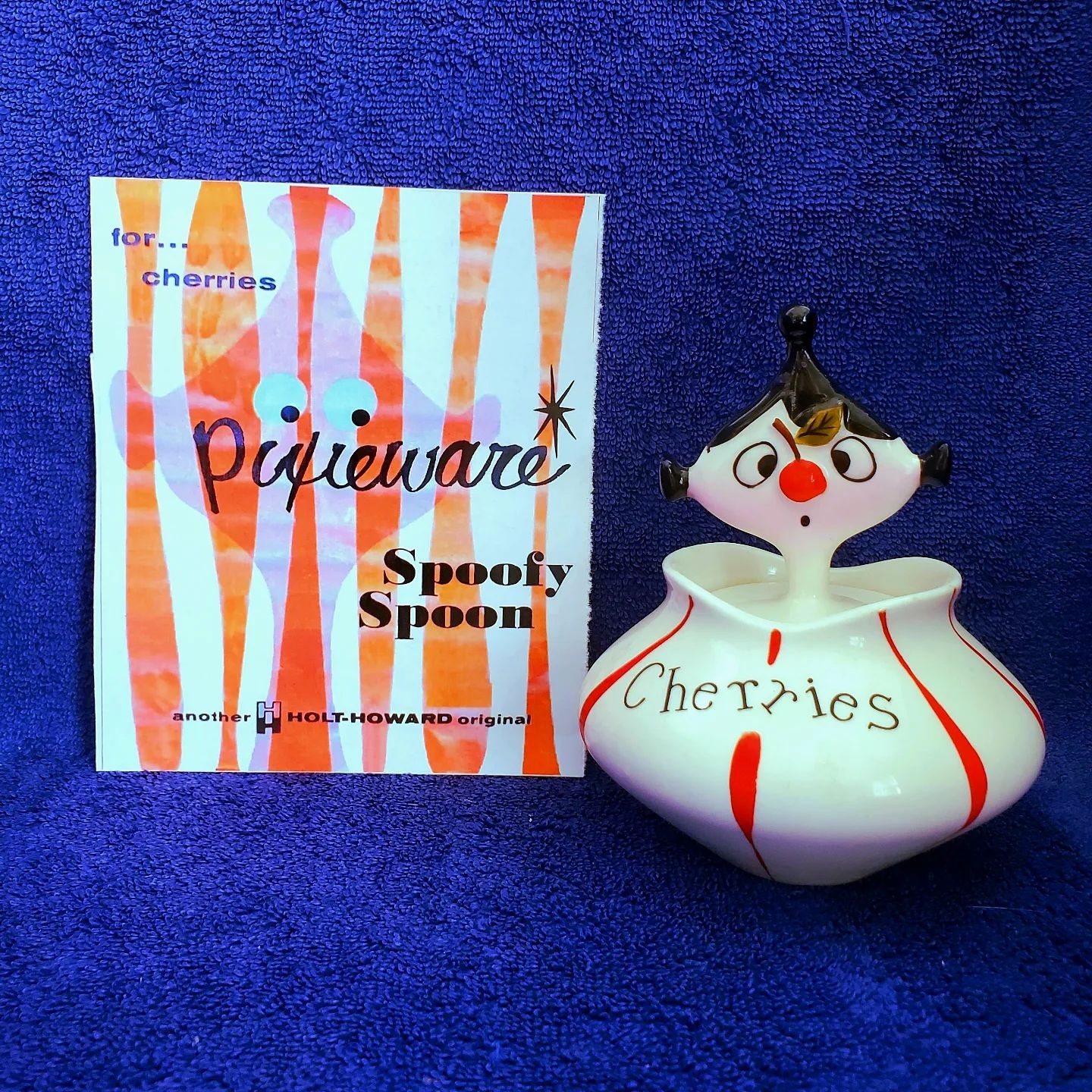
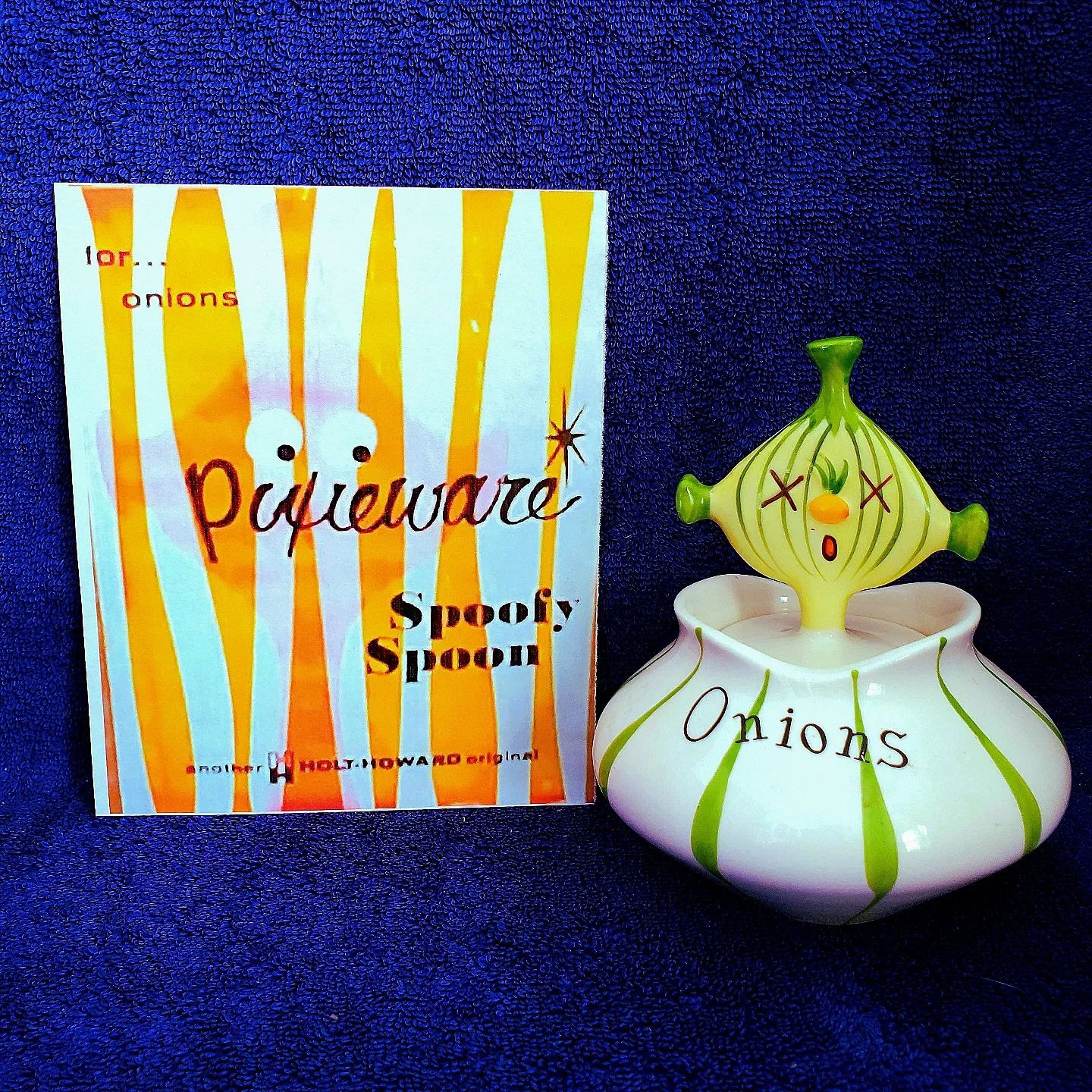
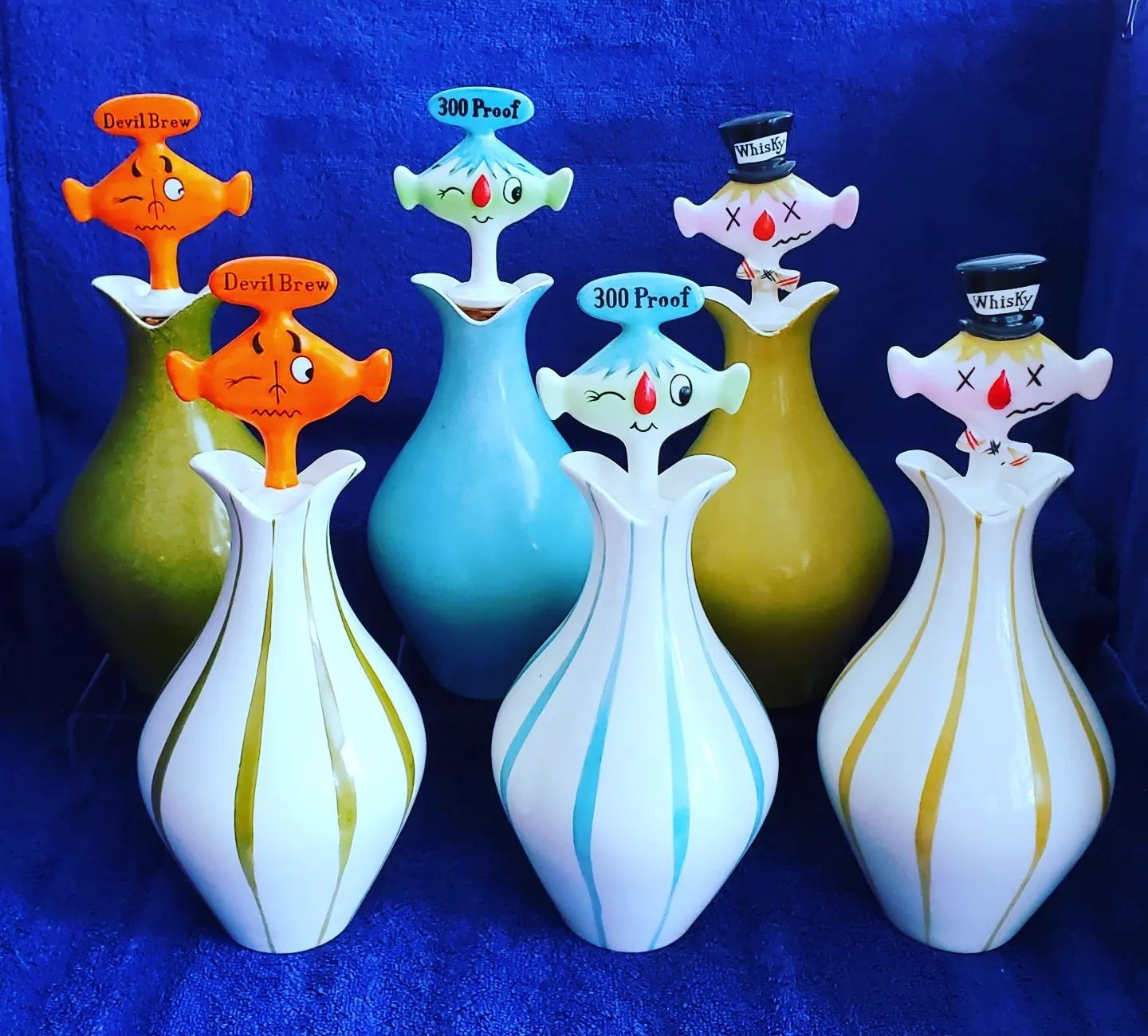
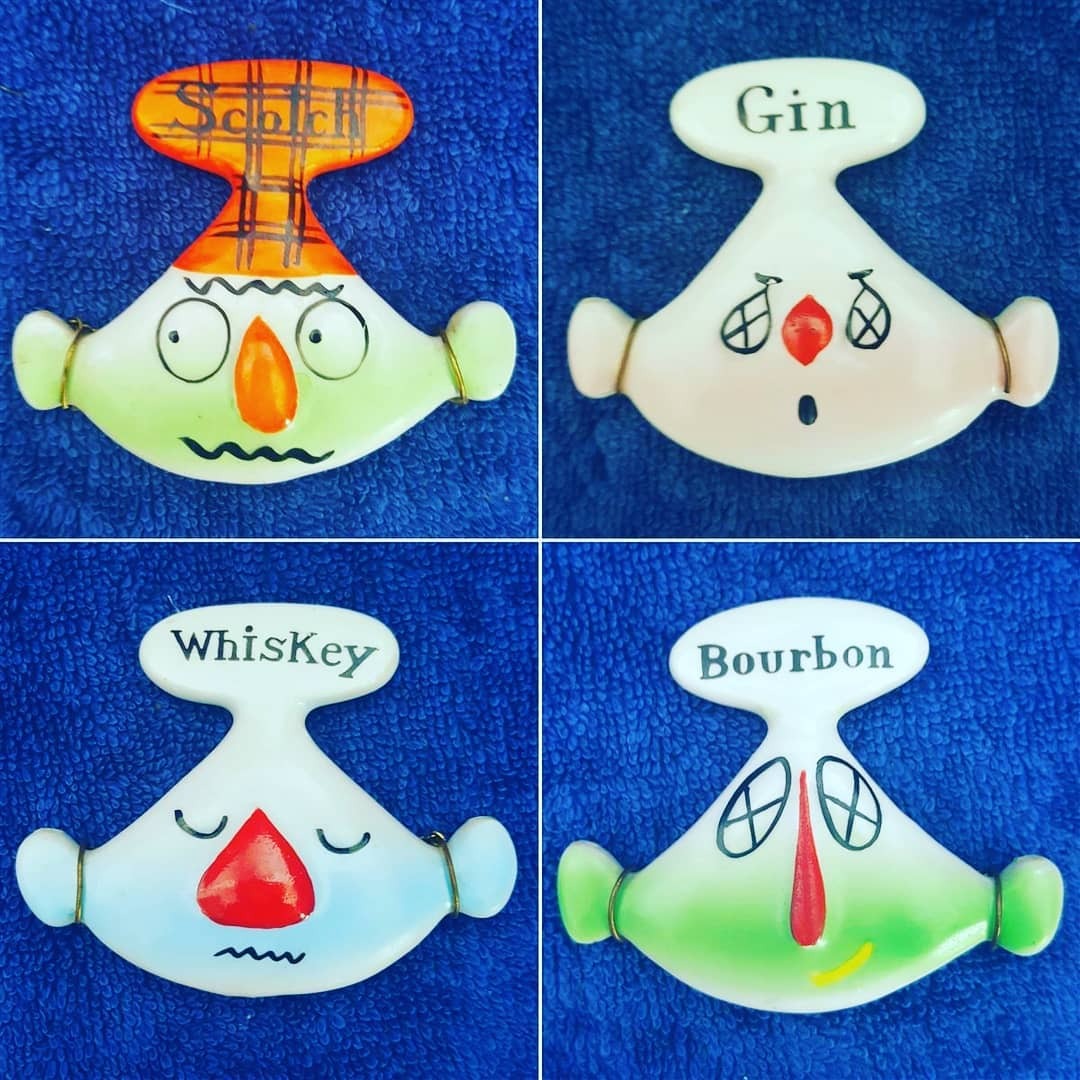
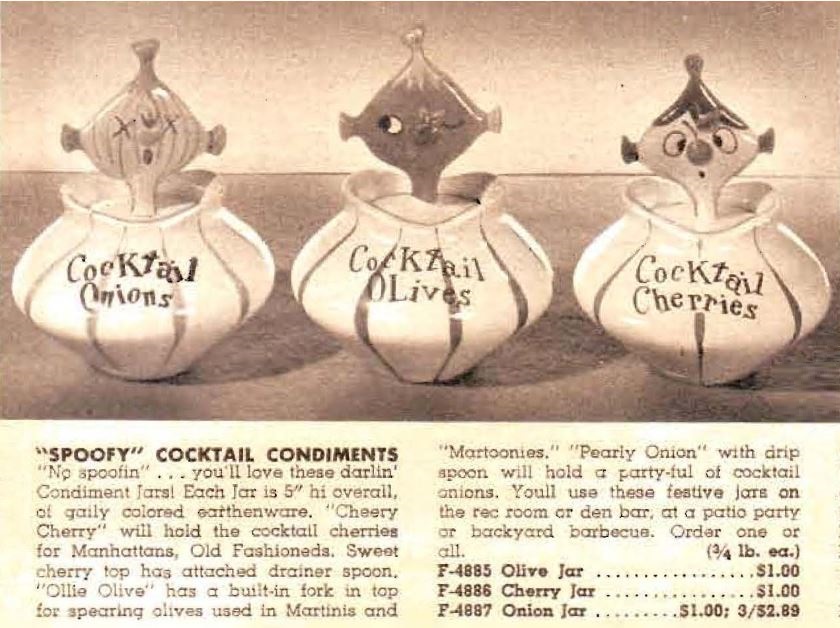
Introduced in 1958, the Happy Party Gremlins liquor decanters represented Holt-Howard's expansion of Pixieware into home entertaining and barware. The trio consisted of Whisky, 300 Proof, and Devil Brew, each featuring a removable pixie-head stopper atop a large ceramic decanter base. Holt-Howard advertised the decanters alongside the Cocktail Cherries, Cocktail Onions, and Cocktail Olives jars, as well as a matching set of pixie bottle bracelets, creating a coordinated bar-service series for the mid-century home.
The Original Solid-Base Decanters
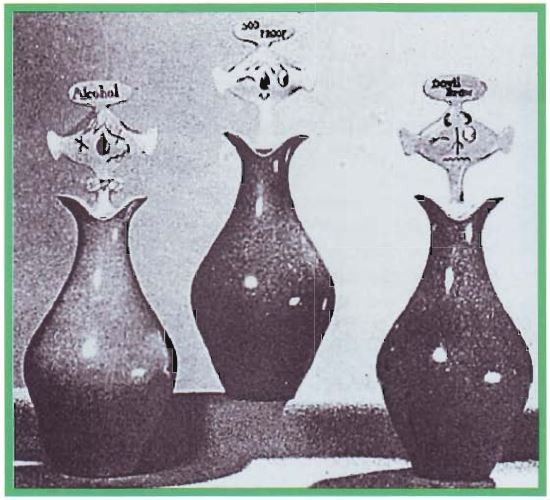
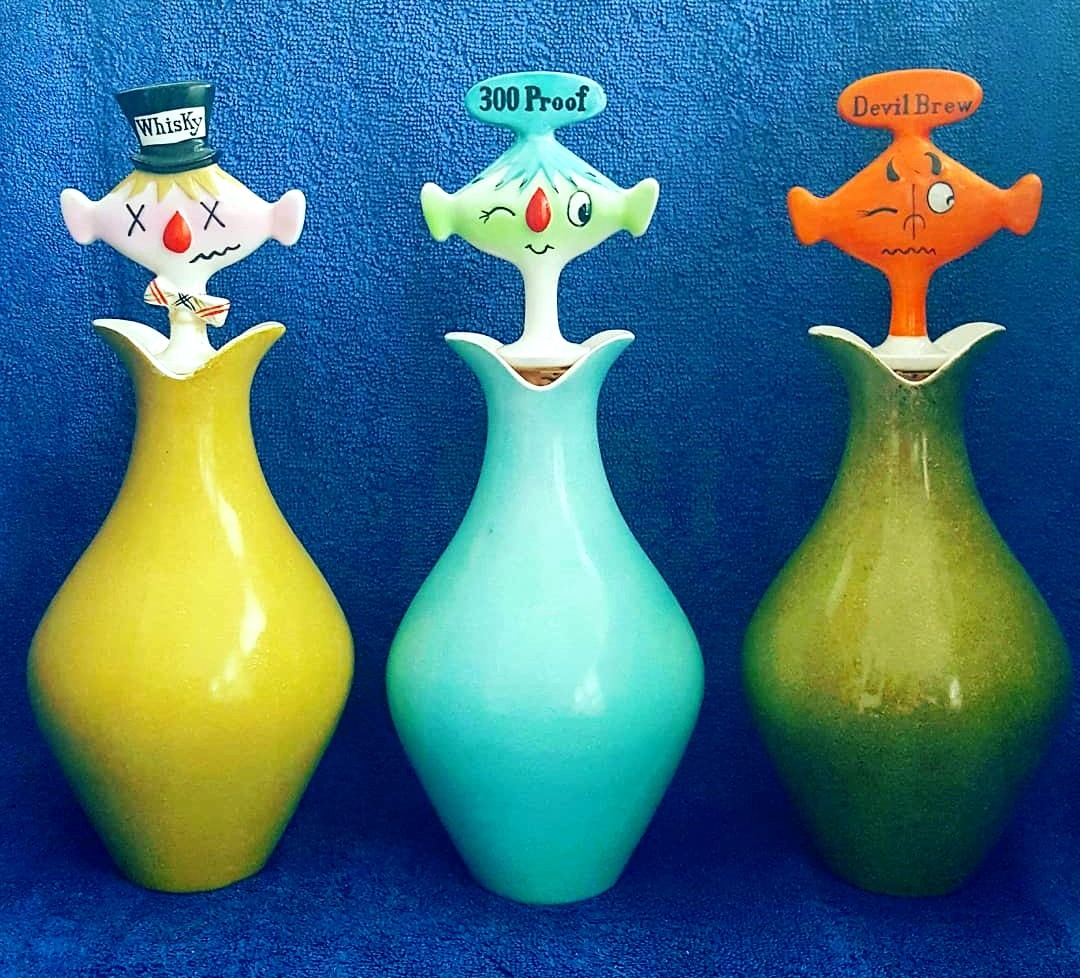
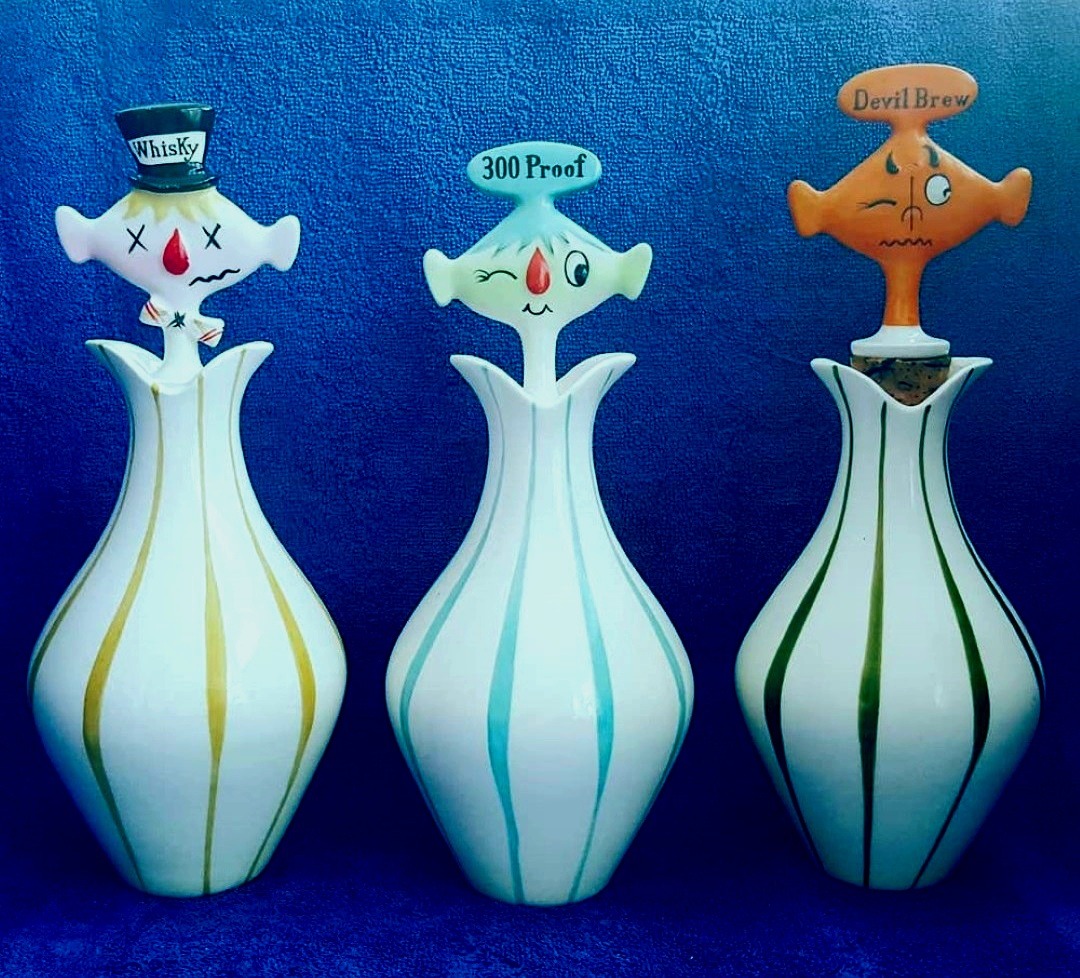
The earliest known version of the Happy Party Gremlins appears in Holt-Howard catalog photography showing three decanters with solid-colored ceramic bases. These original decanters were the only Pixieware pieces ever produced without the striped decoration that would later become synonymous with the line. According to John Howard, although the solid-colored decanters featured a well-coordinated design, consumers preferred the striped appearance used throughout the rest of the Pixieware family. Within a short time, Holt-Howard revised the decanters and reissued them with striped bases.
Large Pixieware pieces such as these decanters were manufactured in limited production runs of approximately 300 pieces each, compared to the condiment jars which were often produced in runs of approximately 100 dozen (1,200 pieces). As a result, substantially fewer liquor decanters were produced than the condiment jars, helping explain their relative scarcity today.
The Mystery of “Alcohol”
The black-and-white catalog image reproduced above presents an intriguing mystery. The leftmost decanter is labeled “Alcohol,” while later production examples are labeled “Whisky.” When the decanters were redesigned with striped bases, the “Alcohol” pixie appears to have evolved into the whimsically misspelled “Whisky” character. In addition to the name change, the production version received a top hat and an altered bow tie design.
No confirmed example of the “Alcohol” decanter had surfaced by the time the collector guides were published. Whether the piece entered full production, existed only as a prototype, or survives today in extremely limited numbers remains unknown. The catalog image therefore provides important evidence of an early developmental stage in the evolution of the Happy Party Gremlins line.
The Transition to Striped Bases
When Holt-Howard introduced the striped versions, it retained the color schemes established by the original solid-base decanters. According to company catalog information, 300 Proof received aqua stripes, Devil Brew olive stripes, and Whisky amber stripes. While 300 Proof and Devil Brew remained largely unchanged, the Whisky character underwent the most significant redesign.
John Howard also provided insight into the creation of Devil Brew. The bright orange paint used on the character's head was applied as cold paint rather than beneath the glaze. Because of this manufacturing process, an orange body would have been impractical. John also recalled that his brother Bob Howard preferred a strong contrast between Devil Brew's bright orange head and darker olive-colored base, creating a more ominous and diabolical appearance.
Design Notes & Production Details
Both the solid-base and striped-base decanters stand approximately 10½ inches tall and hold about three cups (24 ounces) of liquid. Although intended as liquor decanters, Holt-Howard also advertised the bases as functioning well as flower vases. This secondary use has become particularly relevant to collectors because many surviving examples have become separated from their original stoppers over the decades. As a result, decanter bases are frequently encountered and are sometimes mistakenly identified as vases when offered for sale.
The decanters were individually packaged rather than sold as a set, and all examples are copyrighted 1958. Together, they represent one of the most ambitious and visually striking expansions of the original Pixieware line.