PIXIEWARE & THE PIXIE UNIVERSE

1959: Cousins by the Dozens

Holt Howard expands Pixieware beyond condiment jars and into a full family of household giftware.


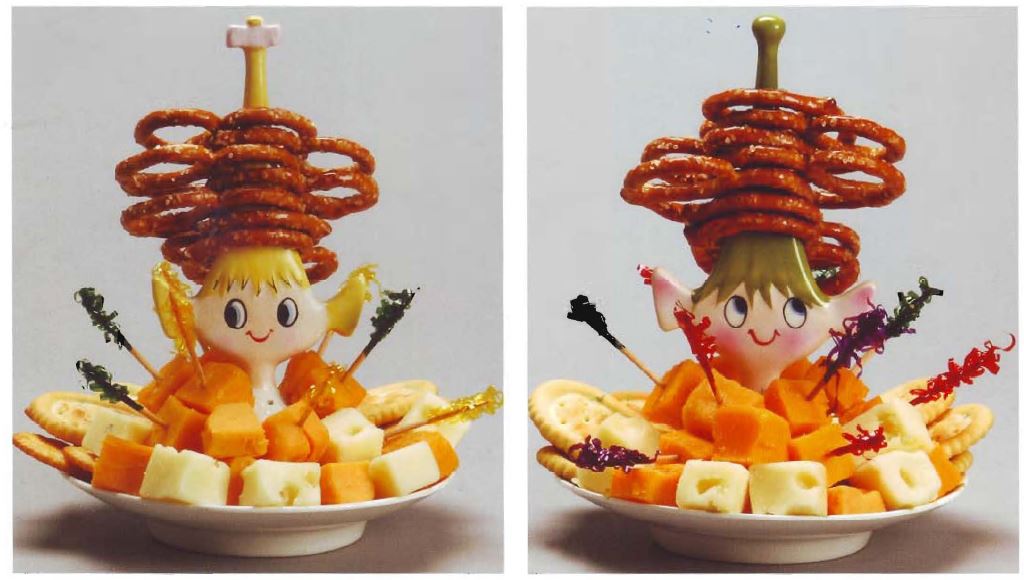
Party Pixies staged with food
Party Pixies staged for use with pretzels, toothpicks, cheese, and other party foods.

The extraordinary success of the original 1958 Pixieware line gave Holt-Howard something few giftware companies ever achieve: a proven hit. Consumers embraced the whimsical pixie characters, and within a year Pixieware had become one of the company's most recognizable and successful product families.

Pixieware's rapid rise attracted attention throughout the giftware industry. As Walter Dworkin observed, numerous companies large and small began introducing their own lines of condiment jars and novelty kitchenware in an effort to capitalize on the growing popularity of Holt-Howard's designs. For the first time, Pixieware faced competition from imitators seeking to capture a share of the market. Yet while competitors were busy copying the original concept, Holt-Howard was already moving ahead.

Rather than simply producing more jars, the company dramatically expanded the Pixie universe in 1959. Holt-Howard referred to these new introductions as "Cousins by the Dozens"—more than thirty new Pixieware giftware items that transformed the line from a collection of condiment containers into a complete family of household novelties. The 1959 line was not only larger than its predecessor, but considerably more experimental, applying the Pixie concept to an increasingly diverse range of household products. New condiment jars joined the growing roster, but Pixies also appeared as hors d'oeuvre servers, snack dishes, sundae topping servers, dressing cruets, lamps, planters, ashtrays, towel hooks, and other imaginative creations.


The 1959 Holt Howard Pixieware Line

Condiment Expansion Jars

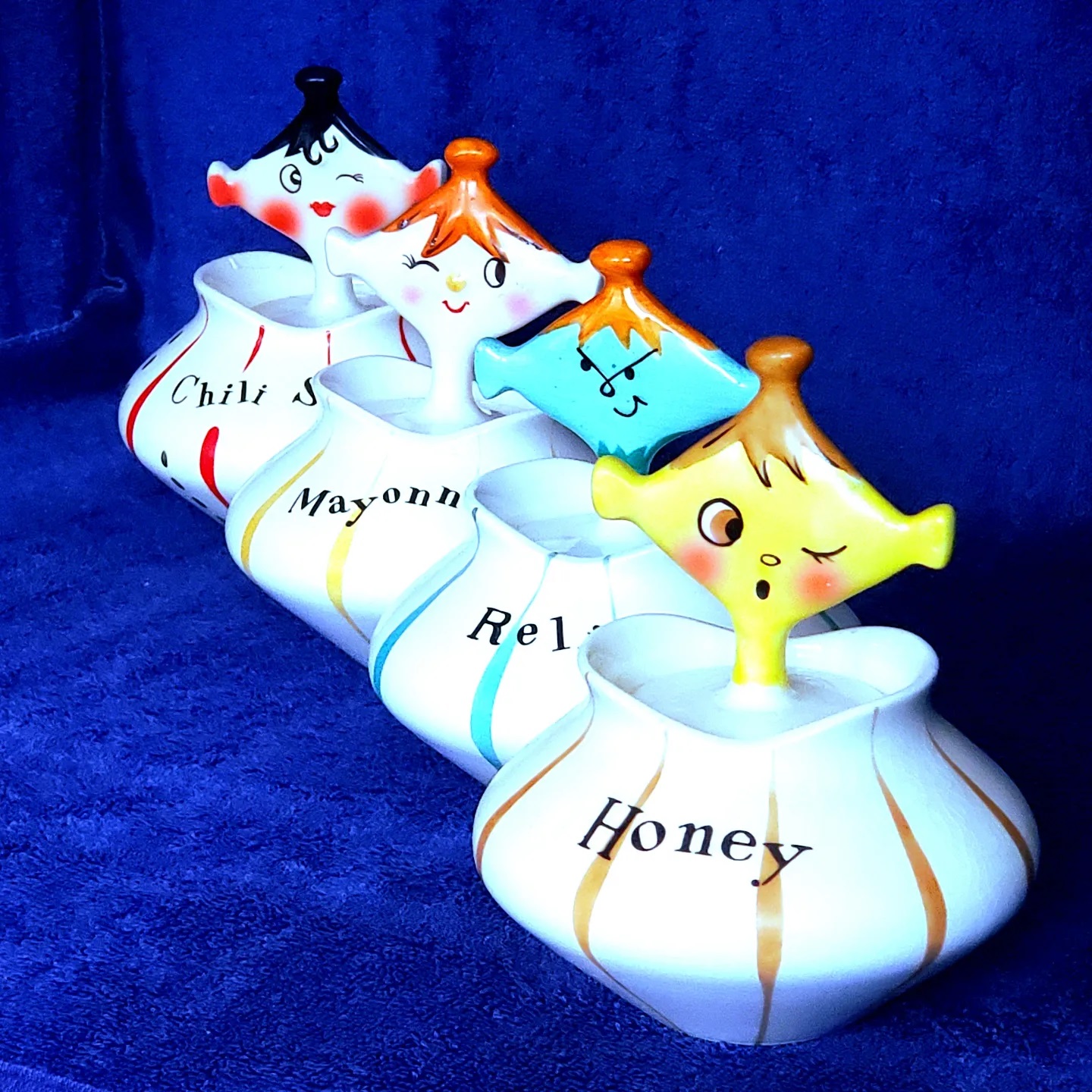
1959 Pixieware condiment jars
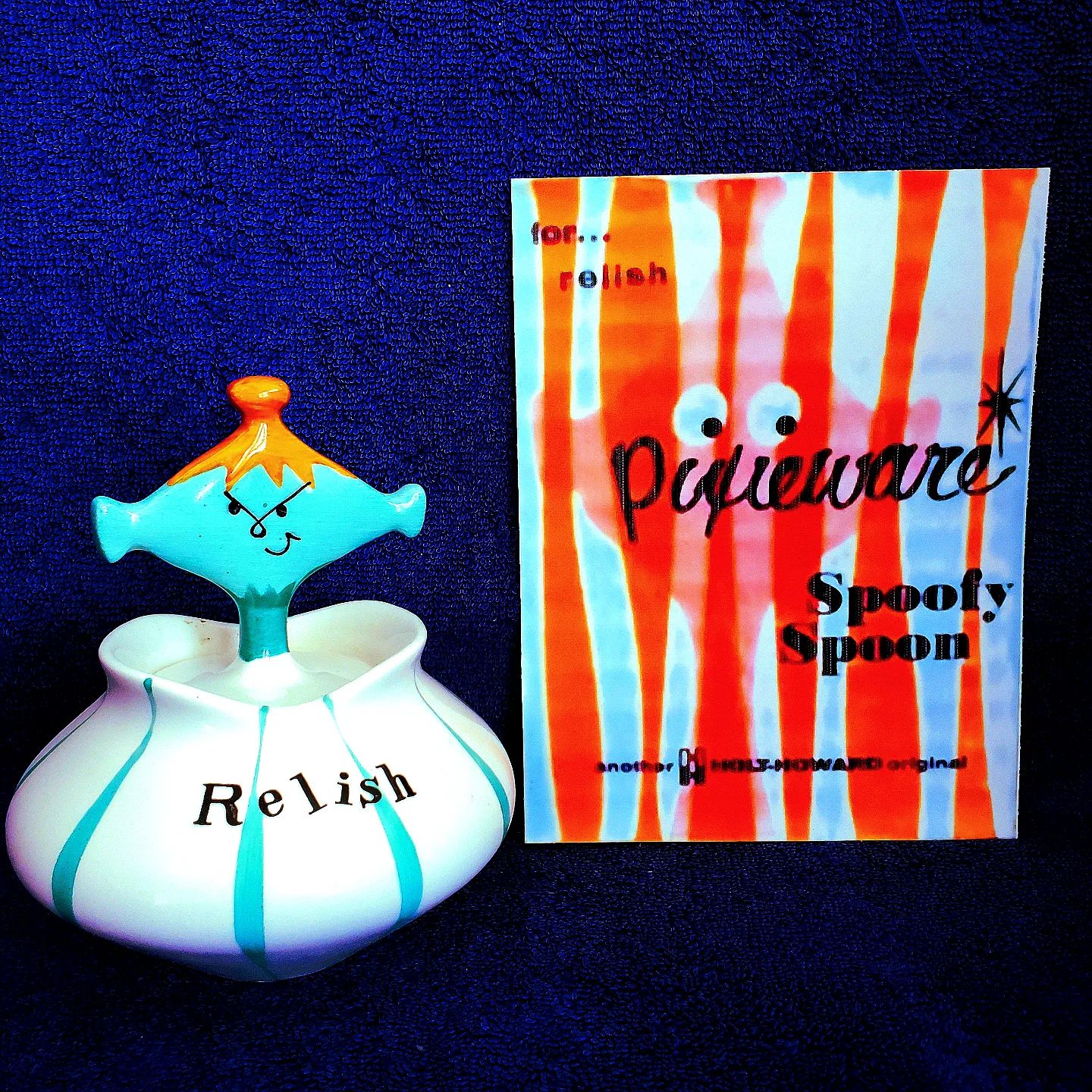
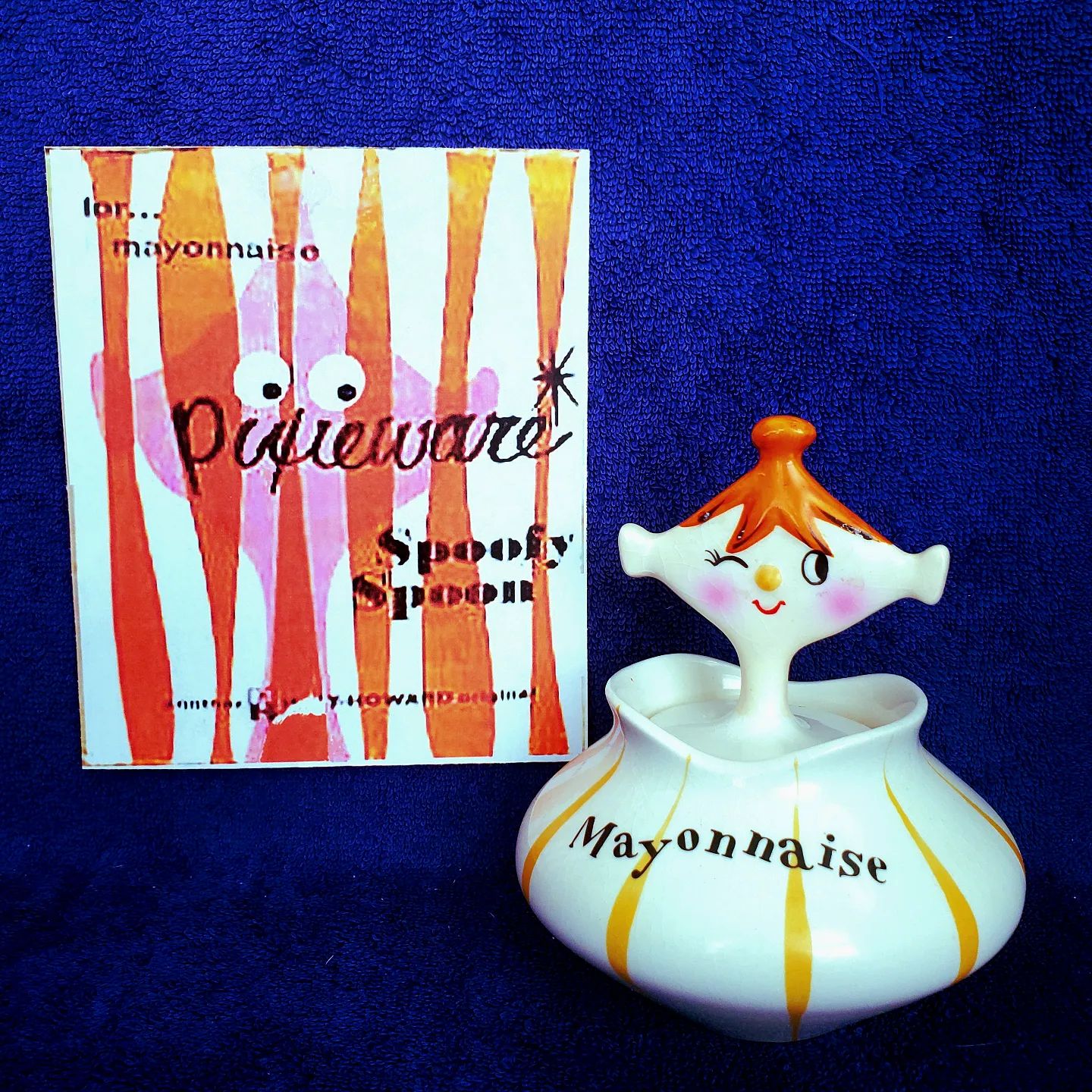
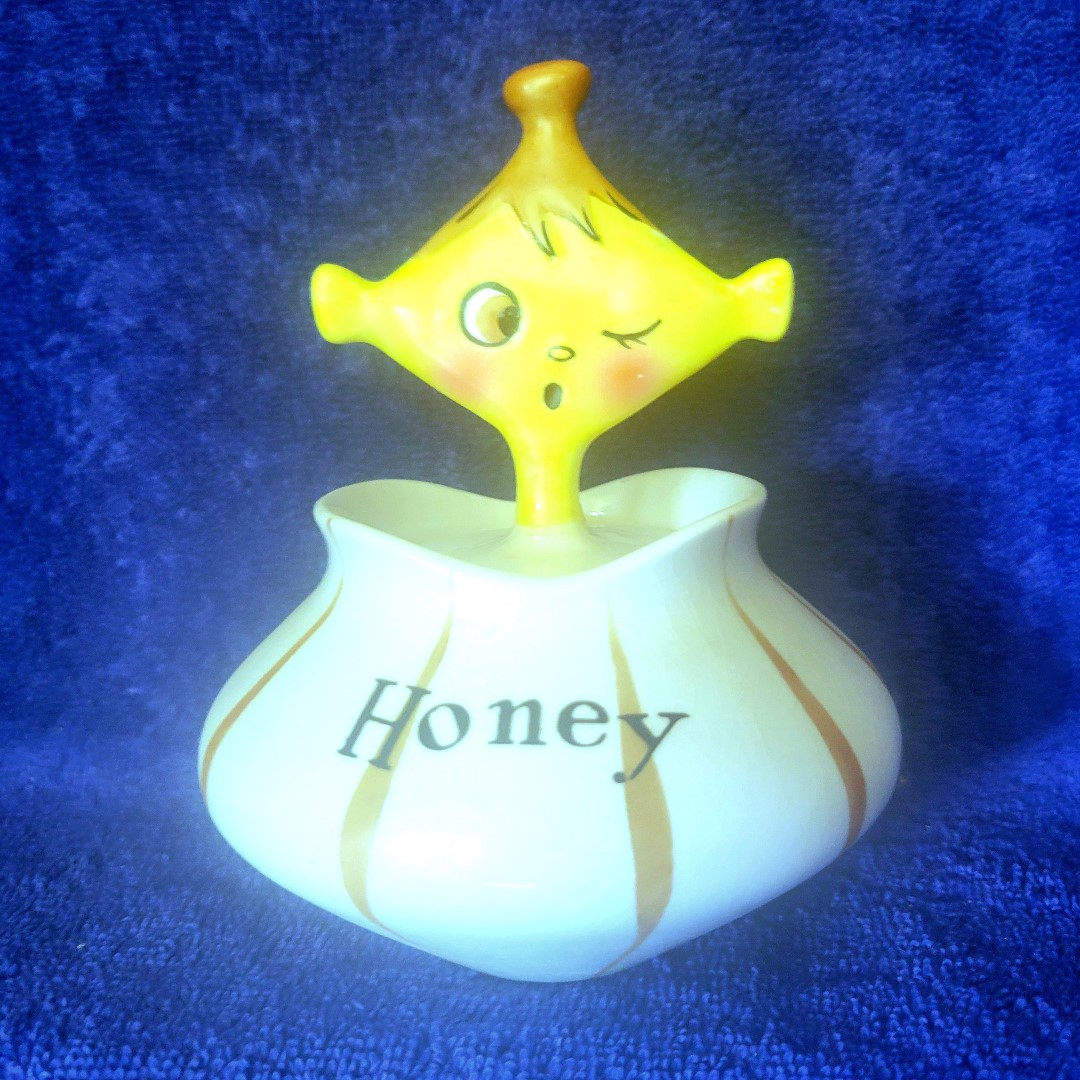
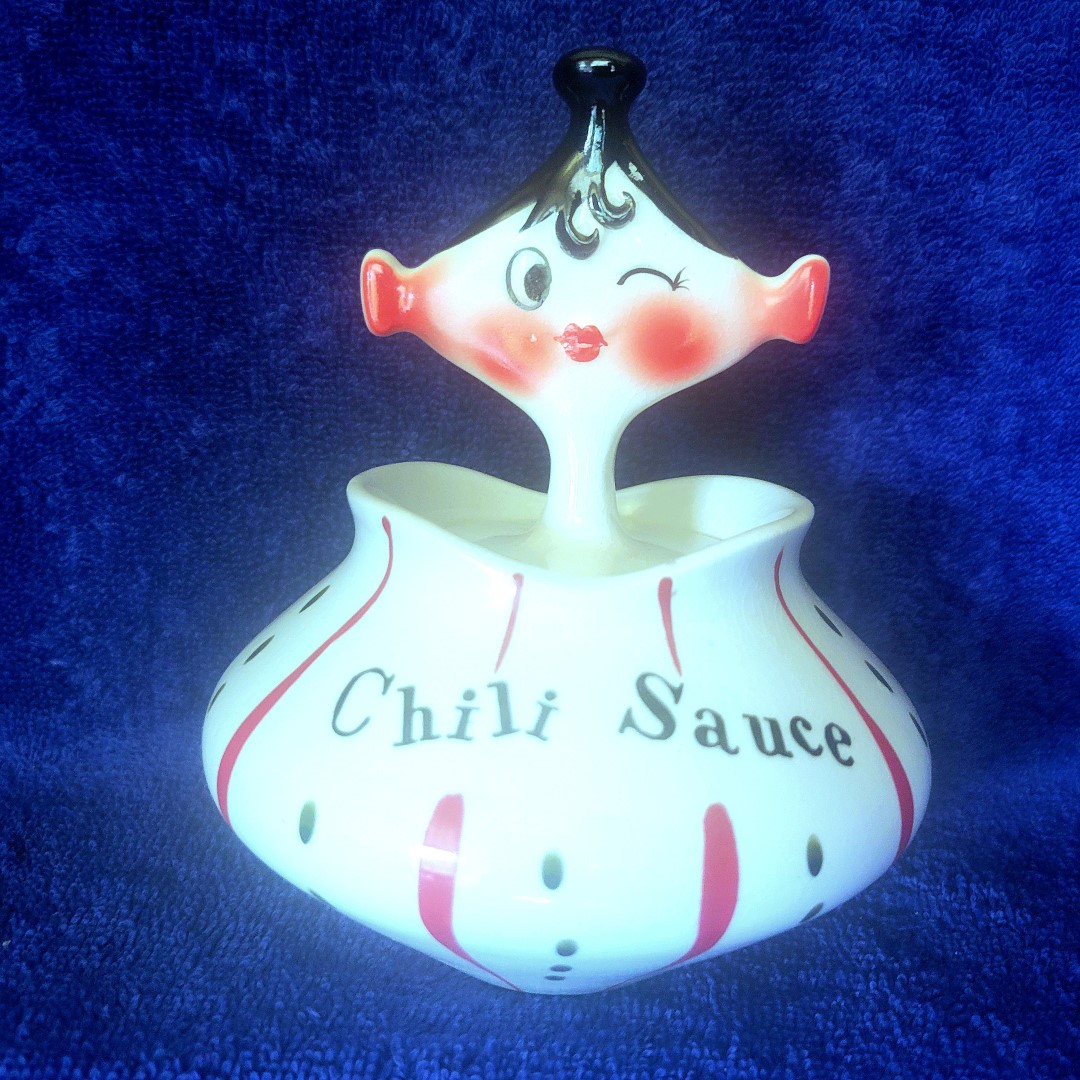
The four new 1959 condiment jars: Relish, Mayonnaise, Honey, and Chili Sauce.

The four new condiment jars introduced in 1959—Relish, Mayonnaise, Honey, and Chili Sauce—expanded the original Pixieware jar concept while also showing how quickly Holt-Howard was refining the line’s visual language. Compared with many of the 1958 pixies, these new jars often feature more elongated, diamond-shaped heads, revised hair treatments, and increasingly specialized facial expressions tied to the food each jar was meant to hold. Honey and Chili Sauce would eventually become two of the most sought-after standard American Pixieware jars, while Relish and Mayonnaise remain important examples of the 1959 design shift.

Relish

Relish

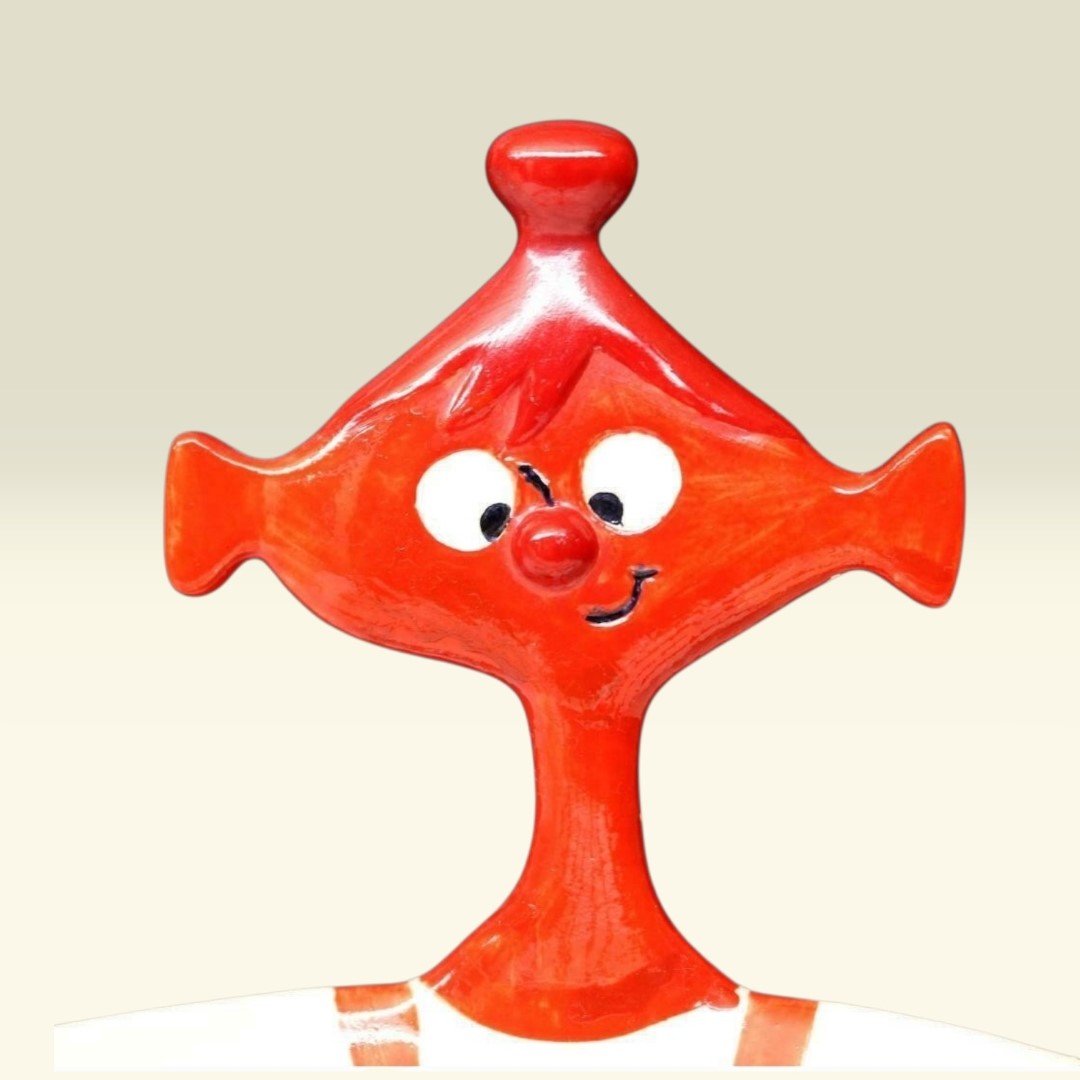
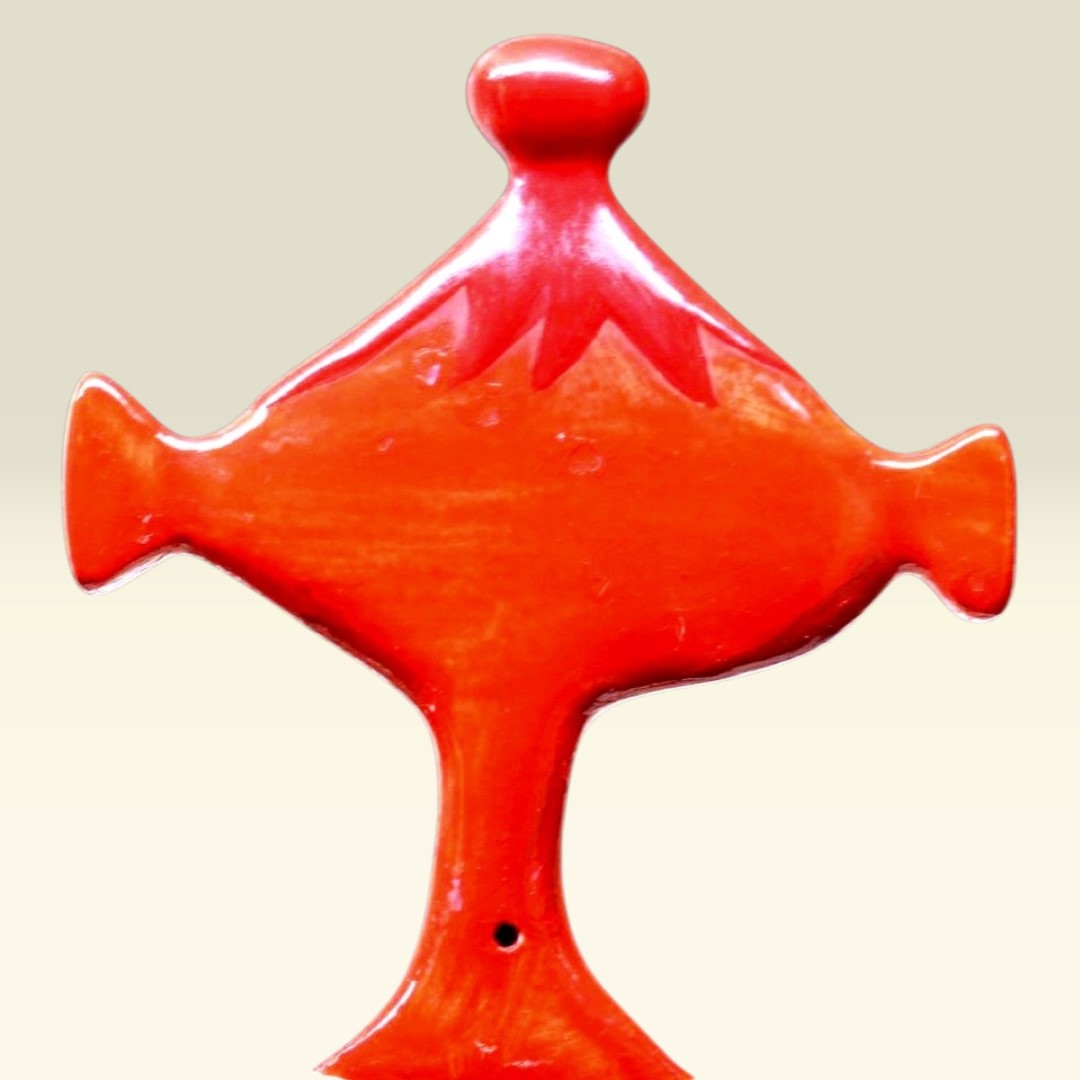
The Relish jar was one of four new Pixieware condiment jars introduced in 1959. Compared with the original 1958 condiment jars, Relish shows the updated 1959 head shape, with a broader, more diamond-like form and especially elongated ears. Walter Dworkin noted that Relish is the only one of the original twelve American Pixieware condiment jars with a head stretched so dramatically from ear to ear, giving the face a slightly peeved expression, as though someone had tugged too hard on both ears.

Relish also introduces one of the newer 1959 Pixieware hair treatments: a rounded, somewhat elliptical knob at the top of the head rather than the spoke-like hairstyles seen on most of the 1958 pixies. The neck is decorated with scallion-like leaves, reinforcing the jar’s relish-and-condiment function.

Dimensions: Approximately 5½ inches tall. Backstamped “Holt-Howard 1959.”

Mayonnaise

Mayonnaise

The Mayonnaise jar was one of four new Pixieware condiment jars introduced in 1959. Like the Relish jar, it reflects the evolving design language of the second year of Pixieware production, with a more elongated head shape and a stronger emphasis on food-themed character details. The pixie's most distinctive feature is its egg-yolk-shaped nose, a whimsical design element that directly references one of the primary ingredients used in making mayonnaise.

The Mayonnaise pixie also displays one of the newer hairstyle variations introduced in the 1959 lineup, while its yellow-striped body further reinforces the connection to its contents. Together, these details demonstrate Robert Howard's growing tendency to give each Pixieware character a unique visual identity through specialized facial features, colors, and decorative elements tied to the food it was intended to serve.

Like the other 1959 condiment jars, the Mayonnaise jar remained in production through the early 1960s and helped expand Pixieware beyond the original group of 1958 introductions.

Dimensions: Approximately 5½ inches tall. Backstamped "Holt-Howard 1959."

Honey

Honey

The Honey jar was introduced as part of the 1959 Pixieware expansion and has become one of the most recognizable and sought-after members of the American Pixieware condiment jar family. Like the Relish, Mayonnaise, and Chili Sauce jars introduced alongside it, Honey reflects the continued evolution of the Pixieware design aesthetic, featuring a more elongated head shape and decorative details closely tied to its intended contents.

The Honey pixie is distinguished by its warm palette of golden yellow and amber tones, colors that immediately evoke the honey it was designed to hold. As with many of Robert Howard's best Pixieware creations, the design is both functional and instantly recognizable, relying on color, expression, and form to create a character that feels perfectly suited to its purpose.

One unusual aspect of the Honey jar is its backstamp history. While the vast majority of examples are marked "Holt-Howard 1959," a very small number of examples have surfaced bearing 1960 and 1961 copyright dates despite the design itself remaining unchanged. At present, only a single example of each updated date is known. Why a handful of Honey jars received revised copyright dates while most Pixieware pieces continued using their original year of introduction remains unknown, making these variants one of the more intriguing production mysteries in the Pixieware line.

Like the Jam 'n Jelly, Ketchup, and Mustard jars before it, the Honey jar remained in production through the early 1960s. Strong collector demand and its distinctive appearance have made it one of the most desirable standard American Pixieware condiment jars today.

Dimensions: Approximately 5½ inches tall. Most examples are backstamped "Holt-Howard 1959," with extremely rare 1960 and 1961 variants also documented.
Chili Sauce

Chili Sauce

Introduced in 1959 alongside the Relish, Mayonnaise, and Honey jars, the Chili Sauce jar is among the most visually distinctive members of the American Pixieware condiment family. While it shares the elongated head shape and specialized food-themed design approach seen throughout the 1959 introductions, Chili Sauce stands apart through its unusually bold decorative treatment and dramatic color palette.

Unlike nearly every other standard Pixieware condiment jar, which relies primarily on painted stripes to decorate the body, the Chili Sauce jar incorporates a series of black dots between its red stripes. While Holt-Howard never documented the purpose of this unusual design element, the dots strongly resemble the rows of seeds visible inside a sliced chili pepper and were likely intended as another visual reference to the jar's contents. This subtle but clever detail is entirely consistent with Robert Howard's growing practice of incorporating food-related design elements directly into his Pixieware characters. The result is one of the most distinctive and easily recognizable decorative treatments in the entire Pixieware line.

The pixie's red coloration further reinforces the spicy nature of its contents, while its expressive face and distinctive hairstyle continue Howard's tendency to give individual Pixieware characters unique personalities tied to their intended purpose. The design demonstrates how Holt-Howard was increasingly willing to move beyond the visual formulas established in 1958 while still maintaining the overall look and charm that made Pixieware successful.

Like the Honey jar introduced alongside it, Chili Sauce has become one of the more sought-after standard American Pixieware condiment jars among collectors. Its distinctive appearance, combined with its unique decorative treatment, has helped make it one of the standout pieces of the 1959 Pixieware expansion.

Dimensions: Approximately 5½ inches tall. Backstamped "Holt-Howard 1959."

Party Pixies — Hors d'Oeuvre Server Dishes

Among the most imaginative additions to the 1959 Pixieware expansion were the Party Pixies, a whimsical pair of hors d'oeuvre servers designed specifically for entertaining. Known in Holt-Howard catalogs as both “Party Pixies” and “Pretzel Pixies,” these charming figures demonstrated how far the Pixieware concept could be expanded beyond condiment jars and into the world of serving pieces and partyware.

Introduced as part of Holt-Howard's ambitious “Cousins by the Dozens” expansion, the Party Pixies were intended to hold pretzels, crackers, cheese cubes, toothpicks, and other cocktail snacks. Combining playful character design with practical functionality, they perfectly reflected the company's talent for transforming ordinary household items into decorative conversation pieces. More than six decades later, they remain among the most recognizable and beloved introductions of the 1959 Pixieware line.

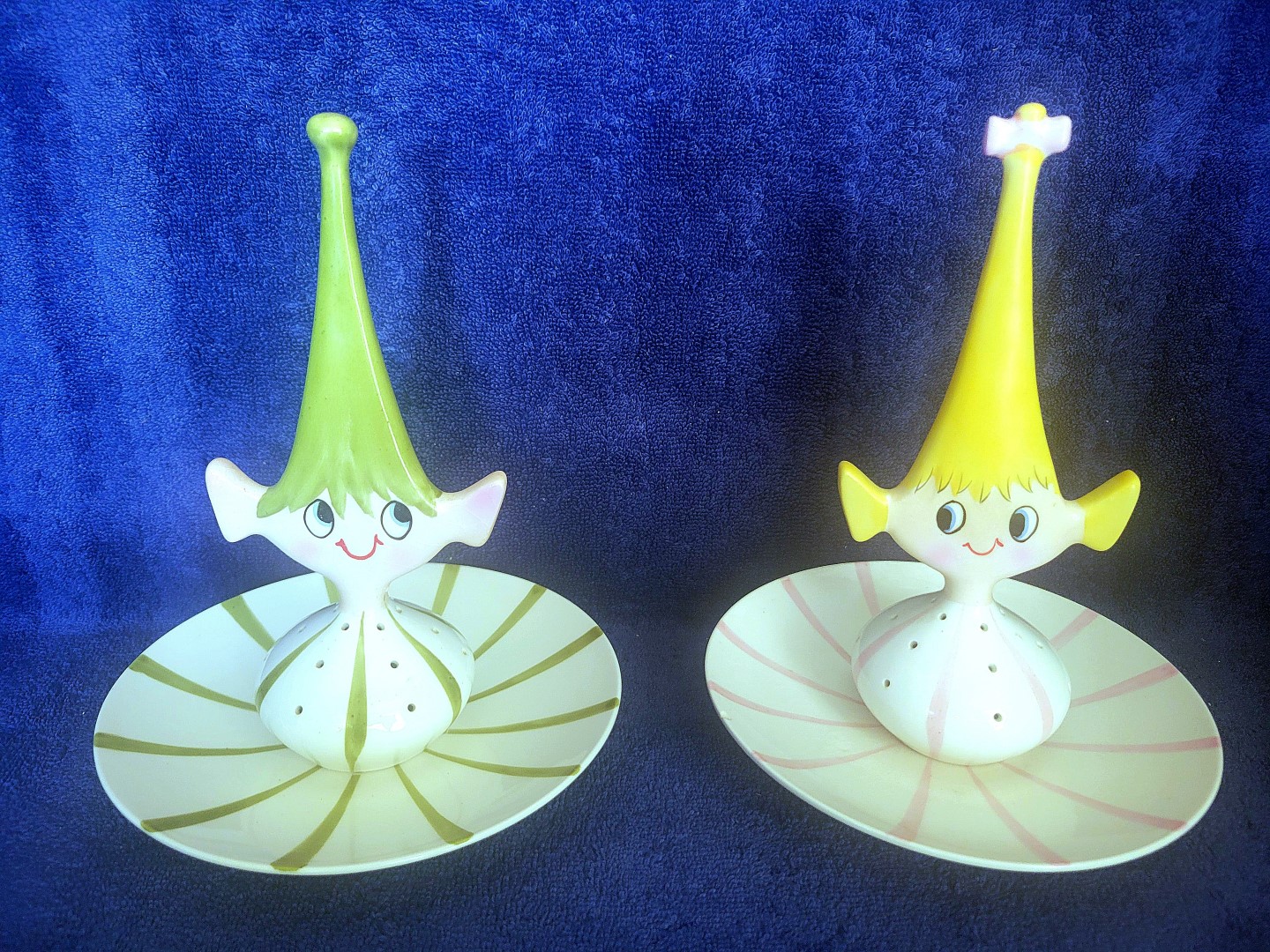
Boy Party Pixie

American Party Pixies (“Pretzel Pixies”)

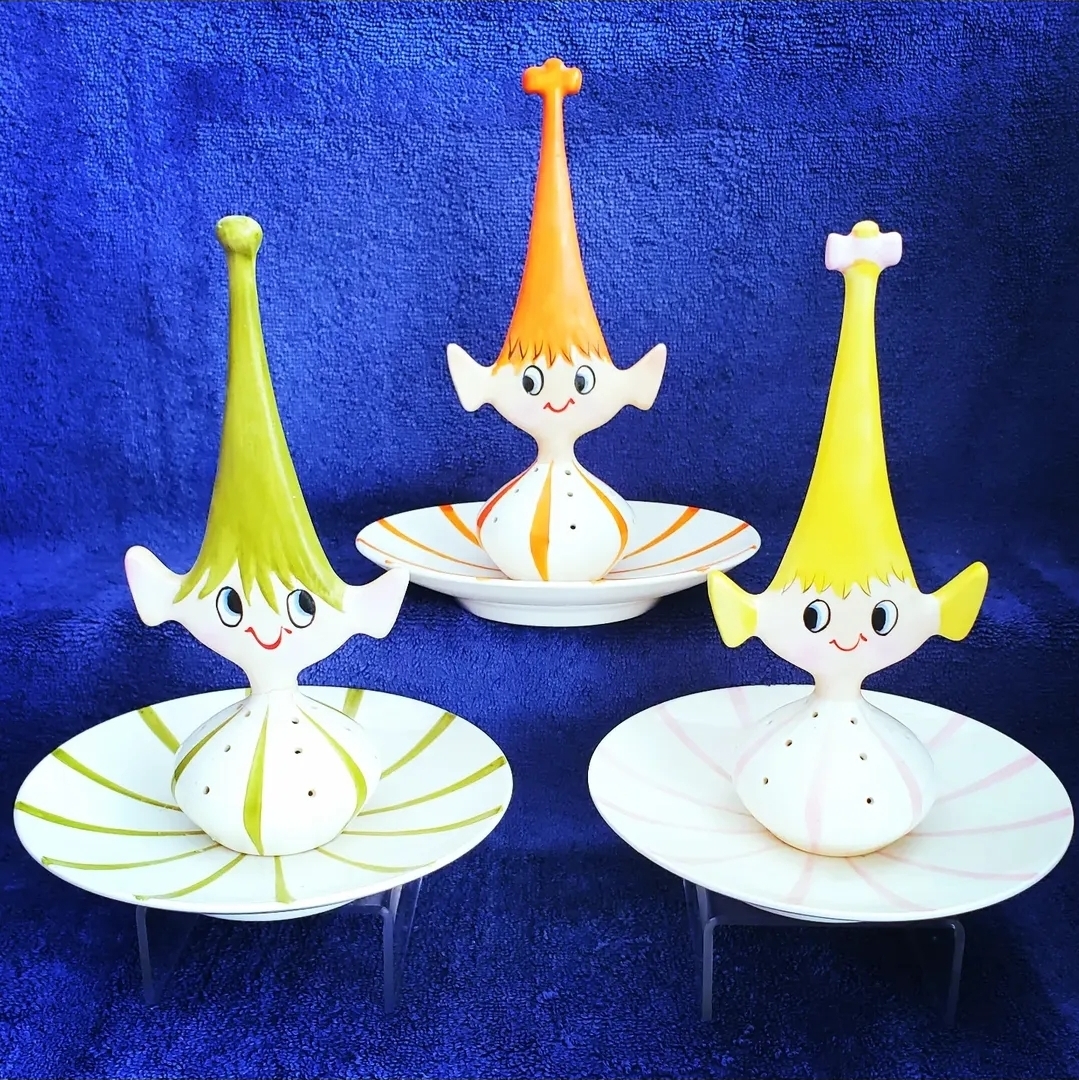
The American Party Pixies were designed to serve hors d'oeuvres and cocktail snacks while doubling as decorative centerpieces. Holt-Howard catalogs referred to them as both “Party Pixies” and “Pretzel Pixies,” a reference to the elaborate hairdos that were designed to hold pretzels and other treats. Their oversized ears provided additional support for snacks placed atop their elaborate hairstyles, while eighteen perforated holes in each body accommodated toothpicks for serving cheese cubes and hors d'oeuvres.

Each pixie stands approximately 7½ inches tall and is mounted on a removable underplate secured by a brass screw and nut, making cleaning and storage easy. The underplates measure approximately 5¾ inches in diameter and feature twelve coordinating stripes that match the colors found on each figure. The pieces carry a 1959 Holt-Howard copyright backstamp.

Although created as functional serving pieces, the Party Pixies possess a personality all their own. Displayed together, the boy and girl appear to gaze affectionately toward one another, giving them a playful and slightly flirtatious quality that collectors have long appreciated. Their coordinated forms, complementary expressions, and shared serving function make them one of the most charming examples of Holt-Howard's 1959 expansion beyond condiment jars.
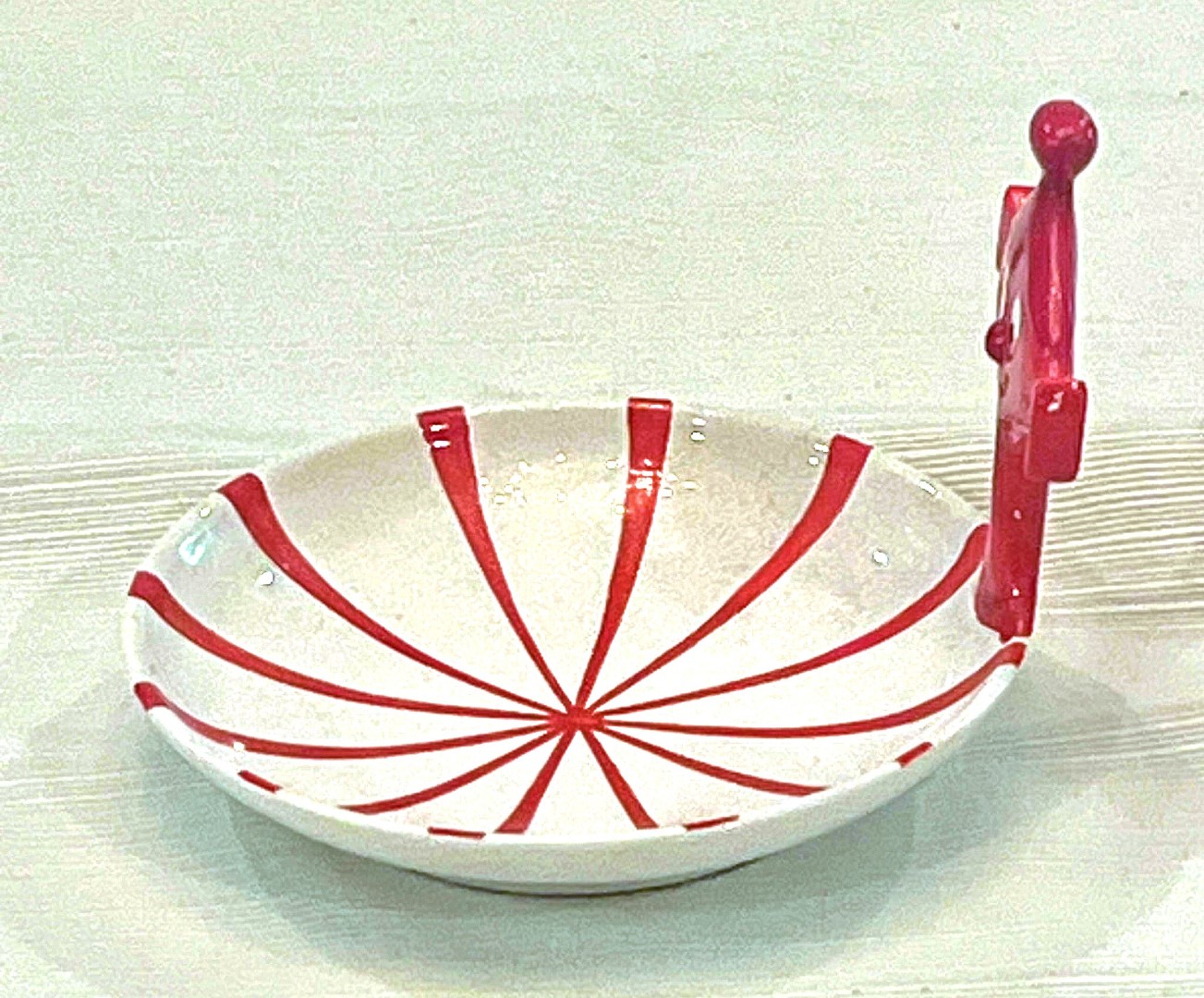
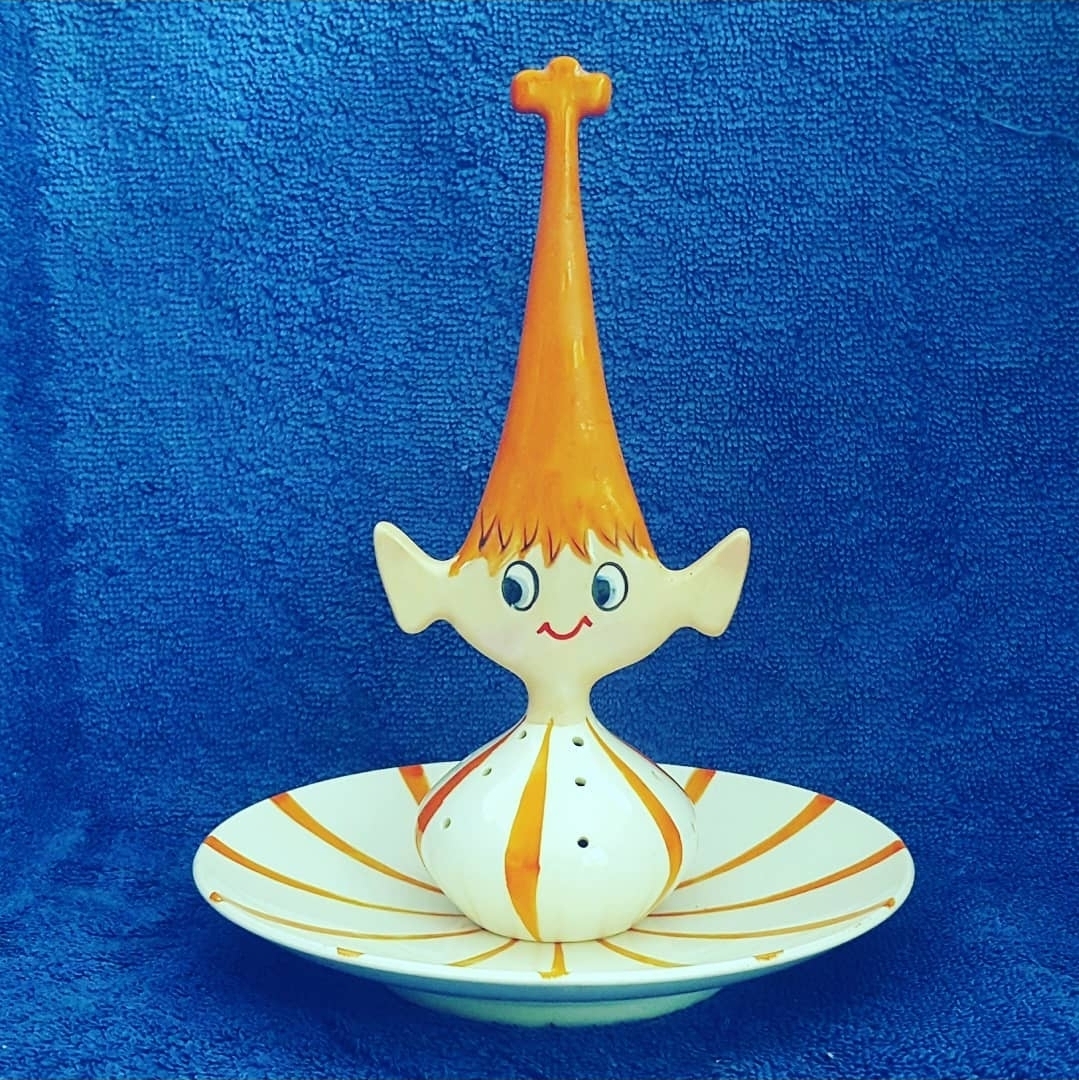
Orange Australian Party Pixie

Orange Australian Party Pixie

The Orange Australian Party Pixie occupies a unique place in Pixieware history. According to information provided by John Howard, the piece originated through Holt-Howard's relationship with an Australian trade customer who admired the Party Pixie design and requested a version tailored specifically for the Australian market. The result was a striking orange variation unlike anything offered through Holt-Howard's American distribution channels.

Orange was an especially popular color in Australia during the period, and the specially commissioned pieces were manufactured in Japan and exported directly to Australia rather than being sold in the United States. As a result, relatively few examples have surfaced compared to their American counterparts.

Unlike the separately licensed British Pixieware line, which developed its own forms and production history, the Orange Australian Party Pixie appears to be the only known market-specific variation of a standard American Pixieware design. Created exclusively for export and never offered through normal American retail channels, it remains one of the most unusual and sought-after pieces in the entire Pixieware family and serves as an early example of Pixieware's growing international reach.

Salty & Peppy Wooden-Handled Shakers

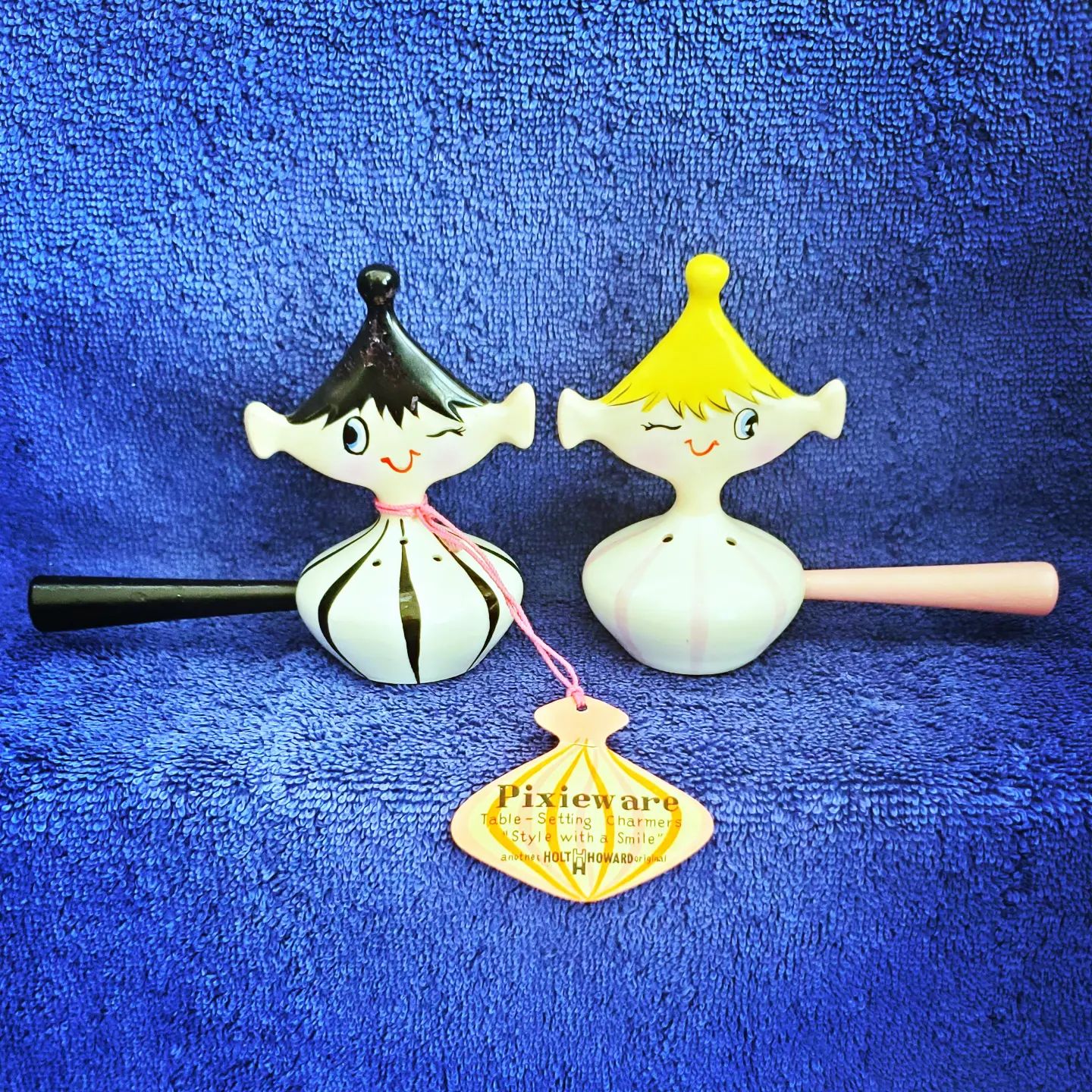
Salty and Peppy wooden-handled Pixieware shakers with original hang tag
Salty & Peppy wooden-handled shakers with original Pixieware hang tag.
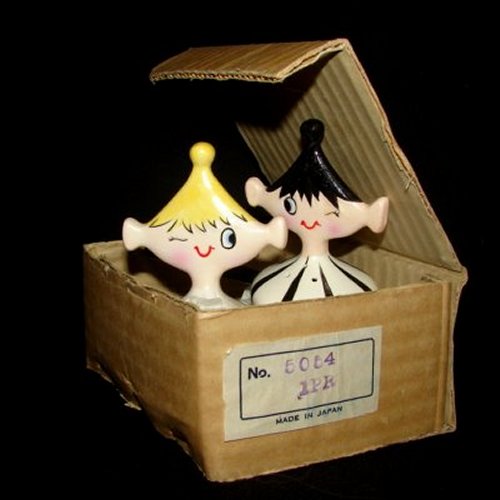
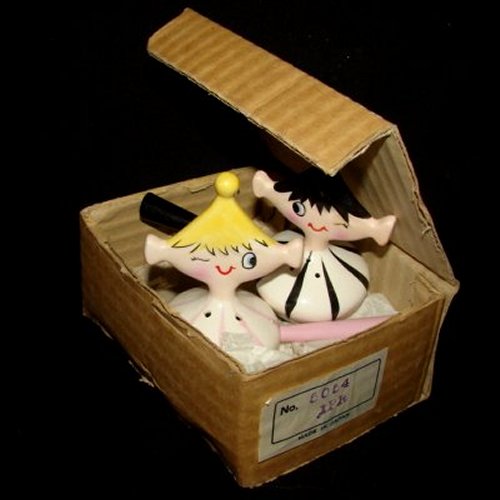
Salty and Peppy shakers peeking out of original cardboard box
Salty and Peppy shakers in original cardboard box with import label
Photographs courtesy of fellow collector Sandy Shores.
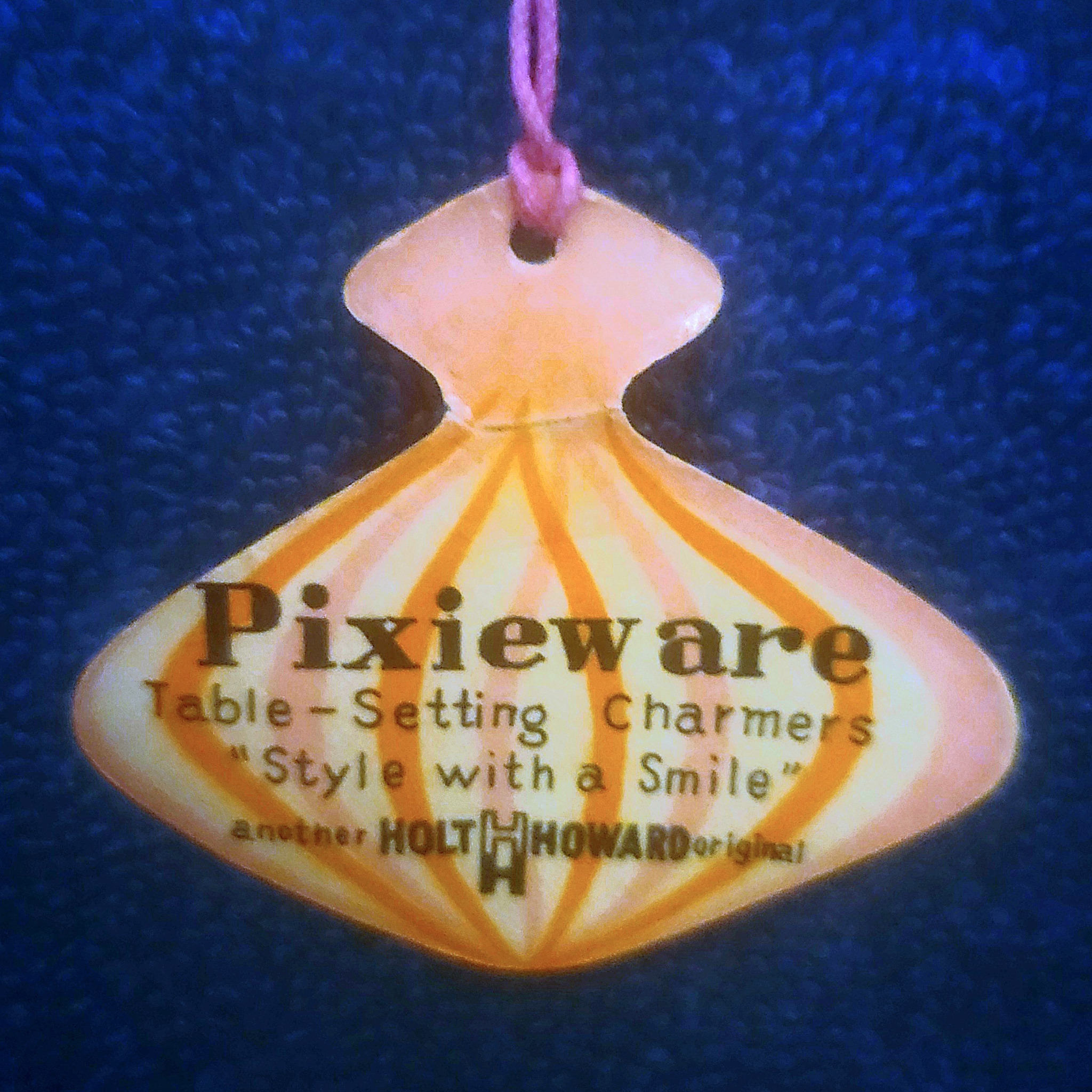
Original Pixieware hang tag close-up
Original Pixieware hang tag from author's collection.

Among the more unusual additions to Holt-Howard's 1959 Pixieware expansion were the Salty & Peppy shakers, a whimsical salt-and-pepper set that adapted familiar Pixieware styling to the dining table. Named “Salty & Peppy” in Holt-Howard's 1959 catalog, the pair retained the colorful striped bodies and expressive pixie forms that collectors had come to associate with the growing Pixieware family while introducing a distinctive feature found nowhere else in the line: wooden handles.

Each shaker is fitted with a painted wooden handle color-coordinated to match the eight vertical stripes decorating the pixie's body. The handles were designed to allow the shakers to be comfortably inverted when dispensing their contents, giving the pair both a practical purpose and a distinctive appearance. Rubber stoppers in the base held the salt and pepper, while original examples were covered by small “H.H.” paper labels. Surviving examples are occasionally found with their original paper hang tag still attached, as seen in the accompanying photograph. The tag identifies the pieces as “Pixieware Table-Setting Charmers” and promotes the line with the slogan “Style with a Smile,” offering a rare glimpse into Holt-Howard's original marketing of the Pixieware brand.

Unlike many Pixieware pieces, Salty & Peppy are not dated, although they were introduced as part of the 1959 Pixieware releases. They stand approximately 4½ inches tall and were originally packaged together in a simple corrugated cardboard box filled with protective packing material. Unlike the colorful ceramics themselves, the packaging was entirely utilitarian, consisting only of a plain shipping box and a small identifying label. Surviving boxed examples provide a fascinating glimpse into how Holt-Howard products were packaged and distributed during the period.

Salty & Peppy demonstrate Holt-Howard's continued effort to expand Pixieware beyond condiment jars and into nearly every corner of the kitchen and dining room. While less frequently encountered than many of the company's better-known jars and serving pieces, they remain one of the most distinctive members of the 1959 “Cousins by the Dozens” expansion and are immediately recognizable thanks to their unique wooden handles.

Snack Pixies

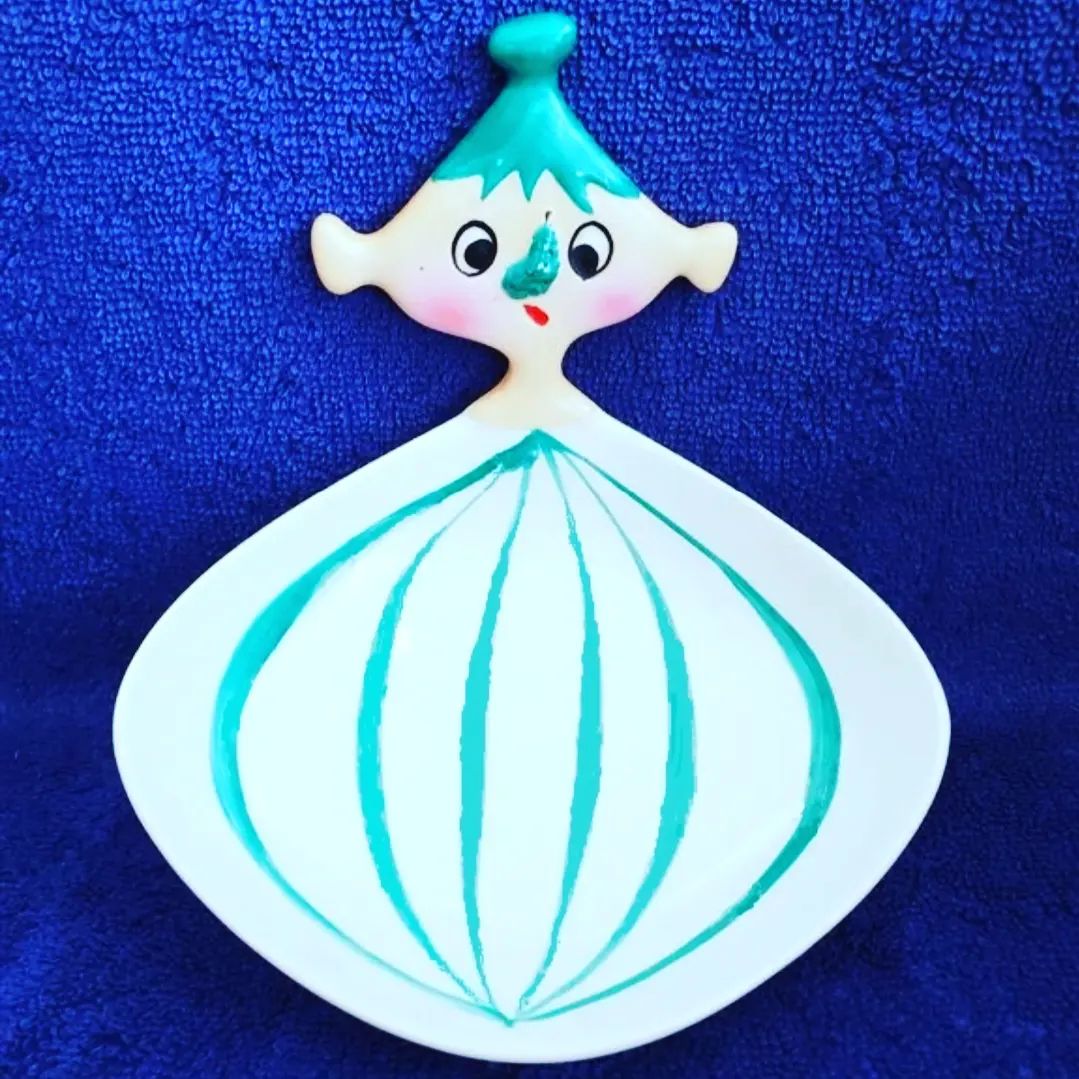
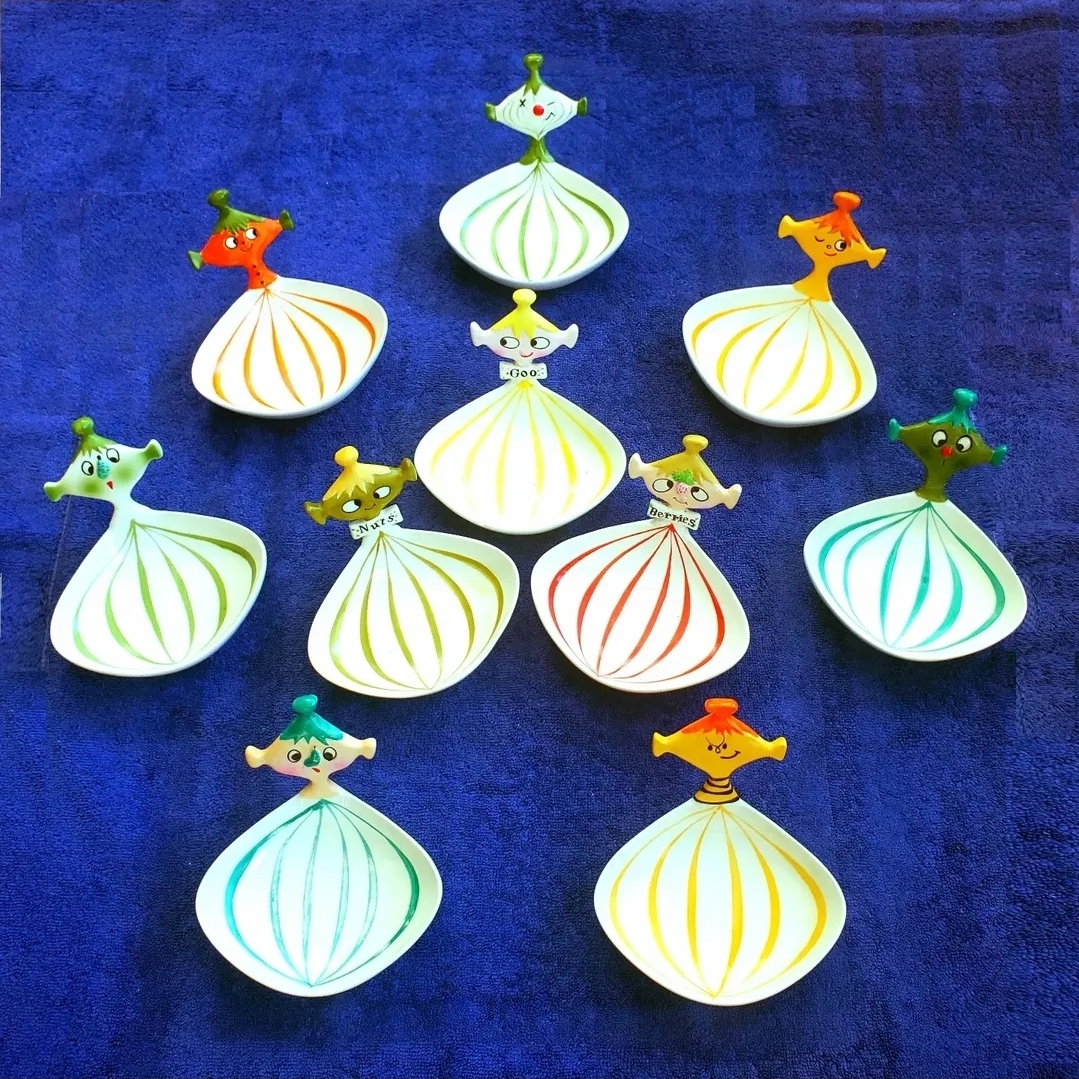
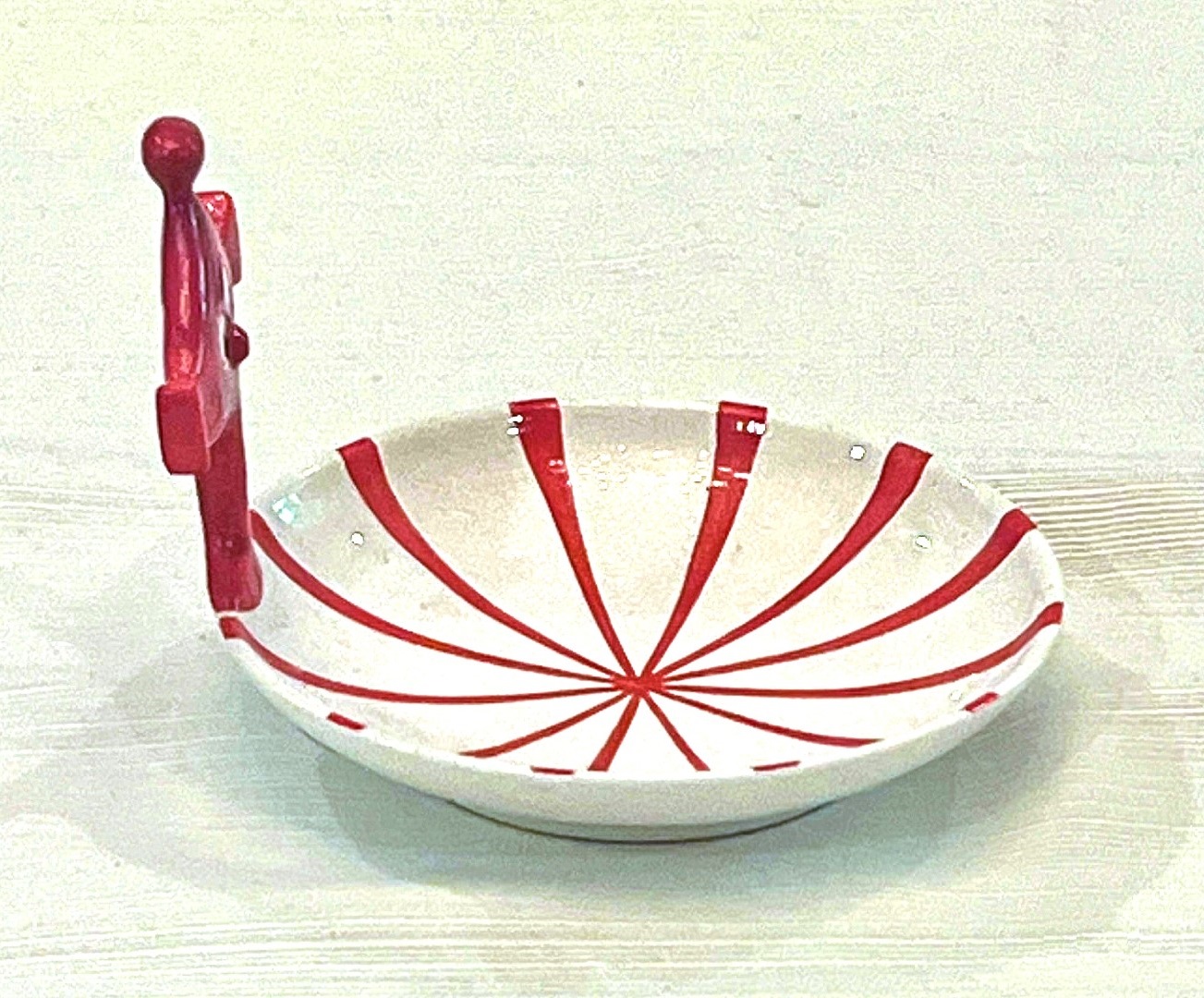
In 1959, Holt Howard continued expanding Pixieware beyond condiment jars by introducing a series of shallow serving dishes known today as the Snack Pixies. The line consisted of seven individually sold serving dishes: Mustard Max, Ketchup Katie, Onion Annie, Pickle Pete, Oscar Olives, Peanut Butter Pat, and Tartar Tom. Each combined a whimsical pixie handle with a shallow serving bowl, transforming ordinary condiments and accompaniments into colorful tabletop displays.

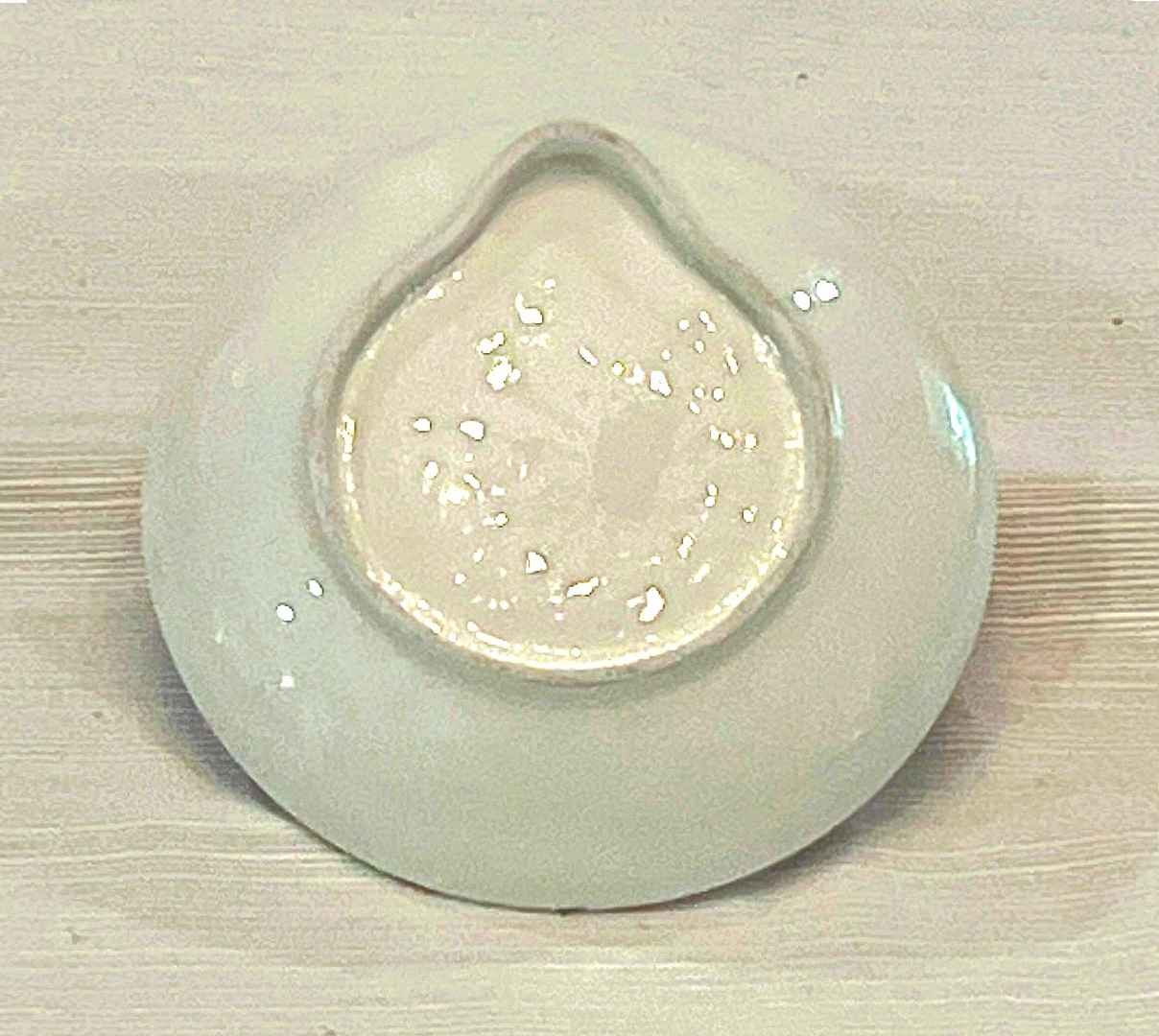
Like many Pixieware creations, the Snack Pixies blended humor with functionality. Facial expressions, color schemes, and decorative details were carefully coordinated to reflect the intended contents of each dish, while the shallow bowls made them ideal for serving relishes, condiments, and snack foods. All seven pieces were introduced in 1959, sold individually, and carry 1959 copyright markings. Each measures approximately 5 inches wide, 5¼ inches front-to-back, 1¼ inches deep, and 3¾ inches tall to the top of the pixie's head. Together, the series demonstrated Holt Howard's growing confidence in extending the Pixieware concept far beyond its original condiment jar roots.

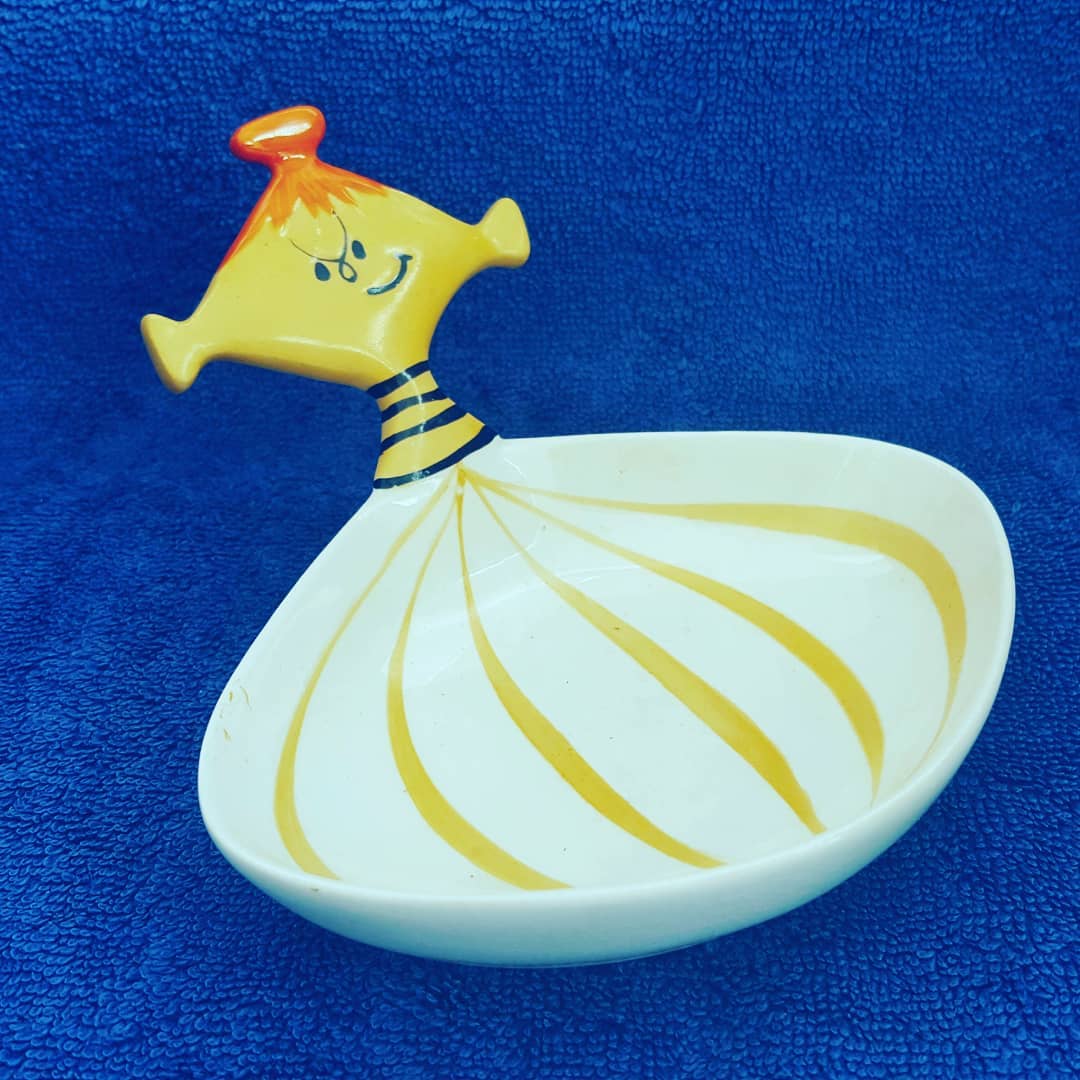
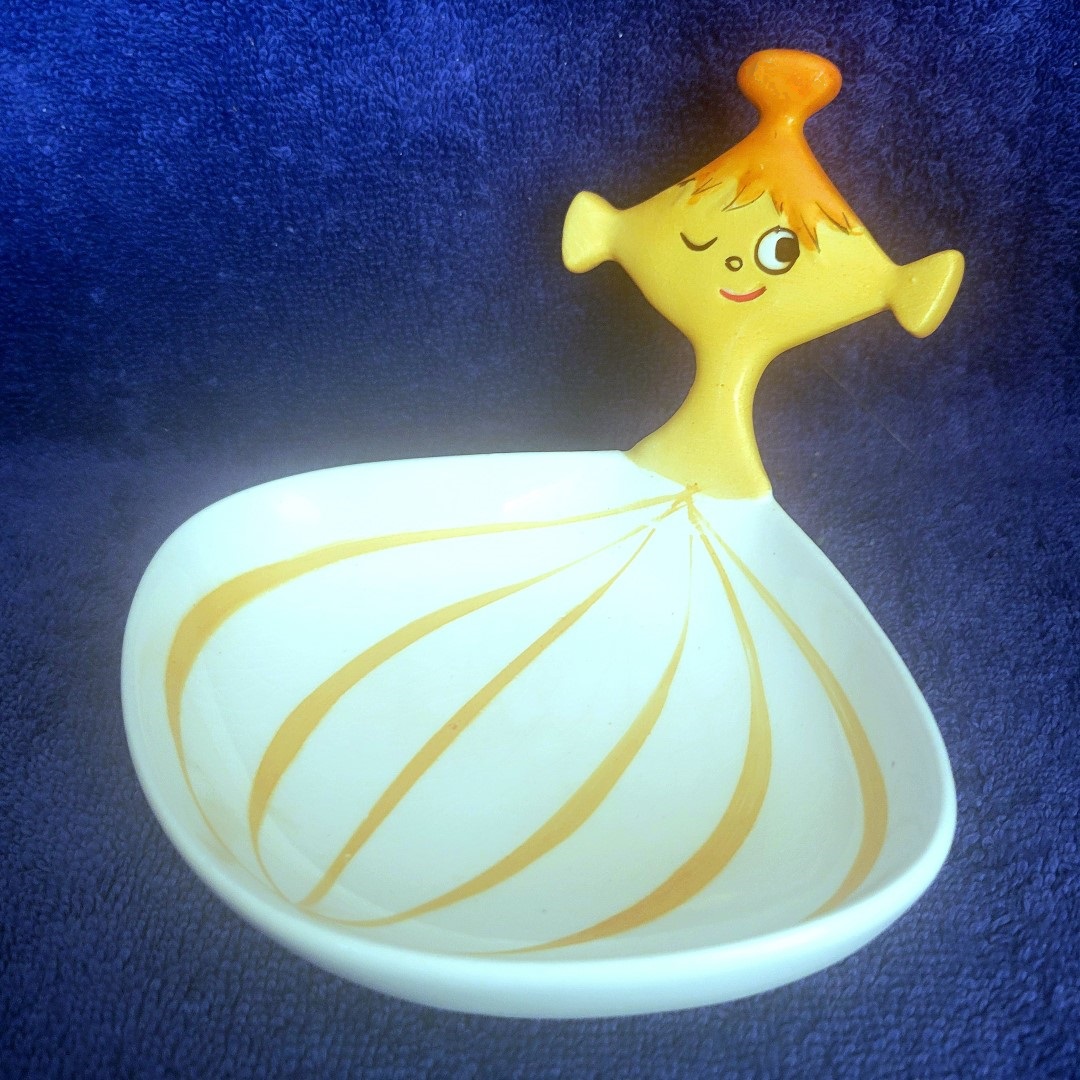
Mustard Max

Mustard Max

Among the seven Snack Pixies, Mustard Max maintains one of the strongest visual connections to the original 1958 Pixieware condiment jars. His butterscotch-yellow coloration, orange hair, and black striped collar clearly echo the earlier Mustard jar, creating an immediate family resemblance between the two pieces. His bowl features matching yellow stripes that radiate outward from the handle, continuing the color-coordinated design approach seen throughout the series.

Like the other Snack Pixies, Mustard Max was sold individually and carries a 1959 copyright mark. Intended for serving mustard and other condiments, he demonstrates how Holt Howard adapted the visual language of the original Pixieware jars into an entirely new line of serving pieces.

Ketchup Katie

Ketchup Katie

Ketchup Katie serves as the companion piece to Mustard Max and shares many of the same design characteristics. Her bright red hair, coordinated striping, and cheerful expression reflect the color and personality associated with one of America's most familiar condiments. Like the 1958 Ketchup jar that preceded her, Katie's appearance creates an immediate visual connection between the original Pixieware condiment line and the expanded serving pieces introduced in 1959.

Although Ketchup Katie and Mustard Max were frequently pictured together in Holt Howard advertising, the two dishes were sold individually rather than as a matched set. Carrying a 1959 copyright mark, Katie was intended for serving ketchup and similar condiments while adding a playful decorative element to the table. Her close relationship to Mustard Max makes the pair one of the clearest examples of Holt Howard extending successful Pixieware characters into new forms and functions.

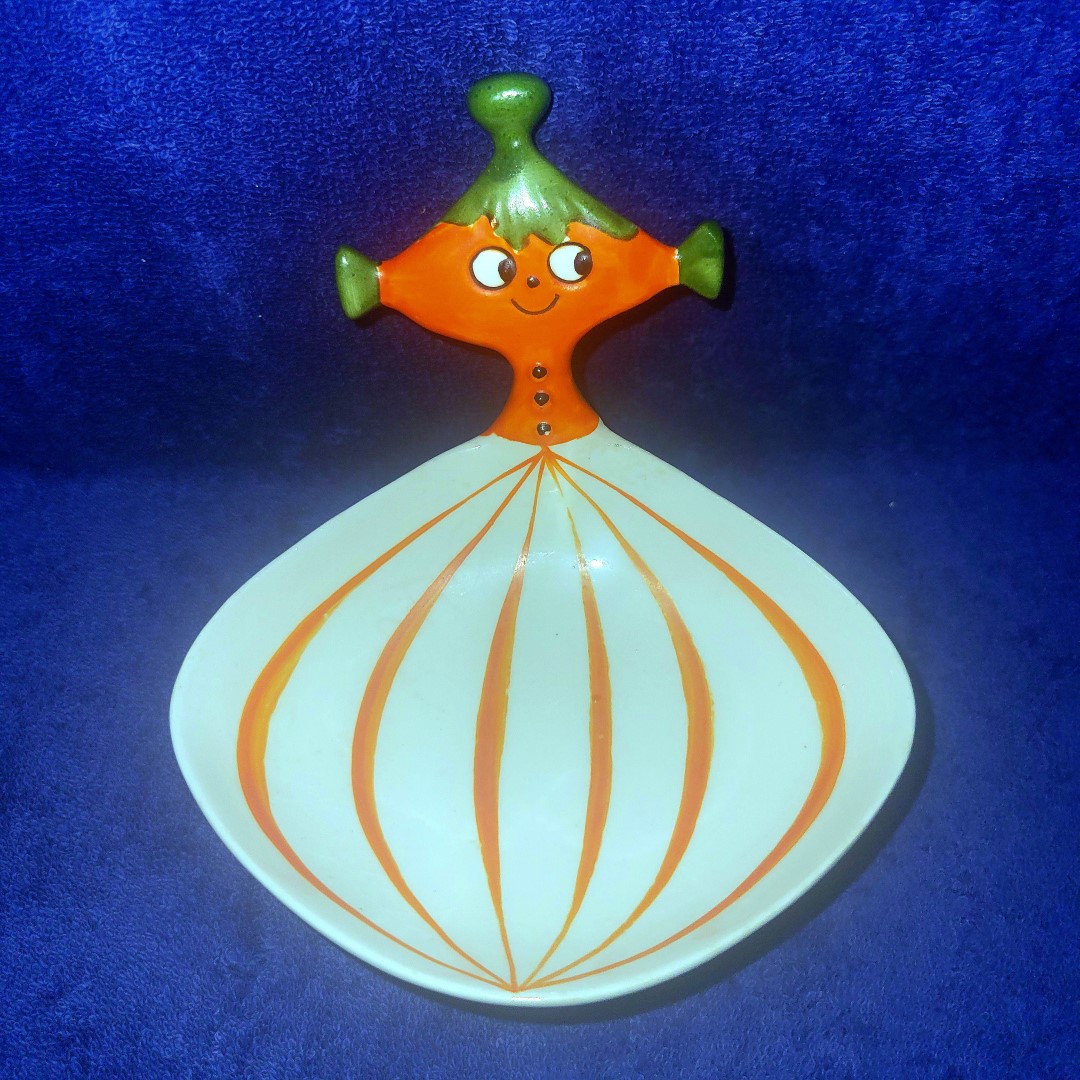
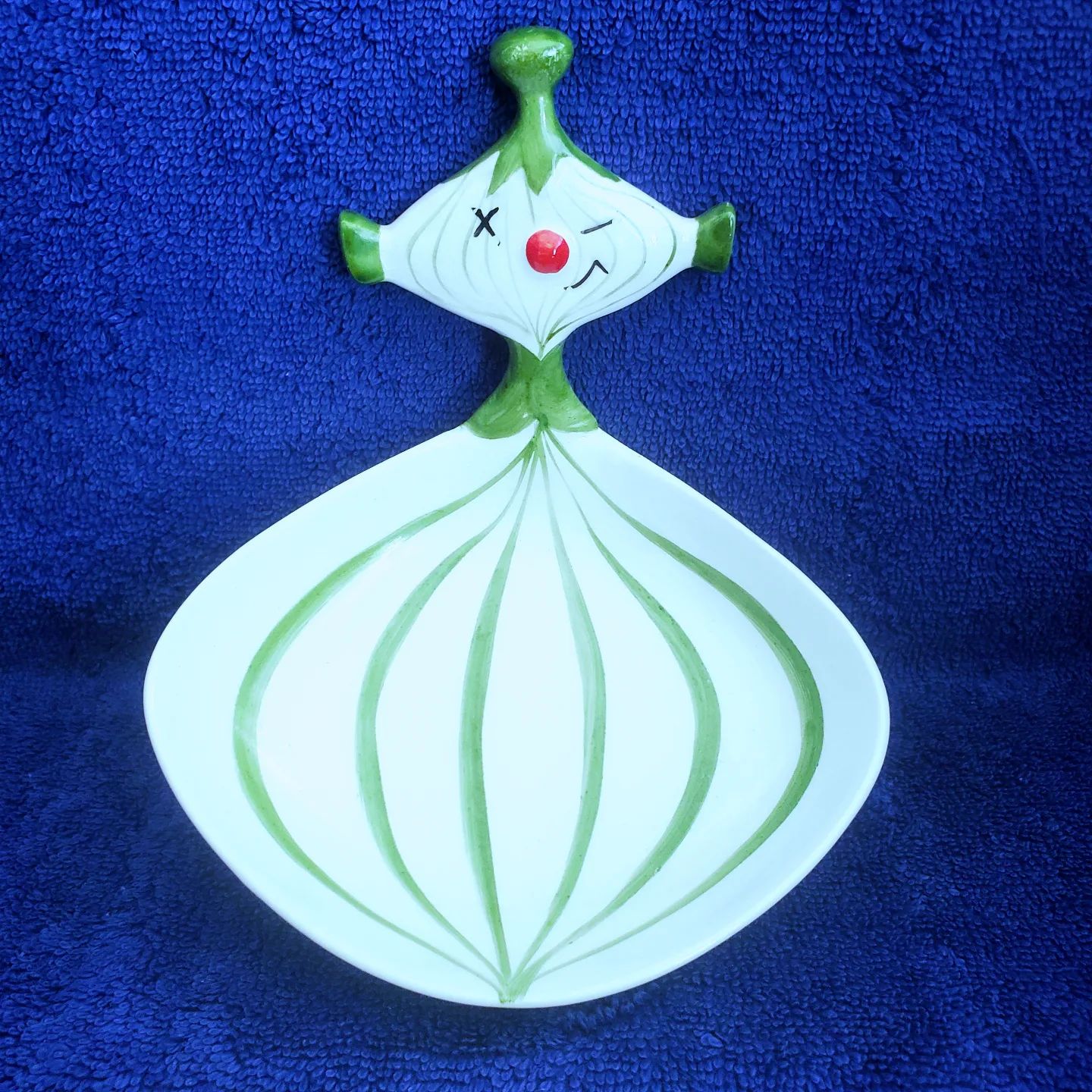
Onion Annie

Onion Annie

Onion Annie closely follows the design established by the 1958 Onion jar, incorporating onion-inspired features into her whimsical appearance. Her red onion nose, green onion-leaf collar, and coordinated green striping immediately identify her intended purpose, while her distinctive facial expression gives her one of the most memorable personalities in the entire Snack Pixies series. The green striping on her bowl matches the onion leaves around her neck, continuing the color-coordinated design approach found throughout Pixieware.

Like the other Snack Pixies, Onion Annie was sold individually and carries a 1959 copyright mark. Her winking eye and "X"-shaped eye appear to be a playful reference to the tears and irritation often associated with cutting onions, adding an extra layer of humor to the design. Her red onion nose also departs from the color of a natural onion, reflecting Holt Howard's preference for playful stylization over strict realism. Among the seven Snack Pixies, Annie stands out as one of the most literal examples of Holt Howard tailoring a character's appearance to the food it was designed to serve.

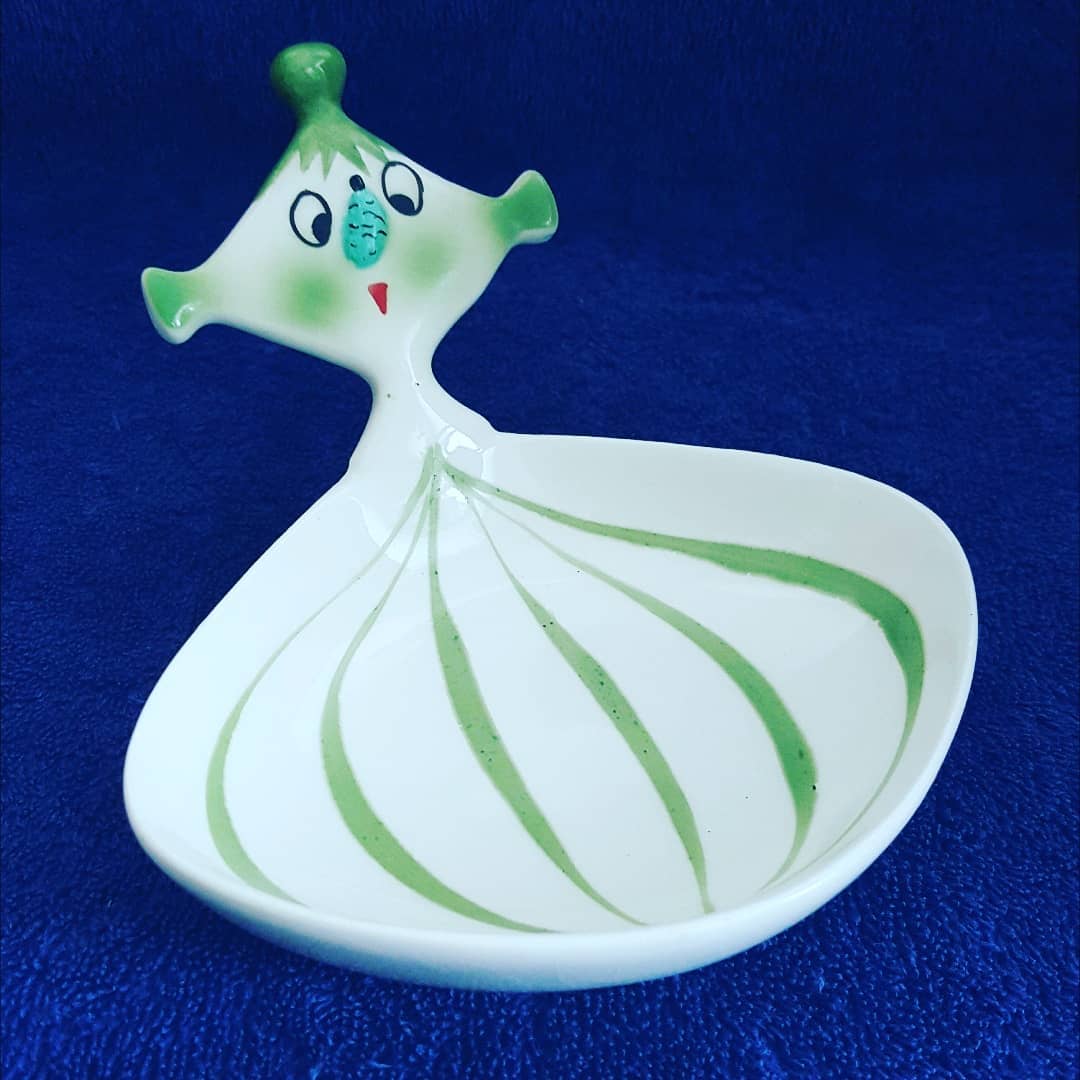
Pickle Pete

Pickle Pete

Pickle Pete is one of the most immediately recognizable members of the Snack Pixies series thanks to the oversized pickle that serves as his nose. His green coloration, pickle-shaped features, and coordinated bowl striping leave little doubt about the condiment he was designed to accompany. Like several of the other Snack Pixies, Pete carries forward the visual language established by the earlier 1958 Pixieware jars while adapting it to an entirely new serving form.

Like the other Snack Pixies, Pickle Pete was sold individually and carries a 1959 copyright mark. Intended for serving pickles, relishes, and similar accompaniments, he demonstrates Holt Howard's talent for transforming ordinary tableware into playful conversation pieces. Among the seven Snack Pixies, Pete may be the most literal interpretation of his intended contents, with his pickle-shaped nose serving as both a decorative element and an unmistakable visual clue to his purpose.

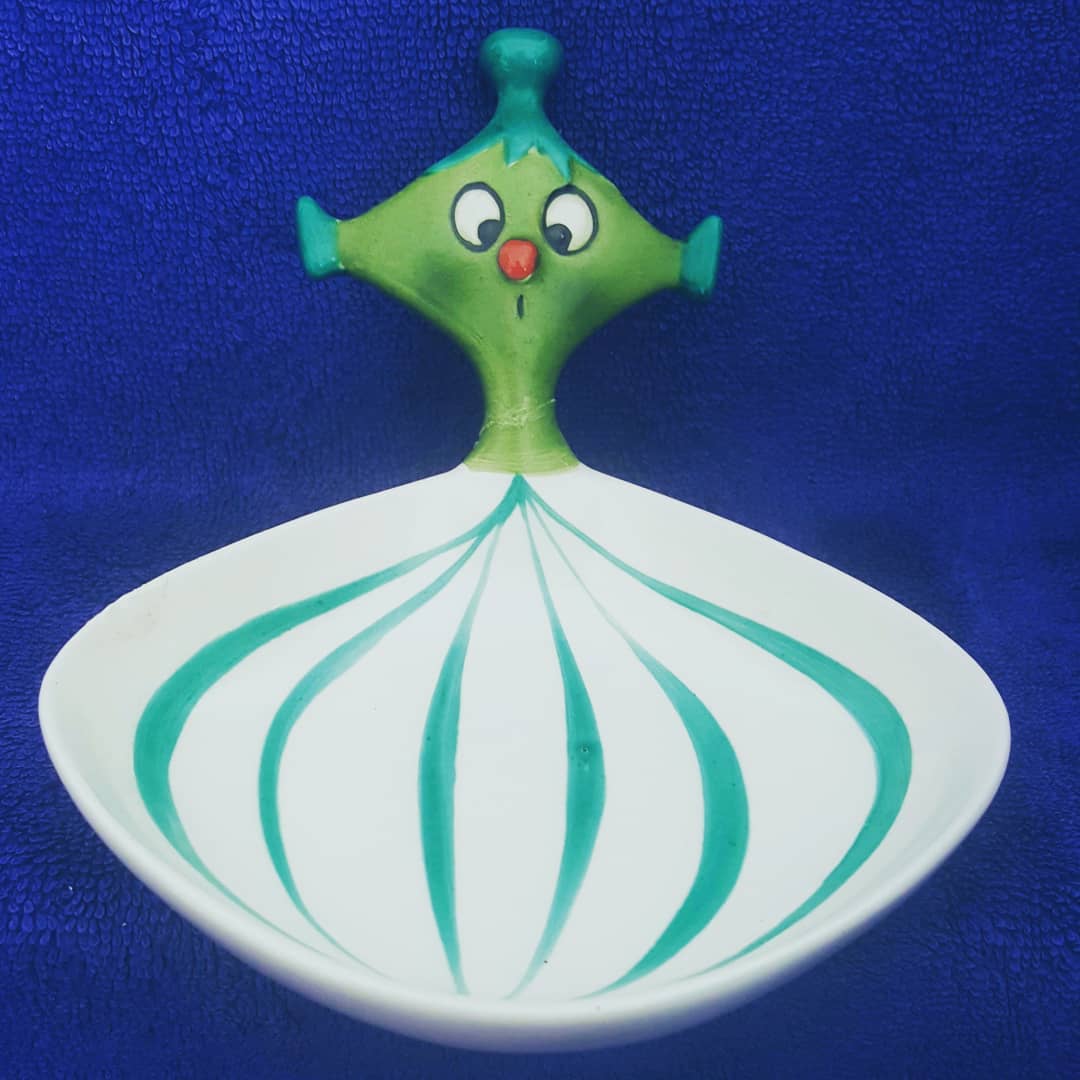
Oscar Olives

Oscar Olives

Oscar Olives is perhaps the most expressive member of the Snack Pixies family. His olive-green face, turquoise bowl striping, and distinctive cross-eyed expression immediately identify the dish's intended contents. Unlike several of the other Snack Pixies, whose food items appear as noses attached to otherwise conventional pixie faces, Oscar's entire head is designed to resemble an olive, with the red pimento occupying the position normally reserved for a nose. The result is one of the most humorous and character-driven designs in the entire 1959 Pixieware lineup.

Like the other Snack Pixies, Oscar Olives was sold individually and carries a 1959 copyright mark. Intended for serving olives and cocktail garnishes, he reflects Holt Howard's talent for blending function with visual storytelling. Among the seven Snack Pixies, Oscar stands out for the way his facial features are integrated directly into the food itself, creating a playful character whose identity is inseparable from the olive that inspired his name.

Peanut Butter Pat

Peanut Butter Pat

Peanut Butter Pat is one of the most recognizable members of the Snack Pixies series, featuring a warm brown color scheme that reflects the dish's intended contents. His rounded facial features, coordinated bowl striping, and cheerful expression give him a friendly personality that differs from some of the more exaggerated characters in the lineup. The rich brown tones used throughout the piece create an immediate association with peanut butter while maintaining the whimsical styling that defines Pixieware.

Like the other Snack Pixies, Peanut Butter Pat was sold individually and carries a 1959 copyright mark. Intended for serving peanut butter, spreads, and similar accompaniments, he demonstrates Holt Howard's ability to transform even the most ordinary pantry staples into decorative serving pieces. Among the seven Snack Pixies, Pat is particularly noteworthy because his design later served as the basis for a British-market variation, making him one of the few members of the series with a direct connection to the separately licensed British Pixieware line.

Tartar Tom

Tartar Tom

Tartar Tom rounds out the Snack Pixies series with a distinctive teal and aquamarine color scheme that sets him apart from the other condiment-themed dishes introduced in 1959. His cheerful expression, coordinated bowl striping, and pickle-shaped nose create a playful design that hints at the ingredients commonly associated with tartar sauce. While several of the Snack Pixies feature direct visual references to the foods they were designed to serve, Tom takes a more subtle approach by incorporating one of tartar sauce's most recognizable ingredients into his appearance.

Like the other Snack Pixies, Tartar Tom was sold individually and carries a 1959 copyright mark. Intended for serving tartar sauce and similar condiments, he represents one of the more creative designs in the series, as tartar sauce is itself a mixture of ingredients rather than a single identifiable food item. By incorporating a pickle-shaped nose into the character, Holt Howard's designers created a memorable visual connection while maintaining the whimsical personality that defines the entire Snack Pixies line.

Sundae Servers

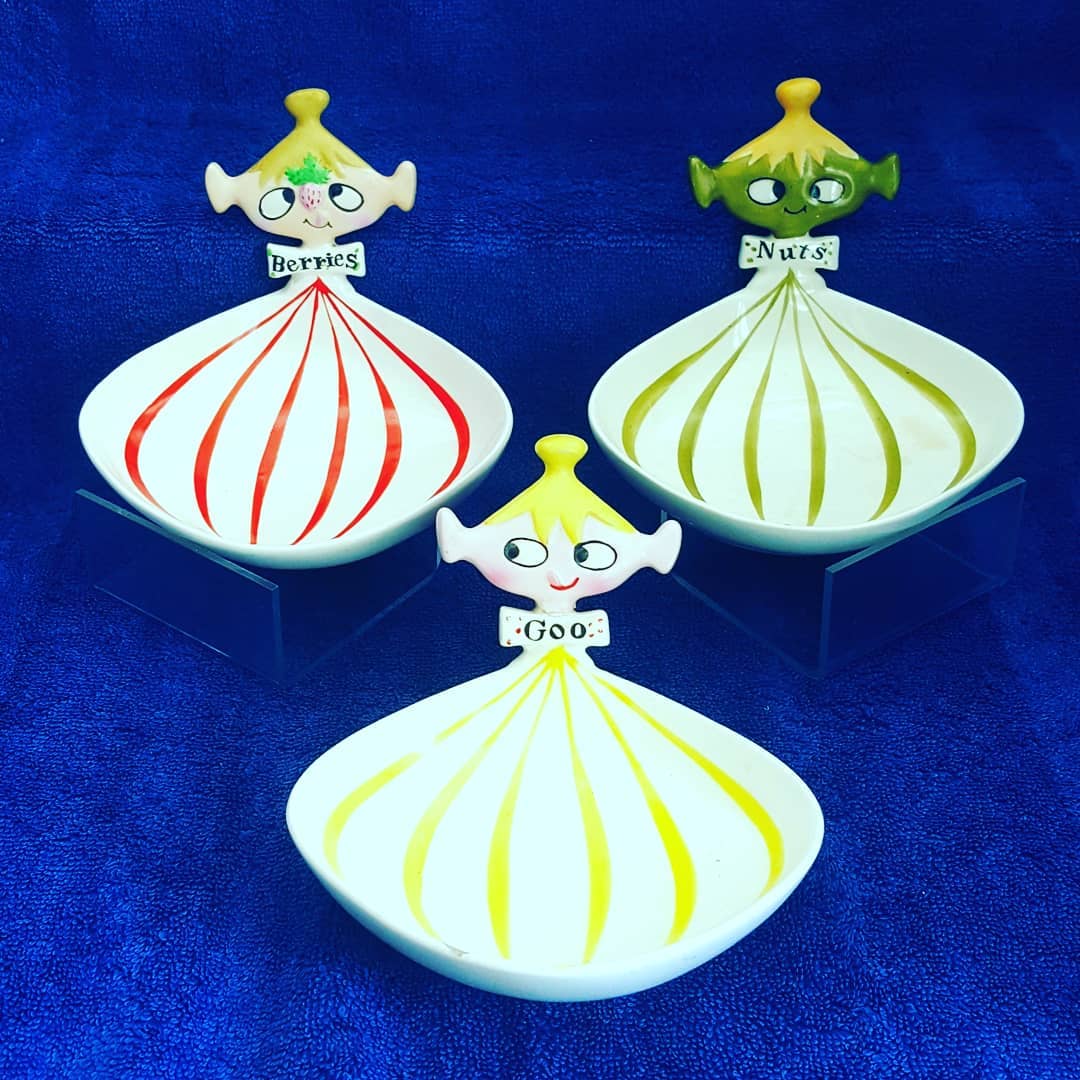
Nuts, Berries, and Goo sundae servers

Introduced in 1959 alongside the seven Snack Pixies, the three Sundae Servers expanded the Pixieware concept into the world of desserts and ice cream toppings. Sharing the same shallow bowl form and dimensions as their condiment-serving cousins, these cheerful pixies were designed to hold nuts, berries, syrups, sauces, and other favorite sundae toppings. Each piece features a distinctive white bow tie identifying its intended contents, making the trio instantly recognizable within the broader Pixieware line.

Like the Snack Pixies, the Sundae Servers measure approximately 5 inches wide, 5¼ inches front-to-back, with a bowl depth of 1¼ inches and an overall height of approximately 3¾ inches to the top of the pixie's head. All three pieces were introduced in 1959, sold individually, and carry 1959 copyright markings. While originally intended for ice cream service, they remain equally useful for candies, sauces, dessert toppings, relishes, and countless other entertaining purposes.

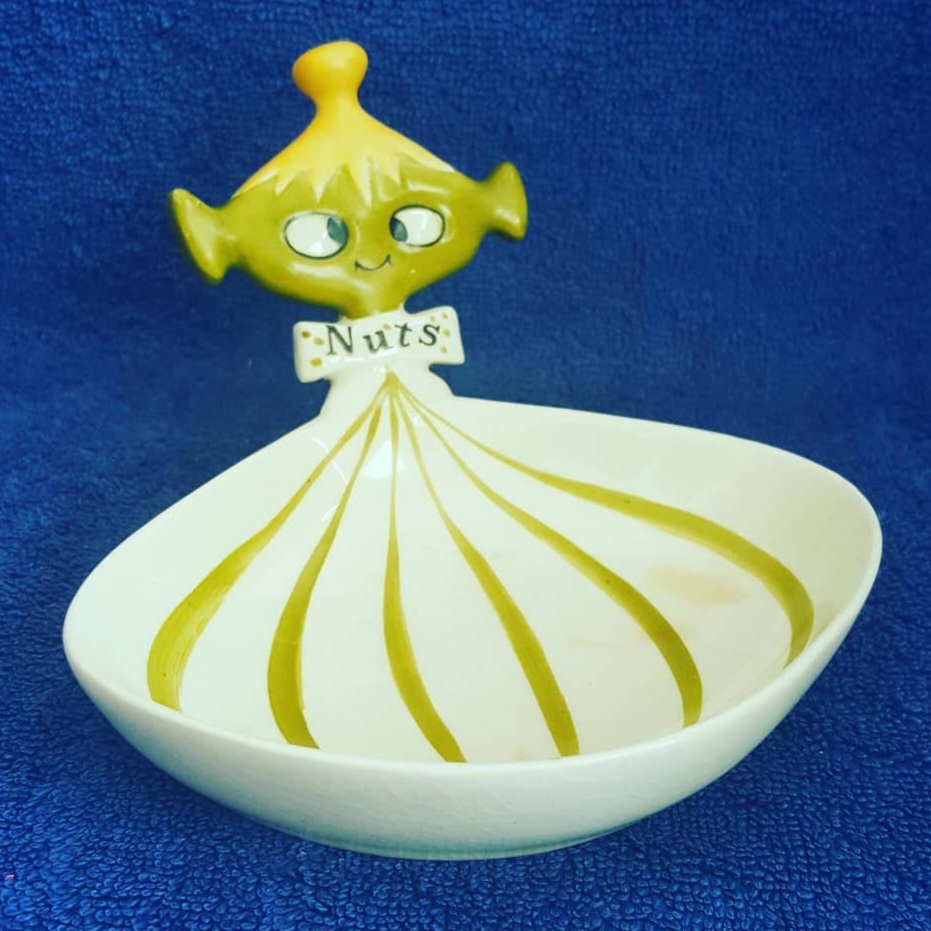
Nuts

Nuts

The Nuts Sundae Server is perhaps the most playful member of the trio. His white bow tie is decorated with green polka dots and prominently labeled "Nuts," while his deliberately crossed eyes suggest that he may be a little "nuts" himself. The joke is typical of Holt Howard's lighthearted design philosophy, transforming a simple serving dish into a character with a personality all its own.

Like the other Sundae Servers, Nuts was sold individually and carries a 1959 copyright mark. Intended for chopped nuts and other ice cream toppings, the dish could just as easily be used for candies, relishes, or small snacks. Walter Dworkin observed that Nuts appears more frequently than either Berries or Goo, suggesting that higher production or survival numbers may have contributed to its greater availability today.

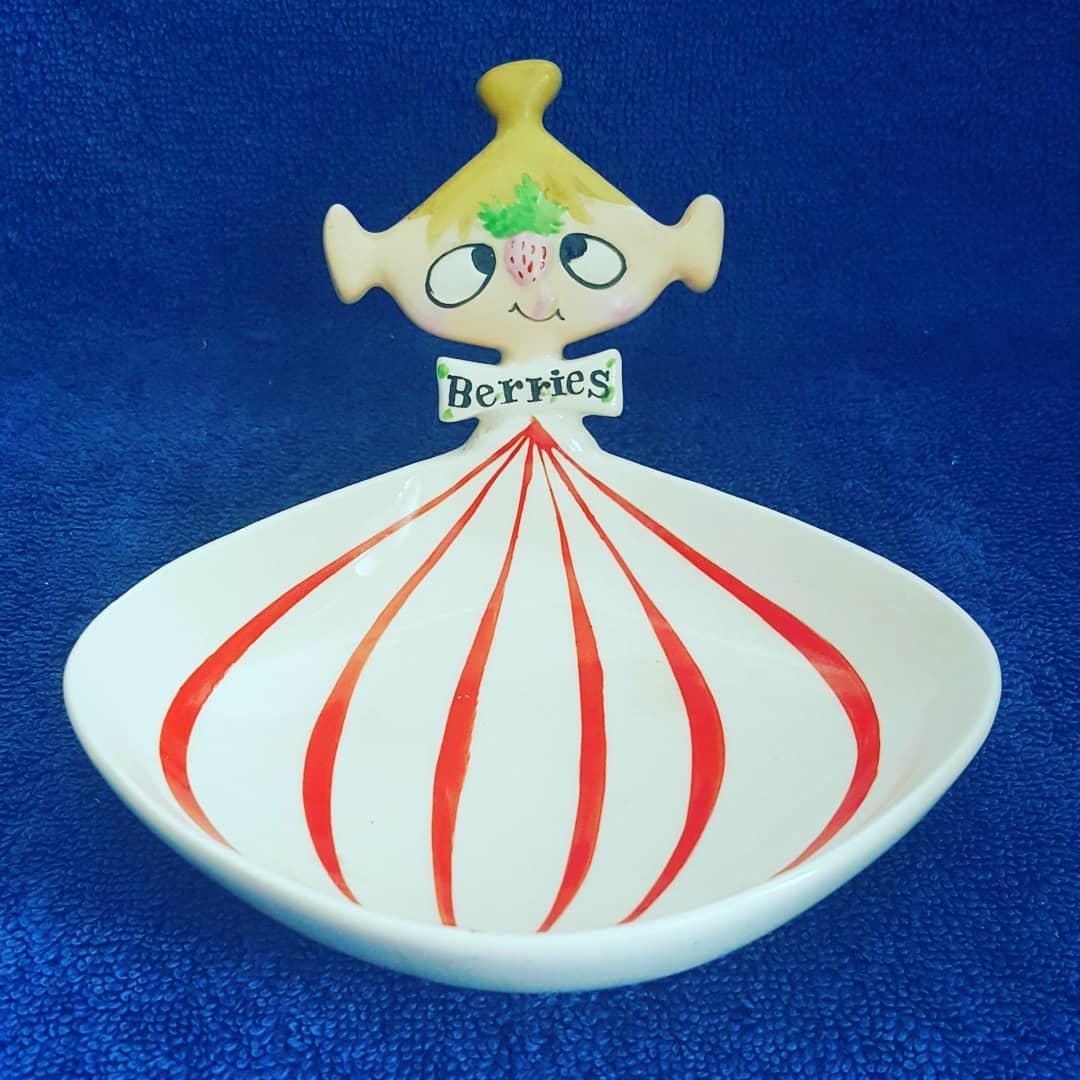
Berries

Berries

Berries is among the most colorful and visually striking pieces in the entire Pixieware line. His pink-and-red strawberry-like nose immediately identifies his purpose, while six green polka dots on his white bow tie echo the leaves attached to the berry. Continuing a familiar Pixieware tradition, he gazes cross-eyed toward the fruit at the center of his face, creating the playful expression that collectors associate with many of the line's most memorable characters.

Like the other Sundae Servers, Berries was sold individually and carries a 1959 copyright mark. Intended for strawberries, berries, and other fruit toppings, the dish remains equally suitable for candies, sauces, and dessert accompaniments. Compared to Nuts, surviving examples appear considerably less often, and collectors have long regarded Berries as one of the scarcer members of the sundae trio.

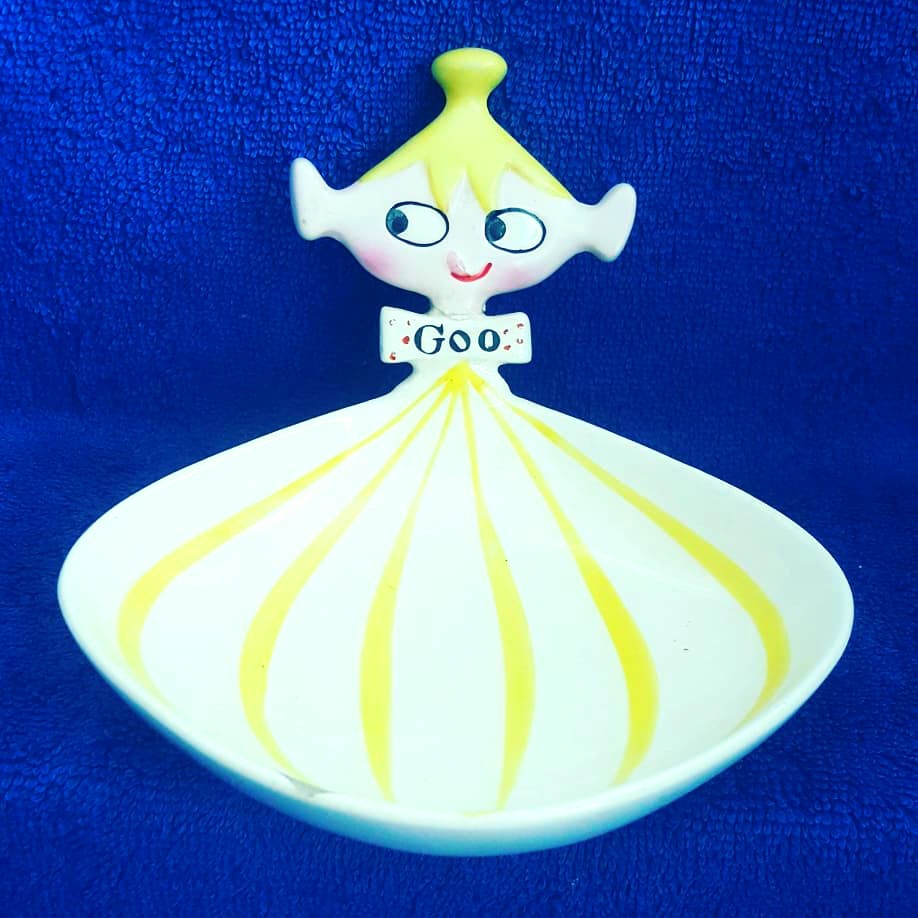
Goo

Goo

Few Pixieware pieces have generated more collector interest than Goo. When Walter Dworkin's first edition guide was published in 1998, no confirmed example had yet surfaced, and only a catalog photograph was known. Within months of publication, however, an example surfaced in Texas and sold online after intense collector bidding. Since that discovery, additional examples have appeared, but Goo remains one of the most sought-after and elusive pieces in the entire Pixieware family.

Unlike his two companions, Goo is not cross-eyed. His white bow tie is decorated with numerous red polka dots and plainly identifies his purpose, while his cheerful expression and lip-licking grin suggest anticipation of whatever sweet topping the dish might contain. One possible explanation for Goo's scarcity is that sticky toppings such as syrups, fudge, caramel, or marshmallow sauce would have required more cleaning than nuts or berries, increasing the chance of accidental breakage over time. While no production records confirm this theory, it offers a plausible explanation for why Goo appears less frequently today than its two companions.
Teapot Candleholder Hurricane Vases

Among the most inventive additions to Holt Howard's 1959 Pixieware expansion were the Teapot Candleholder Hurricane Vases. At first glance, the pair appear to be whimsical Pixieware teapots decorated with traditional striped bodies and pixies perched atop their handles. Closer inspection reveals a far more ambitious design that combines several household functions into a single decorative object.

Each piece serves simultaneously as a flower vase, candleholder, and hurricane lamp. A removable candle insert fits beneath a clear glass chimney, while six teardrop-shaped openings surrounding the center of the teapot accommodate fresh flowers placed in water held within the body of the vessel. The result is a remarkably versatile centerpiece that demonstrates Holt Howard's talent for transforming ordinary household objects into imaginative works of functional art.

Like many of the company's most successful designs, the Teapot Candleholder Hurricane Vases balance whimsy with practicality. Measuring approximately 8¼ inches tall including the glass chimney, 4¼ inches in diameter, 6 inches from pixie to spout, and 3 inches tall to the top of the ceramic teapot body, they were sold individually and carry a 1959 copyright mark. More than sixty years later, they remain among the most creative applications of the Pixieware concept, combining decorative character figures, floral display, candlelight, and teapot-inspired design into a single piece.

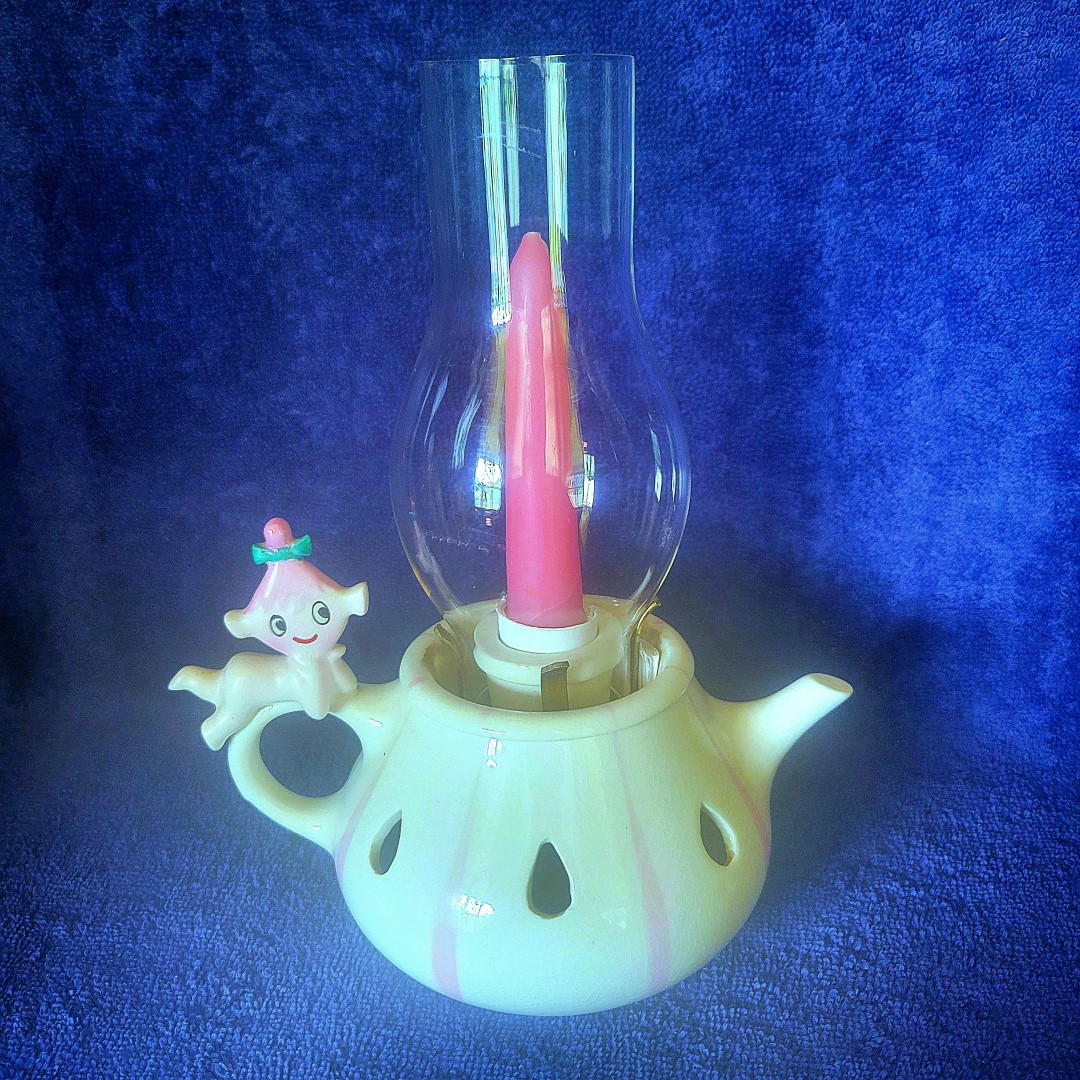
Girl Hurricane Lamp

Girl Teapot Candleholder Hurricane Vase

The Girl Teapot Candleholder Hurricane Vase serves as the companion piece to the boy version and features pink stripes accented by a green bow in the pixie's hair. Perched atop the handle and gazing upward toward the glass chimney, she mirrors the whimsical spirit of the companion piece while maintaining a distinct personality of her own. Her rear leg is raised dramatically behind her, creating one of the most animated poses found anywhere in the Pixieware line.

Like the Boy Hurricane Vase, the girl version functions simultaneously as a flower vase, candleholder, and hurricane lamp. Sold individually and carrying a 1959 copyright mark, it showcases Holt Howard's talent for combining decorative ceramics with practical household utility. Displayed together or separately, the pair remain among the most distinctive and creative pieces produced during the company's ambitious 1959 Pixieware expansion.

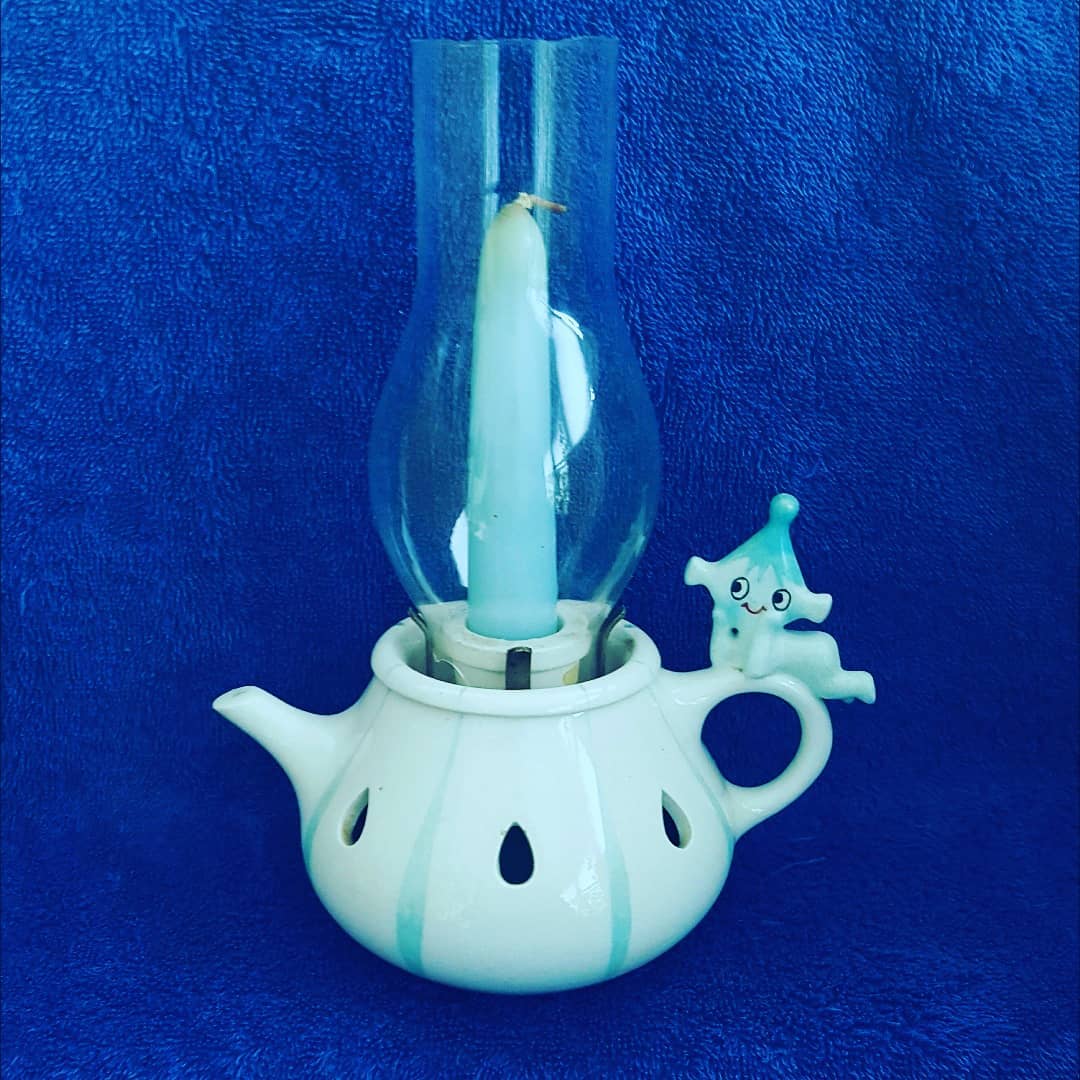
Boy Hurricane Lamp

Boy Teapot Candleholder Hurricane Vase

The Boy Teapot Candleholder Hurricane Vase features aqua stripes and a full-bodied pixie perched atop the handle of the teapot. Gazing upward toward the glass chimney above, the figure appears to admire the candlelight it was designed to support. His front leg is slightly raised, giving the piece a sense of movement while maintaining the playful character that defines the Pixieware line.

Like its companion piece, the Boy Hurricane Vase functions simultaneously as a flower vase, candleholder, and hurricane lamp. Sold individually and carrying a 1959 copyright mark, it demonstrates Holt Howard's ability to blend decorative appeal with practical household use. Together with the girl version, it represents one of the company's most imaginative interpretations of the Pixieware concept.

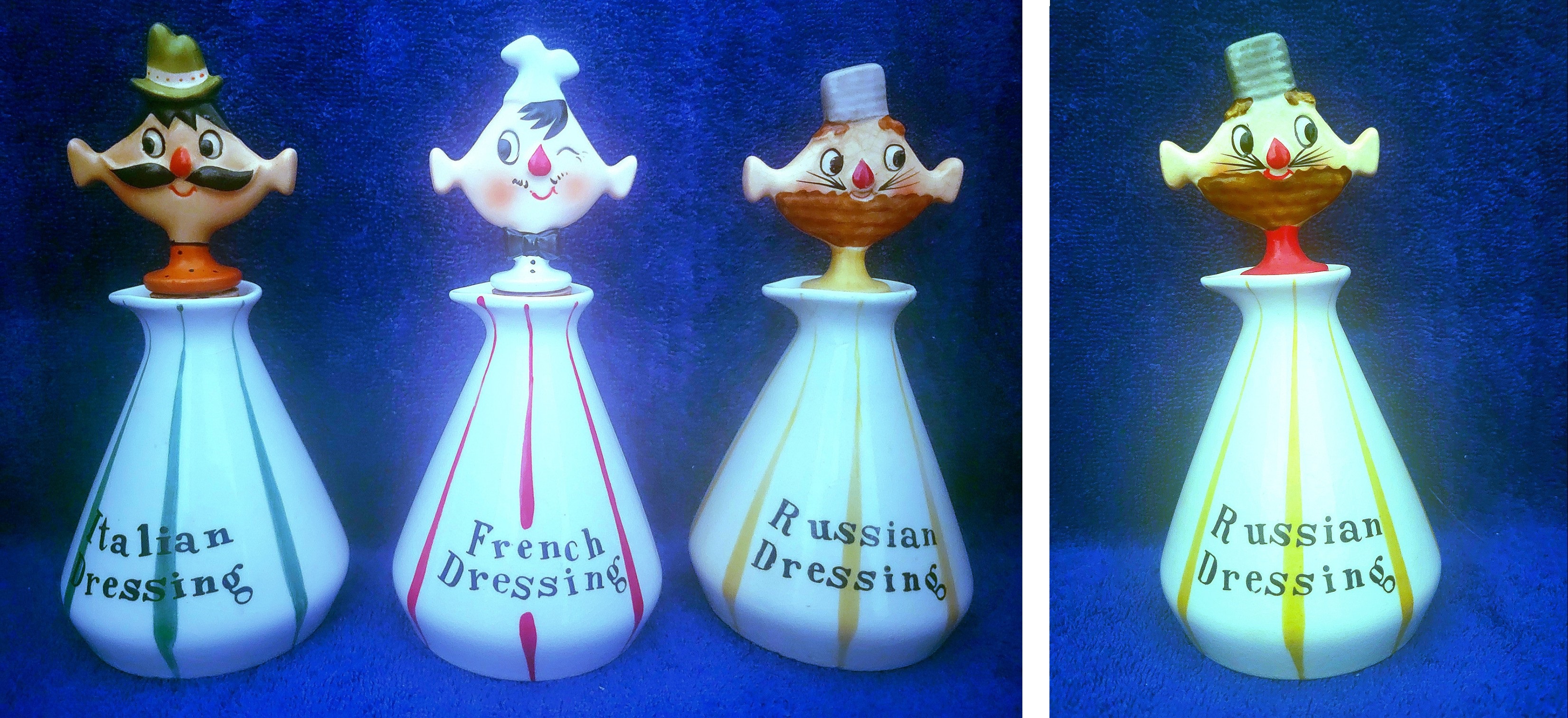
Salad Dressing Cruets

The 1959 Pixieware expansion also introduced a trio of salad dressing cruets for Russian, French, and Italian dressing. Unlike the earlier cocktail garnish bottles, these pieces were designed for liquid dressings and include built-in pouring spouts, cork stoppers beneath the character heads, and jar bodies that hold approximately 8 ounces, or one cup, of liquid. Each version carries a 1959 copyright mark.
The dressing cruets exist in two distinctly different design families. The round-headed trio, presented first here, represents one of the most unusual departures from standard Pixieware styling and appears to be the only round-headed Pixieware form Holt Howard produced. The flat-headed trio follows the more familiar Pixieware design language, with larger pointed ears, broader smiles, and stronger color coordination between the character heads and striped cruet bodies.

Round Head Dressing Cruets

Round Head Dressing Cruets

The Round Head Salad Dressing Cruets are among the most unusual pieces in the entire Pixieware line. Although clearly related to the flat-headed dressing cruets, nearly every aspect of their design was reworked. The jars are slightly shorter, feature seven vertical stripes instead of eight, and have smaller, more rounded ears. All three characters share flesh-colored noses, circular lips, and eyes that look in the same direction, giving them a noticeably different personality from their flat-headed cousins.

The redesign is most dramatic in the Russian and French figures. The Frenchman loses his chef's hat and bow tie, gains blond hair and a mustache, and receives an orange-striped cruet in place of the earlier red version. The Russian wears a black hat and has a large rust-colored beard and mustache, while the Italian remains closest to his flat-headed counterpart, retaining the familiar mustache and green color scheme. Although atypical for Pixieware, the Round Head Dressings remain one of the most fascinating variations produced during the 1959 expansion.

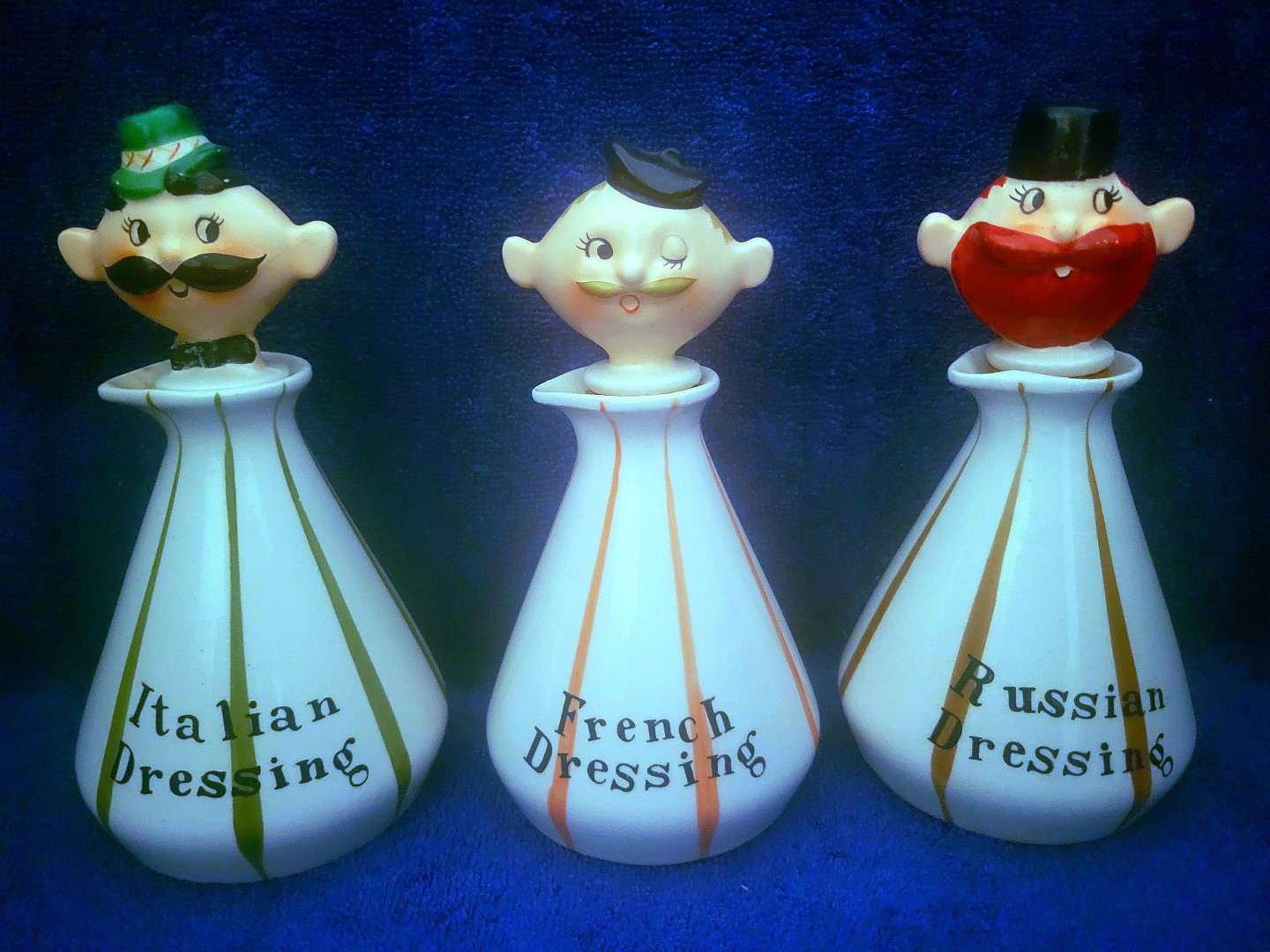
Flat Head Dressing Cruets

Flat Head Dressing Cruets

The Flat Head Salad Dressing Cruets consist of Russian, French, and Italian dressing varieties, each represented by a character whose appearance loosely suggests its country of origin. The Russian wears a square cap and beard, the Frenchman appears as a winking chef, and the Italian sports a hat and mustache. When displayed together, the Russian looks left, the Italian looks right, and both appear to direct their attention toward the winking French companion positioned between them.

Each flat-headed cruet stands approximately 7 inches tall, features eight vertical stripes, and includes an integrated pouring spout with a cork stopper concealed beneath the character head. Color coordination was carefully incorporated into the decoration: the Italian's green hat matches the stripes on his cruet, the Russian's stopper matches his stripes, and the Frenchman's red nose echoes the color of the stripes on his vessel. The Flat Head Dressings were sold as a six-piece set consisting of three heads and three cruet bodies.

Research Note: A small number of Flat Head Russian Dressing cruets have been documented with a red neck rather than the standard yellow neck found on most examples. The reason for this variation remains unknown. Possible explanations include an early production version later revised by Holt Howard, a temporary paint substitution during manufacturing, or a factory error that resulted in a limited number being produced with the incorrect color. Until additional examples or documentation surface, the origin of the "Redneck Russian" variant remains one of the more intriguing unanswered questions within the Pixieware line.

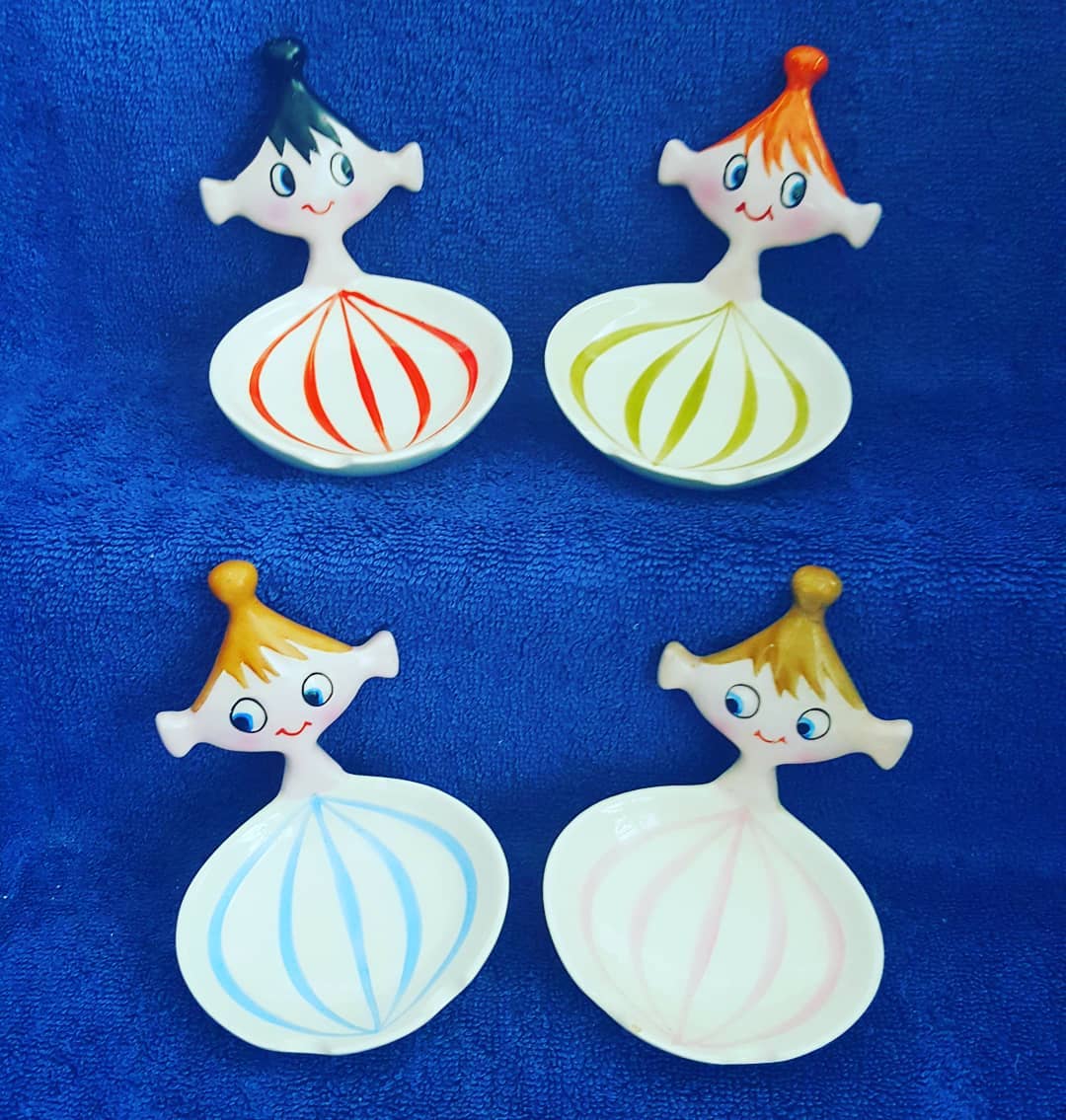
Table Favor Pixies

Four Pixieware Serviette Ashtrays

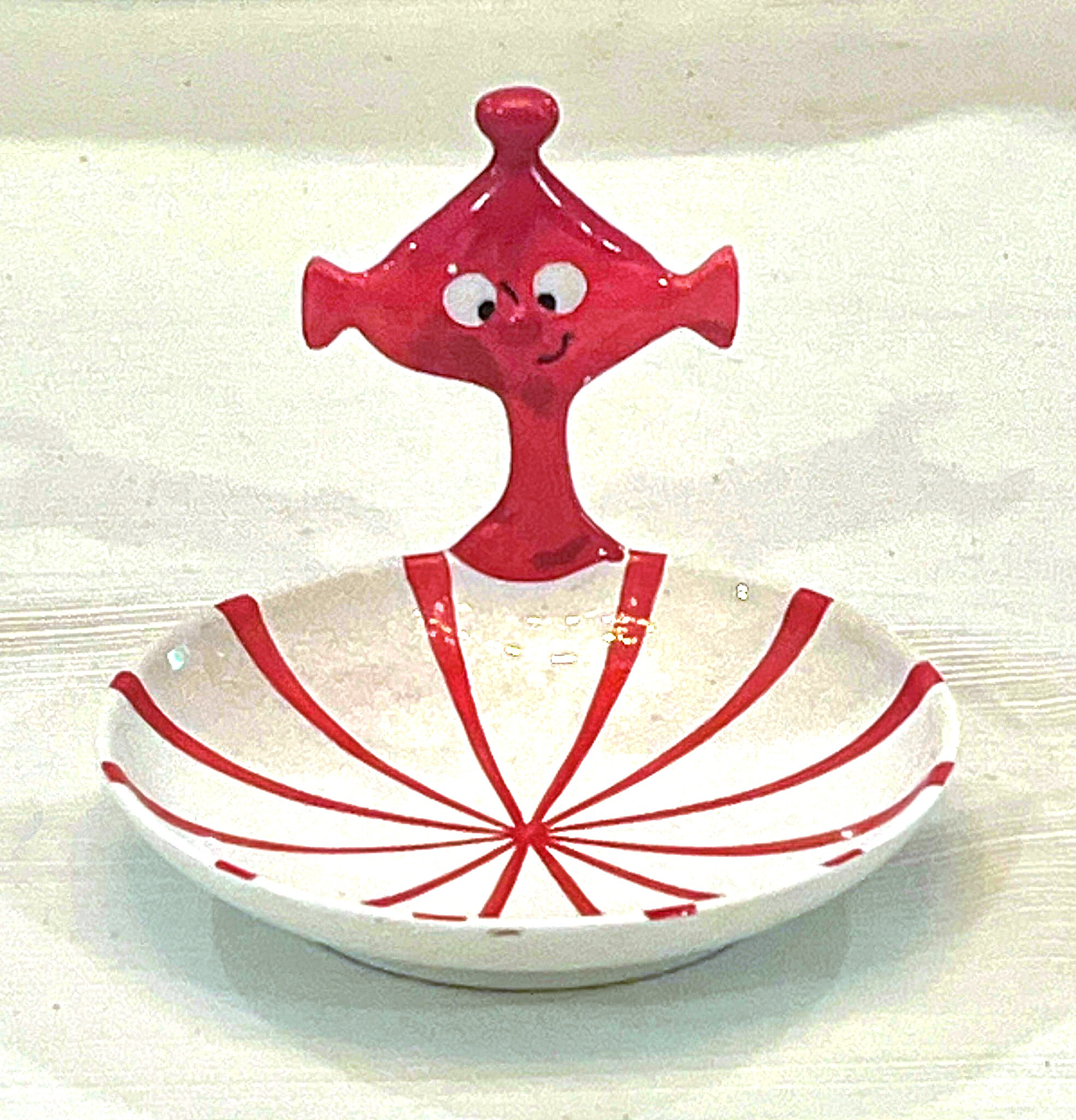
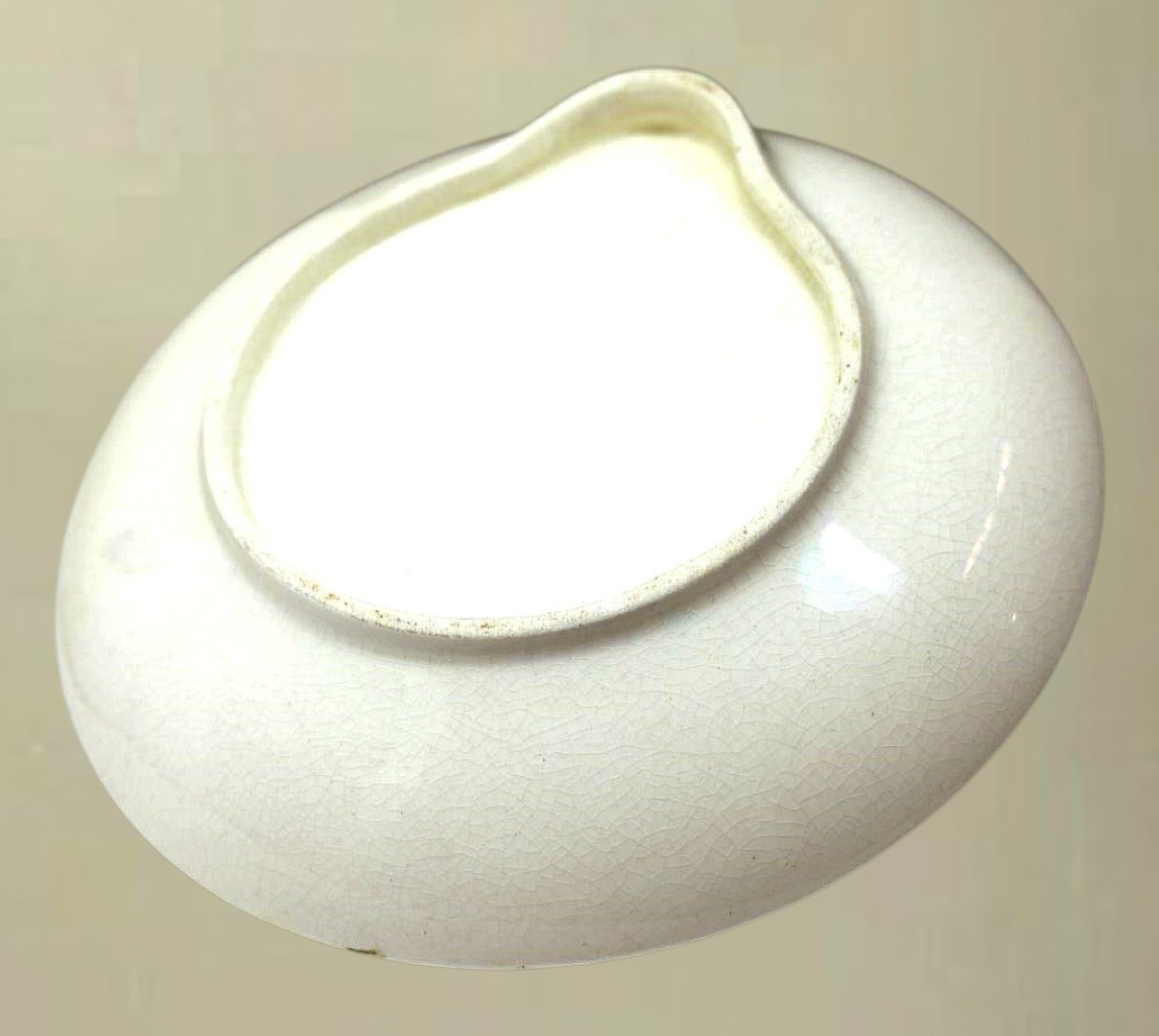
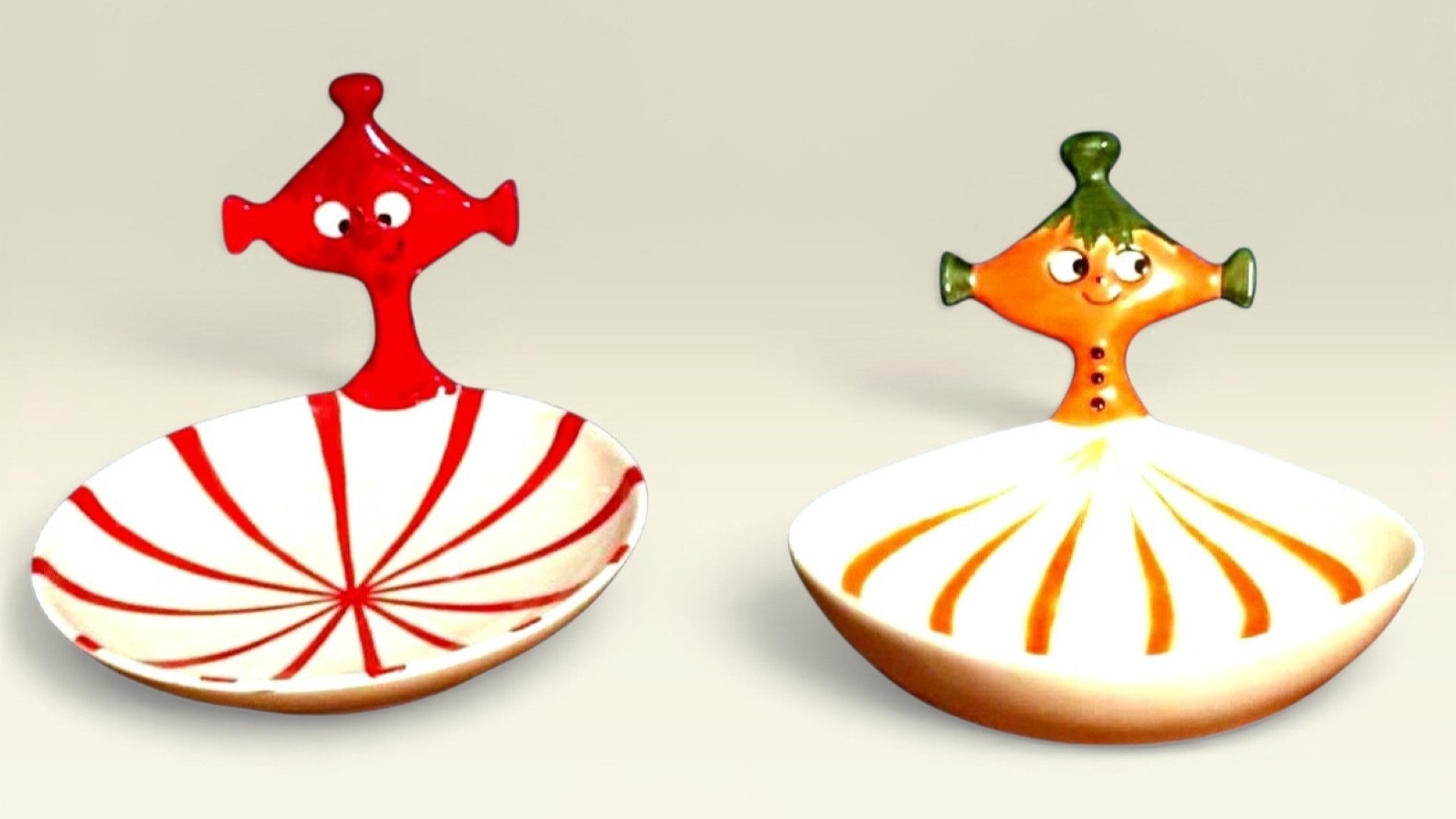
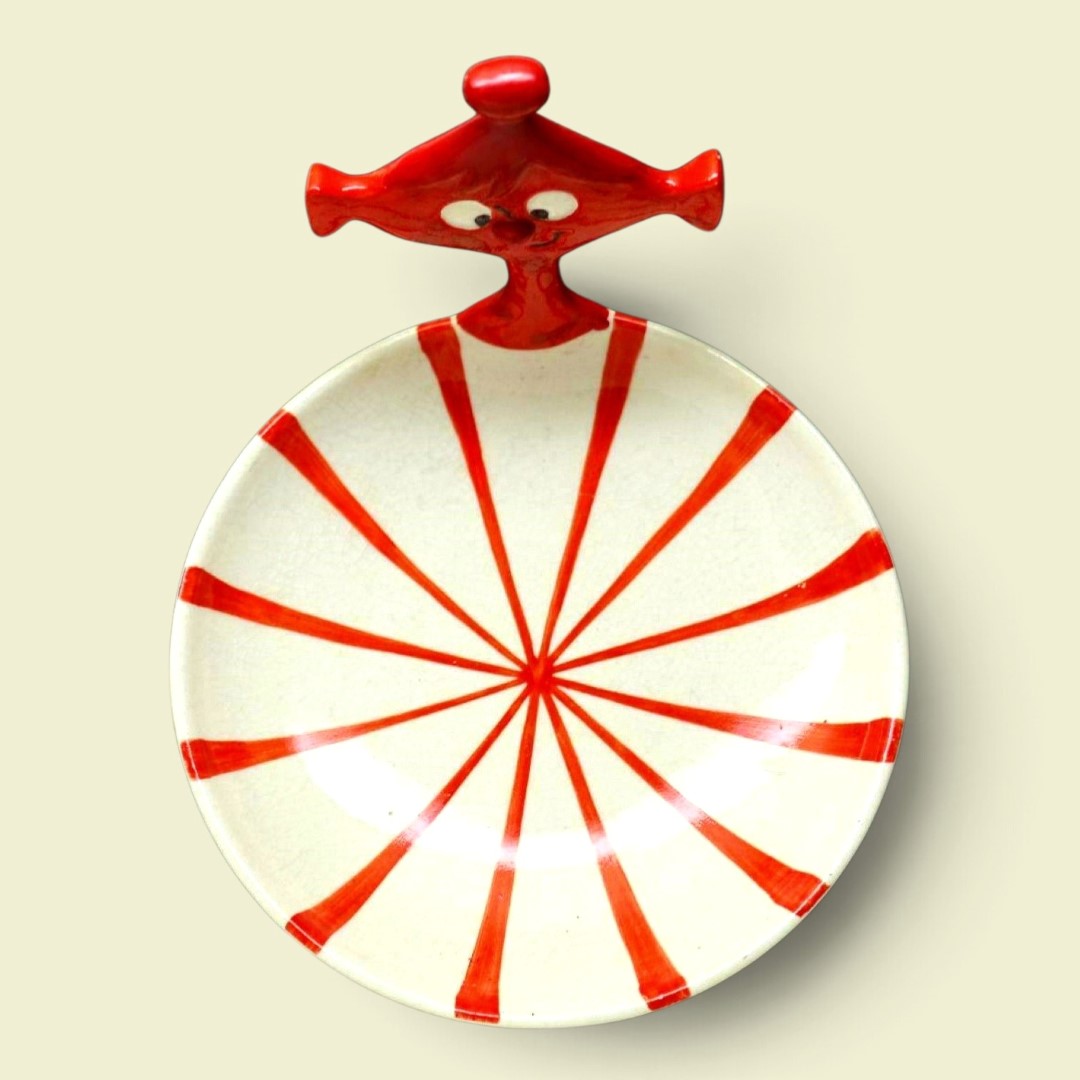
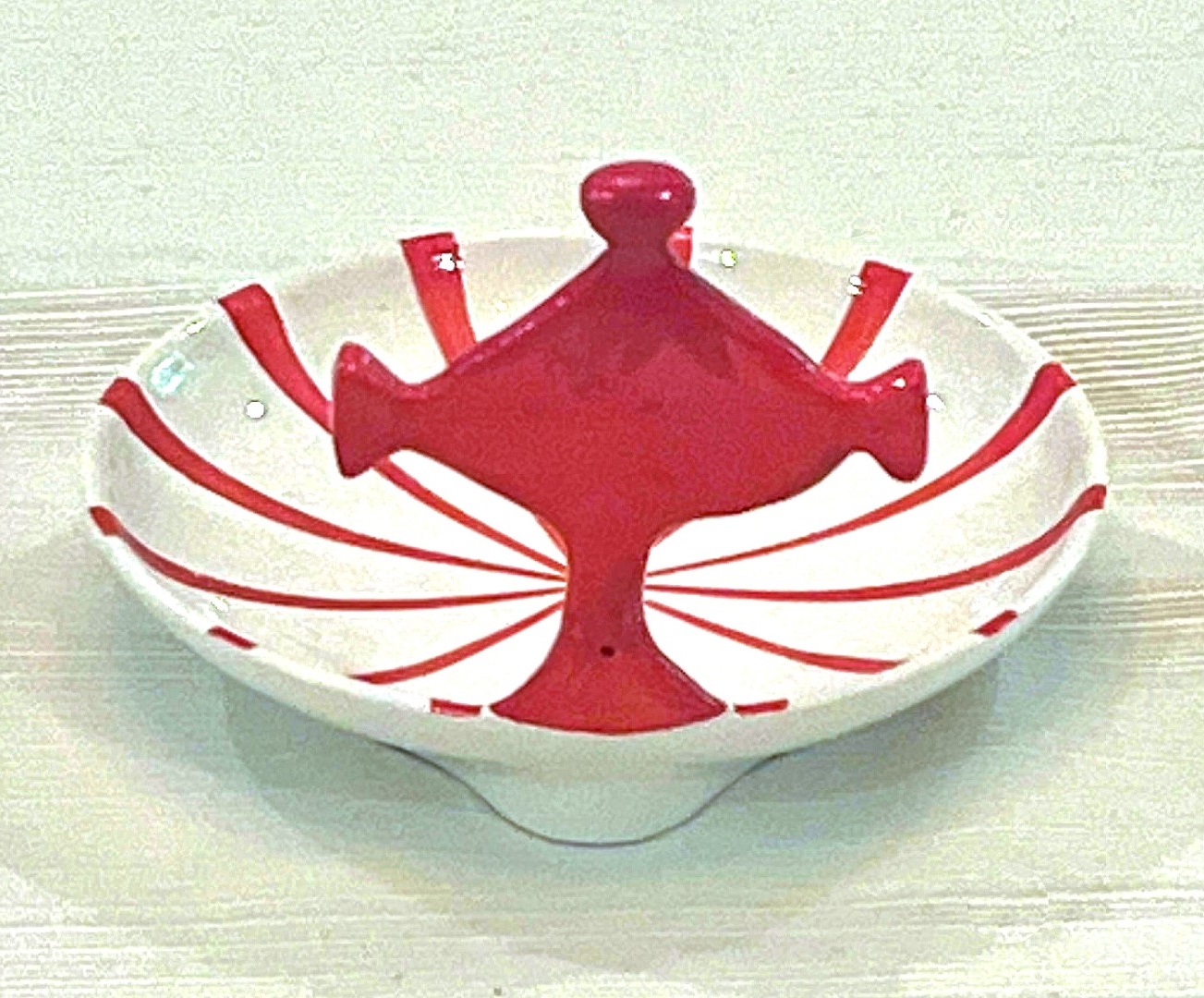
Among the more unusual additions to Holt Howard's 1959 Pixieware expansion were the Table Favor Pixies, a coordinated set of four small tabletop dishes designed for a variety of uses. Although Walter Dworkin referred to these pieces as "Serviettes" in his collector's guides, the term more commonly refers to a napkin or napkin-related accessory. Each dish measures approximately 3 inches wide and features a pixie head that doubles as a convenient handle for passing the dish around the table or clearing its contents.

The paired notches molded into the front edge of each dish strongly suggest that cigarette use was among their intended functions. Given the prevalence of smoking at restaurants, parties, and even dinner tables during the late 1950s, Holt Howard likely envisioned these versatile dishes serving multiple purposes, including use as ashtrays. At the same time, they work equally well as spoon rests, tea bag holders, nut dishes, condiment dishes, or small serving bowls, making them among the most adaptable pieces in the Pixieware line.

Sold as a coordinated set of four, each Table Favor Pixie features a unique combination of hair color, stripe color, and facial expression while retaining the same basic form. Introduced in 1959 and carrying Holt Howard 1959 backstamps, the set reflects the company's talent for transforming even the simplest household accessory into something whimsical, functional, and unmistakably Pixieware.

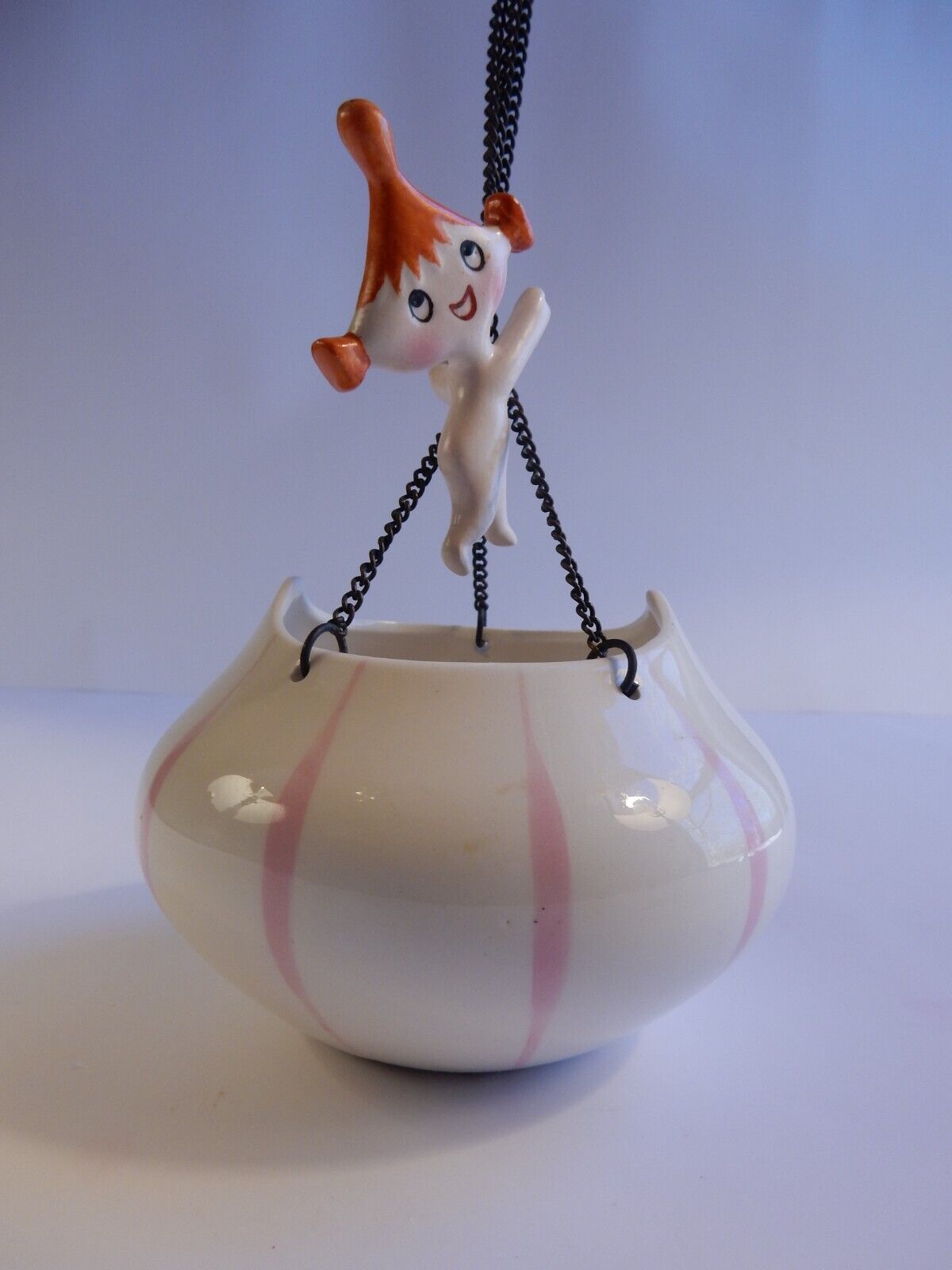
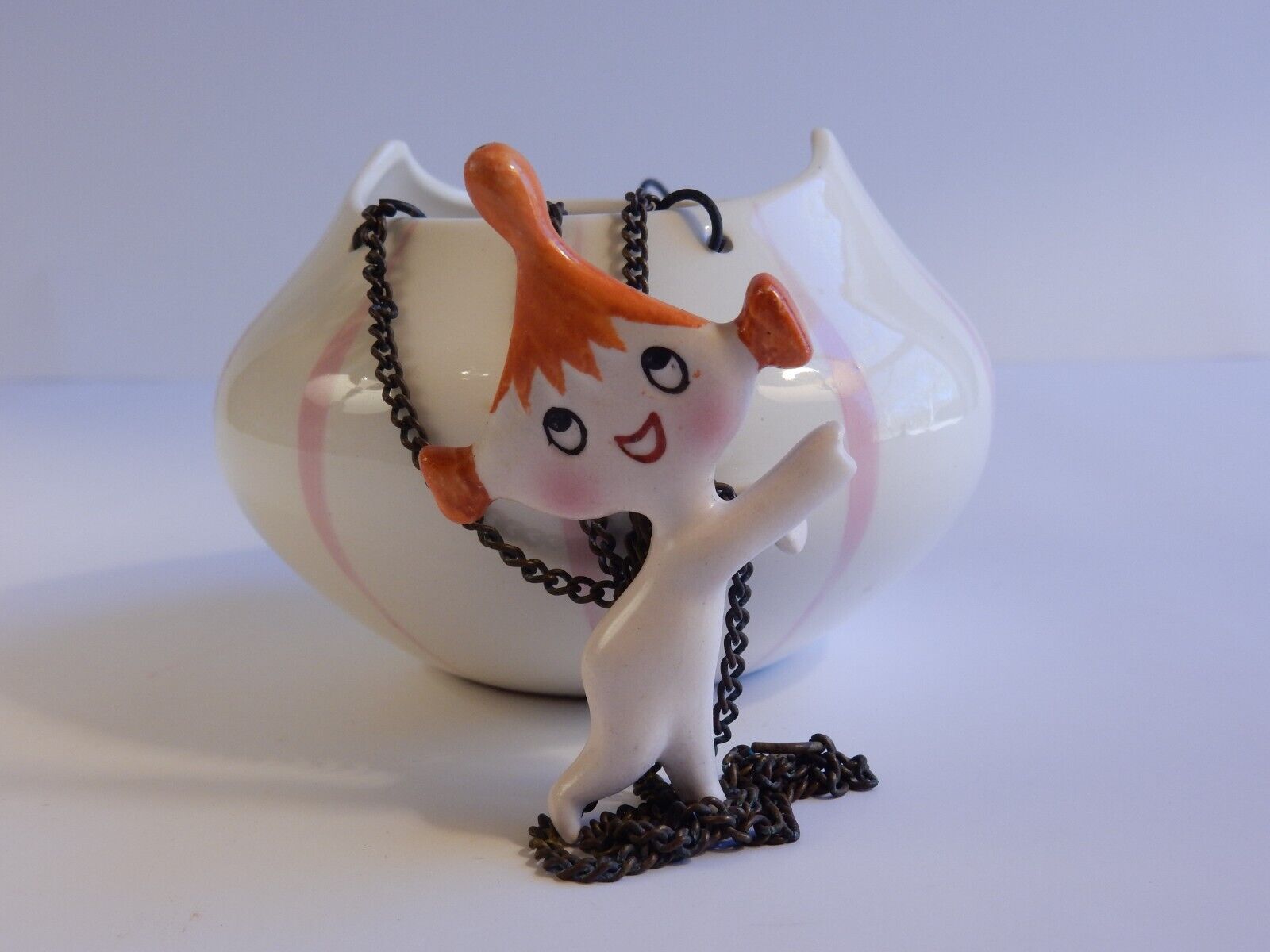
Hanging Pixie Planter

Hanging Planter with Clinging Pixie

The Hanging Pixie Planter is one of the most distinctive and unusual creations in the entire Pixieware line. While most Pixieware pieces feature only a pixie head, this design incorporates a rare full-bodied pixie figure climbing the suspension chains above the planter bowl. Measuring approximately 2¾ inches from head to toe, the cheerful pixie serves both decorative and practical purposes. Her primary role is to gather the three brass chains together, but she also functions as an adjustable chain keeper, sliding up and down the chains to accommodate the size of the plant container below.

The planter bowl itself echoes the shape of the condiment jar bases but is considerably larger, featuring ten pink vertical stripes and two upward-sweeping points along the rim. Three brass chains attach to the bowl and pass through the pixie's arms, allowing the figure to secure and adjust the hanging assembly. Sold as a three-piece set including the hanging bracket, the planter measures approximately 12 inches in overall length and carries a 1959 copyright mark. One curious aspect of the design is the relationship between the bowl and its suspension system. The planter features two dramatic upward-sweeping points along the rim, yet requires three evenly spaced chain attachment points in order to hang properly. From a design standpoint, one might have expected three upward-sweeping points, each corresponding to a chain attachment. Whether this reflects an earlier design concept or simply a stylistic choice by Holt Howard's designers is unknown, but the unusual arrangement remains one of the more interesting visual characteristics of the piece.

Among collectors, the Hanging Pixie Planter is widely regarded as one of the most elusive pieces in the Pixieware line. Complete examples with the clinging pixie intact appear only rarely. In contrast, examples consisting solely of the planter bowl and chains surface somewhat more frequently. While no documentation explains why, it is possible that the separately attached pixie was particularly vulnerable to damage over the decades, resulting in many surviving planters losing the feature that makes the piece so distinctive. Today, finding a complete example with its original clinging pixie remains a notable challenge for even advanced Pixieware collectors.

Towel Hooks

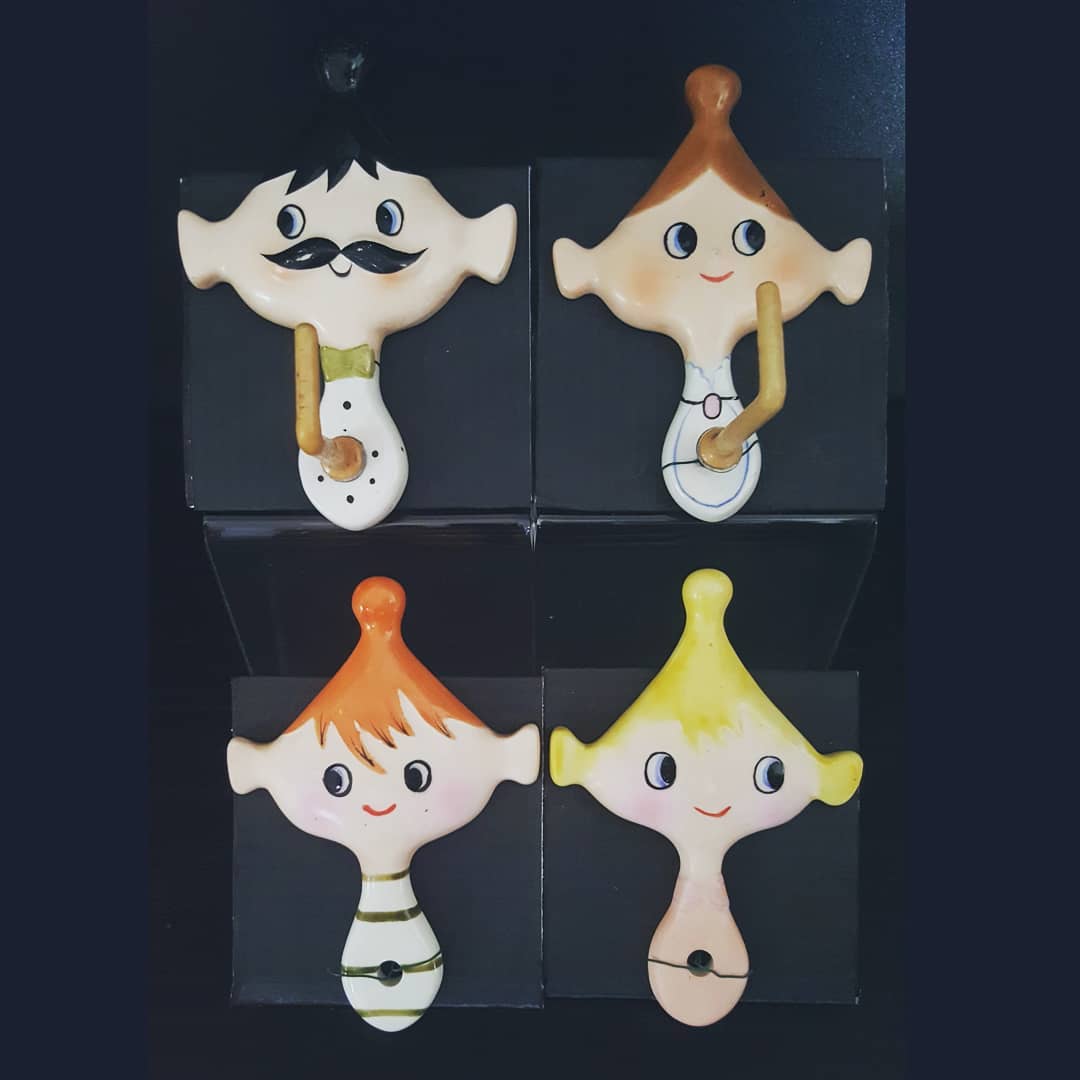
Mom, Dad, Brother, and Sister Towel Hooks

As Holt Howard continued expanding Pixieware beyond serving pieces and tableware, the company introduced four decorative wall-mounted towel hooks designed for kitchens and utility areas. Unlike most Pixieware items, which are fully three-dimensional, these pieces are flat-backed wall hangings designed to support metal hooks for holding dish towels, potholders, aprons, and other household items. Each figure measures approximately 4 inches tall and includes mounting provisions that allow the ceramic piece to be secured firmly to a wall.

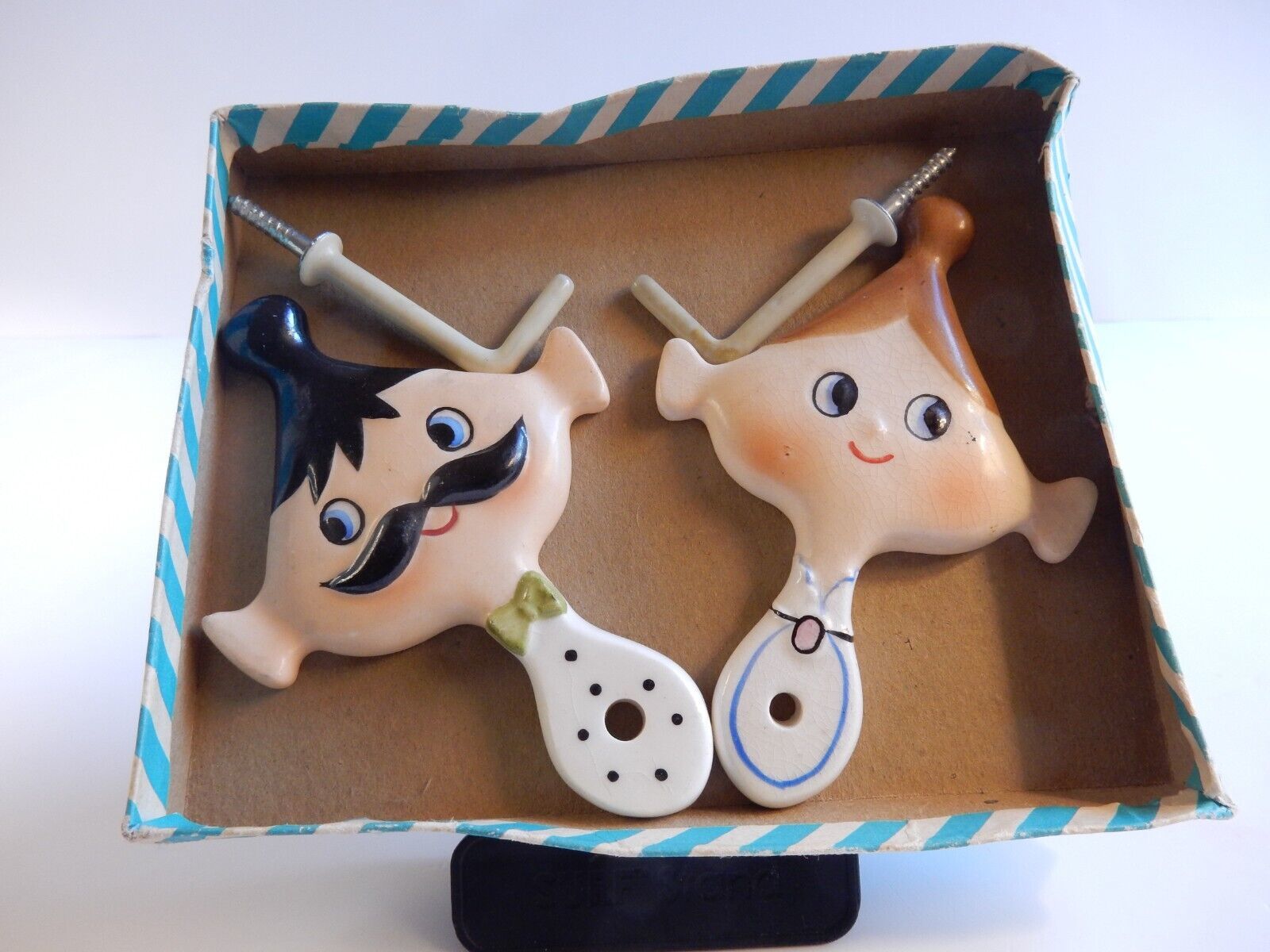
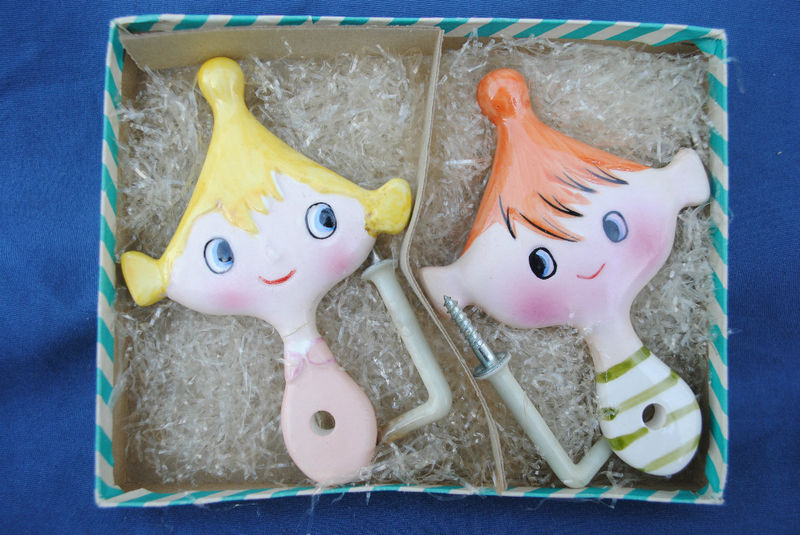
The four hooks were sold as two separate gift-boxed sets: Mother & Dad and Brother & Sister. While all four pieces share the familiar Pixieware styling, each pair was designed to interact visually with its companion piece, creating a playful family-themed display. Introduced in 1959, the towel hooks represent another example of Holt Howard applying the Pixieware concept to practical household accessories beyond the dining table.

As with many wall-mounted accessories of the period, the original rubber-coated metal hooks are frequently missing from surviving examples. Collectors often encounter the ceramic figures without their accompanying hooks, making complete sets somewhat less common than the figures alone.

Mother & Dad Towel Hooks

The Mother & Dad Towel Hooks were sold as a matching pair and feature some of the most character-driven designs found in the Pixieware line. Mother wears a decorative collar and gazes affectionately toward her companion, while Dad is instantly recognizable by his prominent black mustache, spotted shirt, and bow tie. Positioned together, the pair appear to smile toward one another, reinforcing the family theme that inspired the set.

Like all four towel hooks, the Mother & Dad pieces are approximately 4 inches tall and were designed to support a removable metal hook mounted through the base of each figure. Sold as a gift-boxed set and carrying 1959 copyright markings, they remain among the most whimsical wall-mounted accessories produced during Holt Howard's ambitious 1959 Pixieware expansion.

Brother & Sister Towel Hooks

The Brother & Sister Towel Hooks serve as the youthful companions to the Mother & Dad set. Both figures feature simpler, more playful designs and were intended to be displayed together as a coordinated pair. Like the adult versions, the two characters appear to look toward one another, creating a sense of interaction that brings additional personality to the design.

The Brother displays orange hair and matching stripes, while the Sister features yellow hair and a softer decorative treatment. Each stands approximately 4 inches tall and was sold with a metal wall hook designed for hanging towels, potholders, and other household items. Sold as a separate gift-boxed set and carrying 1959 copyright markings, the Brother & Sister hooks complete Holt Howard's family-themed interpretation of Pixieware wall accessories.

Packaging & Presentation

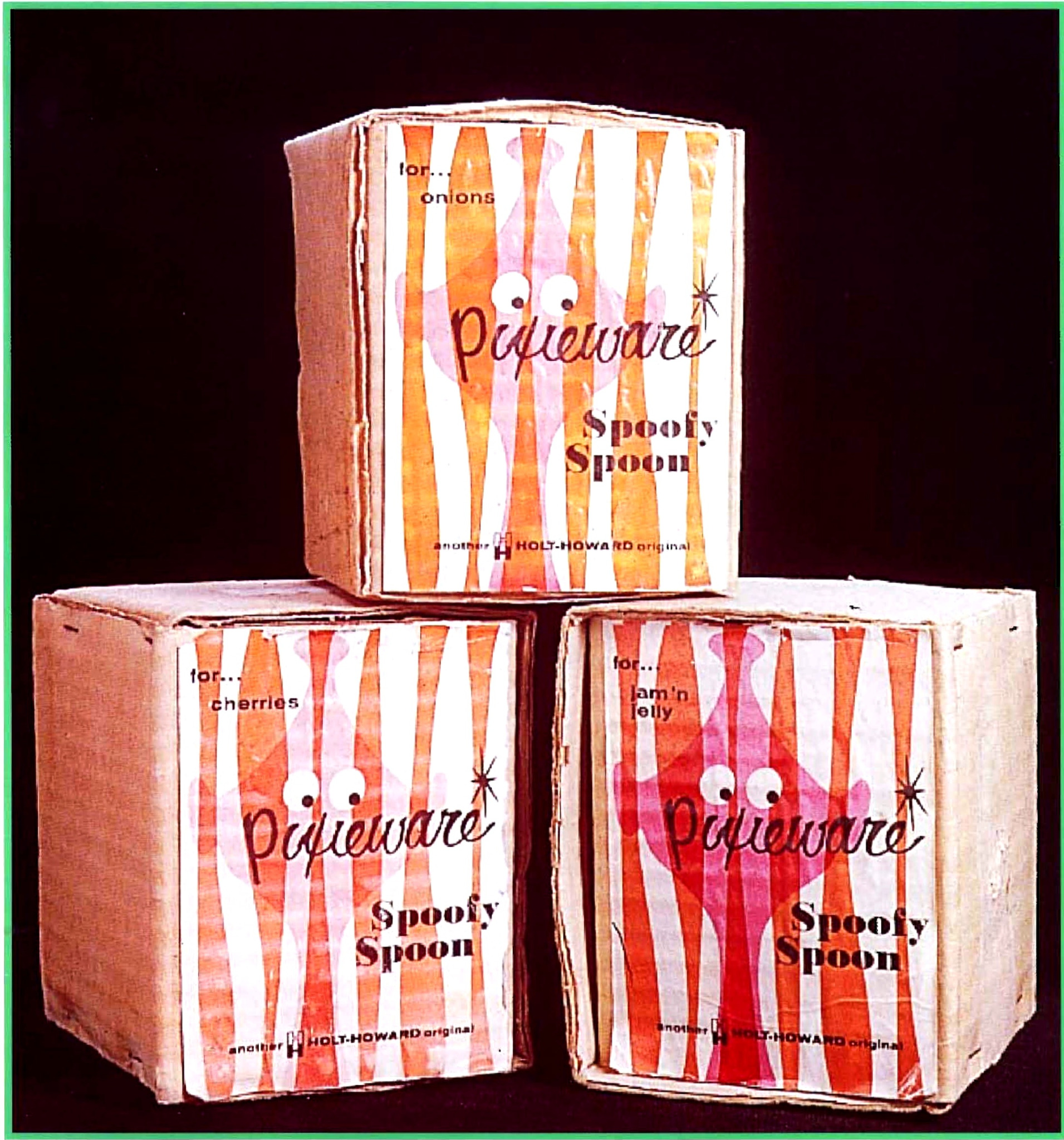
Original Pixieware boxes
Original Pixieware condiment jar boxes.

Part of the appeal of Pixieware extended beyond the ceramics themselves. Holt Howard devoted considerable attention to packaging, creating colorful boxes that reinforced the whimsical personality of the line while helping the products stand out on store shelves. Rather than relying on plain cartons, many Pixieware items were packaged in boldly designed boxes featuring stylized pixie graphics, bright colors, playful typography, and imaginative product names.

One of the most recognizable examples is the "Spoofy Spoon" packaging used for several of the original condiment jars. The boxes featured a simplified pixie face with oversized eyes set against a striped background, creating a design that was instantly identifiable as Pixieware even before the package was opened. Similar graphics and color schemes appeared throughout the line, helping establish a consistent visual identity across multiple products and years of production.

Today, original packaging is considerably scarcer than the ceramics it once contained. Many boxes were discarded shortly after purchase, making surviving examples valuable historical artifacts in their own right. Beyond their collectibility, these packages provide important evidence for product names, marketing terminology, and the way Holt Howard originally presented Pixieware to consumers during the late 1950s and early 1960s.

Closing the 1959 Chapter

Party Pixies trio
The three Party Pixies together: the American boy and girl hors d'oeuvre servers with the orange Australian variant.
All ten 1959 Snack Pixies and Sundae Servers
The complete group of 1959 Snack Pixies and Sundae Servers.

By the end of 1959, Pixieware had grown from a successful line of condiment jars into a sprawling family of whimsical household giftware. Holt-Howard's "Cousins by the Dozens" expansion introduced lamps, planters, towel hooks, serving pieces, dressing cruets, ashtrays, and a host of other imaginative products that transformed Pixieware from a successful novelty line into a complete family of household giftware.

The next chapter would take the Pixies far beyond American shores. Crossing the pond to Great Britain, the Pixie invasion was already underway. Although it would be another three years before Beatlemania swept across America, Pixieware had already begun making its way to British shores with just as much excitement. There, familiar faces would take on new forms, new names, and entirely new identities.

The story of British Pixieware and the John Buck Company begins in the next section.