British Pixieware
The John Buck Company branch of the Pixieware story.
John Buck & British Pixieware
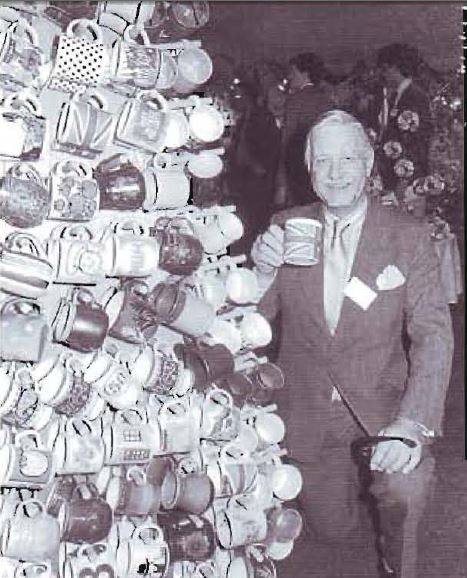
By 1960, Holt Howard's whimsical Pixieware line had become one of the company's most successful and recognizable product families. To serve the British market, Holt Howard held a 45% ownership interest in John E. Buck & Co. Ltd. (later known simply as the John Buck Company), where a select group of Pixieware designs was reimagined specifically for British consumers. While unmistakably inspired by their American counterparts, these pieces were adapted to reflect British tastes, customs, and manufacturing practices, resulting in one of the most fascinating and least understood groups of pieces in the entire Pixieware line.
Although the British line borrowed heavily from existing American designs, it was far more than a simple copy. Familiar forms were renamed, redesigned, and manufactured locally in England and Portugal rather than Japan. At the time, Britain maintained strict import quotas and licensing restrictions on Japanese ceramics in an effort to protect its domestic pottery industry, making local production a practical necessity. New pieces, including the Marmalade jar and a distinctive British salt and pepper set, were developed specifically for the British market, while other American forms were omitted altogether. Even seemingly small details, such as the elimination of the attached "Spoofy Spoon" in favor of a lid notch designed to accommodate a household teaspoon, reflected practical manufacturing decisions and differences in British dining customs.
Unlike the American Pixieware line, comparatively little documentation survives regarding these British pieces. Much of what is presented in this section has been assembled through surviving examples, period catalogs, interviews with John Howard and John Buck, auction records, and decades of observations shared by collectors. As additional examples continue to surface, our understanding of British Pixieware will undoubtedly continue to evolve.
Research Note
Britain's postwar restrictions on Japanese ceramic imports remained in place throughout most of the period when British Pixieware was produced. These policies, designed to protect the country's traditional pottery industry centered around Staffordshire (Stoke-on-Trent), help explain why Holt Howard chose to manufacture British Pixieware through John E. Buck & Co. in England and Portugal rather than importing the Japanese-made American line. Following the end of the Allied occupation of Japan in 1952, trade with Japan remained tightly controlled through import licensing and quota systems administered by the British Board of Trade. These restrictions were gradually relaxed during the late 1960s, eventually allowing Japanese ceramic imports to expand significantly into the British market.
Identifying British Pixieware
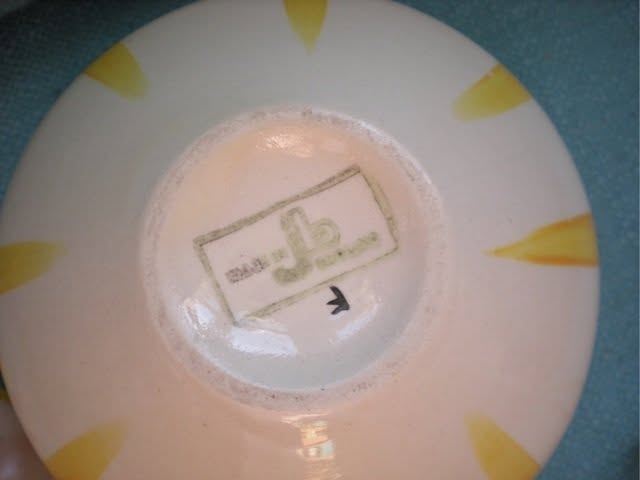
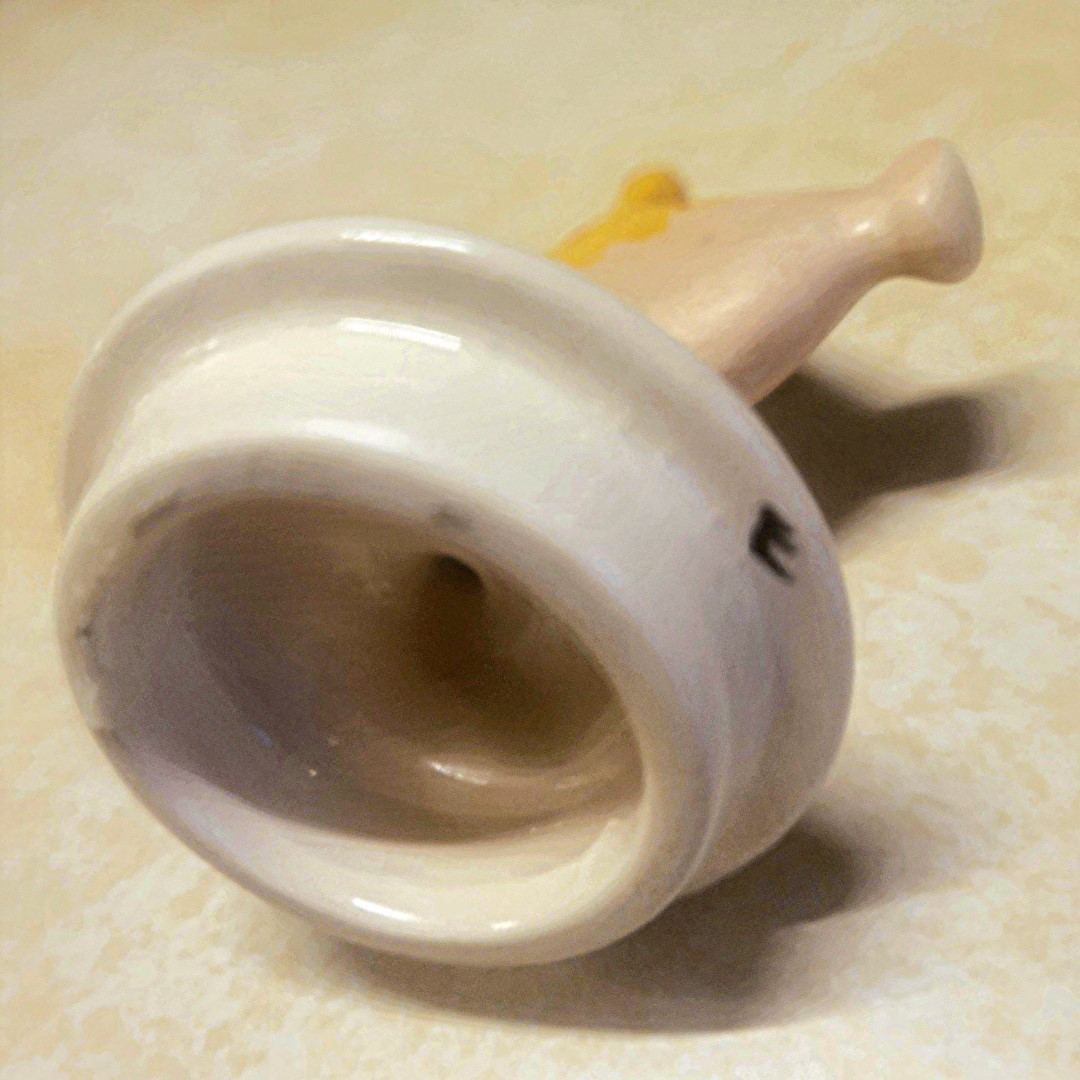
Backstamps & Factory Marks
At first glance, British Pixieware closely resembles its American counterpart. A closer examination, however, reveals several distinctive characteristics that make the British line immediately recognizable. Among the most useful are the manufacturer's backstamp and a small factory mark in the form of a stylized lightning-bolt "F."
British Pixieware bears a backstamp identifying John E. Buck & Co. Ltd., reflecting the company's role in manufacturing these pieces for the British market. In every documented example examined during the preparation of this archive, the backstamp is accompanied by the distinctive lightning-bolt "F" factory mark. While the meaning of this symbol remains unknown, it appears consistently across multiple forms within the British line, making it one of the most useful identifying characteristics observed to date.
Interestingly, the lightning-bolt "F" is not limited to the bases of the pieces. The same mark also appears on the underside of many Pixieware lids, where no manufacturer backstamp is present, demonstrating that it was applied as a separate factory mark rather than as part of the printed backstamp itself. Although its purpose remains a mystery, collectors should look for this distinctive symbol when examining suspected British Pixieware examples.
British Condiment Jars
British Jam
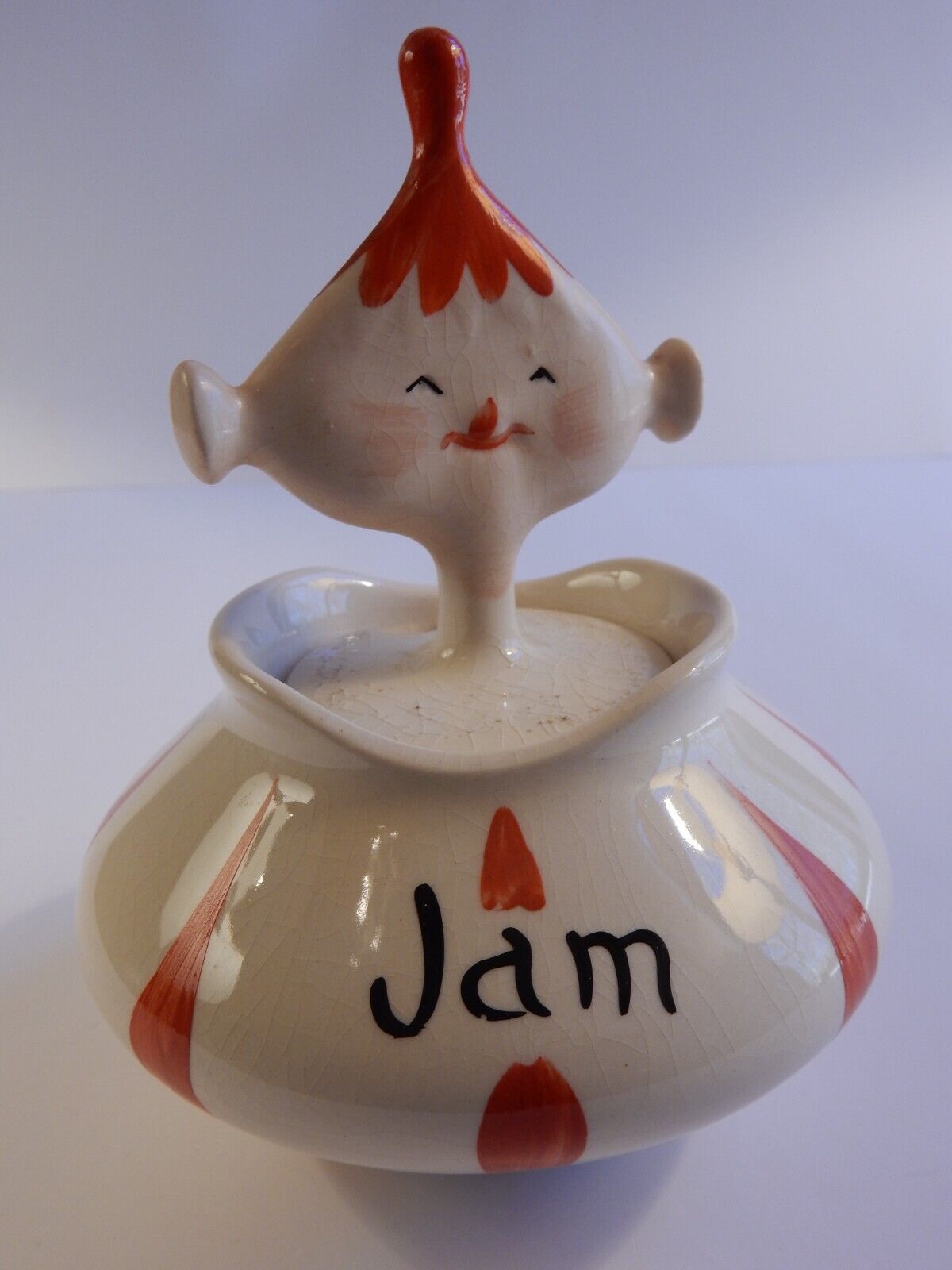
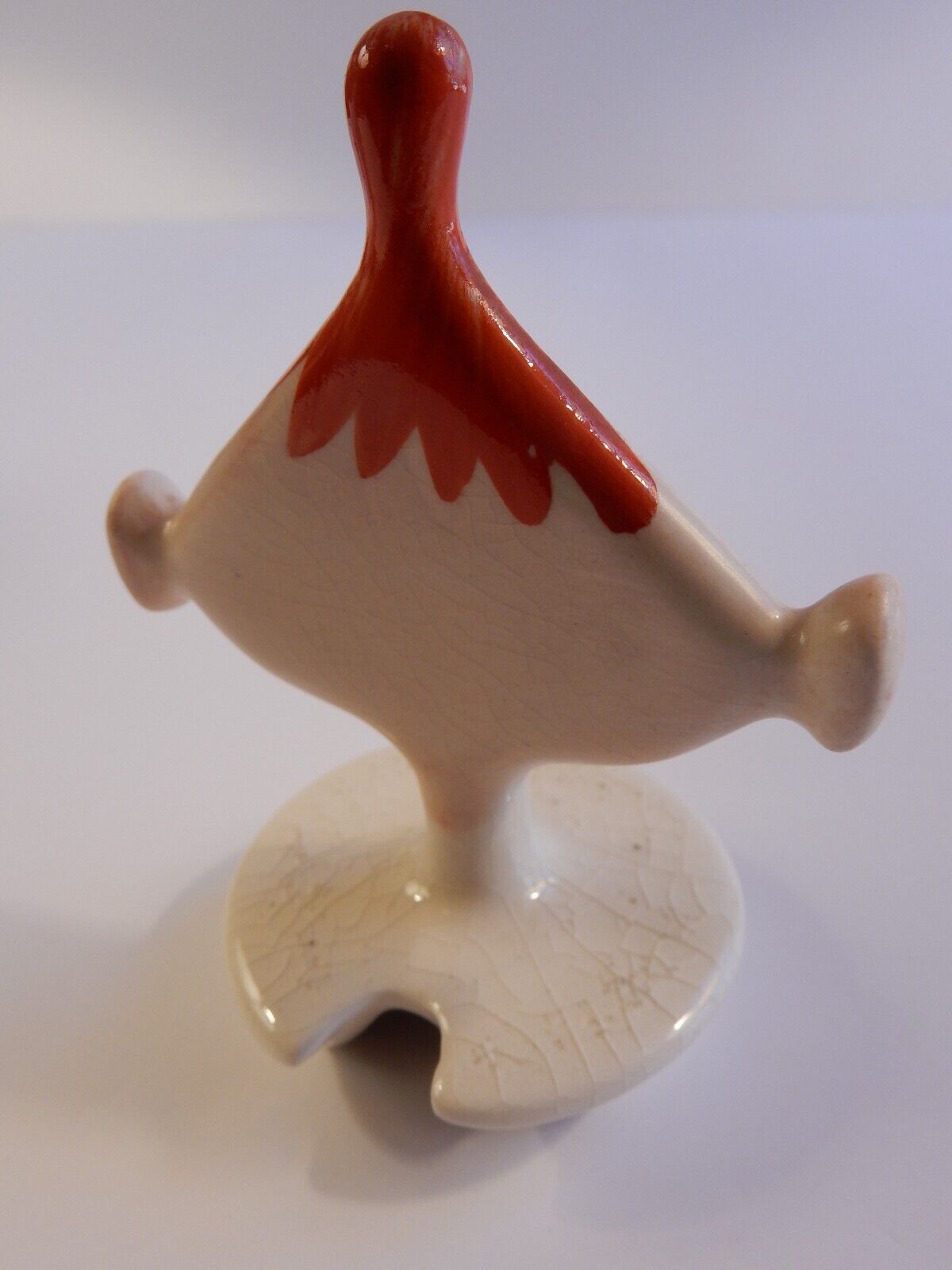
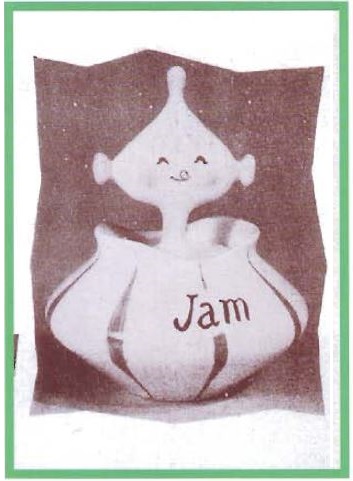
The British Jam jar is the direct British counterpart to the American Jam 'n Jelly jar, retaining the familiar pixie head and overall form while incorporating several distinctly British design changes. The production example features red hair and red body stripes in place of the American pink, while the cheeks are hand brush-stroked rather than softly airbrushed. Although unmistakably part of the same Pixieware family, these subtle differences, along with its slightly larger and heavier construction, give the British jar a character all its own.
One of the most significant departures from the American design is found beneath the lid. Rather than incorporating Holt Howard's trademark attached "Spoofy Spoon," the British Jam jar uses a molded notch designed to accommodate a standard household teaspoon. According to John Buck, this decision simplified production while reducing the likelihood of breakage. The result was a practical solution that also reflected the design of many contemporary British sugar bowls.
The prototype illustrated here reveals that the earliest concept closely followed the American Jam 'n Jelly jar, complete with the familiar American pixie head. By the time production began, however, the design had evolved into the distinctive British version shown above. Changes such as these provide a fascinating glimpse into the development of British Pixieware and demonstrate that the line was thoughtfully adapted rather than simply copied from its American counterpart.
British Marmalade
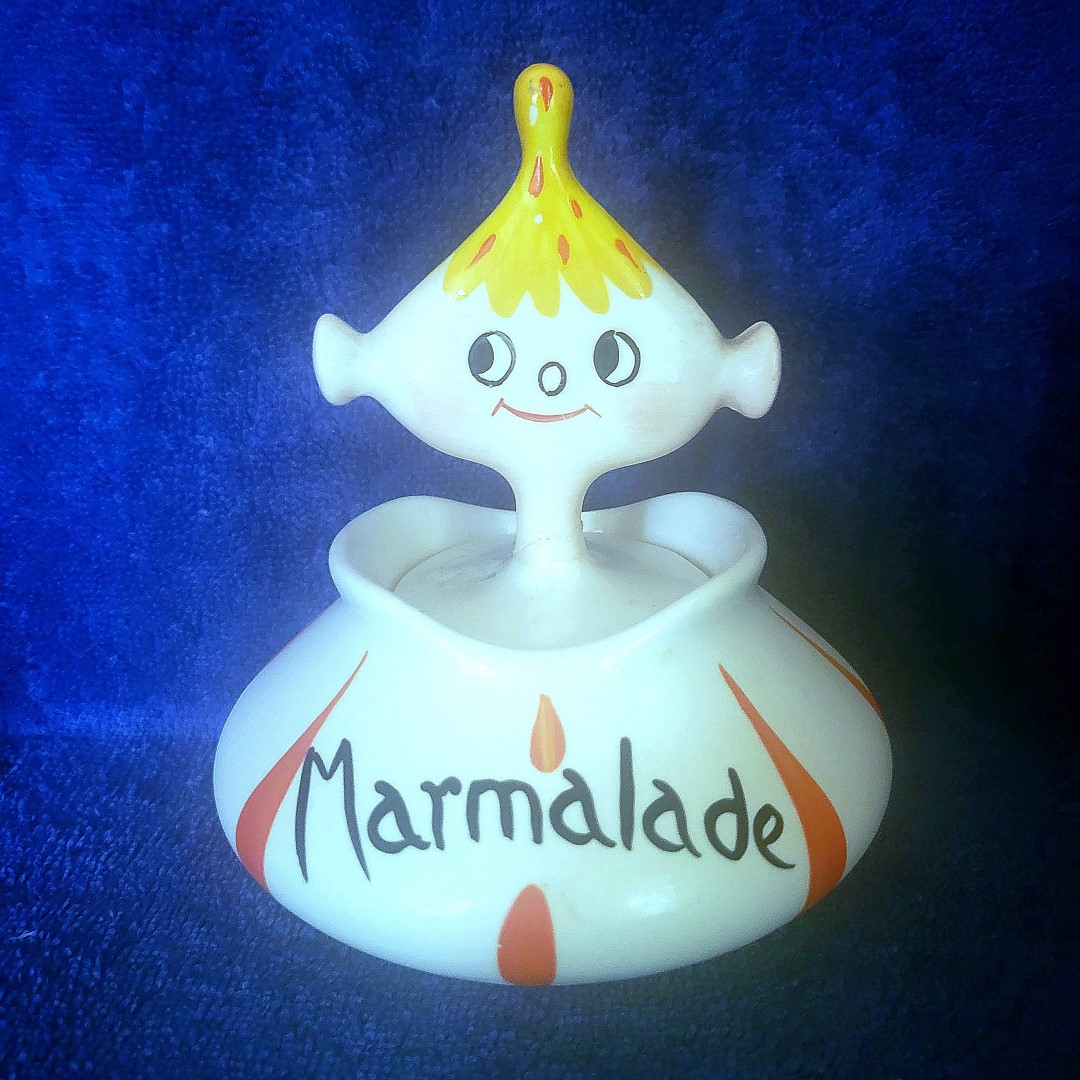
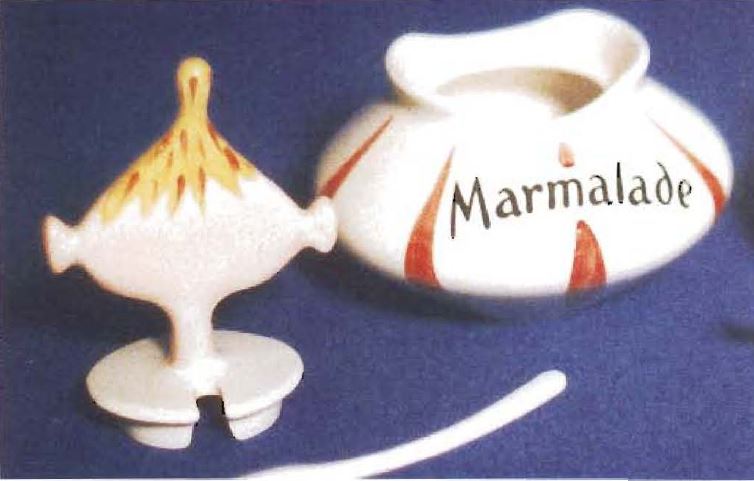
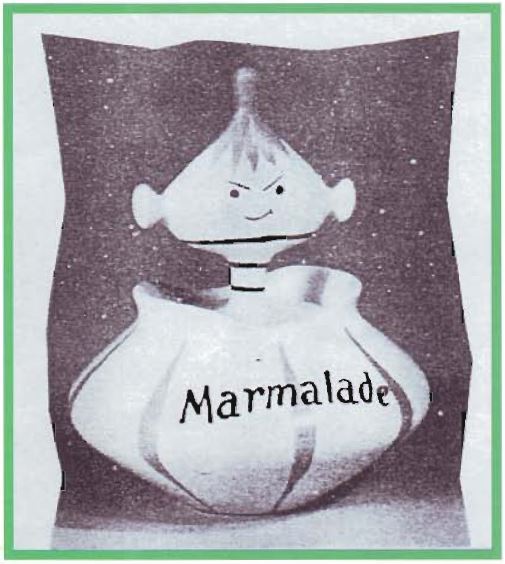
The Marmalade jar is one of the most distinctive creations in the British Pixieware line and was developed specifically for the British market. While clearly inspired by the American Mustard jar, the production version received an entirely new pixie head design, resulting in a piece that is immediately recognizable as British Pixieware while still maintaining a clear connection to its American origins. The production example illustrated here is from the author's personal collection.
The prototype illustrated here demonstrates that the earliest concept simply adapted the American Mustard head for use on a Marmalade jar. Before production began, however, the design was revised to feature the distinctive production head seen on surviving examples today. The Marmalade jar also reflects the practical design changes introduced by John Buck, including the elimination of the attached "Spoofy Spoon" in favor of a separate household teaspoon.
Interestingly, not all documented Marmalade jars appear to have been produced with the same lid. The example illustrated from Walter Dworkin's second edition guide features a molded spoon notch, while the production example shown here does not. At present, the reason for this difference remains unknown, and no evidence has surfaced to indicate whether one version preceded the other or if both were produced concurrently. Like many aspects of British Pixieware, this remains an open question that may be answered as additional examples continue to surface.
British Honey
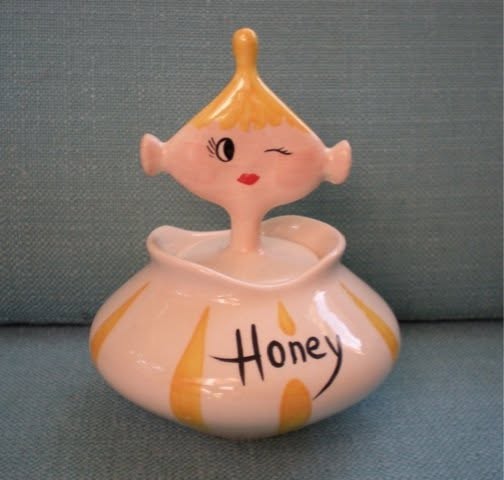
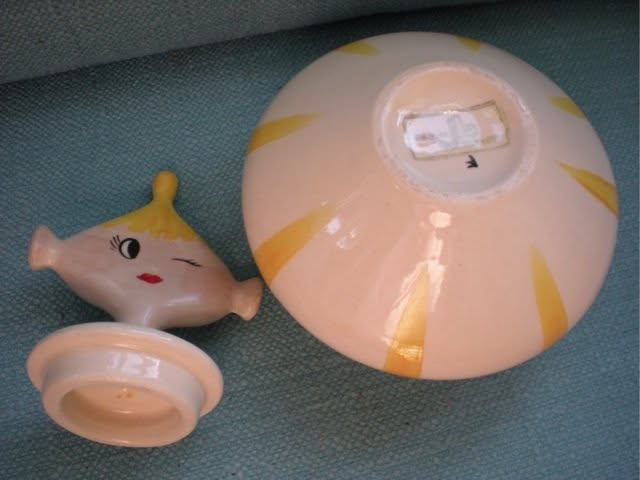
The British Honey jar continues the familiar Pixieware tradition while introducing several refinements unique to the John Buck Company. Although clearly derived from the American Honey jar, the British version features a heavier body, distinctive hand-painted decoration, and the characteristic British Pixieware styling found throughout the line. Like the other British condiment jars, it was manufactured in England specifically for the British market rather than imported from Japan.
Unlike its American counterpart, the British Honey jar was designed without Holt Howard's attached "Spoofy Spoon." Instead, it was intended for use with a separate honey spoon or household teaspoon, reflecting the practical manufacturing decisions adopted throughout the British Pixieware line. This simplified construction also eliminated one of the features most susceptible to damage on American examples.
While less frequently encountered than many American Pixieware pieces, the British Honey jar remains an excellent example of how John Buck adapted successful Holt Howard designs for a different market. Its distinctive appearance, heavier construction, and unique British manufacturing details make it one of the most recognizable and desirable pieces in the British Pixieware line.
British Cruets
The British cruets represent one of John Buck's most thoughtful adaptations of Holt Howard's American Pixieware line. Rather than creating entirely new designs, John Buck repurposed the American Russian Dressing, French Dressing, and Italian Dressing cruets for British kitchens and dining tables. The familiar Pixie heads were retained, but the bottles were relabeled simply Oil, Vinegar, and Dressing, reflecting more common British household usage.
Each British cruet shares several distinctive characteristics. The bottles are of heavier construction than their American counterparts and feature seven hand-painted vertical stripes. The Oil and Vinegar cruets are decorated with red stripes, while the Dressing cruet uses green stripes. In addition, the British Pixie toppers are noticeably larger than their American equivalents, giving the bottles a slightly more substantial appearance while remaining immediately recognizable as descendants of Holt Howard's original designs.
British Oil
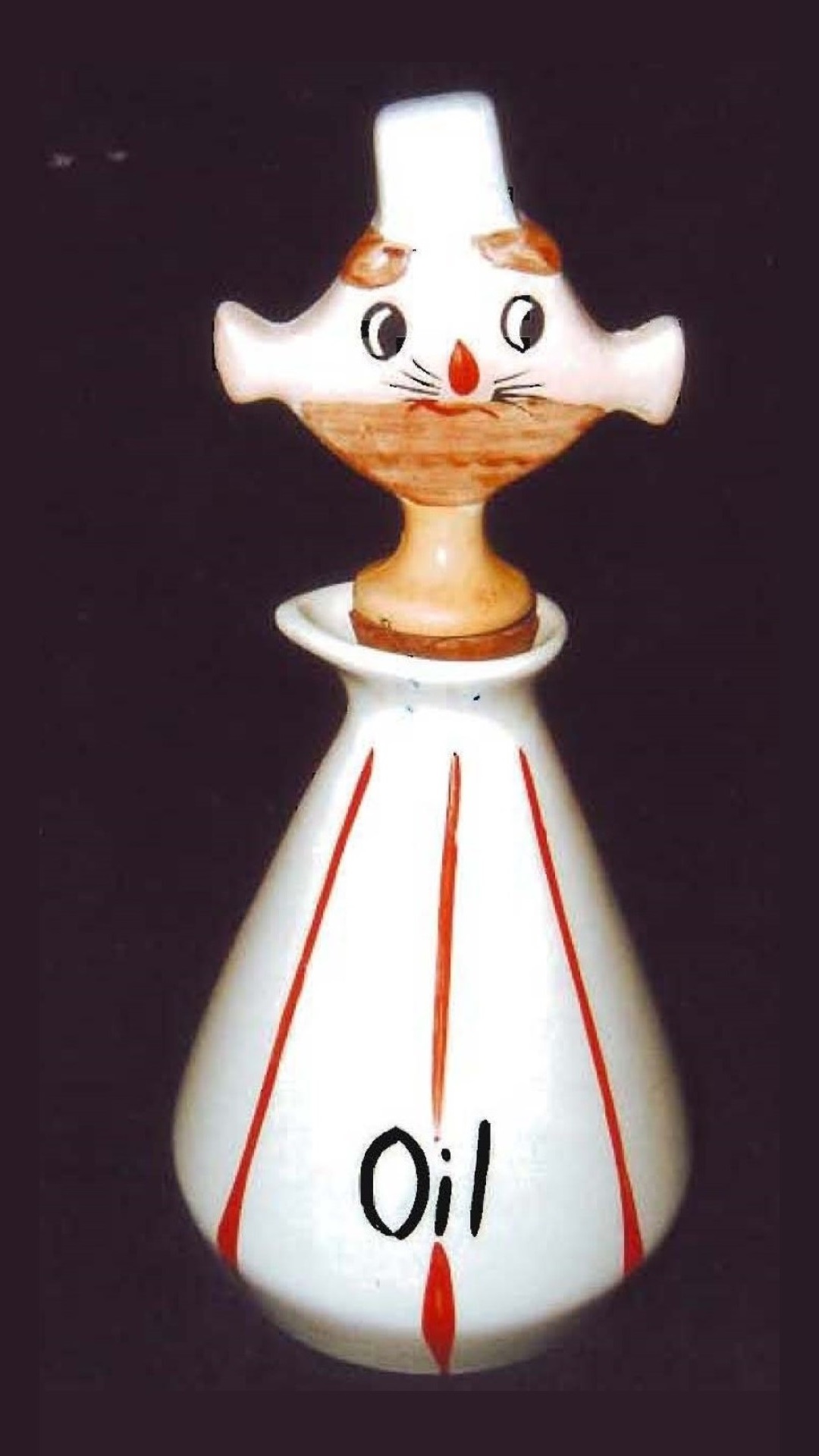
Adapted from the American Russian Dressing cruet, the British Oil bottle retains the same Pixie head while replacing the original label with the simpler British designation "Oil." The result is a practical kitchen cruet that clearly reflects its American origins while establishing its own distinctly British identity.
British Vinegar
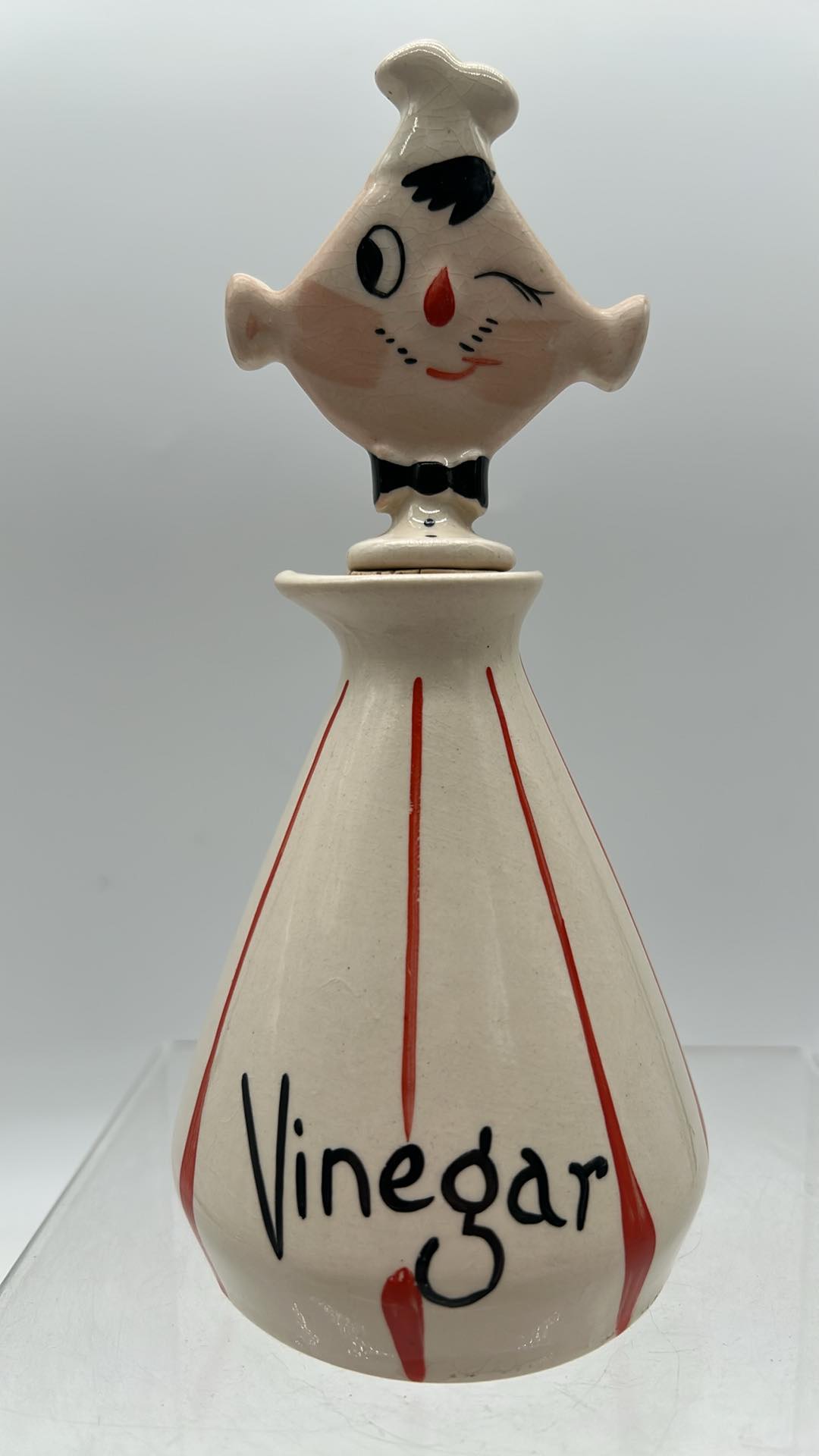
The British Vinegar cruet is adapted from the American French Dressing cruet and retains the familiar chef's head found on its American predecessor. Relabeled "Vinegar," it demonstrates how John Buck successfully transformed an American salad dressing bottle into a cruet better suited to British dining traditions.
British Dressing
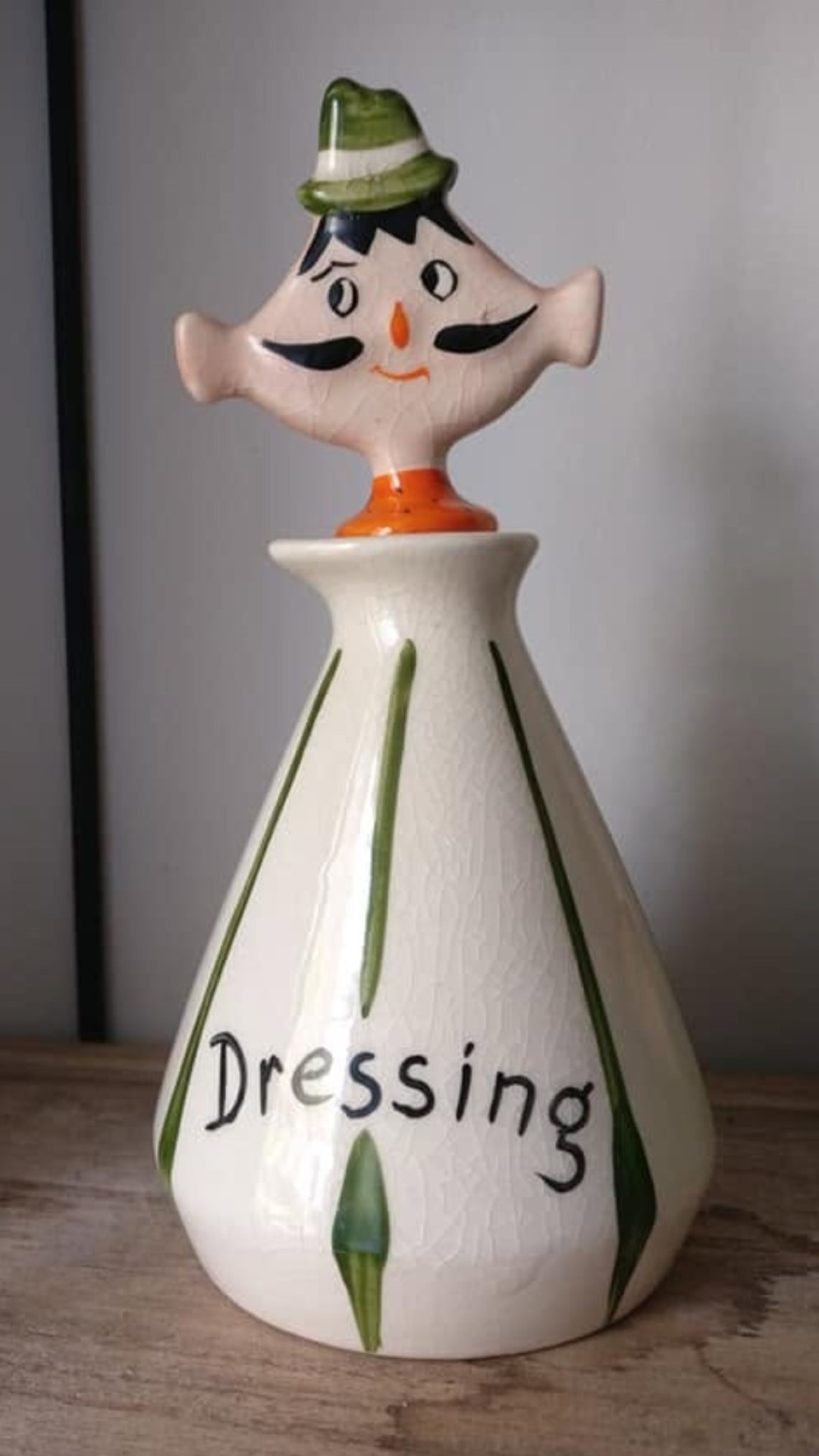
Adapted from the American Italian Dressing cruet, the British Dressing bottle retains the original Italian Pixie character while adopting the broader British designation "Dressing." A side-by-side comparison reveals that the British bottle is slightly taller and differently proportioned, while its topper is modestly larger than the American version. The British topper also features a differently painted orange neck and a noticeably thinner mustache. Together with the Oil and Vinegar cruets, it completes one of the most distinctive and sought-after groups within the British Pixieware line.
.jpg)
 vs American (Right) italian topper (Large).jpg)
British Salt & Pepper Shakers
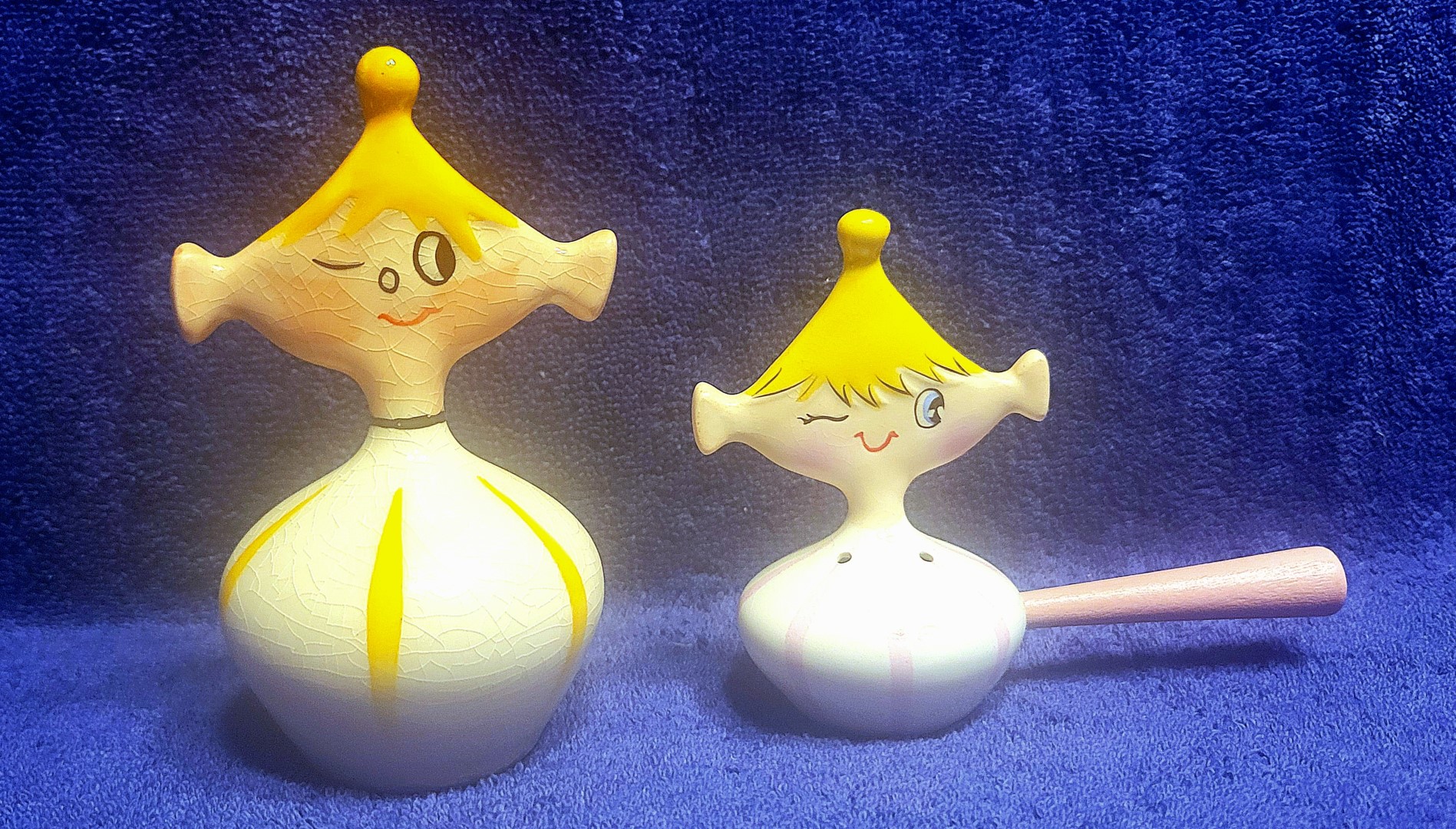
Rather than adapting Holt Howard's compact Salty & Peppy design, John Buck created an entirely different style of shaker for the British market. The British versions feature full-size Pixie heads and body proportions that more closely resemble the British condiment jars than the American salt and pepper shakers. They are also noticeably heavier, made from a denser ceramic body than their American counterparts.
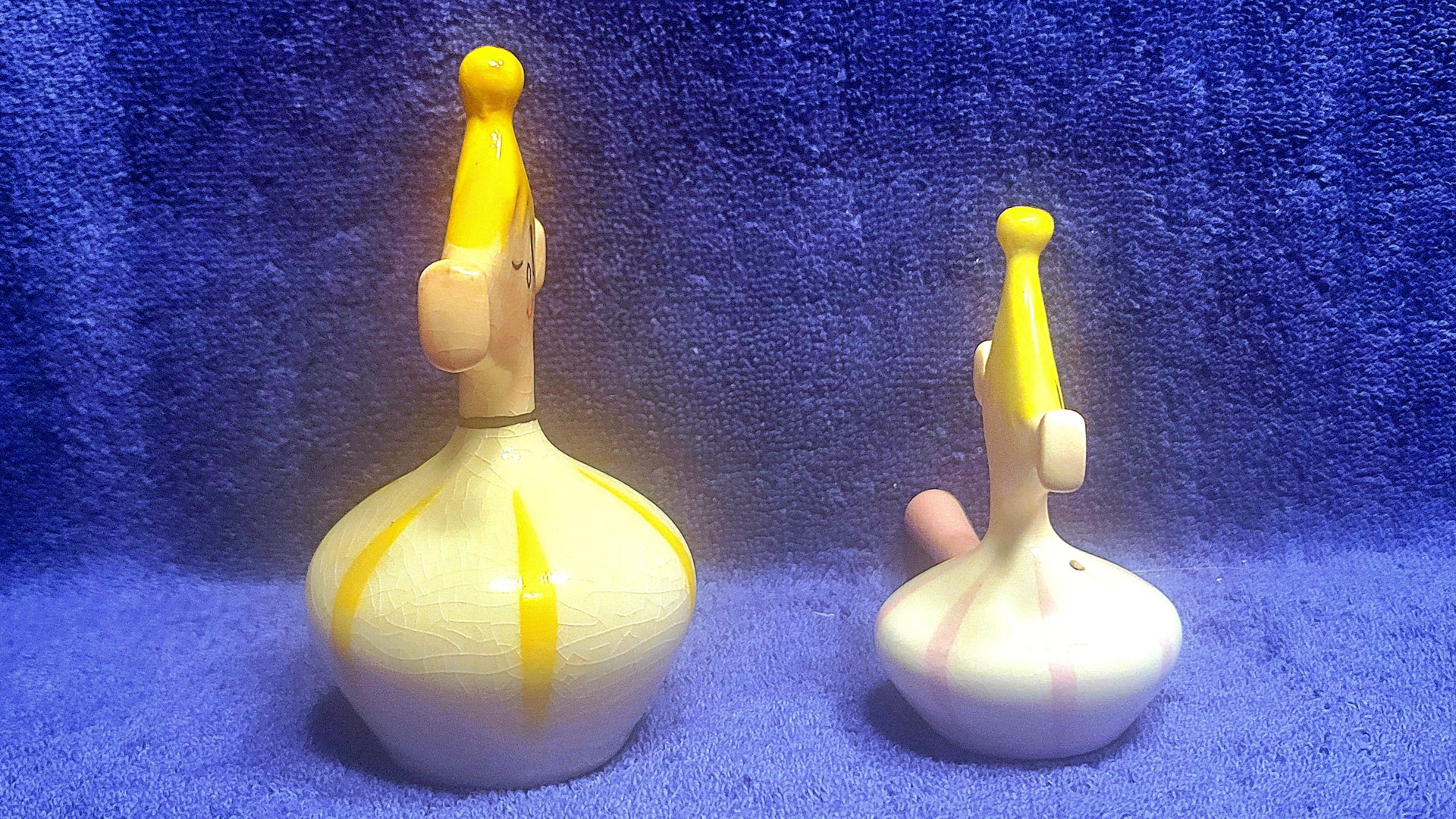
Two British Pixieware shaker sets are presently documented. One features blue and red striping, while the other combines yellow and orange striping. The yellow-and-orange set is further distinguished by a narrow black band around the neck, separating the striped body from the flesh-colored face. The yellow-haired, yellow-striped shaker in the author's collection measures approximately 4¾ inches tall and 2½ inches in diameter and has a single pouring hole on the back.
Whether additional color combinations were produced remains unknown. At present, only these two sets have been documented, and both remain exceptionally scarce compared with standard American Pixieware pieces.
Blue & Red Set
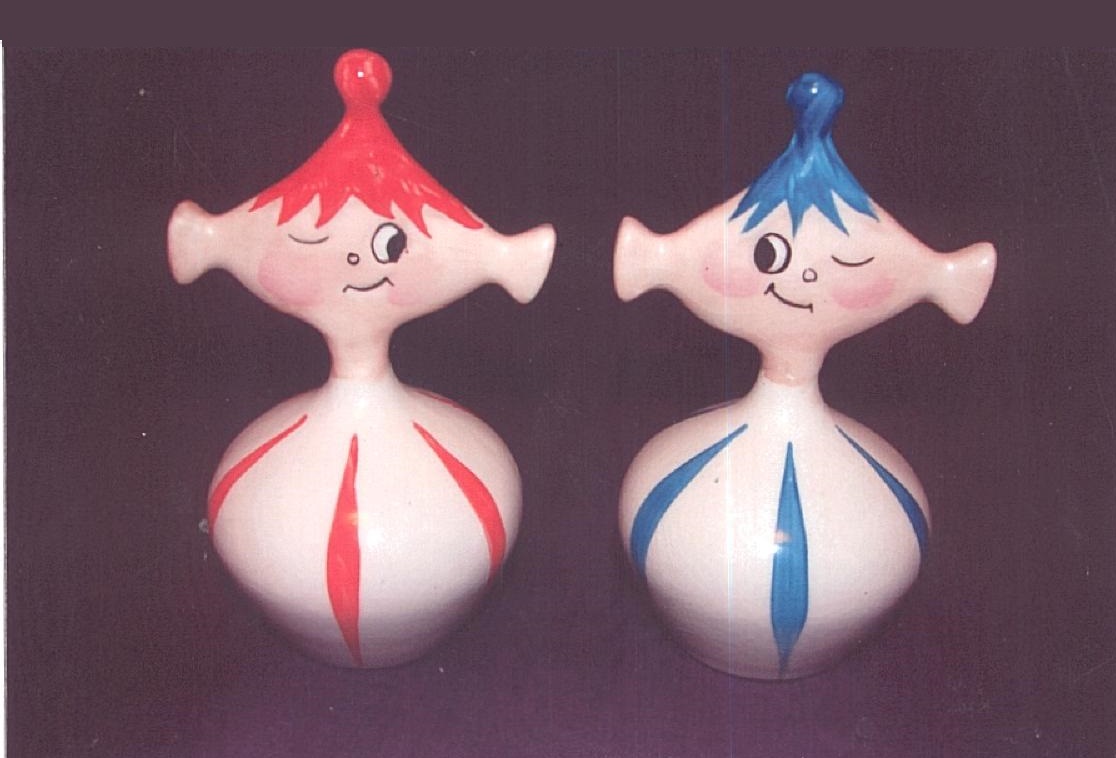
The blue-and-red set represents one of the two documented British Pixieware salt and pepper shaker designs. Its distinctive color combination, full-size Pixie head, and heavier construction immediately identify it as part of the John Buck British Pixieware line.
Yellow & Orange Set
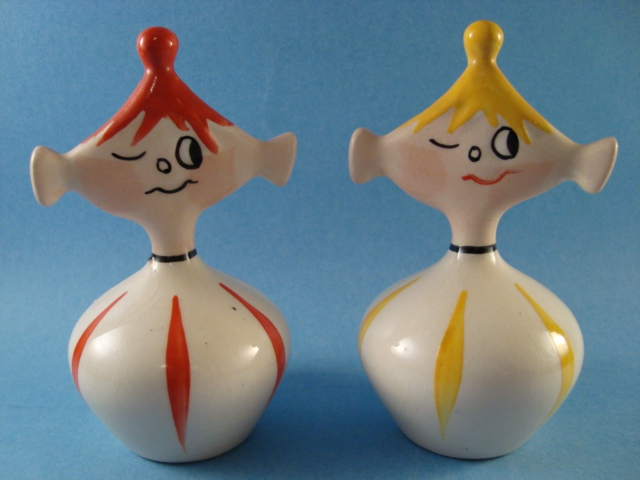
The yellow-and-orange set is distinguished by its warmer color palette and the narrow black band encircling the neck of each shaker, a decorative detail not present on the blue-and-red version. Together, the two documented sets represent one of the rarest and least frequently encountered branches of British Pixieware.
Comparison with American Salty & Peppy
A side-by-side comparison with Holt Howard's American Salty shaker makes the differences immediately apparent. The British shaker is taller, broader, and more substantial, with a larger Pixie head, longer neck, and fuller rounded body. While Salty was designed as a lightweight table shaker with a wooden handle, the British shaker feels closer in spirit to a miniature condiment jar adapted for salt or pepper. The comparison underscores how thoroughly John Buck reimagined the shaker form rather than simply copying Holt Howard's American design.
British Snack Dish
The British Pixieware Snack Dish, sometimes referred to by collectors as the Nut Dish, is one of the most distinctive pieces produced by the John Buck Company. Inspired by Holt Howard's American Peanut Butter Pat snack dish, the British version was redesigned with its own proportions, decoration, and heavier construction while retaining the whimsical personality of the original. Like the rest of the British Pixieware line, it bears the characteristic John Buck backstamp discussed earlier in this section.
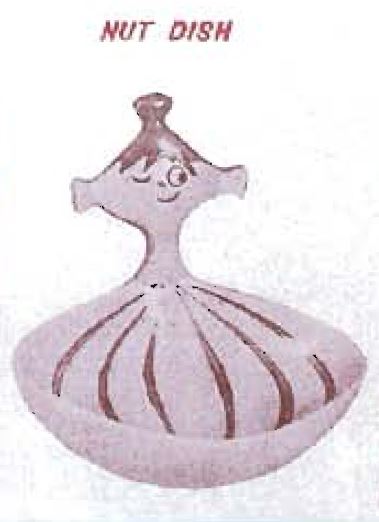
An early black-and-white catalog photograph reproduced in Walter Dworkin's first edition guide reveals that the original concept for the British dish differed from the final production version. While the overall form remained unchanged, the decorative striping was revised before the piece entered production, providing another glimpse into the design evolution that occurred during development of the British Pixieware line.
Two production color variations are presently documented. One features yellow radiating stripes across the bowl, while the other uses green stripes. Although both versions share the same hairstyle, the facial expressions are mirror images of one another, giving the impression that the dishes were intentionally designed to be displayed facing one another—or at opposite ends of a dining table—where the two Pixies appear to be playfully winking at each other across the table.
Yellow-Striped Dish
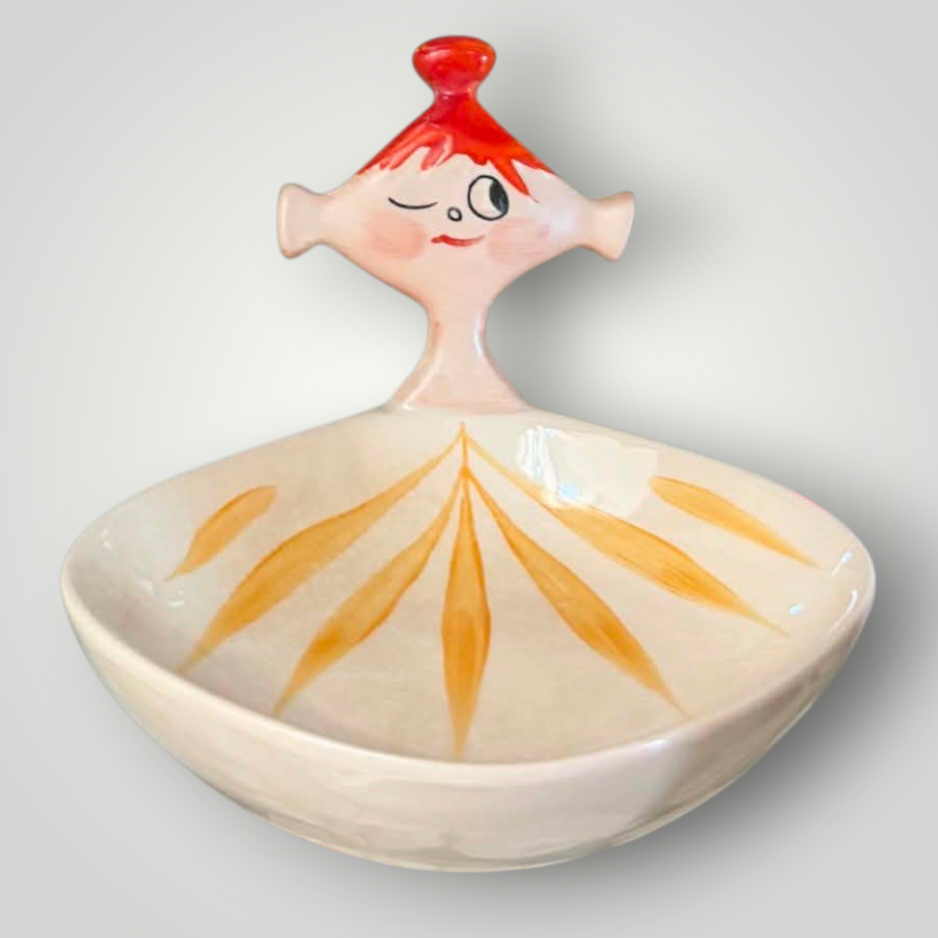
The yellow-striped version is the better documented of the two examples and appears in both surviving catalog photography and collector examples. Its broad radiating stripes create one of the most visually striking designs in the British Pixieware line.
Green-Striped Dish
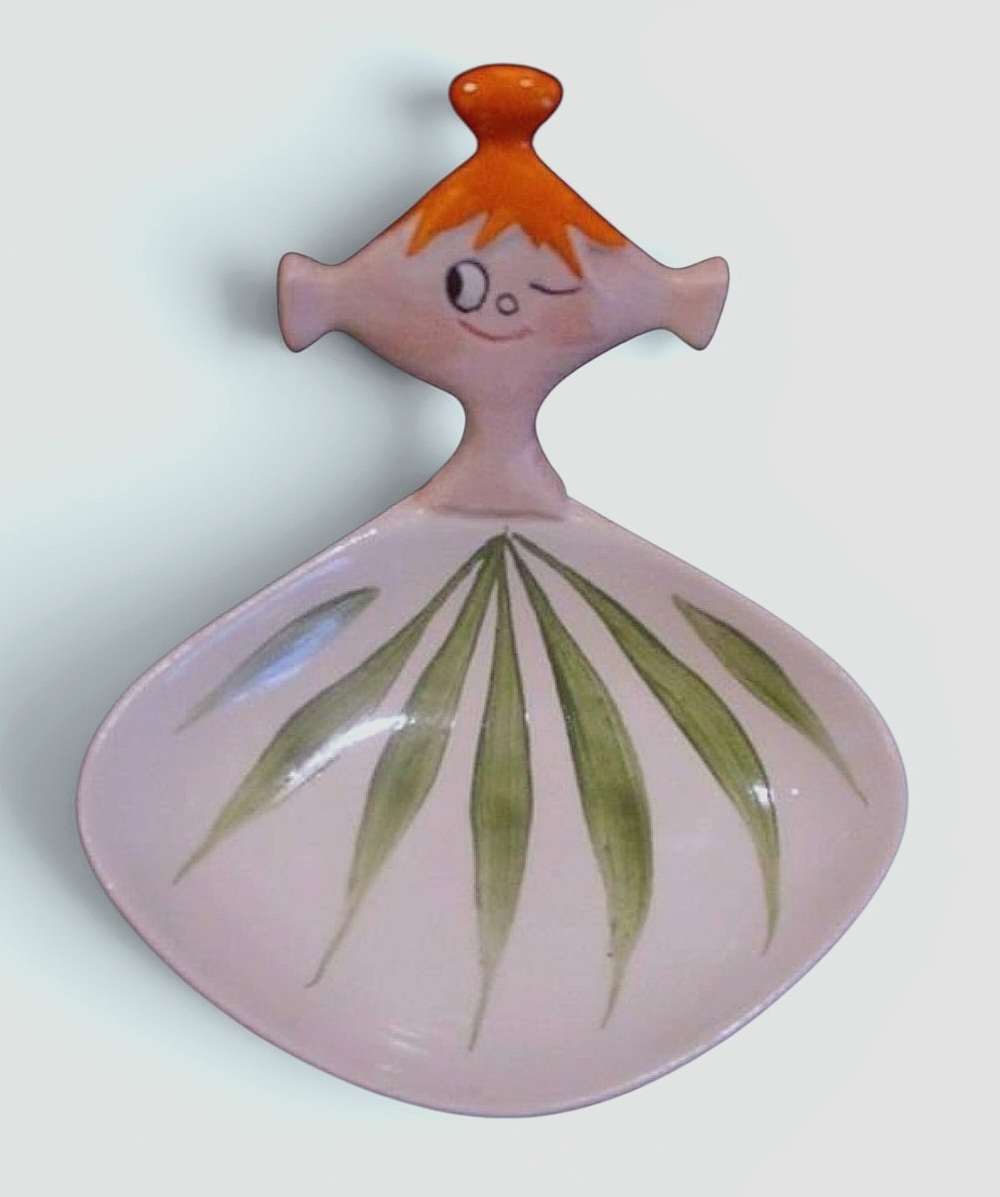
The green-striped version is considerably less frequently encountered but is otherwise identical in form to the yellow-striped example. Together, the two documented color variations demonstrate that John Buck continued experimenting with decorative treatments while preserving the playful character that made the design so memorable.
The Legacy of British Pixieware

Although produced in relatively small numbers, British Pixieware represents a fascinating chapter in the Holt Howard story. It demonstrates how successful American designs were adapted for a different market while retaining the whimsical spirit that made the original line so memorable. Even today, British examples remain among the rarest and least documented branches of the Pixieware family.
Research into British Pixieware continues, and new discoveries may further refine our understanding of its production, distribution, and surviving varieties. As additional examples come to light, this section of the archive will continue to grow alongside the knowledge shared by collectors.
The Pixieware story wasn't over yet—it just paused. More than forty years later, the designs would unexpectedly return through Grant-Holt Associates. Explore them in the next section.