The Davar Pixie Knockoffs
The closest and most persistent imitators of Holt Howard's Pixieware.
Davar and the Pixie Imitation Market
Davar was a New York novelty-products company located at 15 W. 26th Street in Manhattan. The company filed its certificate of incorporation on February 18, 1957, and imported a wide range of Japanese-made condiment jars, liquor decanters, and related giftware before eventually dissolving in 1992.
Davar was one of the few companies to build an entire group of pixie-themed condiment and cruet designs around figures that closely imitated Holt Howard's successful Pixieware line. Although these pieces are properly understood as knockoffs, they have become highly collectible in their own right and now form one of the most interesting side chapters in the broader Pixieware story.
Research & Discoveries: Understanding Davar Variations
Although Davar's product line was much smaller than Holt Howard's Pixieware line, it was produced with two distinct design styles throughout the condiment jars and oil and vinegar cruets. Every known example is either a script-letter version with a floppy ponytail hairstyle or a block-letter version with an upright pointed hairstyle. Collectors often assume these differences represent later production changes, but surviving examples suggest the two styles were produced concurrently.
How to Distinguish Davar from Holt Howard Pixieware
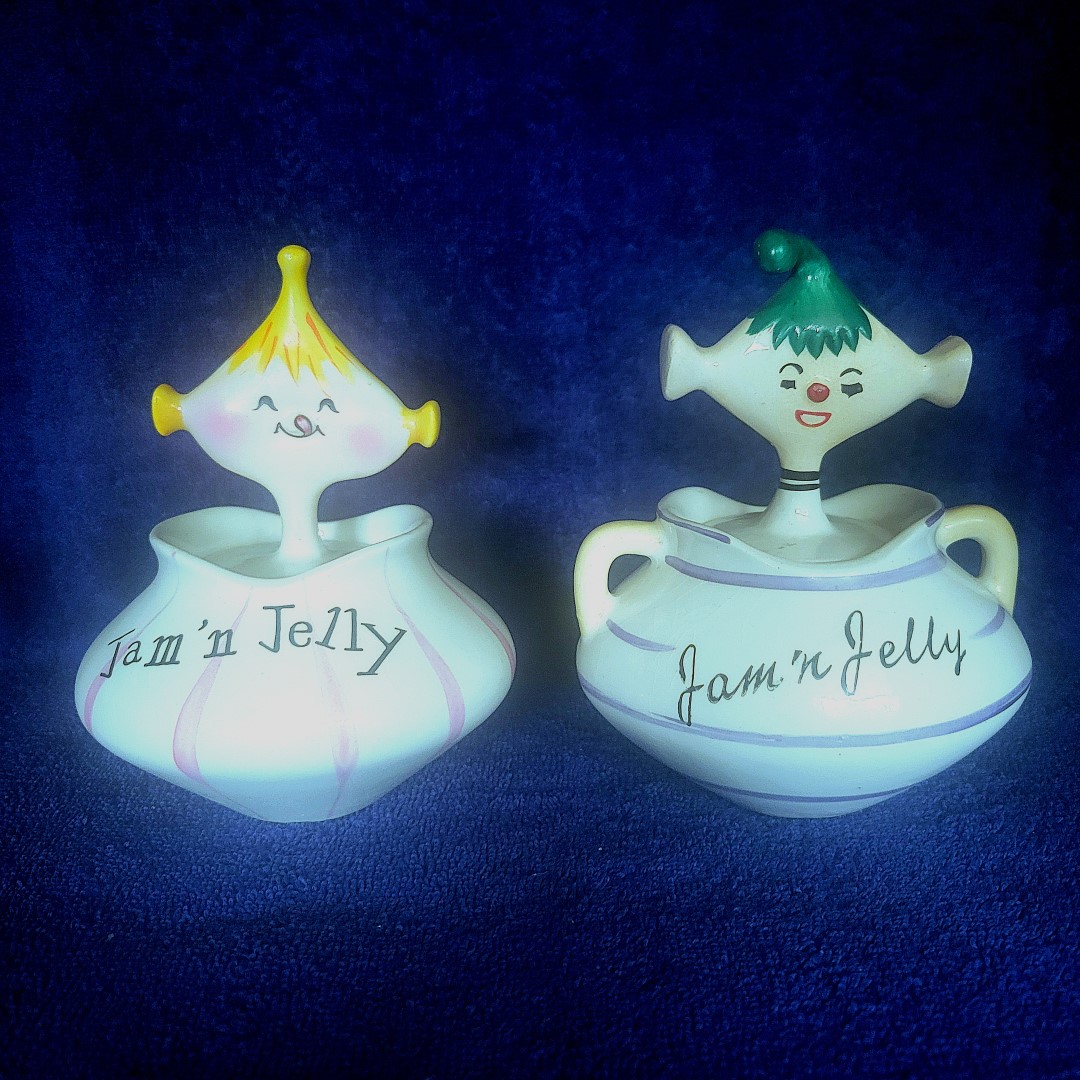
The quickest way to distinguish Davar from Holt Howard is to look at the striping. Holt Howard's standard Pixieware condiment jars use vertical stripes; Davar's condiment jars use horizontal stripes.
- Horizontal stripes. Davar condiment jars have four horizontal stripes, while the oil and vinegar cruets have nine.
- Two design styles. Davar pieces appear in script-letter/floppy-ponytail versions and block-letter/upright-pointed-hair versions.
- Flesh-colored faces and arm handles. Davar pixies have flesh-colored faces, and the condiment jars have molded flesh-colored arms that function as handles.
- Flat heads and red noses. Davar heads are flatter and thicker than Holt Howard Pixieware heads, and all have round red noses.
- Uniform spoons. Davar condiment heads use a simpler spoon form without the more specialized utensil variations found in Holt Howard's cocktail jars.
Davar Condiment Jars
The Davar condiment jars are best understood as a compact, patterned group rather than a large open-ended line. Each jar was produced in both script-letter and block-letter forms, with the hairstyle changing to match the lettering style. The photographs below are arranged to emphasize those pairings.
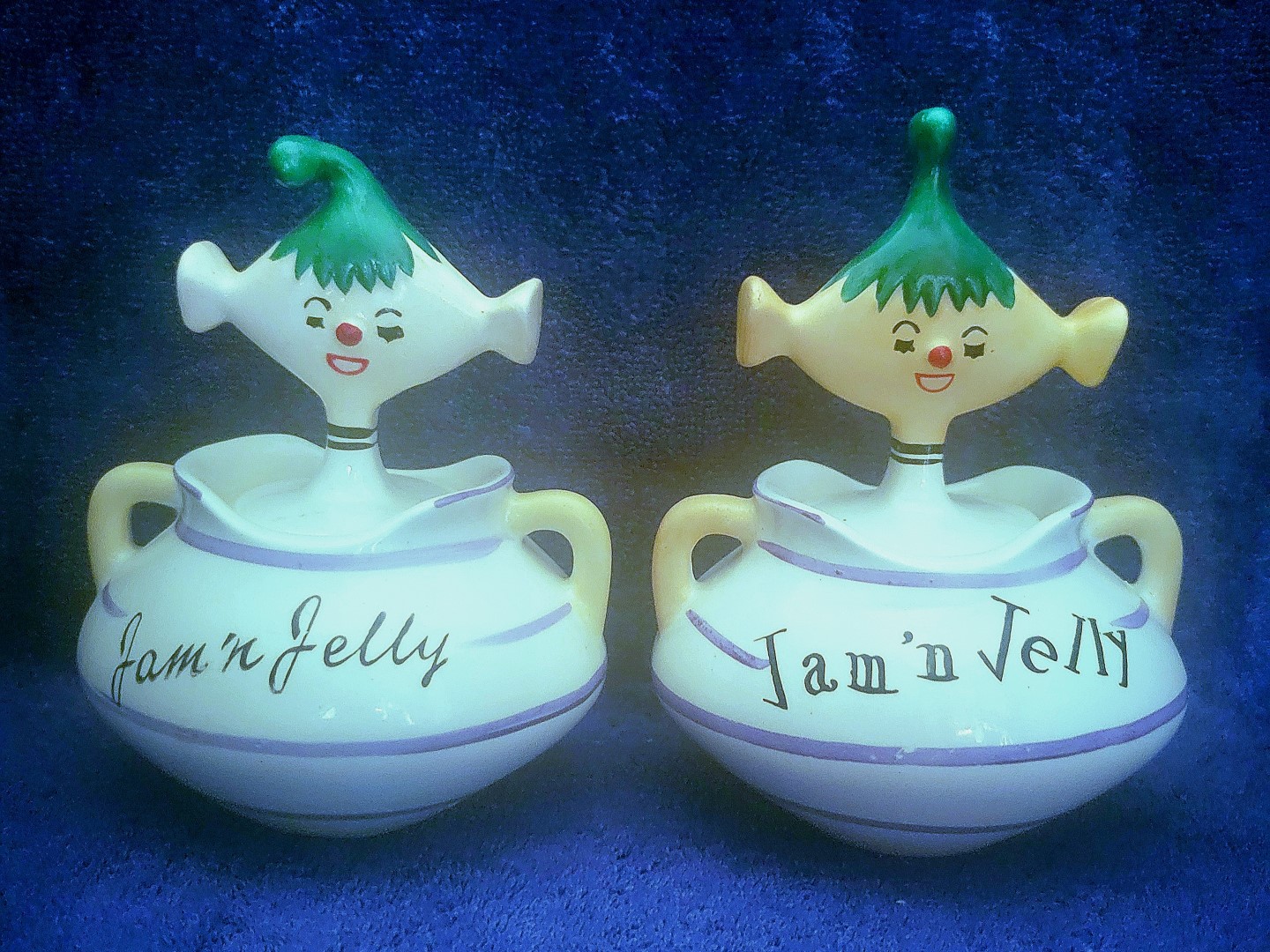
Jam 'n Jelly
The Davar Jam 'n Jelly jar is one of the clearest examples of why hair color alone cannot be used to verify a correct head-and-base pairing. Both versions have green hair, while the jar itself uses purple horizontal striping.
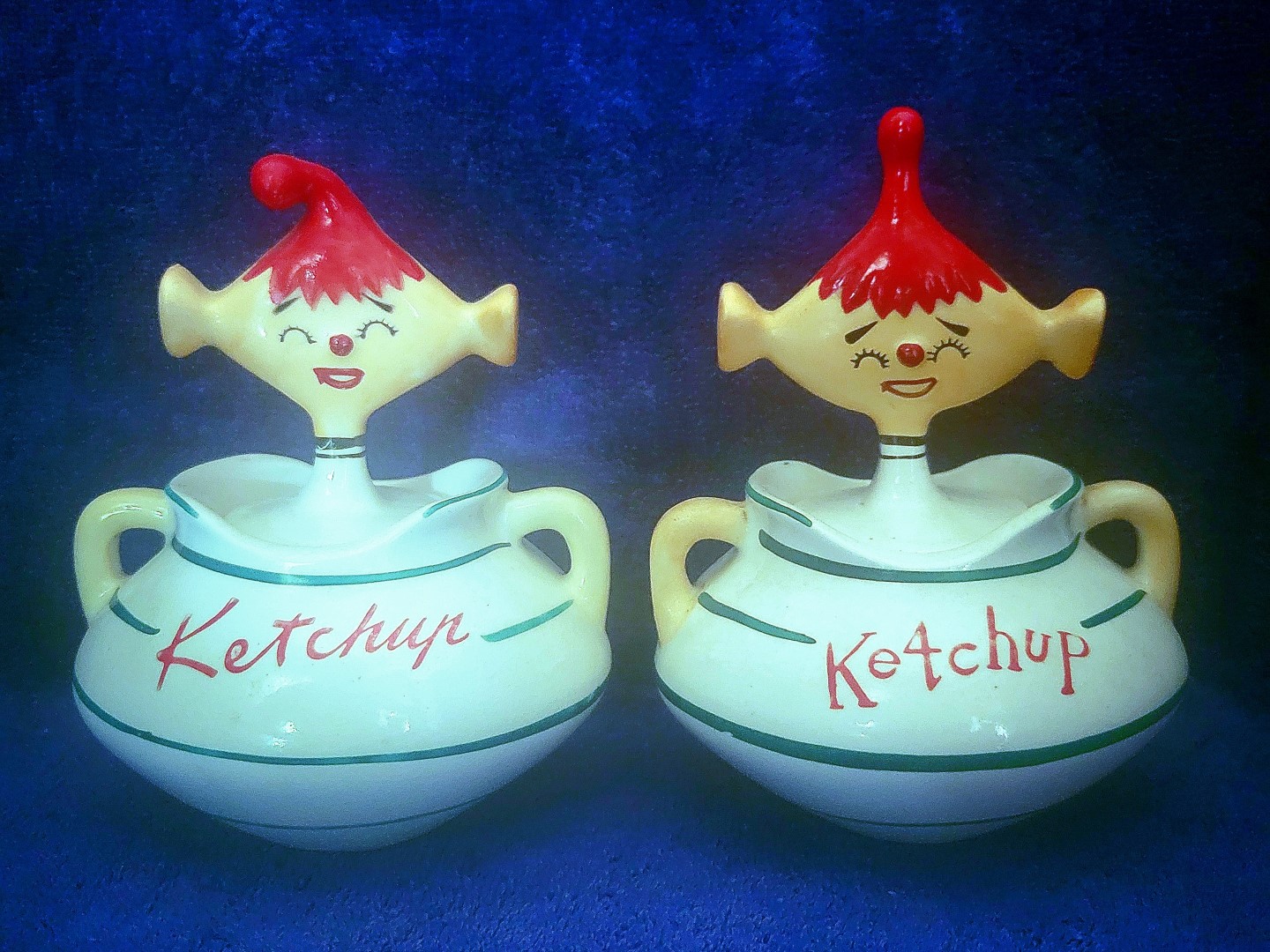
Ketchup
The Ketchup jar has red hair, but the base uses green horizontal striping. In this case, the red hair corresponds to the red Ketchup lettering rather than the stripe color.
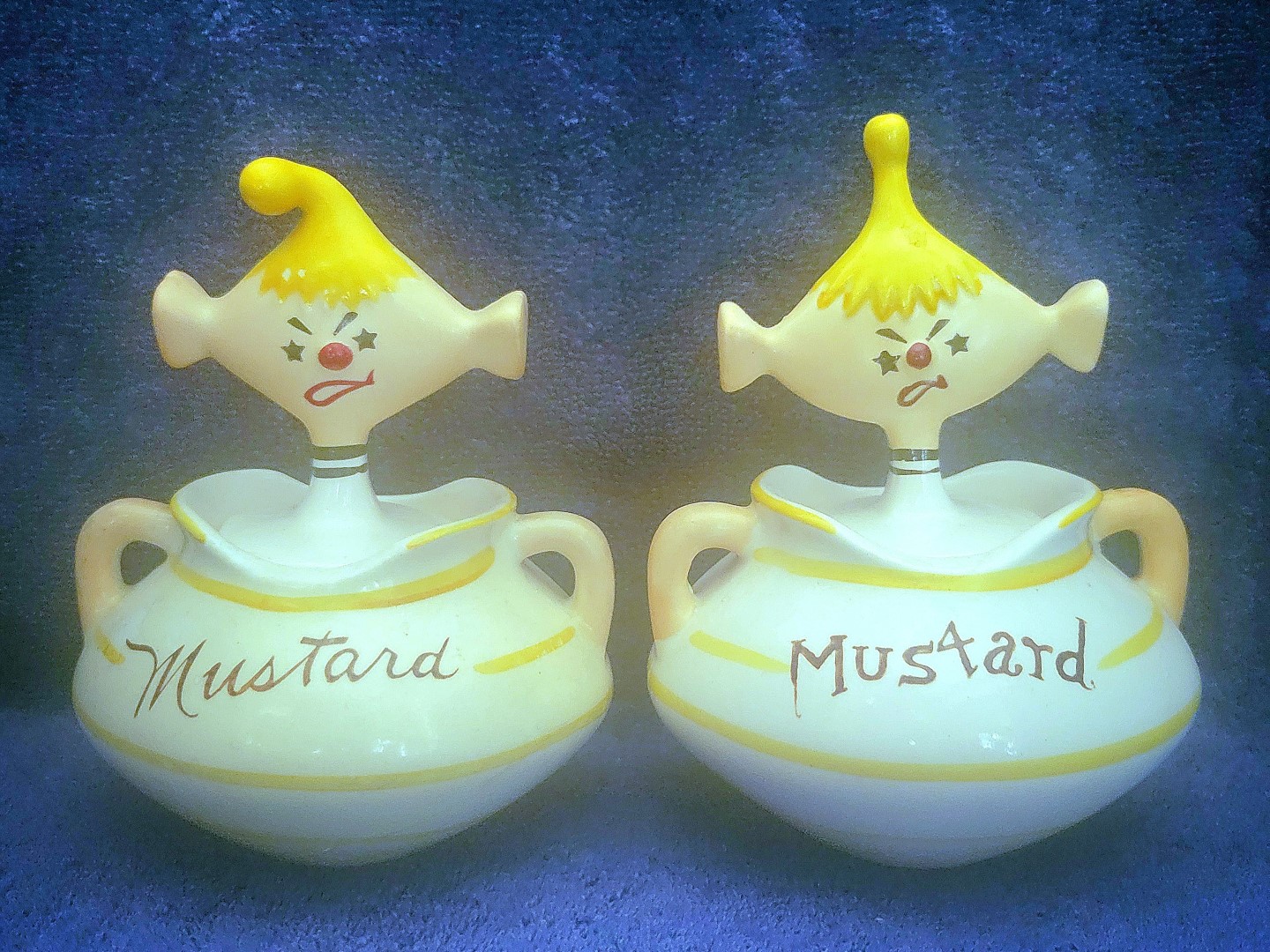
Mustard
The Mustard jars show the Davar script/block distinction particularly clearly: the script-letter jar uses the floppy ponytail head, while the block-letter jar uses the upright pointed hairstyle.
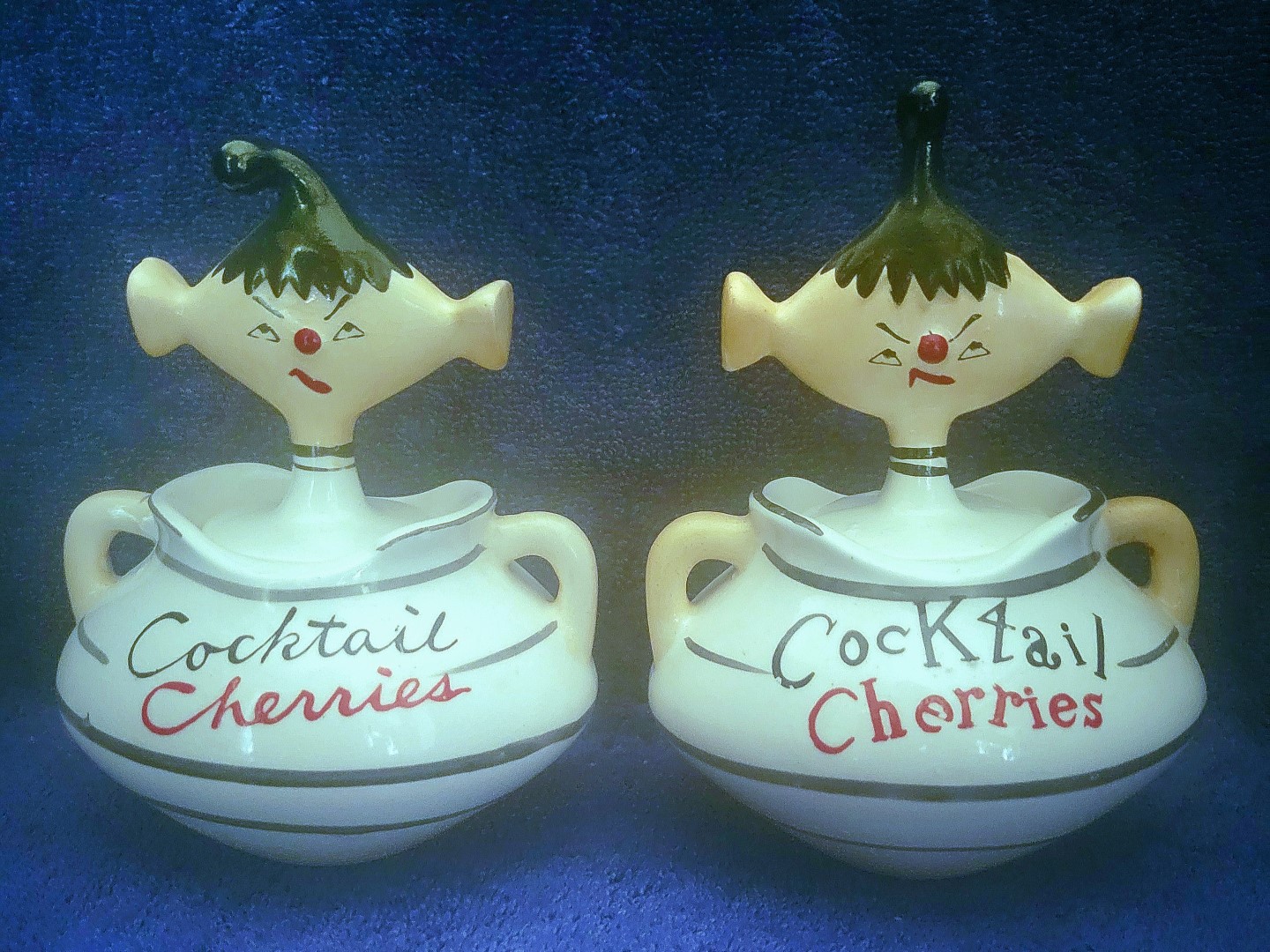
Cocktail Cherries
The Cocktail Cherries jars belong to Davar's bar-set trio, with the secondary condiment word painted in red below the black Cocktail lettering.
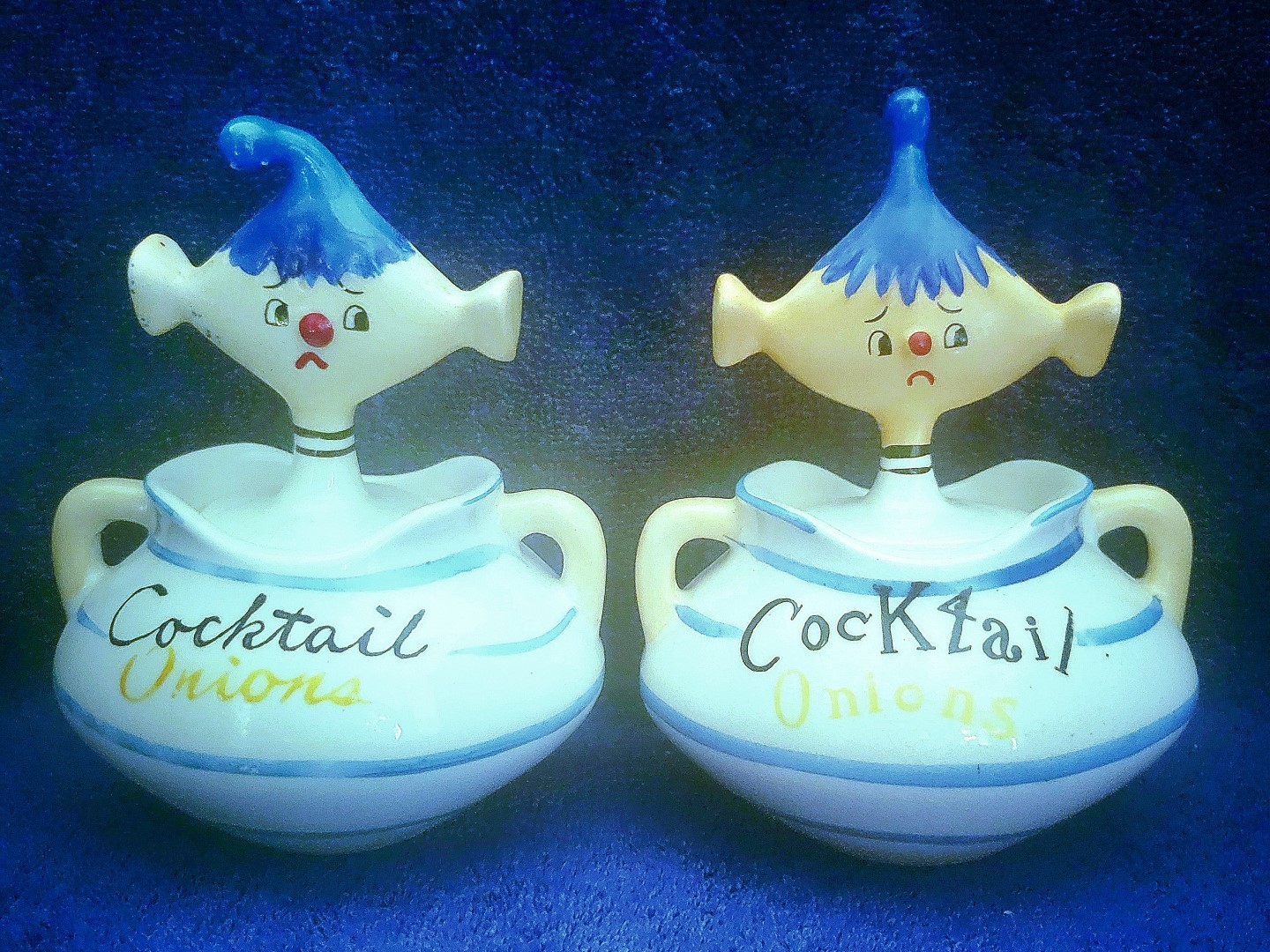
Cocktail Onions
The Cocktail Onions jars pair blue hair with blue horizontal striping, making this one of the easier Davar condiment jars to recognize when correctly assembled.
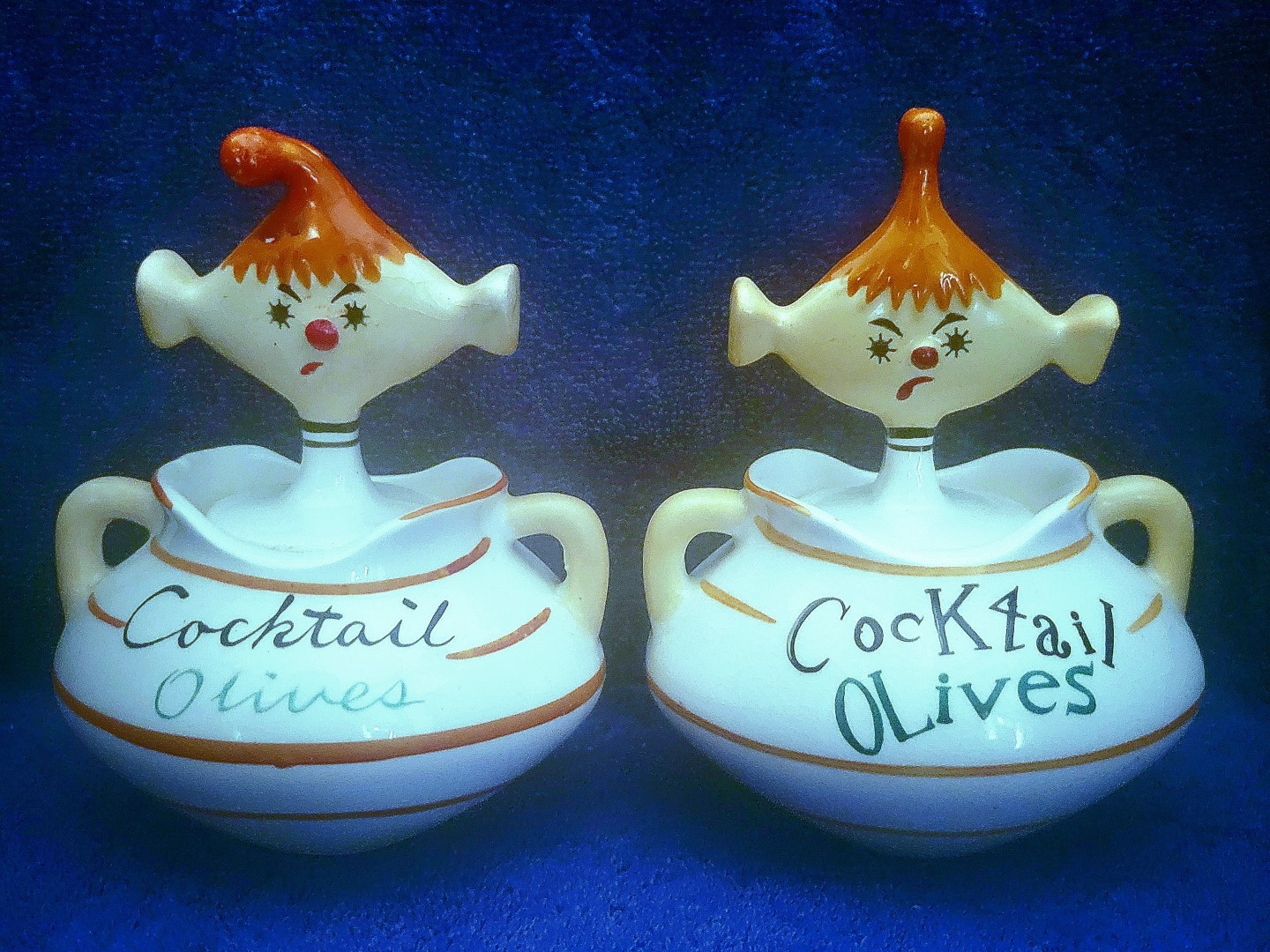
Cocktail Olives
The Cocktail Olives jars complete the bar-set trio and use the same script/block structure found throughout the Davar pixie condiment line.
Party Gremlins Oil & Vinegar Cruets
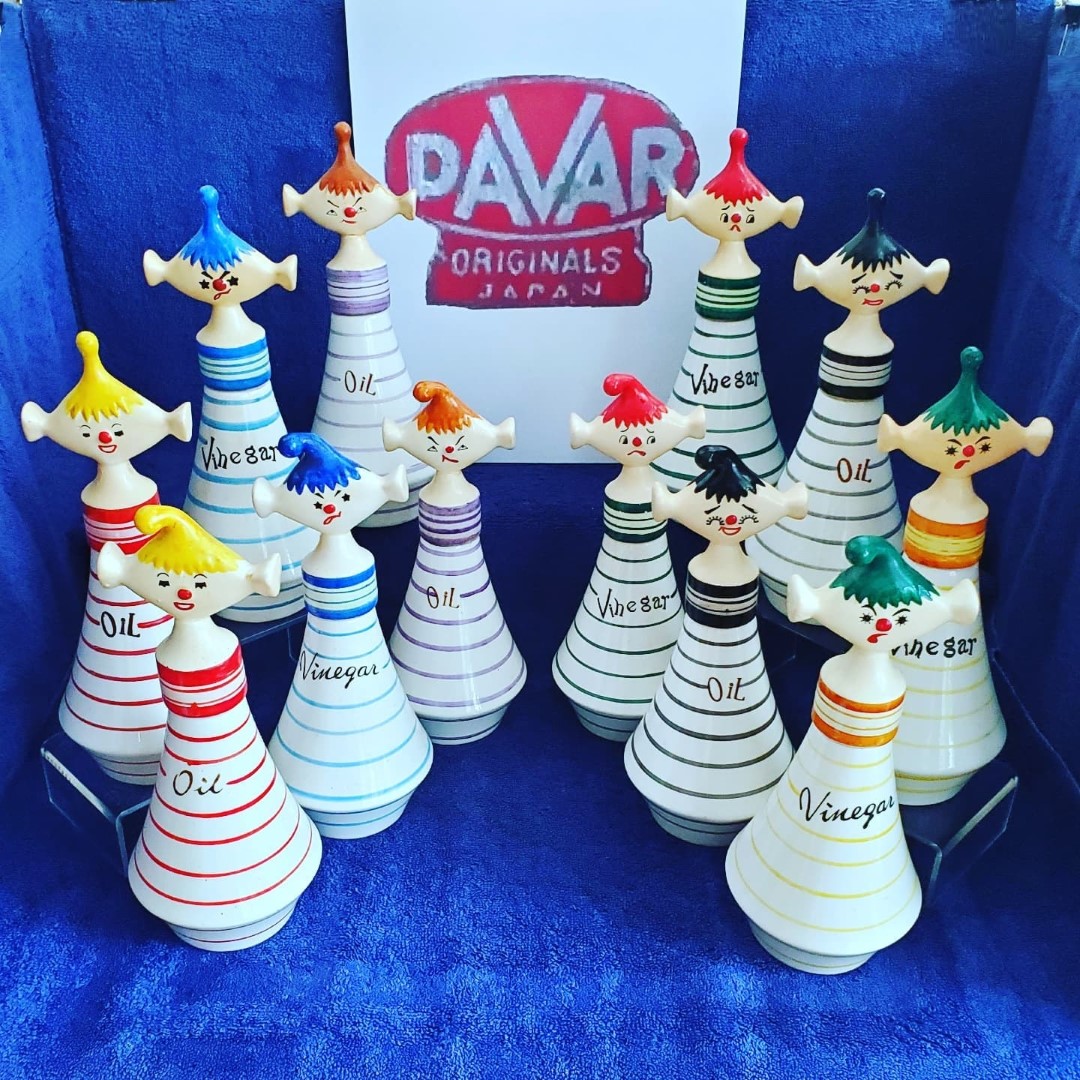
Davar's oil and vinegar cruets are the most elaborate and visually varied pieces in the company's pixie group. Walter Dworkin later documented that Davar used the name Party Gremlins for these characters on an original box, echoing the same nickname Holt Howard had used for its own liquor decanters.
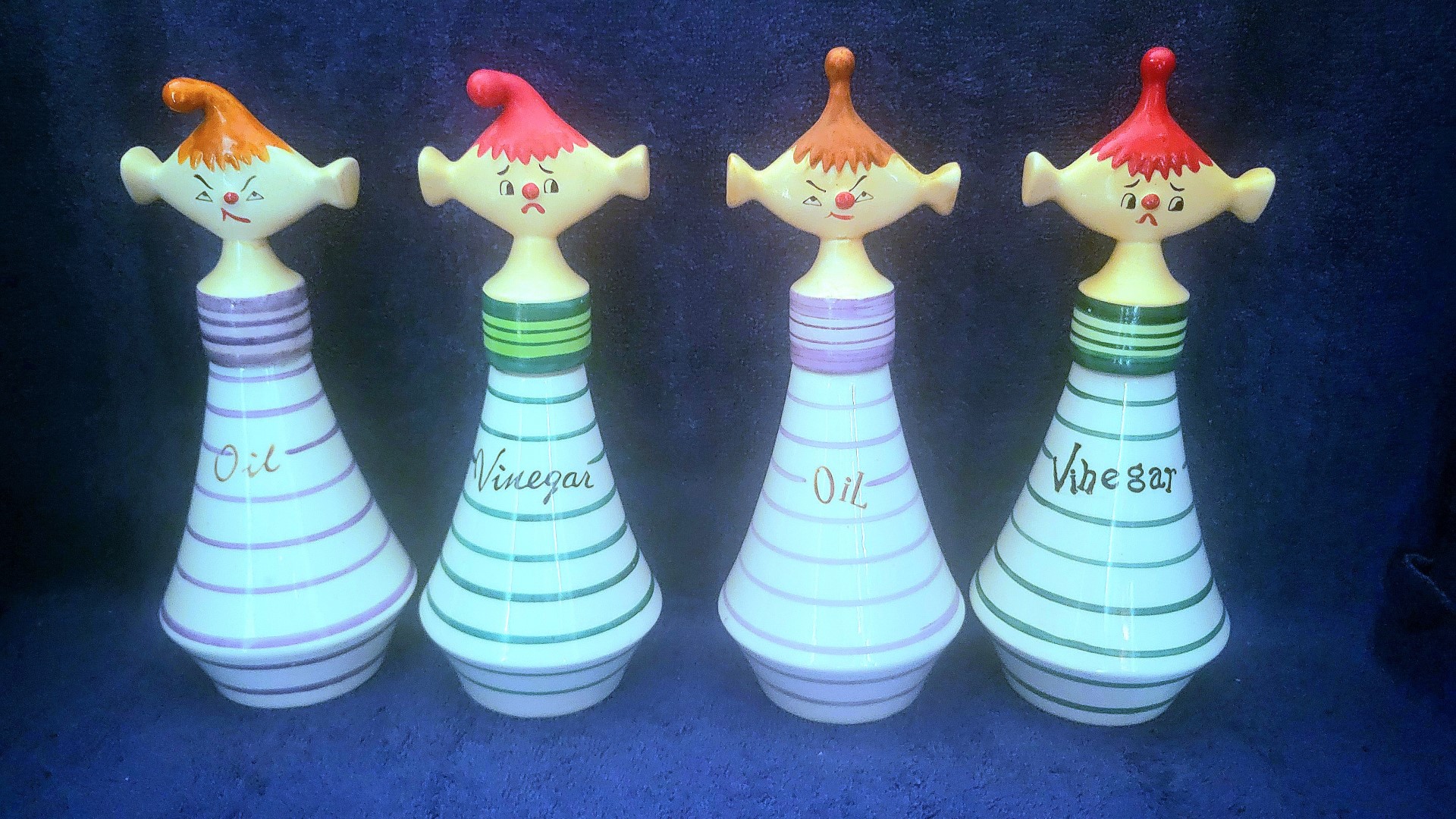
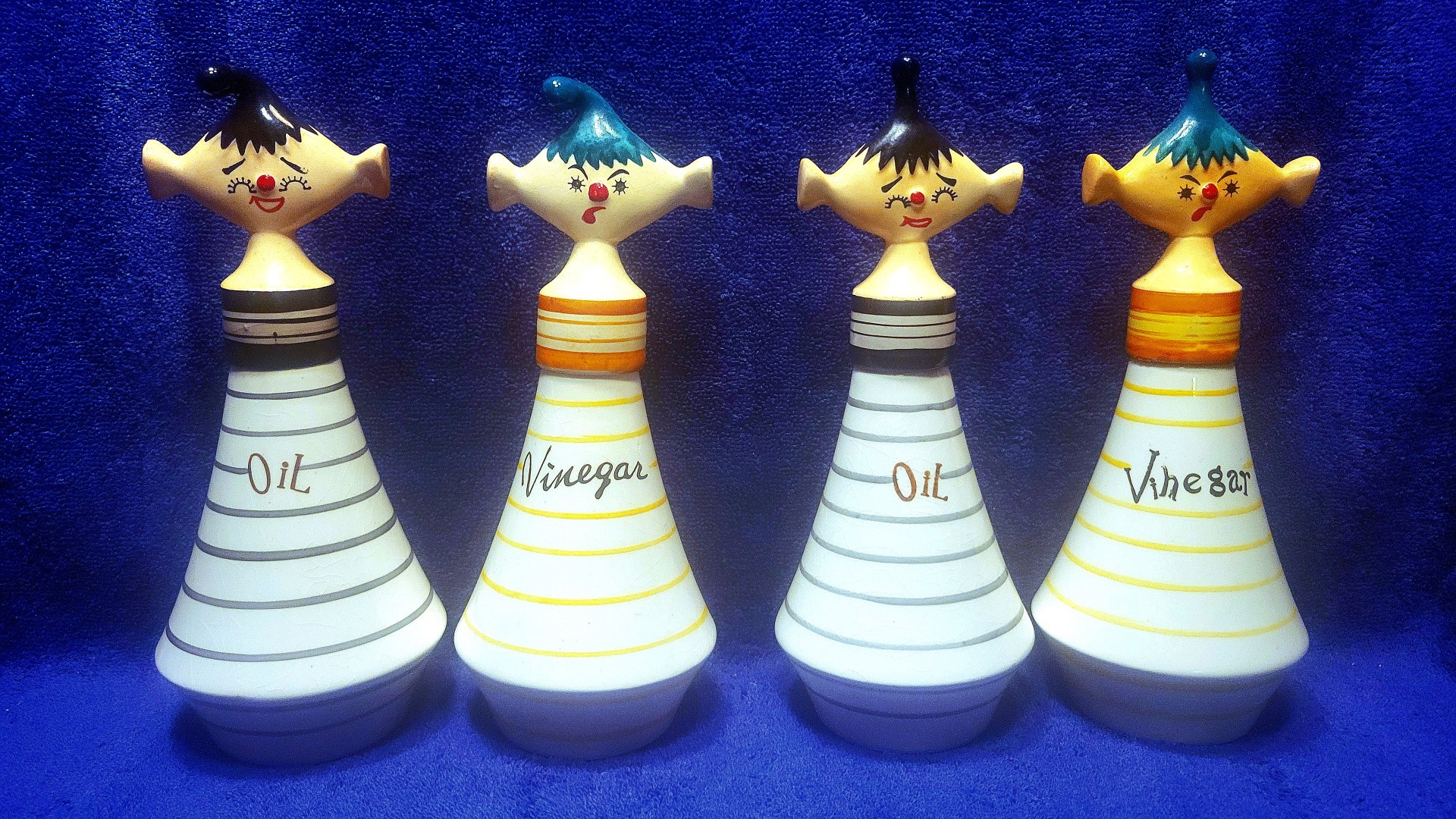
Three color schemes are presently documented, and each appears in both forms: script lettering with floppy ponytail heads, and block lettering with upright pointed heads.
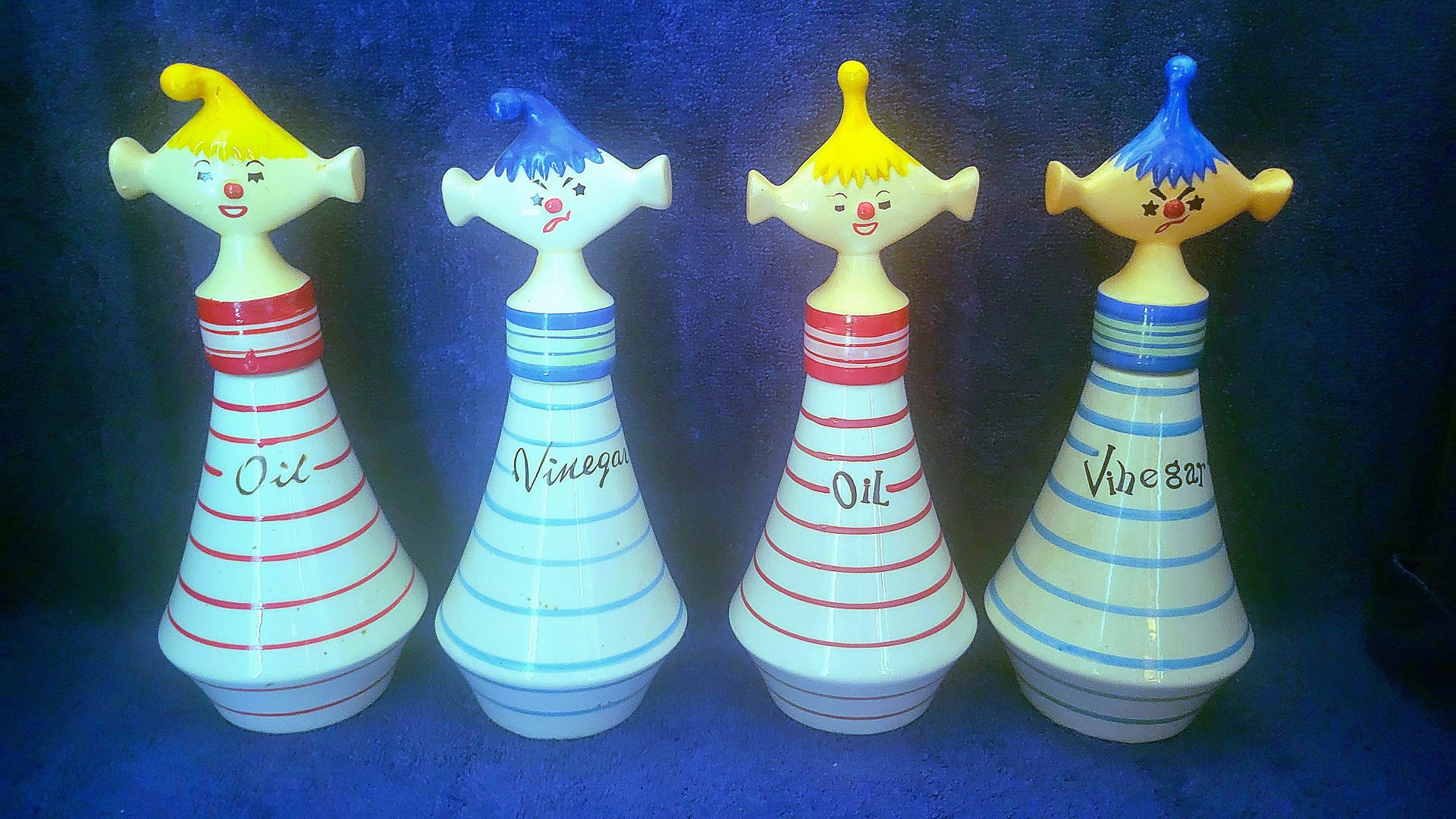
Red & Blue
The red-and-blue oil and vinegar set is the scheme Walter first illustrated in detail. The removable collars are especially useful because their stripe colors confirm the correct pairing with the bottle bases.
Green & Lavender
The green-and-lavender set demonstrates the same two-style system: one script-letter pair with floppy ponytails and one block-letter pair with upright pointed hairstyles.
Gray/Black & Yellow/Tan
The gray/black and yellow/tan set is among the most useful for studying correct matching, since both the collar striping and the lettering style provide confirmation of the proper head-and-base relationship.
Research & Discoveries: Correctly Matching Davar Pieces
One of the most common mistakes encountered today is mismatching Davar heads and bases. Since the heads are interchangeable, many pieces have been reassembled incorrectly over the years. The most reliable way to determine a correct factory pairing is by matching the hairstyle to the lettering style: floppy ponytail heads belong with script-lettered bases, while upright pointed hairstyles belong with block-lettered bases.
For the oil and vinegar cruets, an additional confirmation is available because the colored stripes around the removable collar always match the stripes on the corresponding bottle. This makes original pairings relatively easy to verify.
The condiment jars are not always so straightforward. While several jars use hair colors that coordinate with their bases, there are notable exceptions. The Ketchup jar has red hair but green horizontal stripes, with the hair instead matching the red "Ketchup" lettering. Likewise, the Jam 'n Jelly jar has green hair paired with purple stripes, making it one of the few Davar pieces where the hair color provides little guidance.
Because of these exceptions, correctly restoring original factory pairings can be surprisingly challenging. Experienced collectors frequently purchase mismatched examples simply to obtain the correct head or base, then reassemble the proper combinations before selling the remaining duplicate pieces.
Identifying Marks
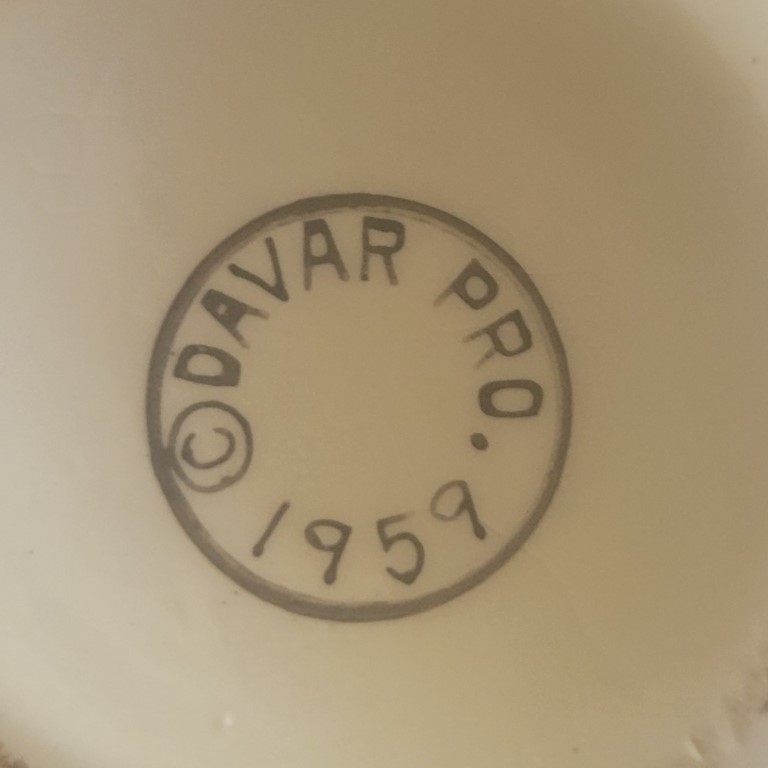
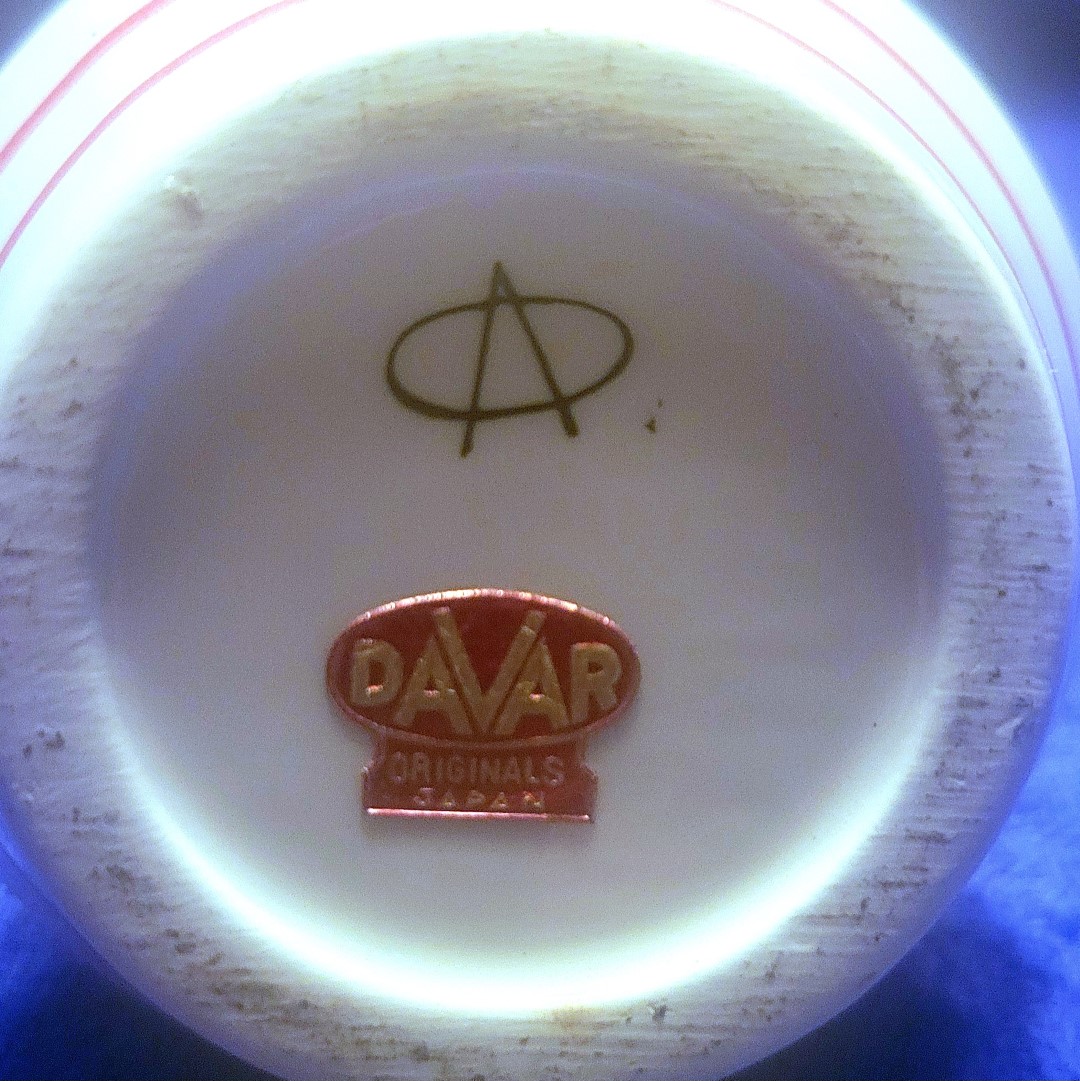
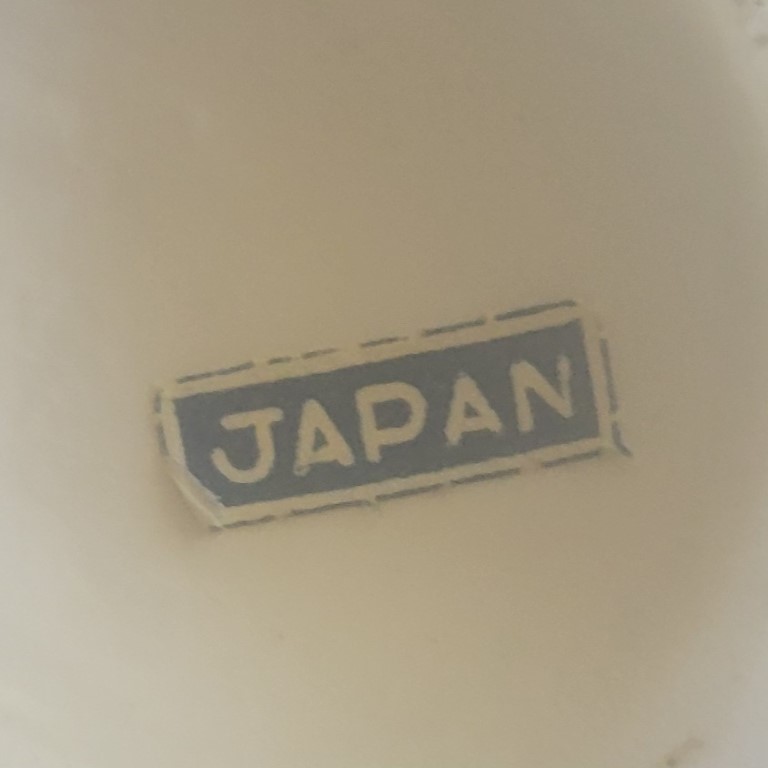
Davar pieces may be found with inked backstamps, foil labels, secondary marks, or paper Japan labels, though not every surviving example retains its original identifying marks. These marks are especially helpful because the line is frequently confused with Holt Howard Pixieware and other Japanese novelty ceramics.
Davar's Place in the Pixie Universe
Davar's pixie condiment jars and Party Gremlins cruets occupy a peculiar but important place in the history of mid-century Japanese novelty ceramics. They are not Holt Howard Pixieware, and the name Pixieware properly belongs to Holt Howard. Yet the Davar line shows just how quickly and visibly Holt Howard's pixie concept influenced the competitive giftware market.
Today, correctly matched Davar examples are collected not merely as imitations, but as artifacts of that broader marketplace. Their horizontal stripes, flat heads, red noses, arm handles, and script/block variation system make them one of the most recognizable and instructive families of Holt Howard-inspired noveltyware.