Miscellaneous Japanese Condiment Jars
A cabinet of curiosities: lesser-documented, unattributed, and newly connected Japanese novelty jars from the golden age of mid-century import giftware.
Introduction
Unlike the preceding sections, which each focus on a single importer or closely related product line, this page brings together a variety of Japanese condiment jars that share one common characteristic: they remain among the least understood pieces in the hobby. Some have never been attributed to any importer, while others can be associated with companies such as Haruta, including its Empress Giftware division. Some were documented in earlier collector references, while others have surfaced through more recent collector research.
Together these jars represent an eclectic assortment of whimsical designs that illustrate just how many companies were producing novelty condiment ware in Japan during the 1950s and early 1960s. Although many remain something of a mystery, each contributes another piece to the larger story of mid-century Japanese ceramics. As additional examples continue to surface and collectors share new discoveries, our understanding of these overlooked lines continues to evolve.
The Blondies
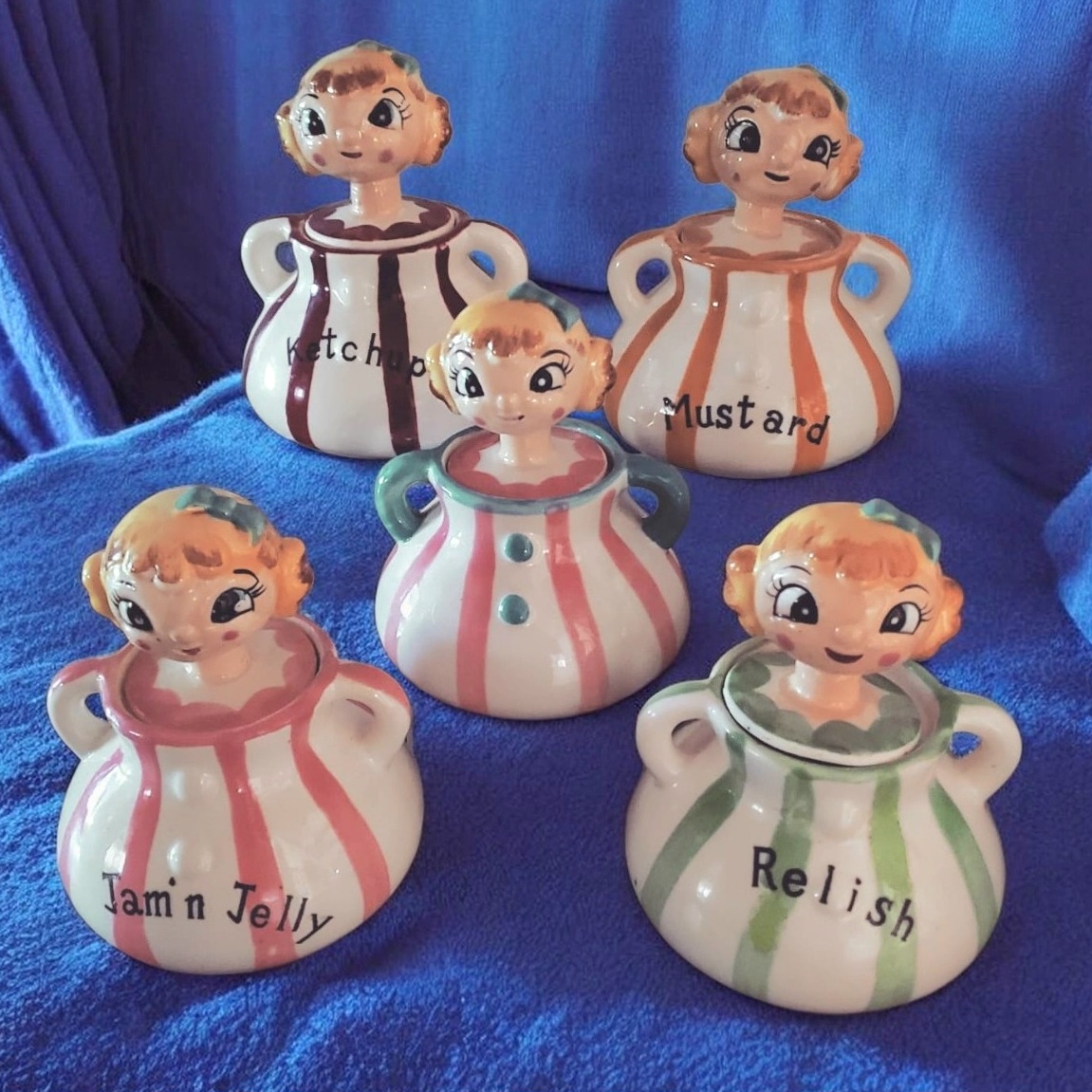
The Blondies are among the better-known unidentified Japanese condiment jar lines and have been familiar to collectors for many years. Their distinctive round-headed blond girls, two-handled bodies, and eight vertical stripes make them instantly recognizable, while their overall styling clearly reflects the influence of Holt Howard and other popular novelty ceramics of the period. Despite their popularity, no importer or manufacturer has yet been positively identified.
Each jar stands approximately 5 inches tall and features a built-in narrow ceramic spoon attached beneath the lid. The lids are decorated with a blue hair bow, while the color surrounding the base of each lid matches the eight vertical stripes decorating its corresponding jar. The bodies incorporate two loop handles similar in style to those found on Davar condiment jars, although the overall design is unique to this series. Like many unidentified Japanese ceramics of the period, the jars are unmarked except for occasional paper “Japan” labels.
Research & Discoveries
Walter Dworkin’s first edition documented only the Ketchup, Mustard, and Relish jars. By the publication of his second edition, collectors had discovered a matching Jam ’n Jelly jar, expanding the known line to four condiment jars. Walter also documented the much rarer “All Purpose” jar, which differs from the others by featuring blue handles and buttons instead of matching striped accents. These discoveries illustrate how previously unknown pieces continue to surface decades after these ceramics were originally produced.
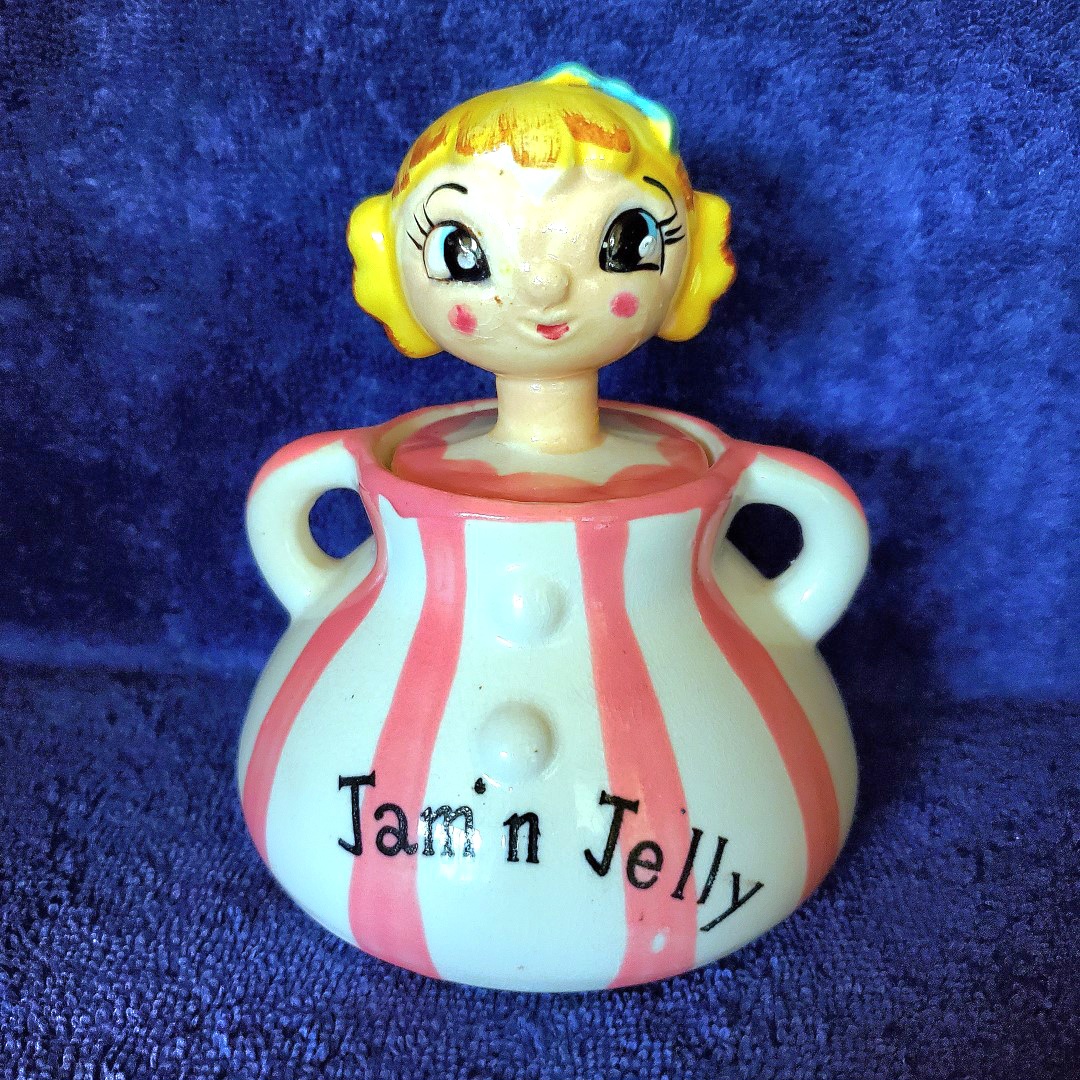
Jam ’n Jelly
The Jam ’n Jelly jar expanded the known Blondies line beyond the three jars documented in Walter’s first edition. It matches the rest of the group in form, expression, handles, and spoon construction.
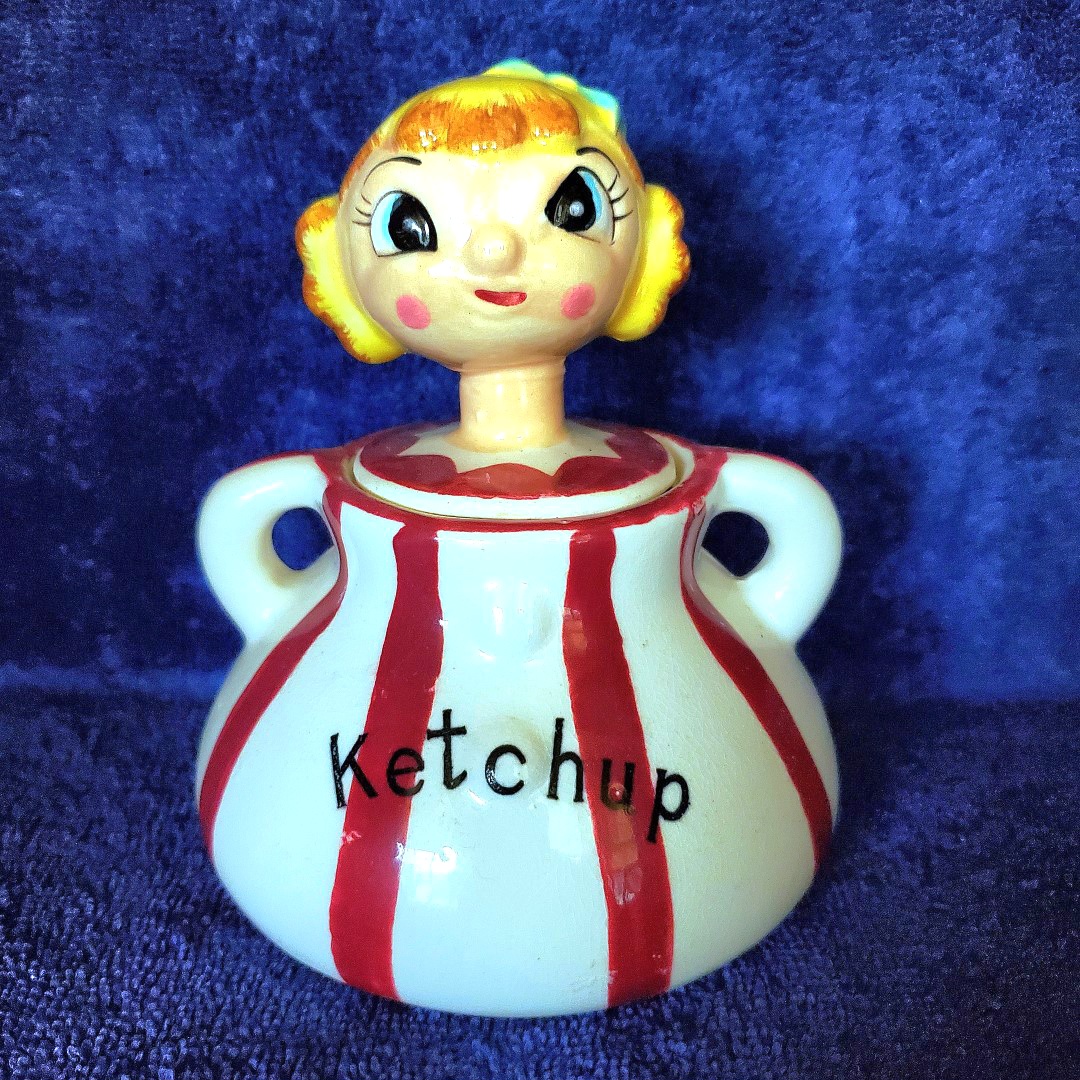
Ketchup
Ketchup is one of the three Blondies in the earliest documented group. Its red striping and matching lid edge follow the line’s consistent color-matching scheme.
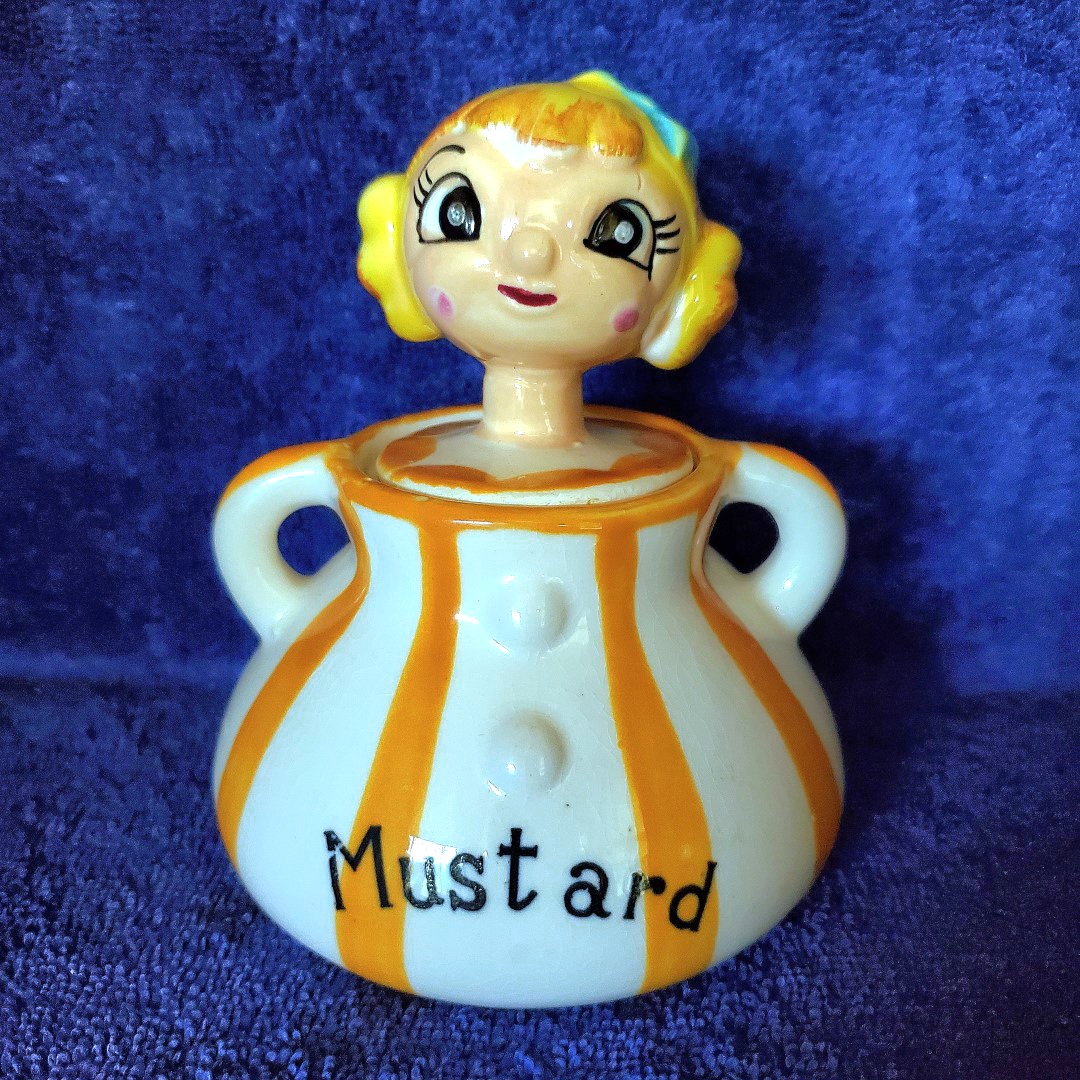
Mustard
Mustard is distinguished by its dark yellow vertical stripes and matching lid edge. The girls are generally cross-eyed, though at least one non-cross-eyed Mustard example has surfaced.
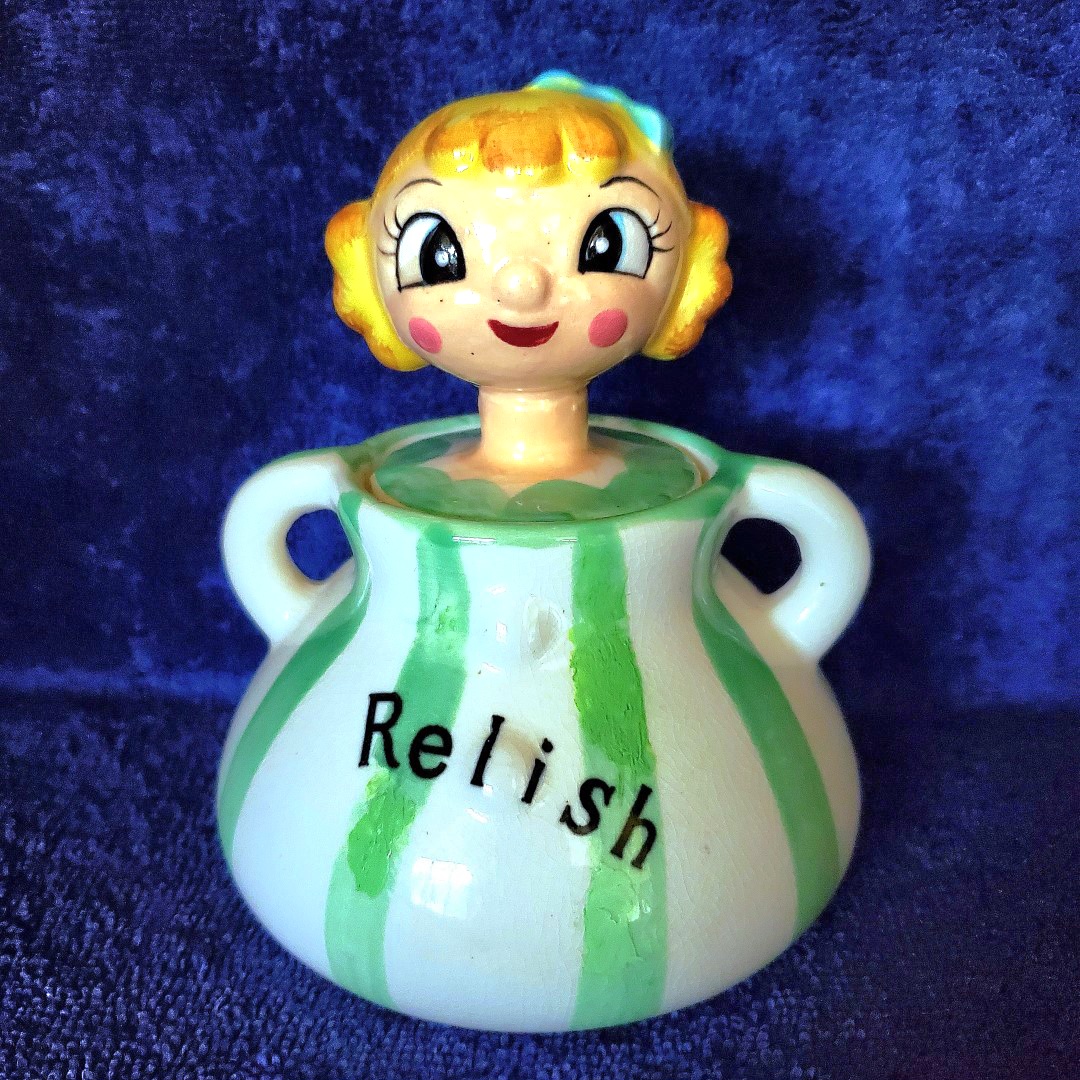
Relish
Relish completes the three jars in the earliest documented group. Its green striping makes it one of the easiest Blondies to identify at a glance.
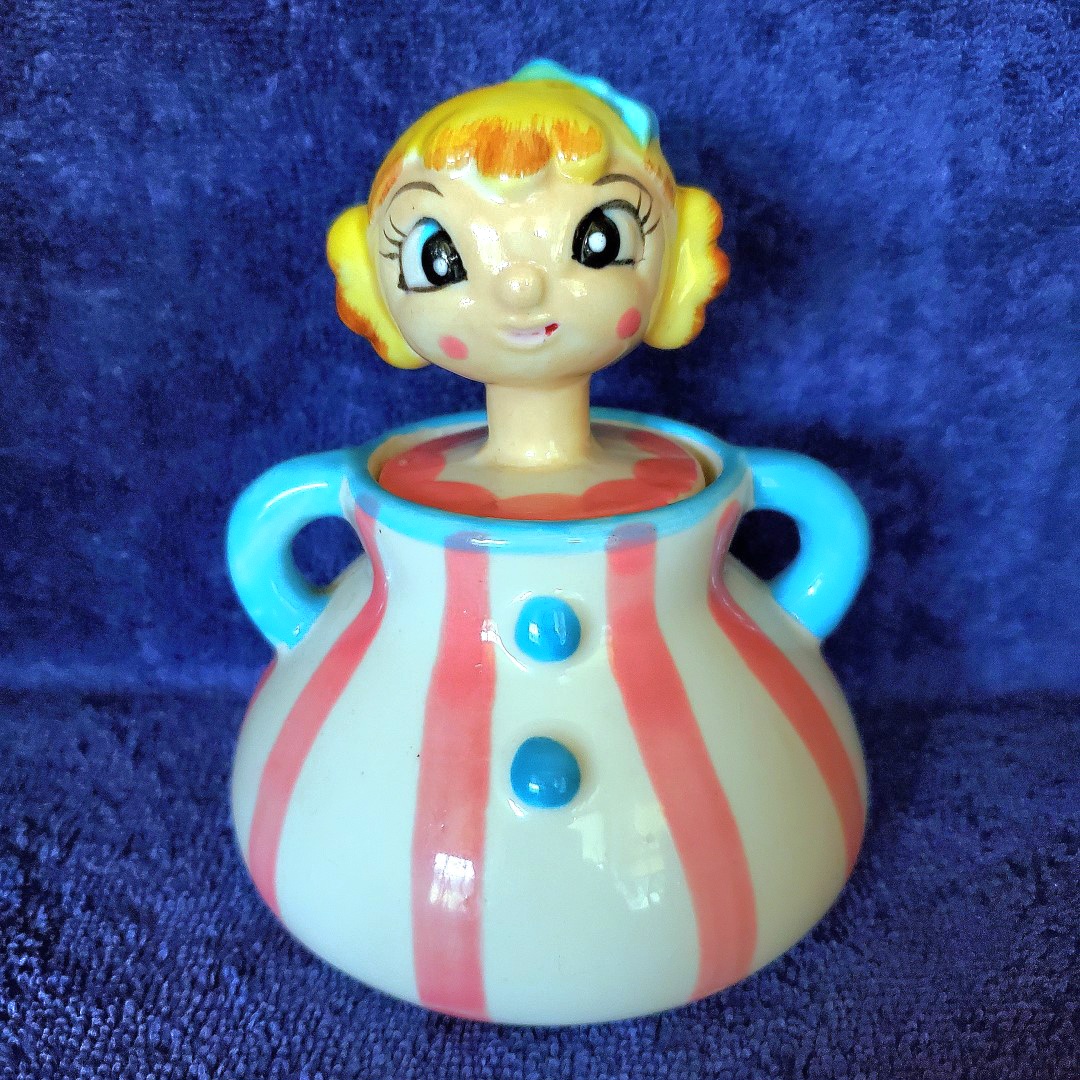
All Purpose
The All Purpose jar differs from the others because it has no designated condiment name and can be used for almost anything. It is also the only Blondie with blue-colored arms and buttons.
The Chefs
The “Chefs” are among the most distinctive unidentified Japanese condiment jar lines produced during the late 1950s and early 1960s. Walter Dworkin gave them their nickname because each jar features a smiling chef wearing a tall white chef’s hat, and the name has remained in common use among collectors. Like many of the novelty condiment jars of the period, neither the importer nor the manufacturer has been identified. Examples are unmarked except for a simple white paper “Japan” label found on pieces that have retained their original foil or paper sticker.
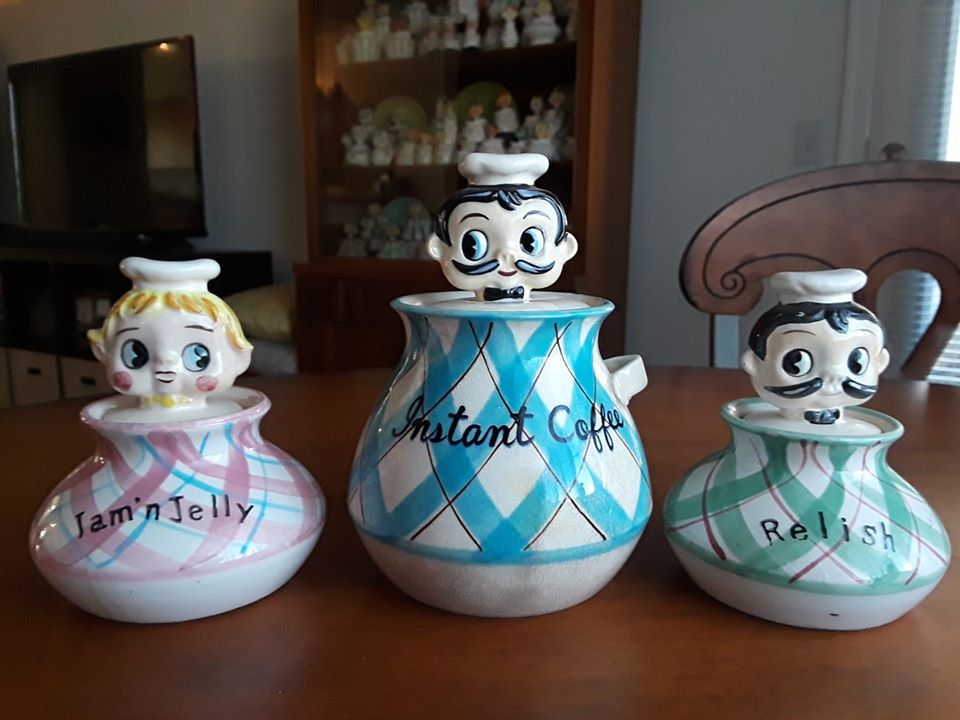
Four condiment jars are known in the core series: Ketchup, Mustard, Jam ’n Jelly, and Relish. Each stands approximately 5 inches tall and originally included a narrow ceramic spoon attached beneath the lid. Their most recognizable feature is the colorful plaid body decoration, complemented by sculpted chef heads that alternate between male and female characters. The male chef heads consistently appear on the Ketchup and Relish jars, while the female heads appear on the Mustard and Jam ’n Jelly jars.
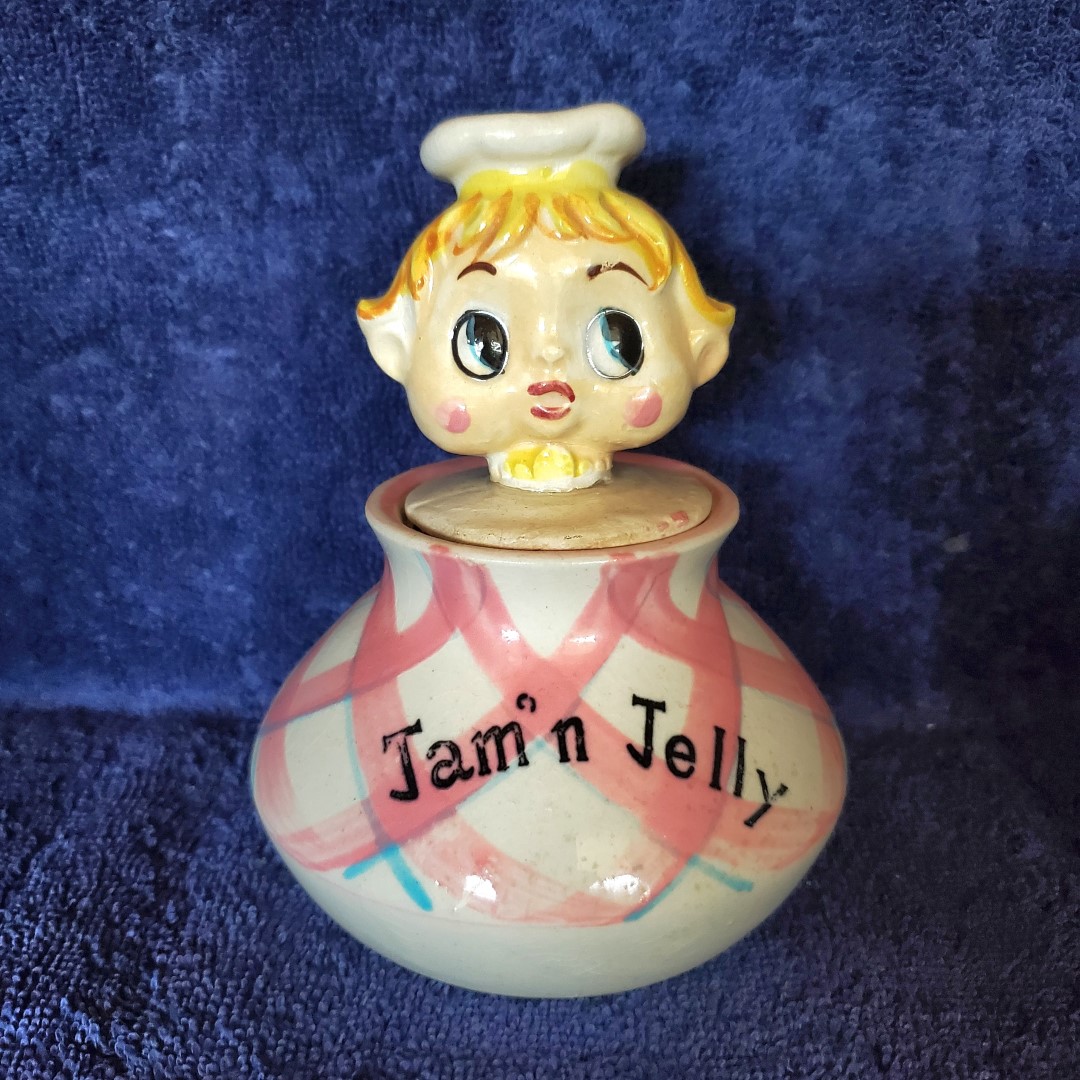
Jam ’n Jelly
The Jam ’n Jelly jar uses the female chef head, consistent with Walter’s observation that the female heads appear on Jam ’n Jelly and Mustard.
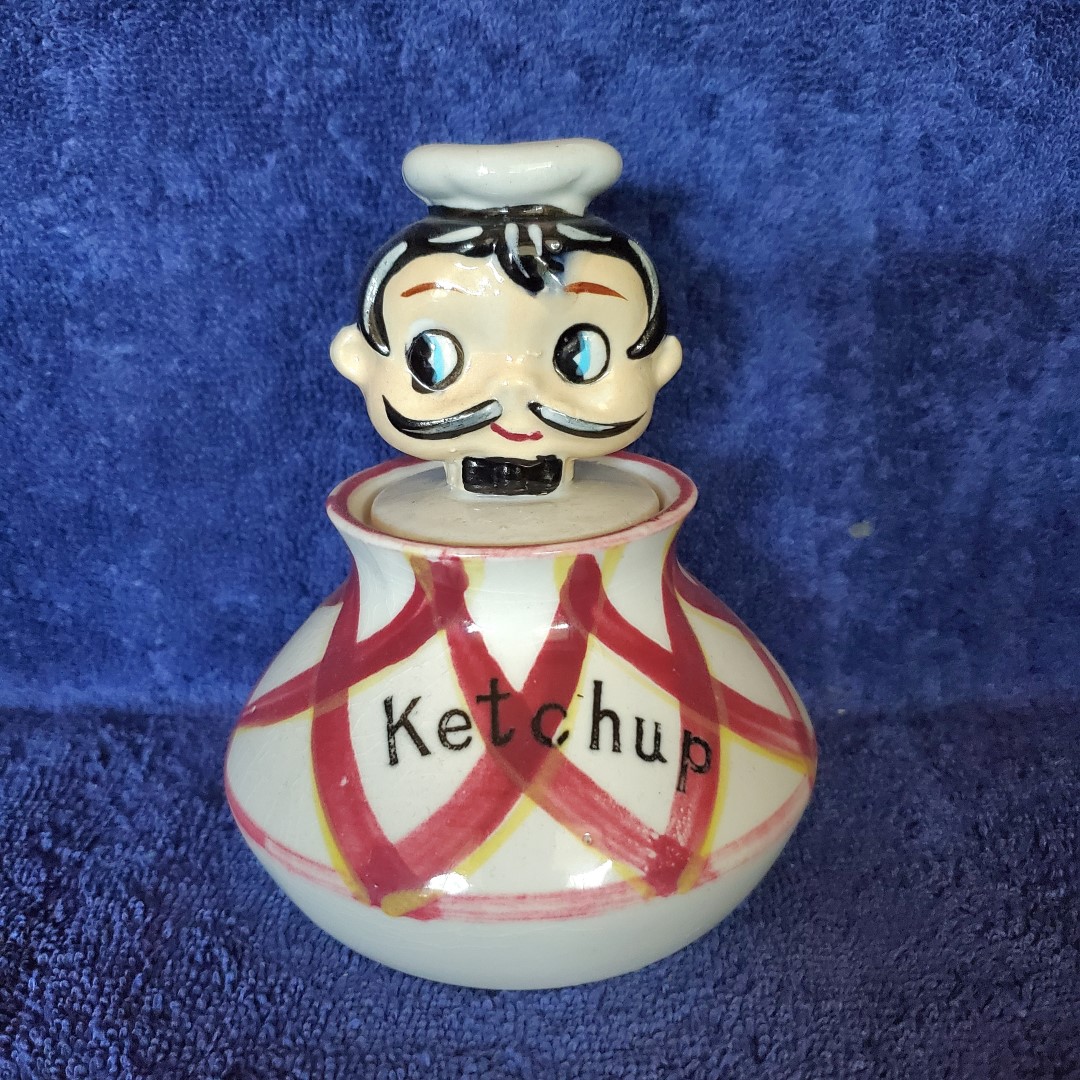
Ketchup
Ketchup uses the male chef head and the same colorful plaid body decoration found throughout the line.
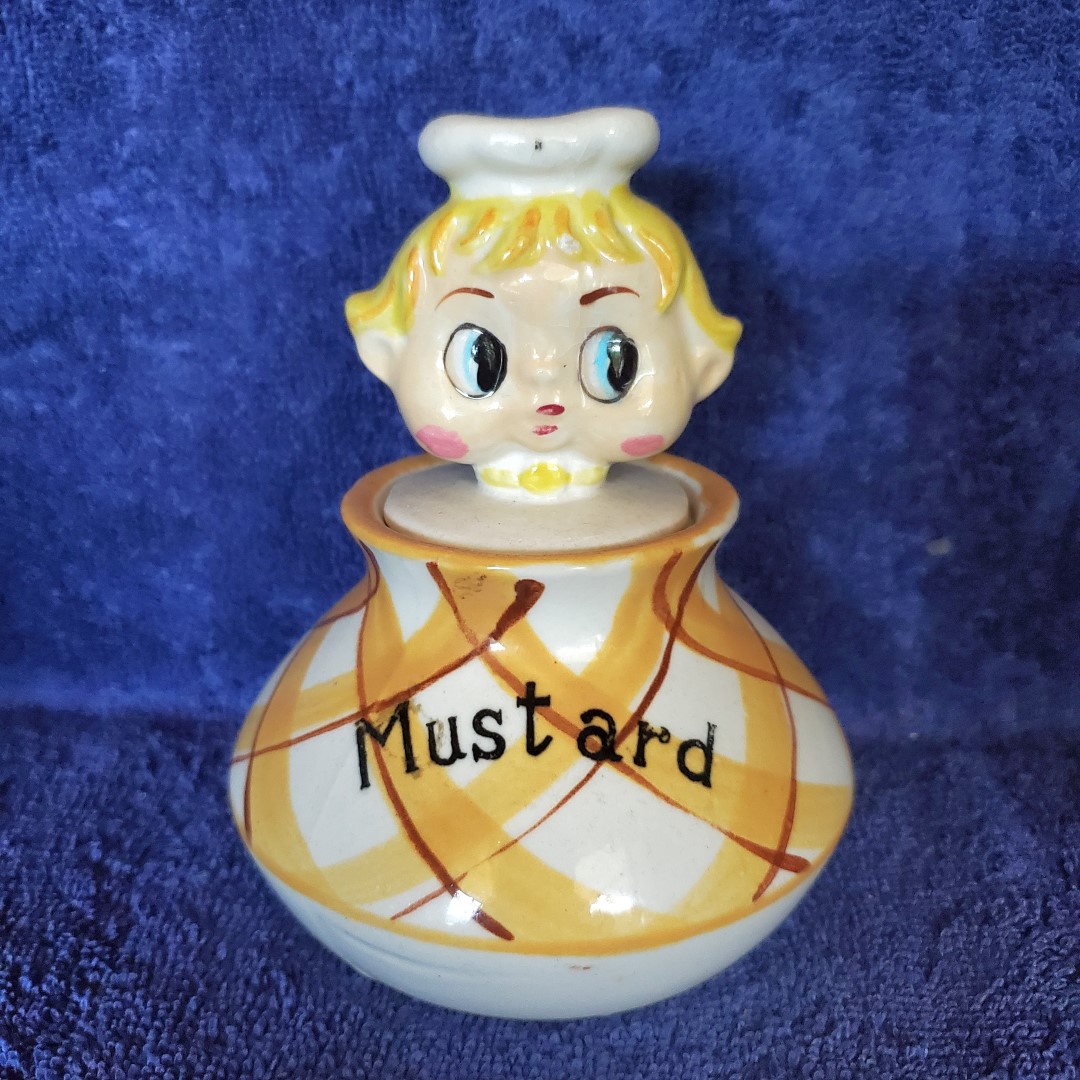
Mustard
Mustard uses the female chef head and shares the same narrow spoon construction as the other condiment jars.
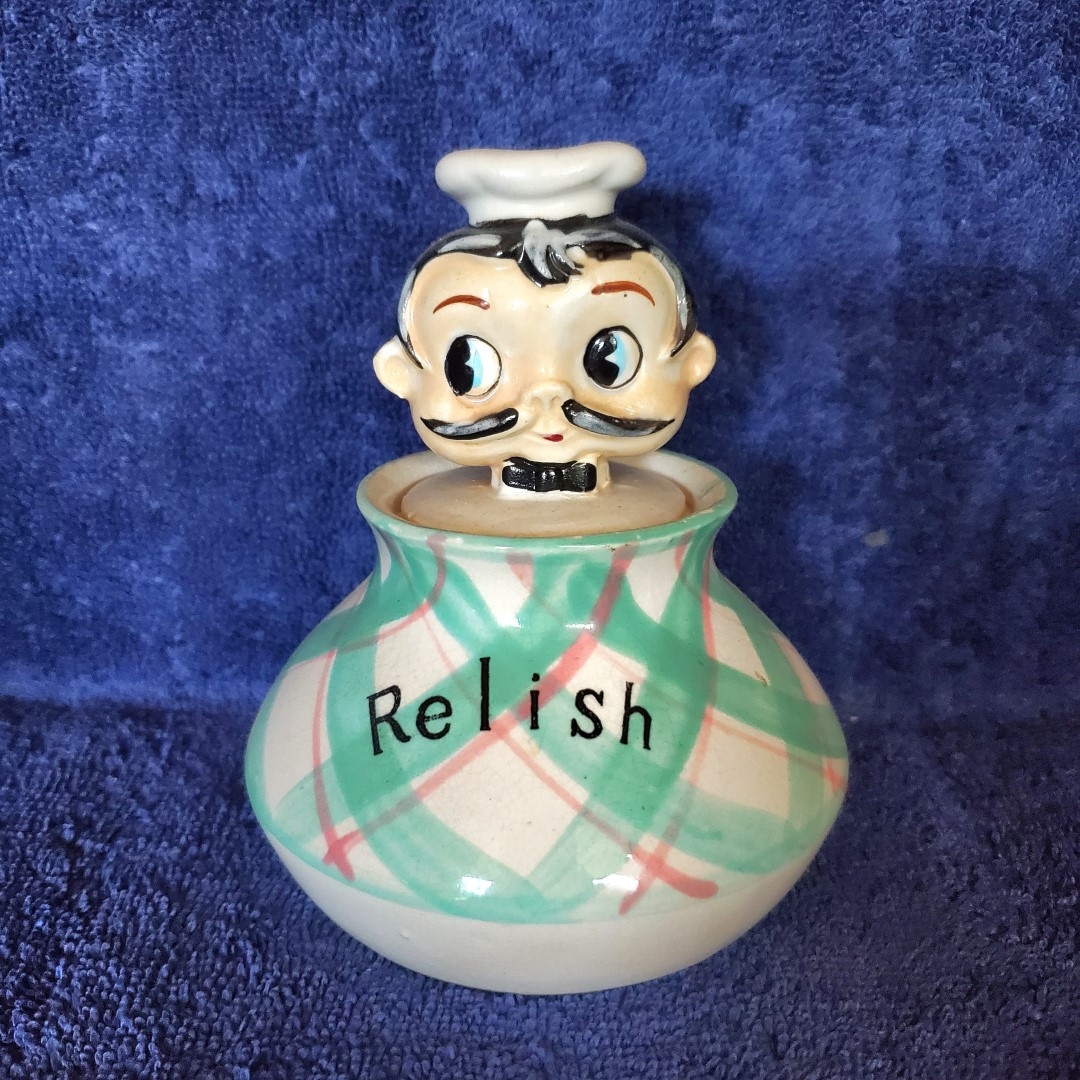
Relish
Relish uses the male chef head, pairing it visually with Ketchup while retaining the same body form as the rest of the condiment jars.
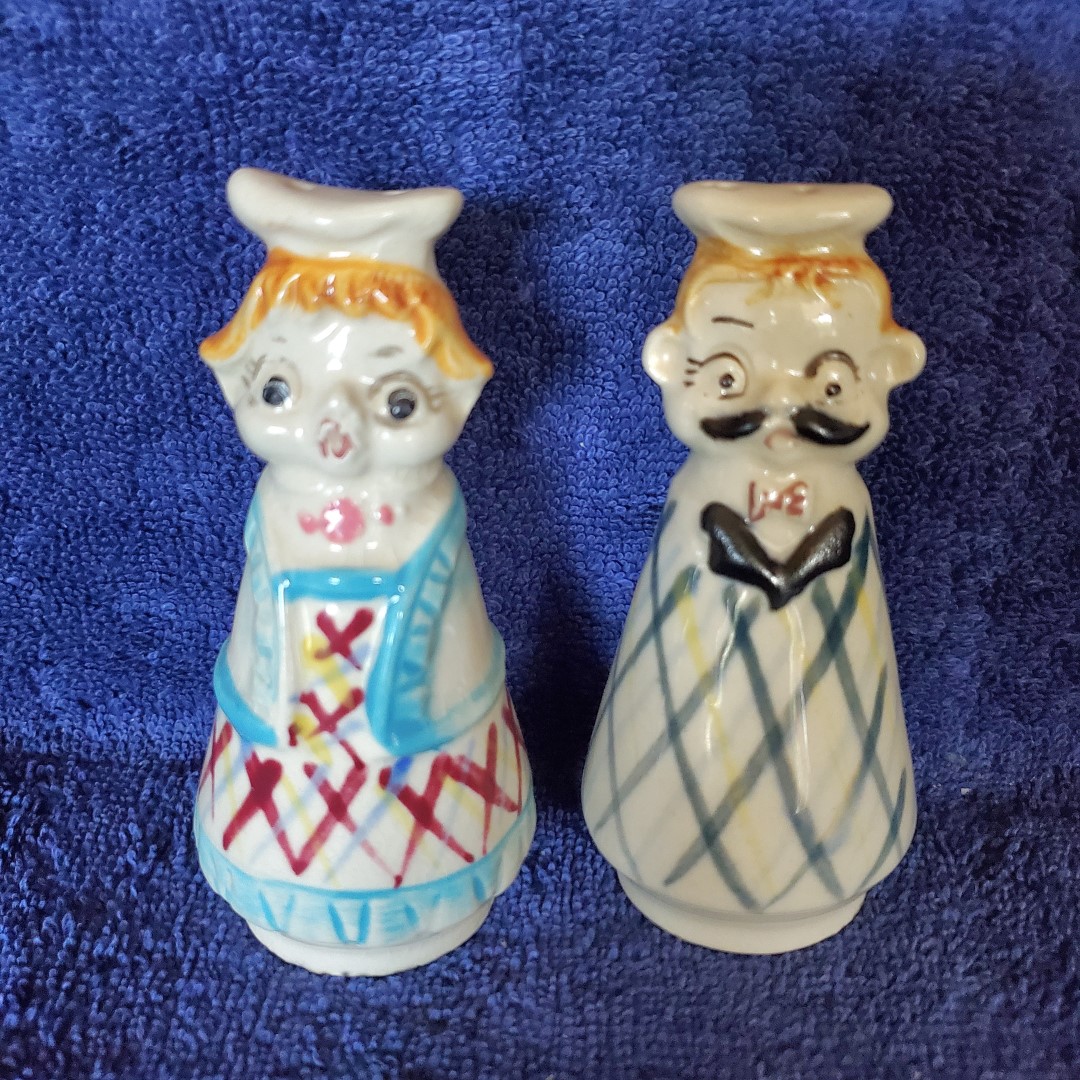
Salt & Pepper Shakers
The matching salt and pepper shakers are unmarked, but their chef heads, plaid decoration, color palette, and overall styling strongly suggest they were intended as companion pieces to the Chef condiment jars.
Research & Discoveries
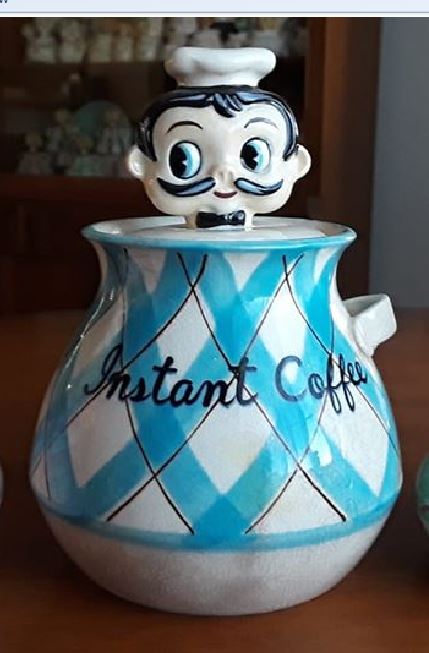
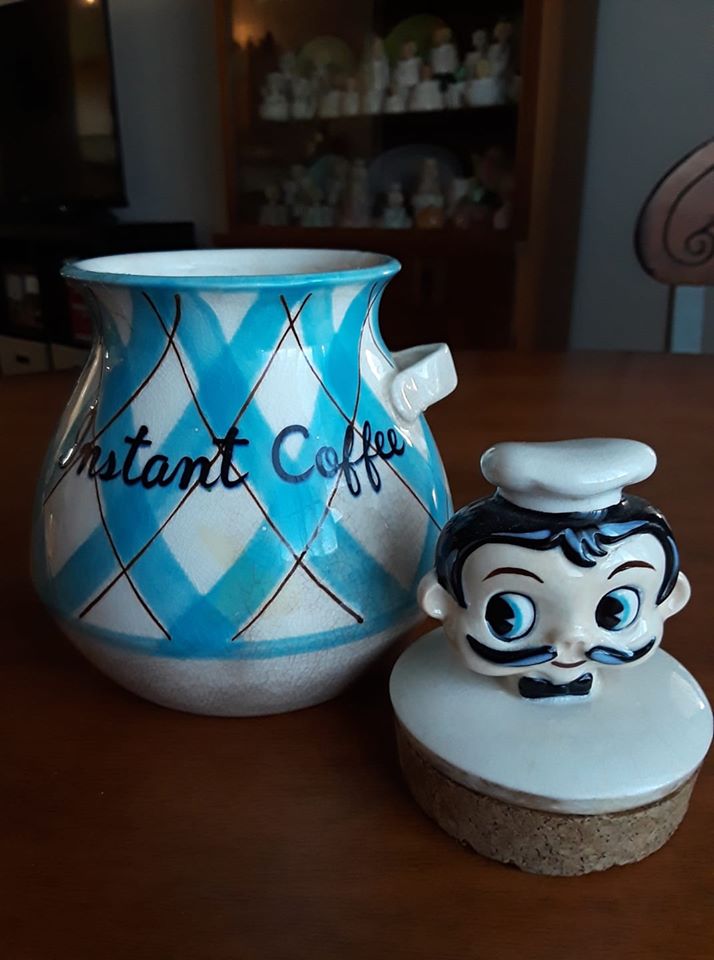
Since Walter’s guides were published, collectors have identified additional pieces that almost certainly belong to the Chef’s line. One is a larger Instant Coffee jar that shares the same plaid decoration, chef head styling, and overall design aesthetic as the condiment jars. Unlike the condiment jars, however, the Instant Coffee jar uses flowing cursive lettering rather than block lettering and features a cork-lined lid instead of a built-in ceramic spoon. The cork gasket was designed to provide a tighter seal for storing instant coffee, similar in concept to the cork-sealed Garlic jar from Lefton’s Vegetable Head Pixieware line.
Collectors have also identified a matching salt and pepper shaker set. Although the shakers are unmarked like the condiment jars, their identical sculpting style, plaid decoration, color palette, and chef motif strongly suggest they were designed as companion pieces for the line. While no catalog or advertising material has yet surfaced confirming this relationship, their close stylistic similarities make that conclusion highly likely.
Cupcake Girl
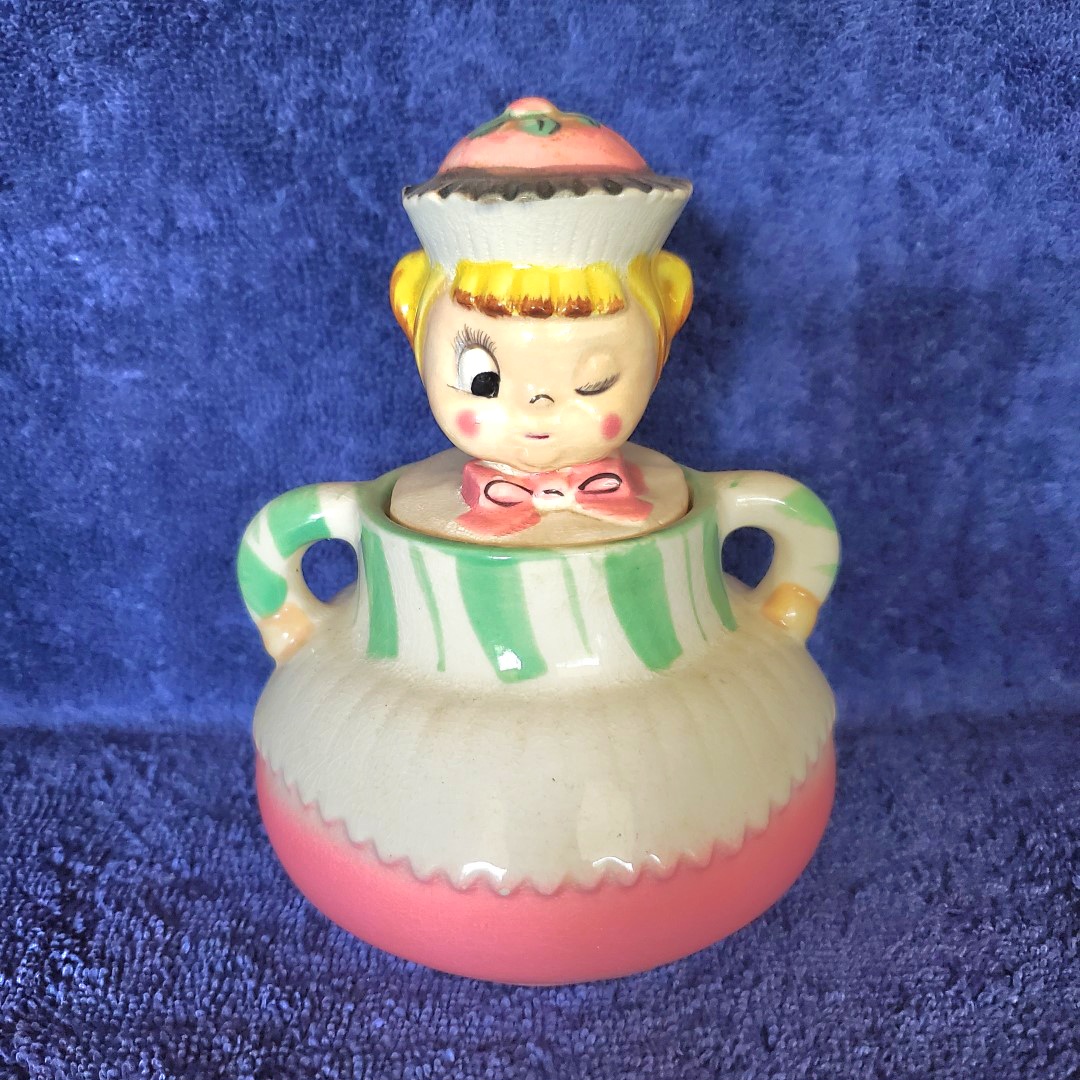
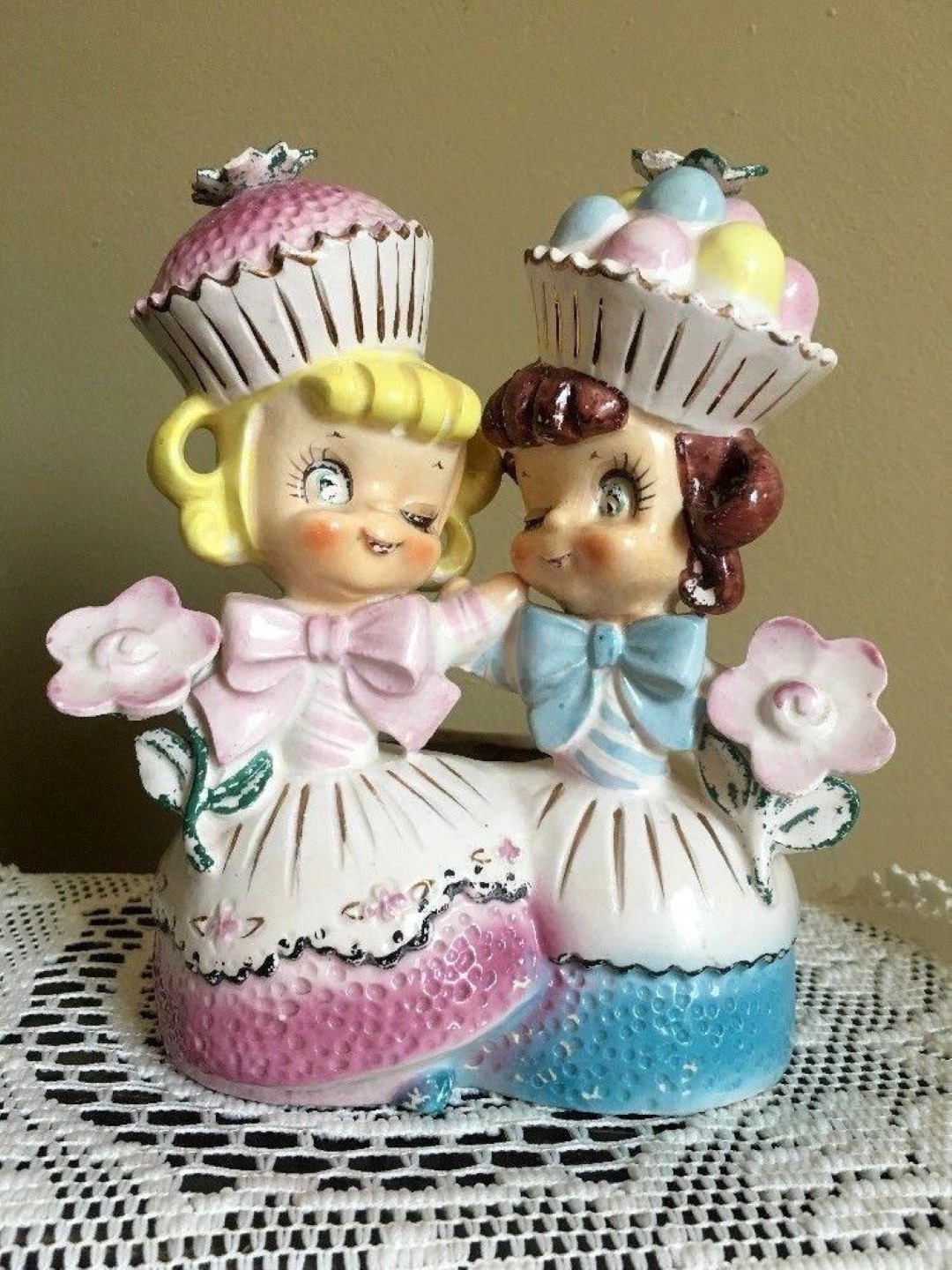
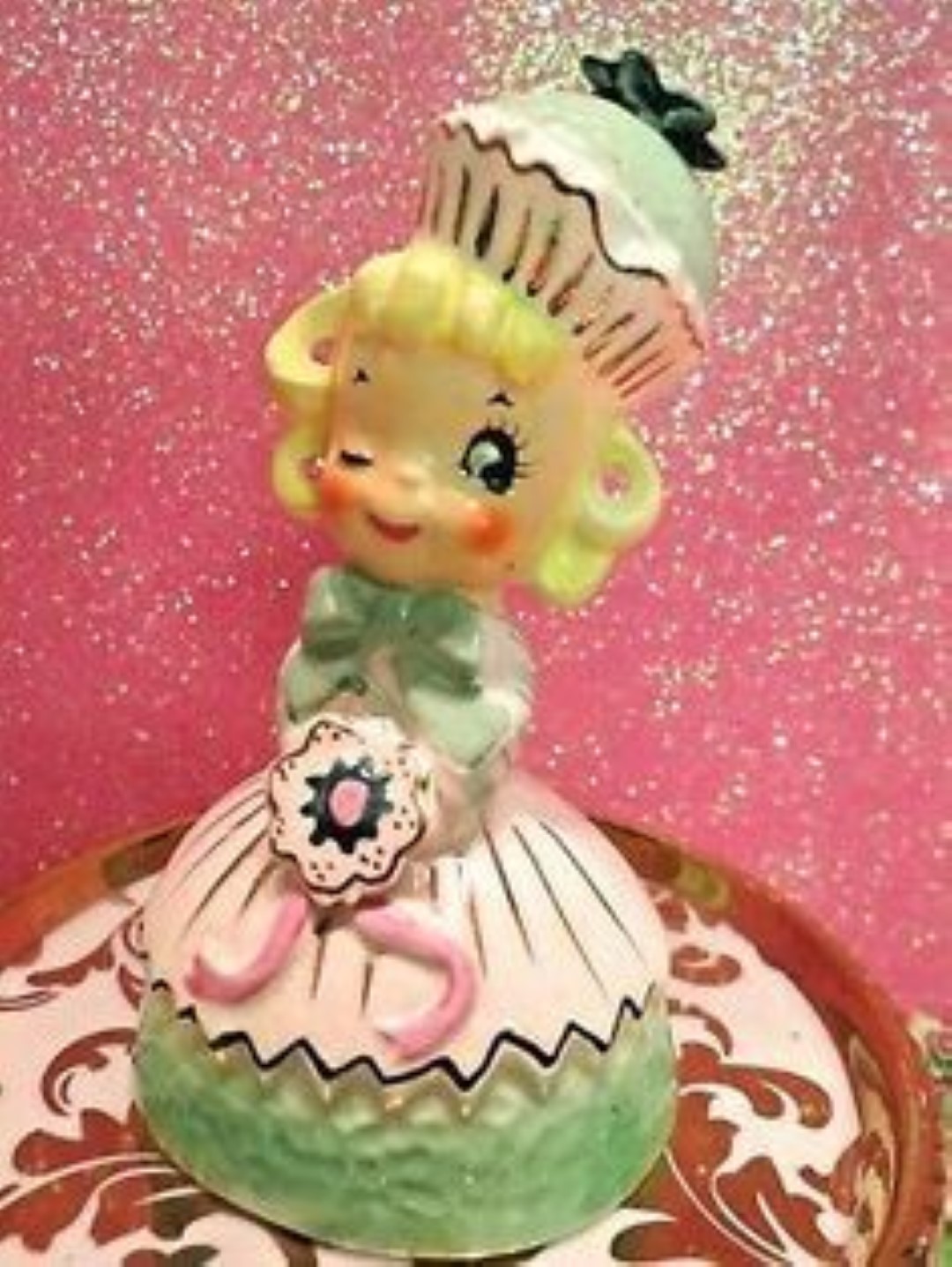
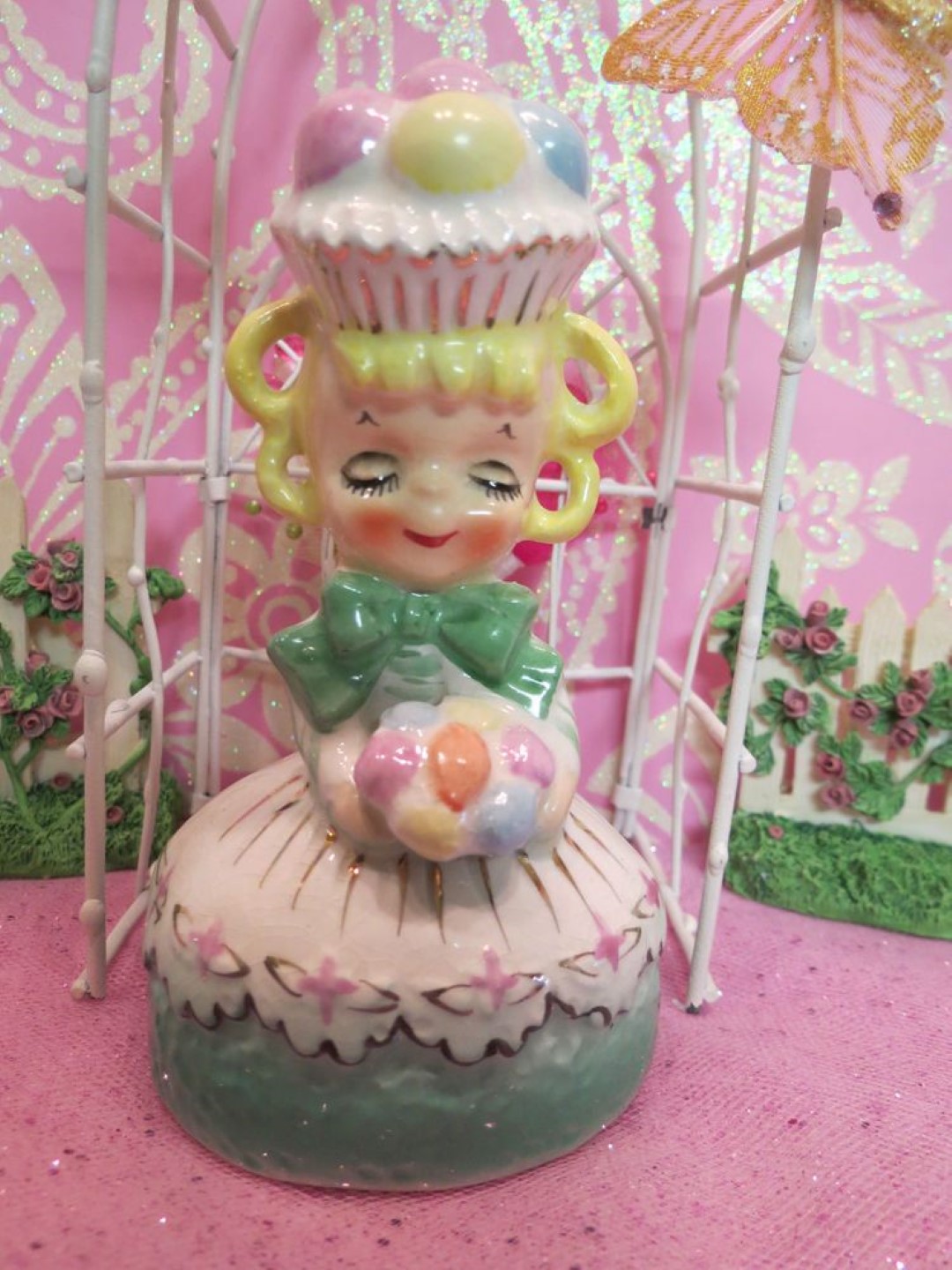
One of the more intriguing unidentified condiment jars is this charming winking girl commonly known among collectors as Cupcake Girl. Like the Blondies and Chef’s jars, she features an attached ceramic spoon and loop handles incorporated into the body of the jar. The lid depicts a blonde girl wearing what collectors have traditionally described as a cupcake on her head, although it may actually represent a pie. Despite the uncertainty, “Cupcake Girl” has become the accepted nickname for the piece and is retained here for ease of identification.
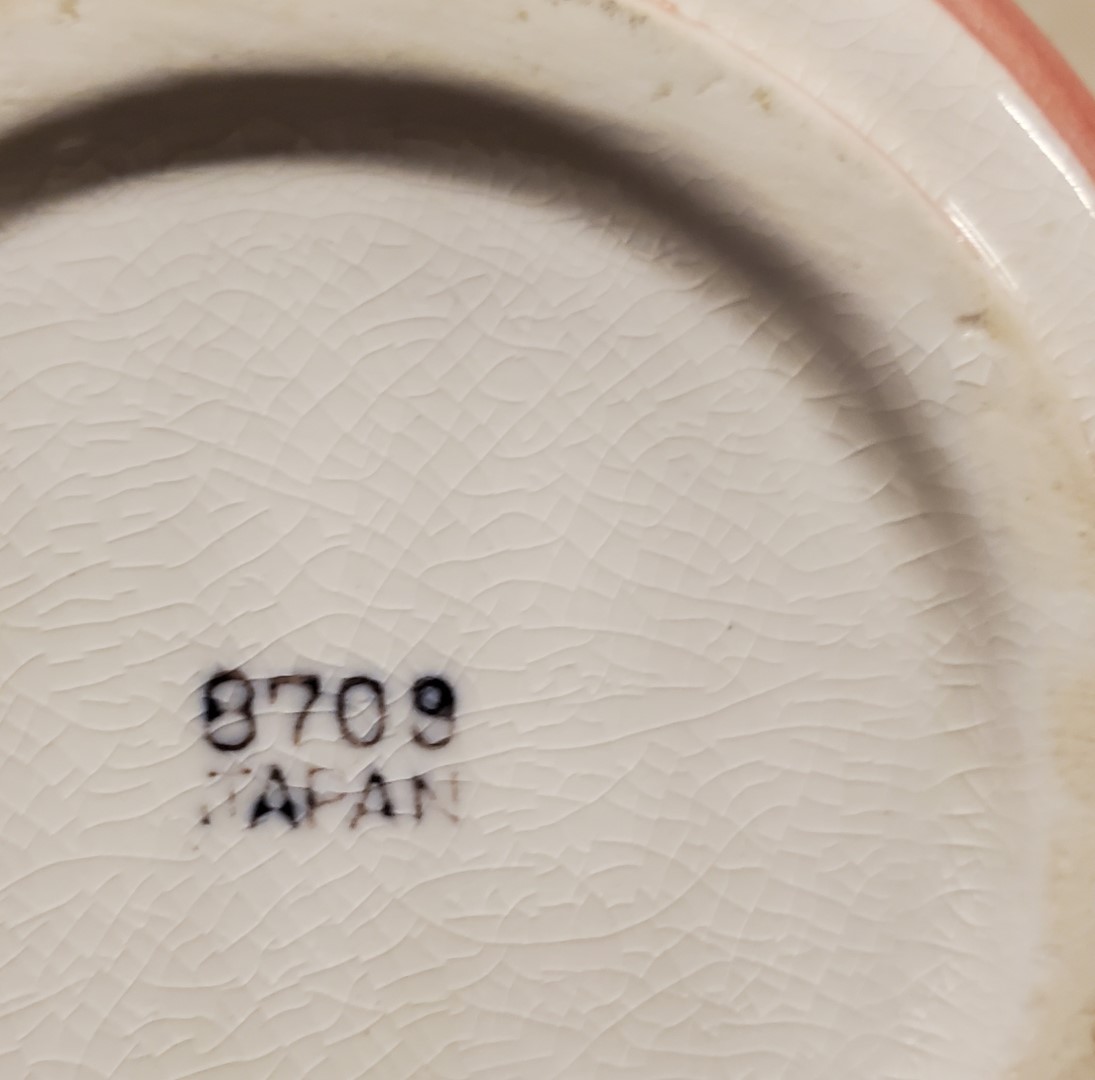
Although completely unmarked except for an inked production number, the jar bears a striking resemblance to Enesco’s Sweet Shoppe line of ceramic figurines produced during the late 1950s and early 1960s. The facial sculpt, winking expression, hairstyle, oversized bow, and pastry-themed headpiece closely resemble numerous documented Sweet Shoppe figures. While no documentation has yet surfaced connecting this condiment jar to Enesco, the similarities are substantial enough that an Enesco origin remains a distinct possibility.
Walter Dworkin illustrated this piece in the second edition of his guidebook under the name “Little Ms. Sweet Shop Sugar” and recorded the inked backstamp as 8700. Examination of the example illustrated here shows the backstamp clearly reads 8708, indicating the final digit was likely misread in the published guide.
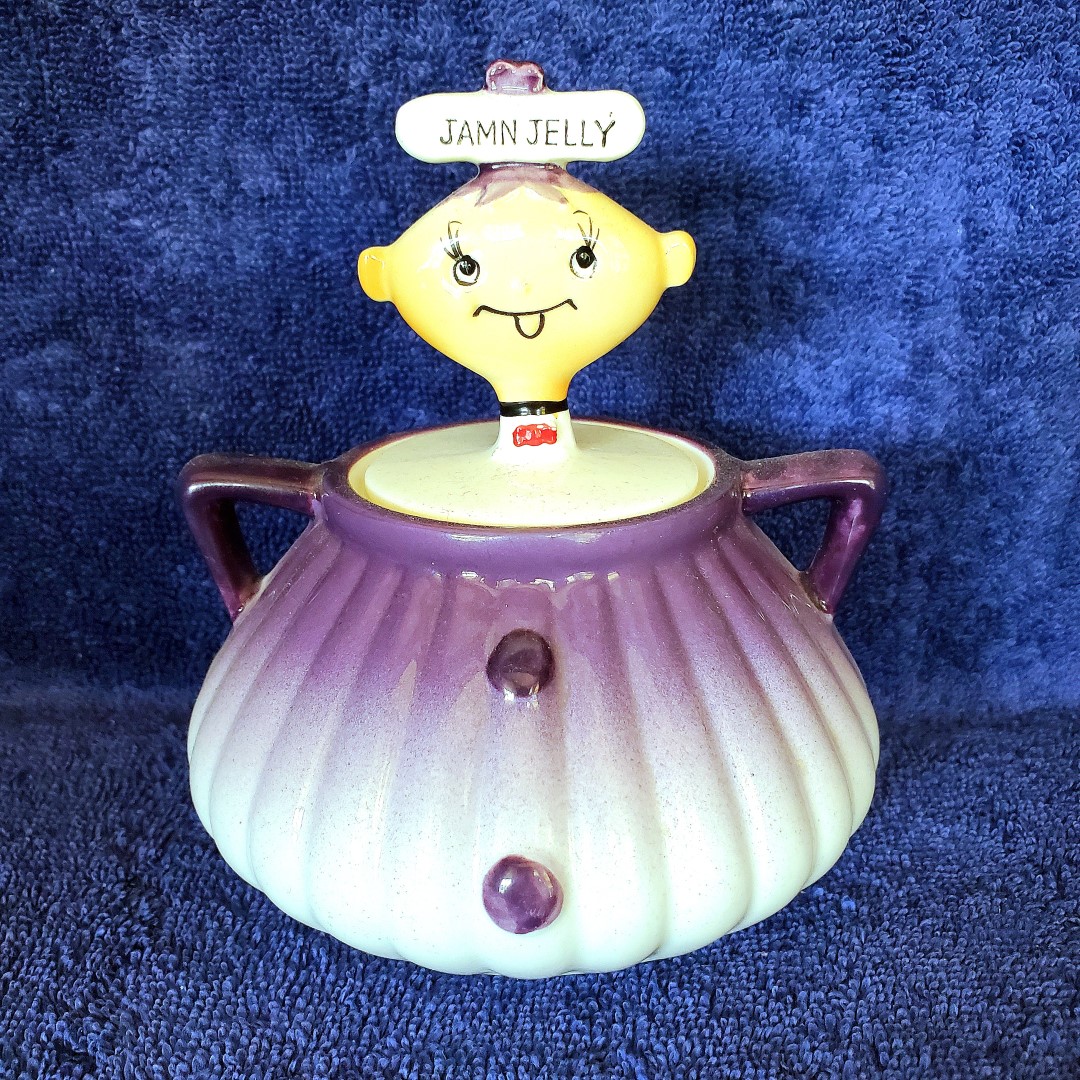
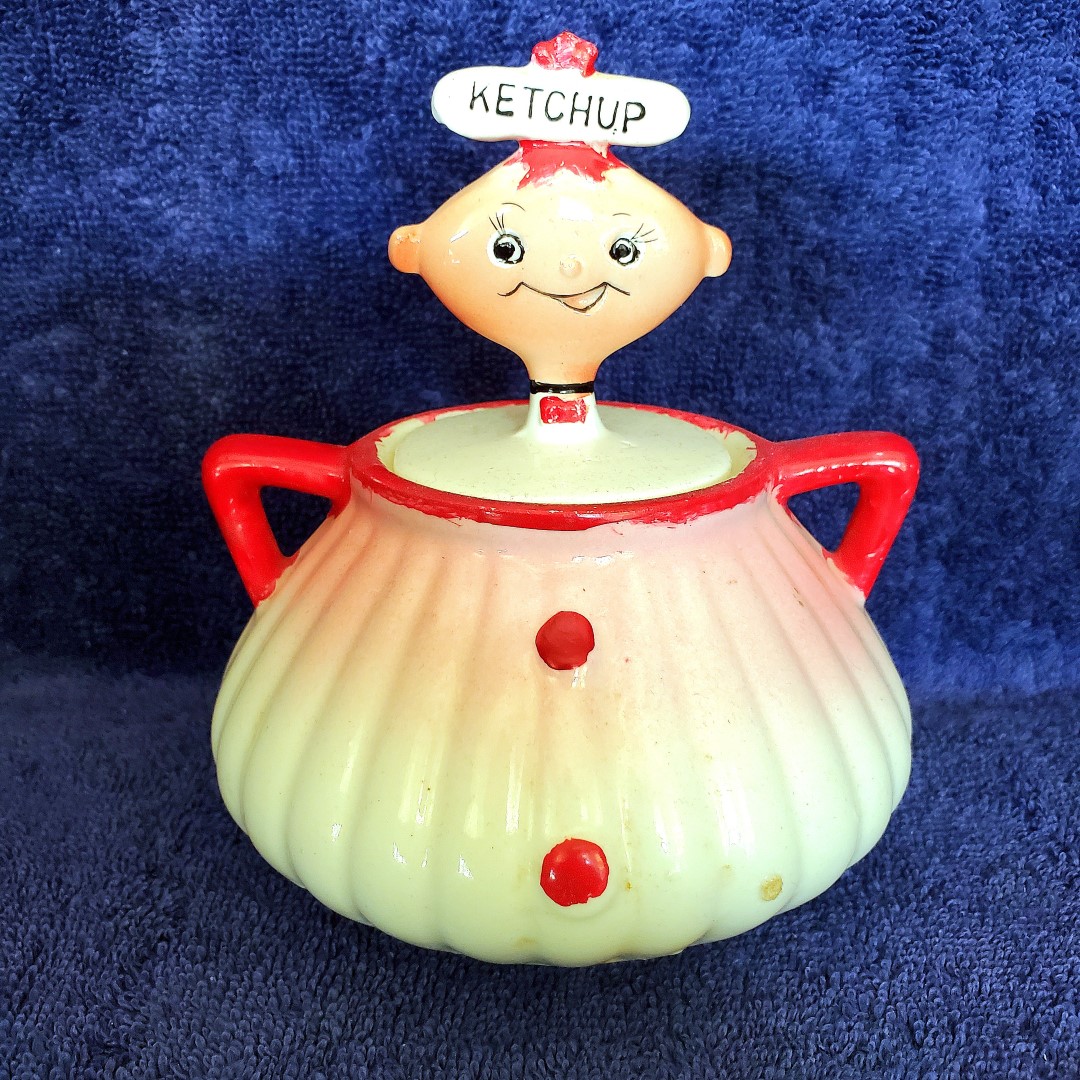
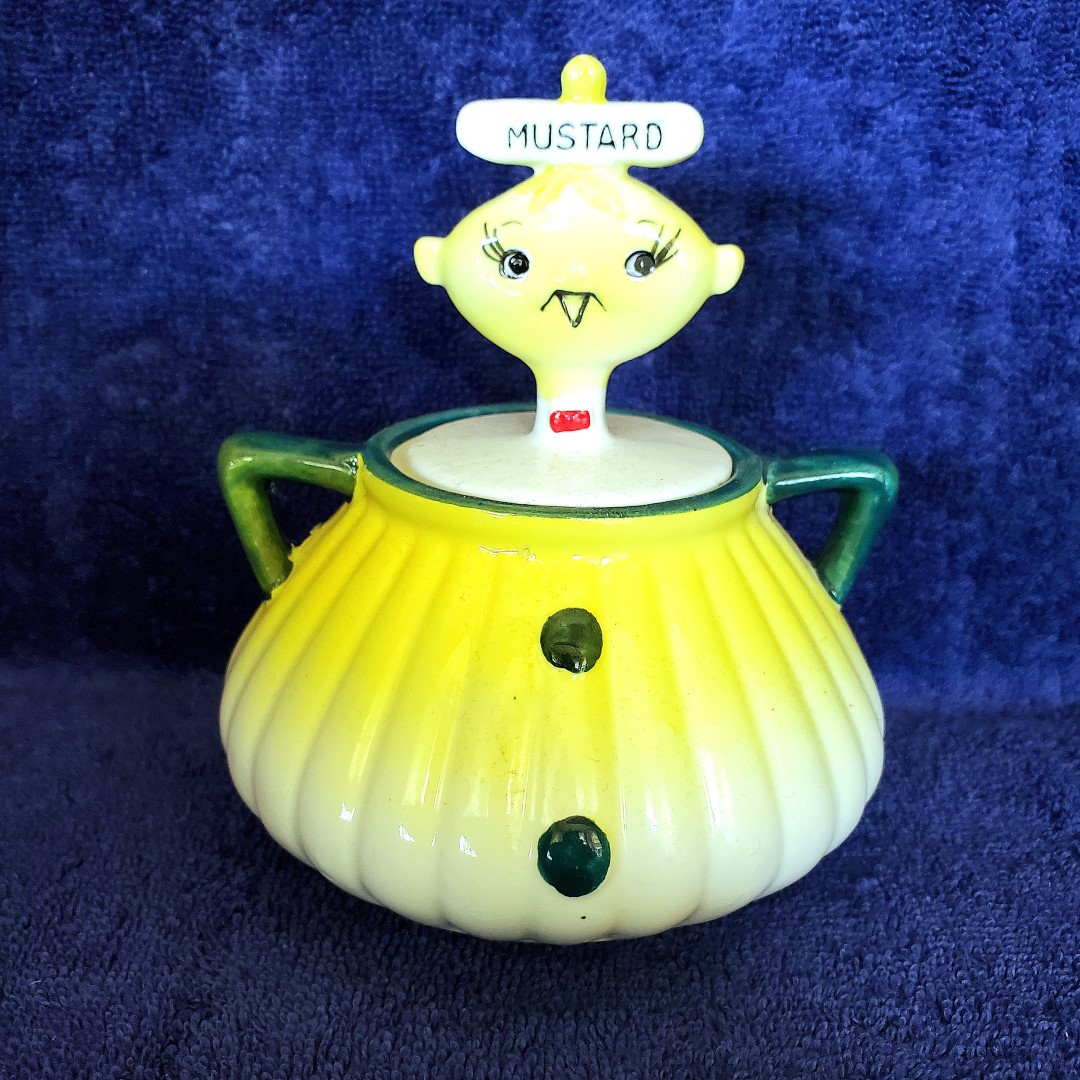
Fading Trio Jars
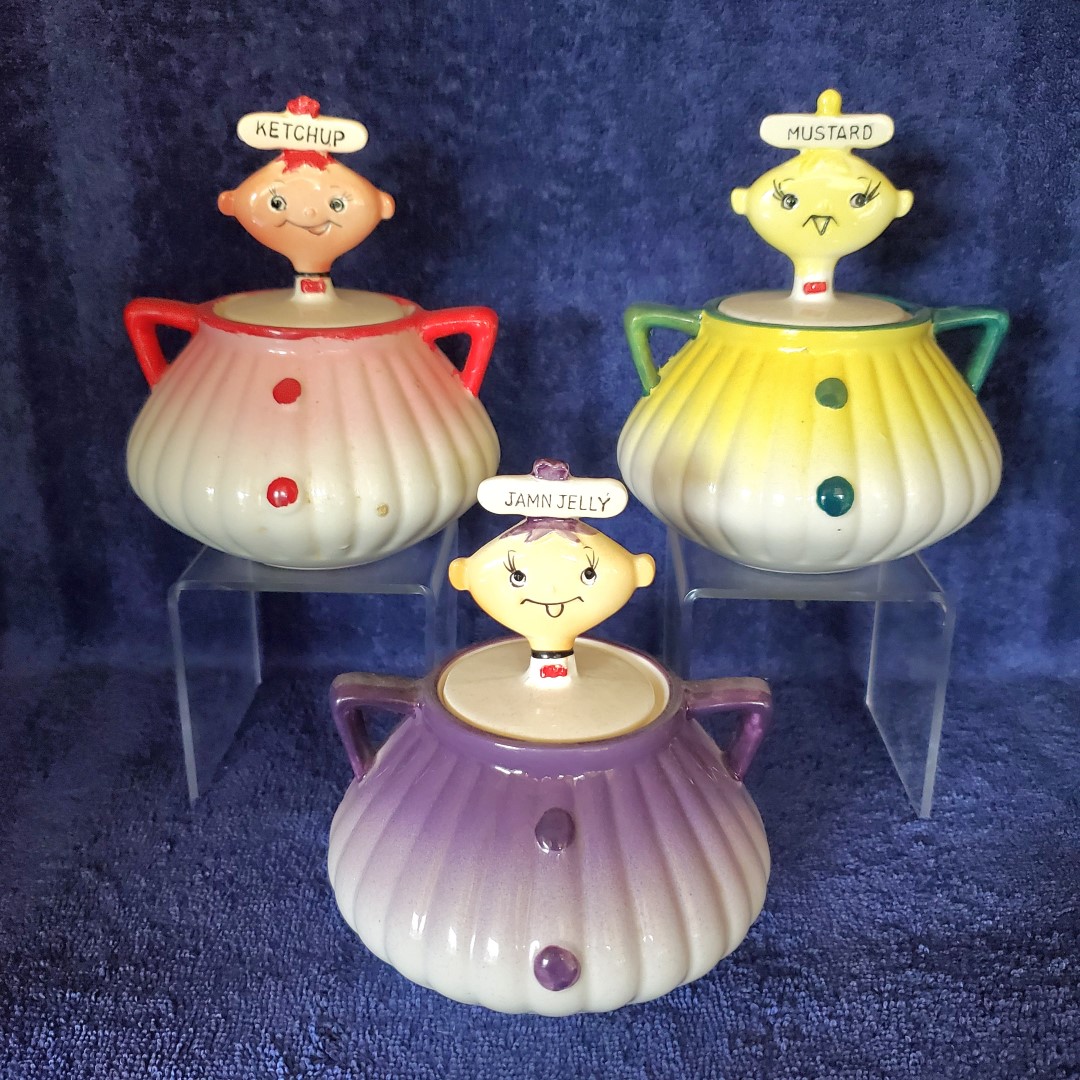
The Fading Trio Jars are a three-piece condiment set consisting of Ketchup, Mustard, and Jam ’n Jelly. The jars have also been described as the “Guy with Arm Handles” group. The Jam ’n Jelly example has a Pixieware-type hairdo and lettering atop the head similar to Holt Howard’s Pixieware liquor bottles. Each jar stands approximately 5¼ inches tall and is unmarked.
Although the arm-like handles are distinctive, the most striking visual feature of the set is the soft fade from color into white across the ribbed body of each jar. The Ketchup jar has red handles with matching red buttons, the Mustard jar has green handles with matching green buttons, and the Jam ’n Jelly jar has purple handles with matching purple buttons. Together, the three jars form a coordinated but still unidentified Japanese condiment set.
Research & Discoveries
No importer, manufacturer, catalog listing, or original packaging has yet been identified for the Fading Trio Jars. Based on the three known examples, the set appears to follow the standard mid-century condiment trio format of Ketchup, Mustard, and Jam ’n Jelly. The jars remain unmarked, leaving their origin unresolved for now.
Boy and Girl Jars (Empress by Haruta)
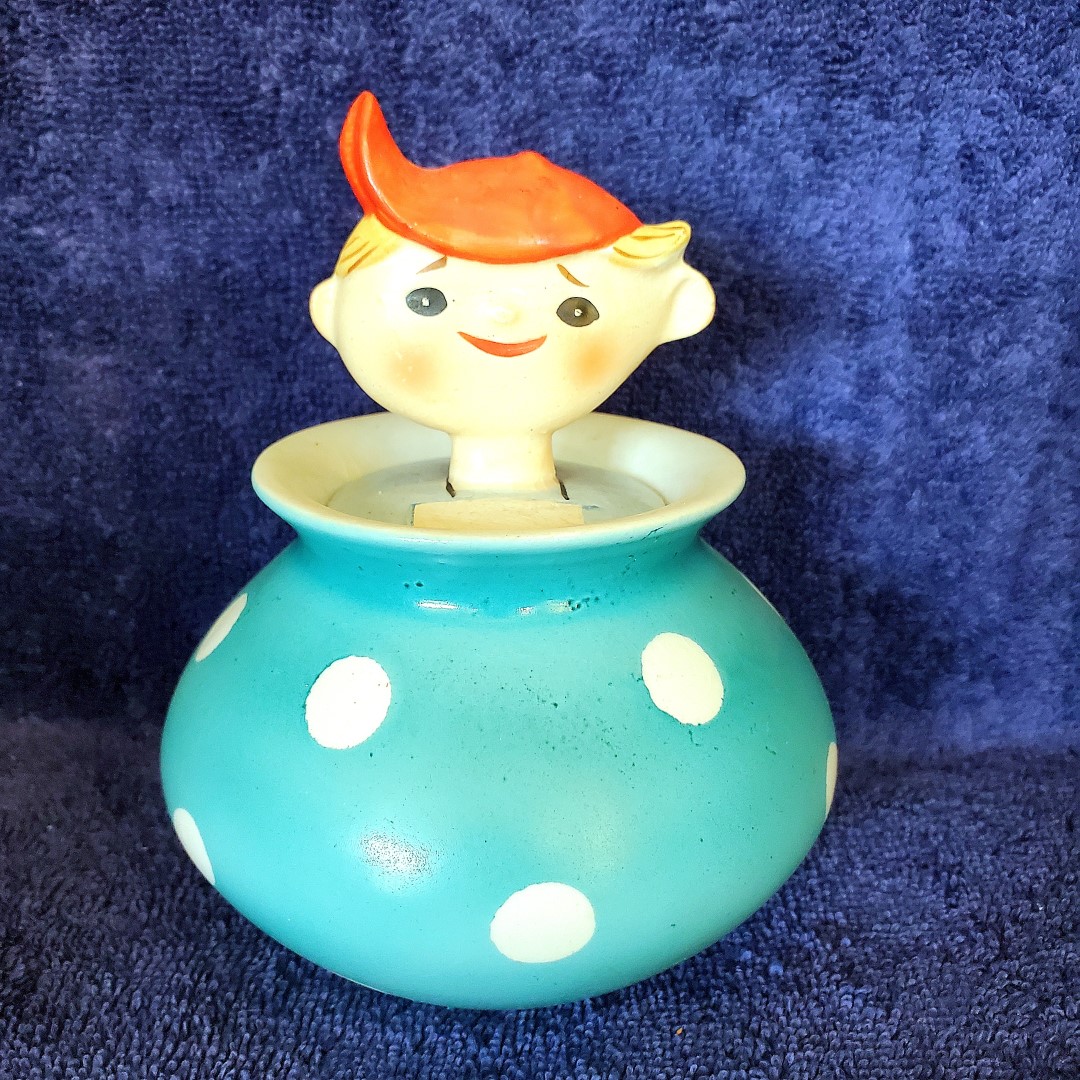
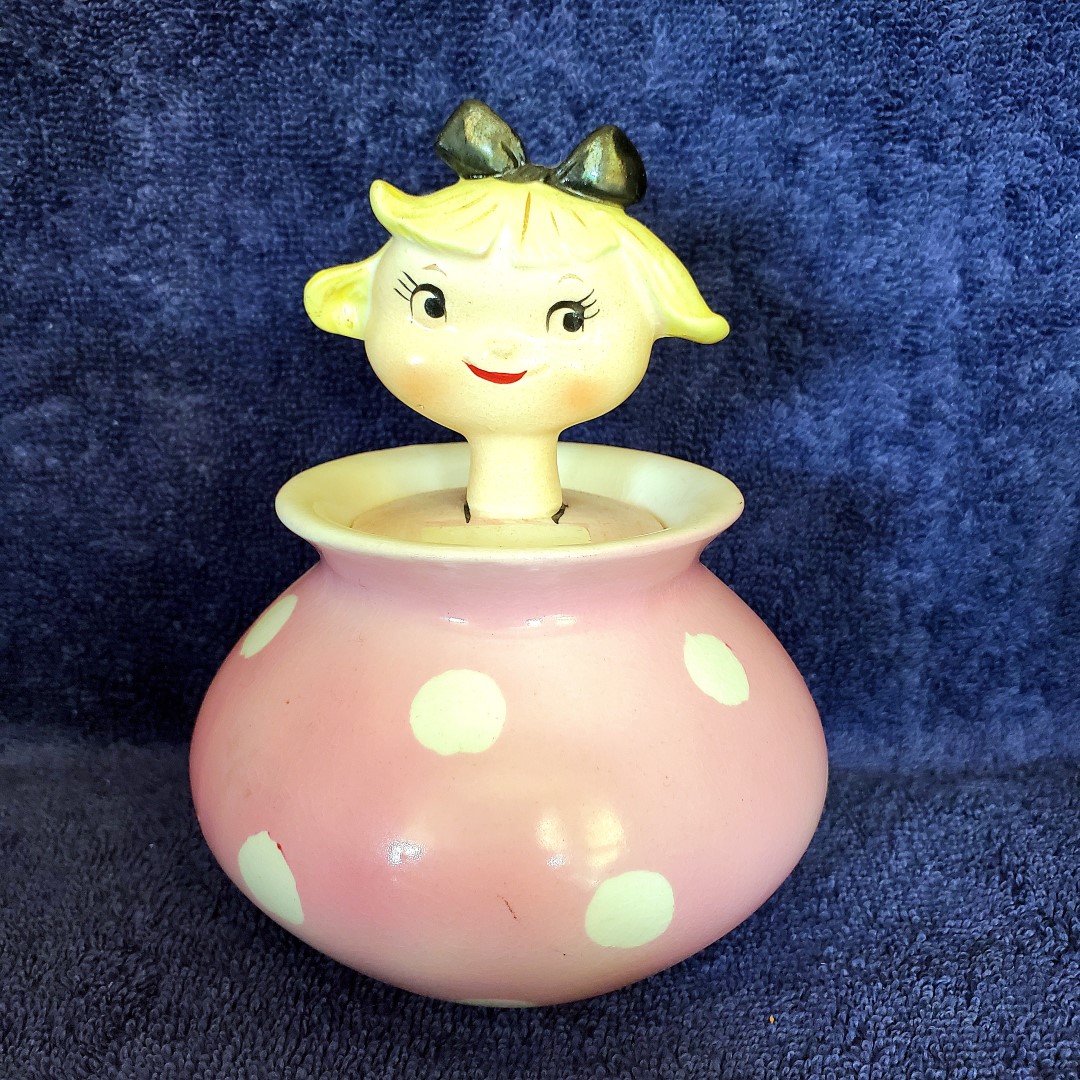
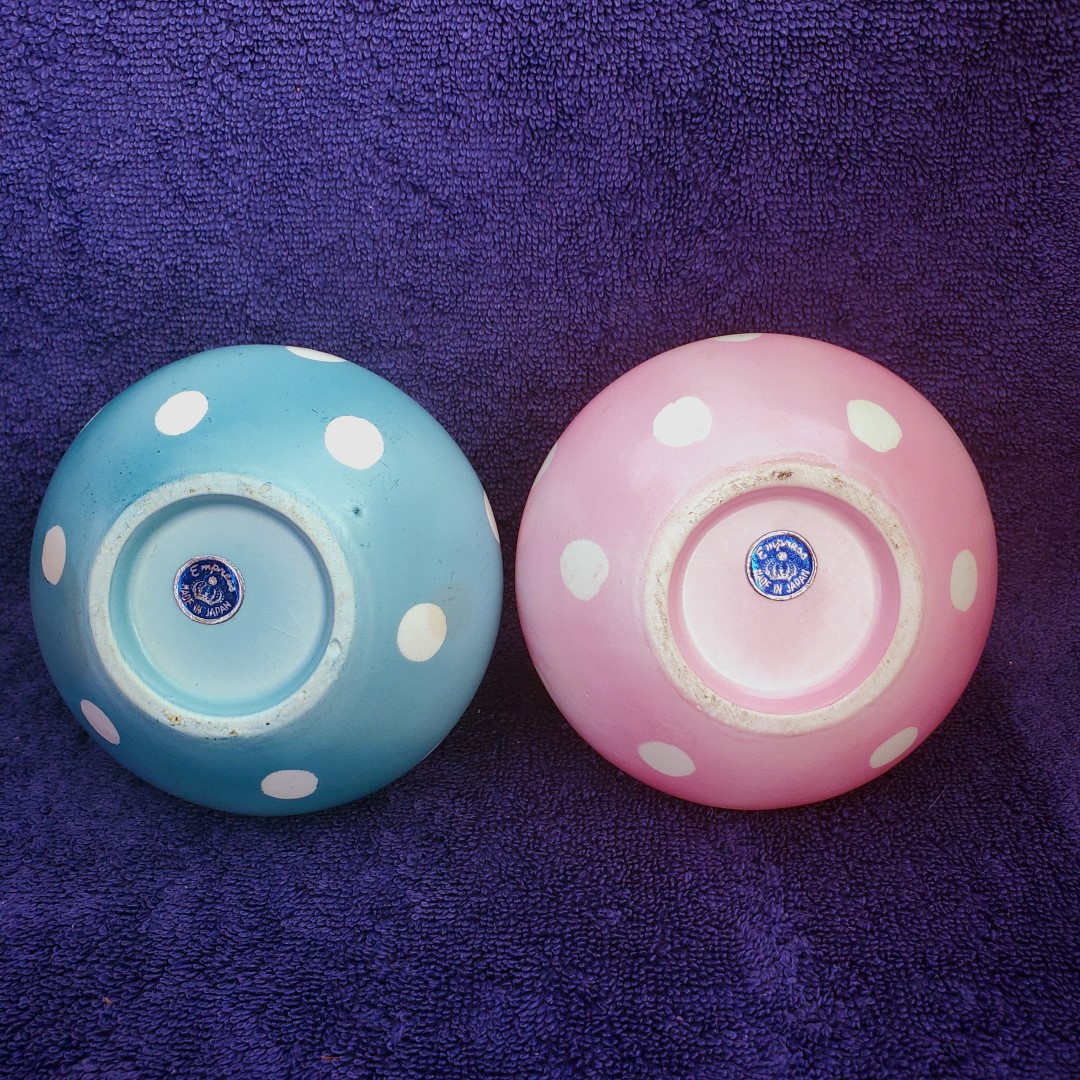
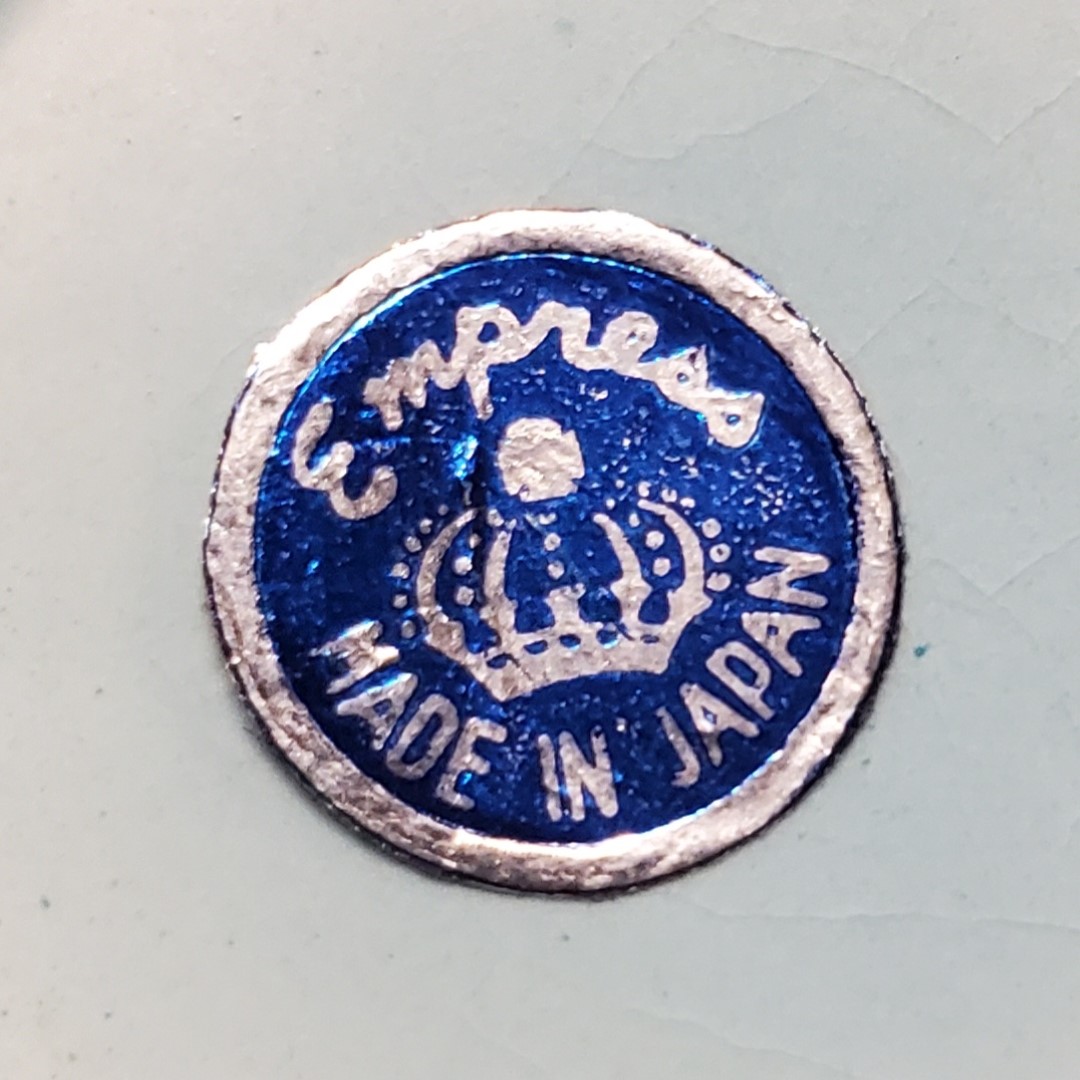
Among the more charming figural condiment jars produced in Japan during the late 1950s and early 1960s is this matching Boy and Girl pair. The jars feature complementary blue and pink color schemes, identical polka-dot bodies, loop handles, and character head lids. Each originally included a narrow ceramic spoon attached beneath the lid, and both examples retain their original round blue-and-gold Empress Made in Japan foil labels.
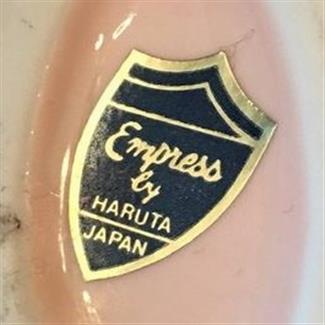
Although the jars themselves identify only the Empress trade name, subsequent collector research has established that Empress was a line or division of Haruta. Surviving shield-shaped foil labels from other pieces in the same giftware line clearly read “Empress by Haruta,” providing the strongest evidence to date that these condiment jars were imported and marketed under the Haruta name. The matching typography, blue-and-gold color scheme, and overall label design leave little doubt that the round Empress labels found on these jars represent an earlier or alternate version of the same branding.
Like many of the figural condiment jars featured in this section, no original catalog, advertisement, or product literature has yet been located. As a result, the intended contents of the Boy and Girl jars remain unknown, although their matching design makes it clear they were conceived and marketed as a companion pair.
Research & Discoveries
The connection between Empress and Haruta was established through comparisons with surviving foil labels from other documented pieces in the Empress giftware line. While the Boy and Girl jars themselves carry only the circular Empress Made in Japan label, the shield-shaped “Empress by Haruta” labels provide a direct link between the Empress trade name and the Haruta importer. Including both label styles here documents an important piece of collector research and helps establish the provenance of this otherwise little-known condiment jar pair.
Mr. Impersonator
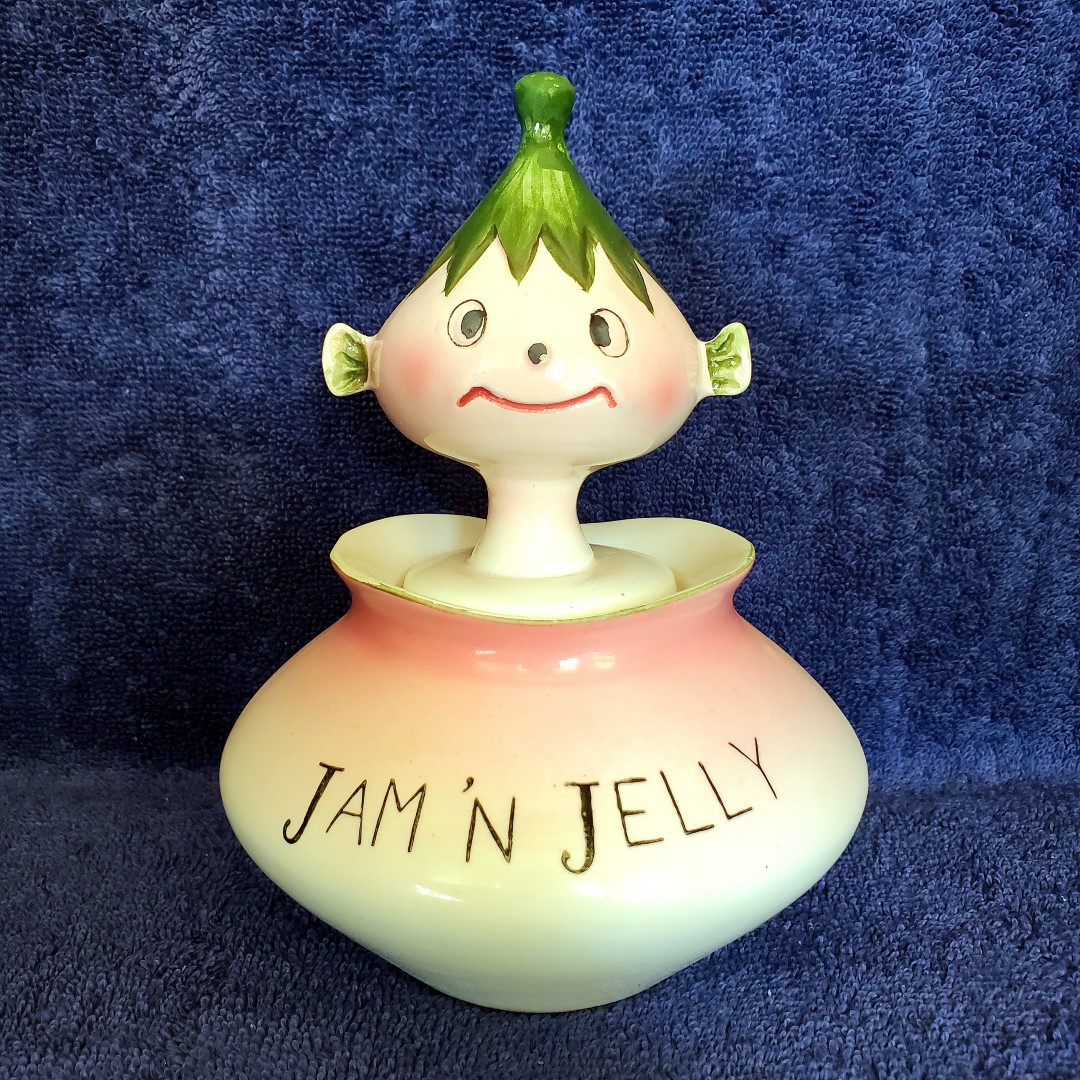
Among the more unusual figural condiment jars produced during the late 1950s is the whimsical Jam ’n Jelly jar affectionately known to collectors as Mr. Impersonator. The nickname, coined by Walter Dworkin, reflects the jar’s obvious resemblance to Holt Howard’s Pixieware line. With his pointed green topknot, oversized ears, rosy cheeks, and mischievous smile, he unmistakably evokes the look of a Pixie, yet differs enough in his proportions and construction to stand on his own as an original design.
Unlike Holt Howard’s Jam ’n Jelly jar, Mr. Impersonator features a smooth, rounded body with softly blended pink shading rather than vertical striping. The lid contains a cork gasket to help keep contents fresh, eliminating the need for the integrated spoon found on Holt Howard examples. A thin green band around the rim echoes the color of the character’s hair and ears, providing a subtle finishing detail.
The jar is completely unmarked, and no importer, manufacturer, or original advertising has yet been identified. The jar measures approximately 6½ inches tall, making it slightly taller and noticeably wider than Holt Howard’s Jam ’n Jelly jar.
Research & Discoveries
Walter speculated that Mr. Impersonator may have been produced in very limited numbers or perhaps never advanced beyond a prototype. While relatively few examples have surfaced over the years, enough are now known to confirm that it was a production piece rather than a one-of-a-kind sample. Even so, it remains one of the scarcer Japanese Pixieware-inspired condiment jars and is seldom encountered in the marketplace.
Samurai Jars
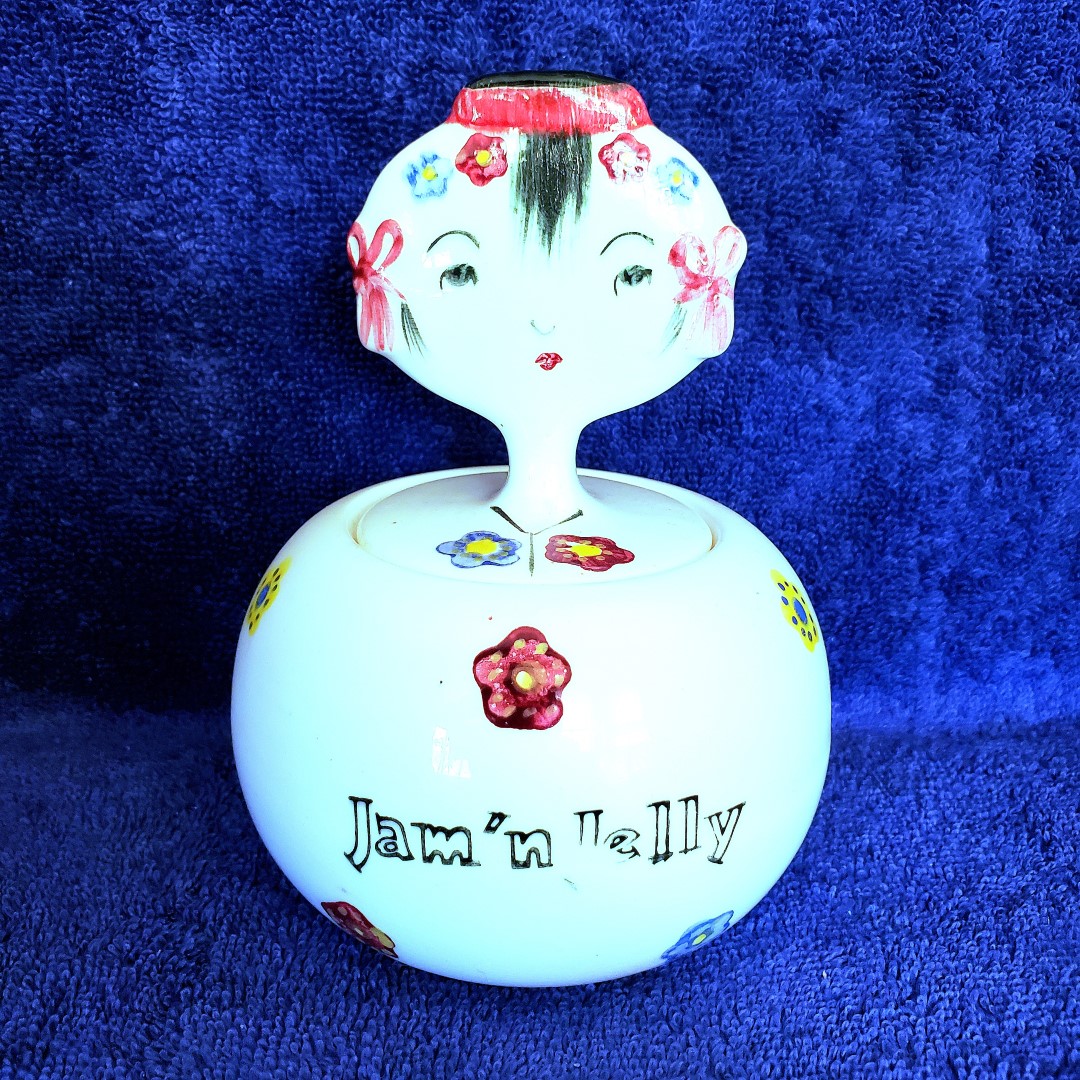
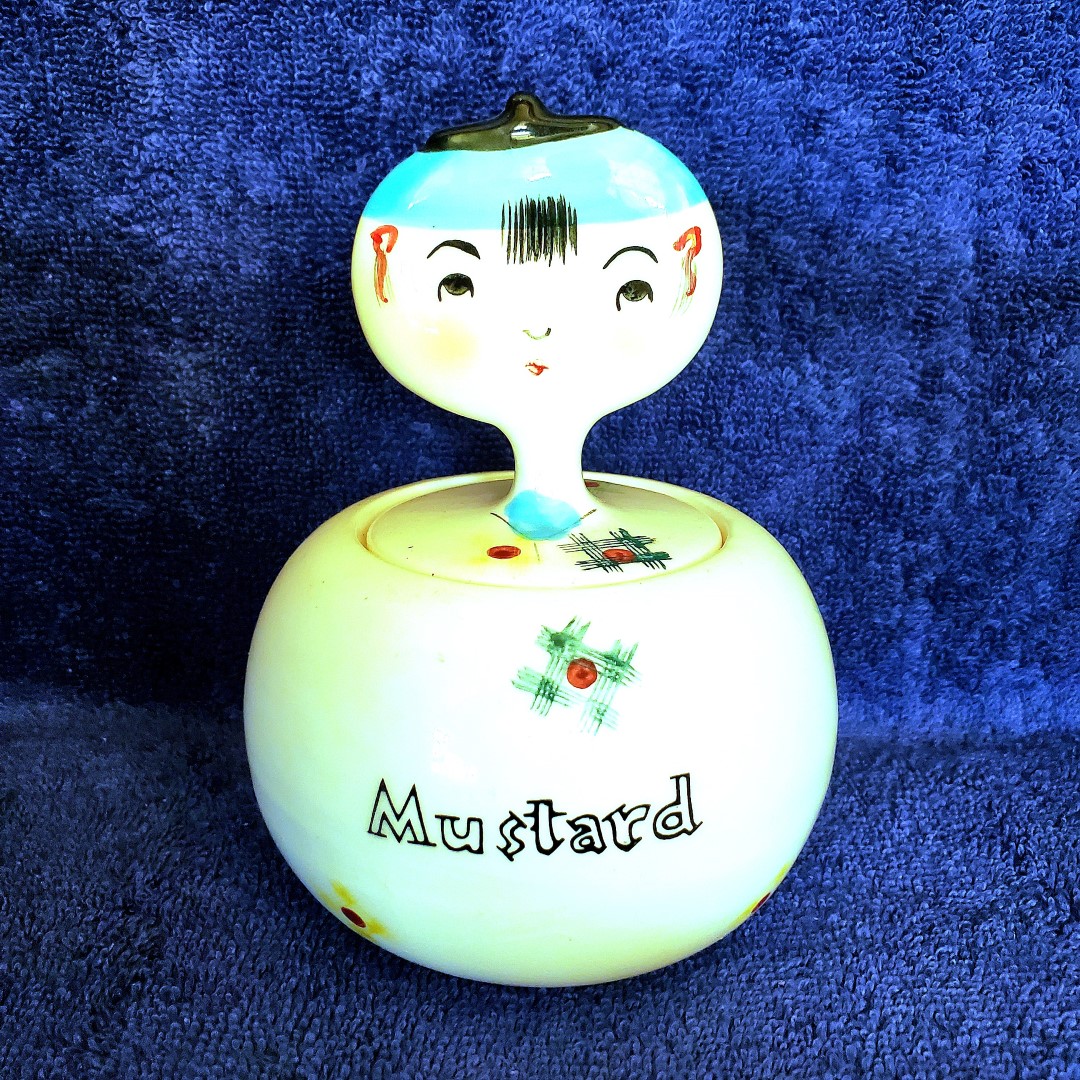
This attractive pair of figural condiment jars features stylized Japanese boy and girl character lids atop matching polka-dot bodies finished in blue and pink. The Jam ’n Jelly jar is decorated in crimson red, while the Mustard jar is finished in a medium powder blue—an unexpected color choice that suggests the series did not follow the color conventions typically associated with condiment jars of the period.
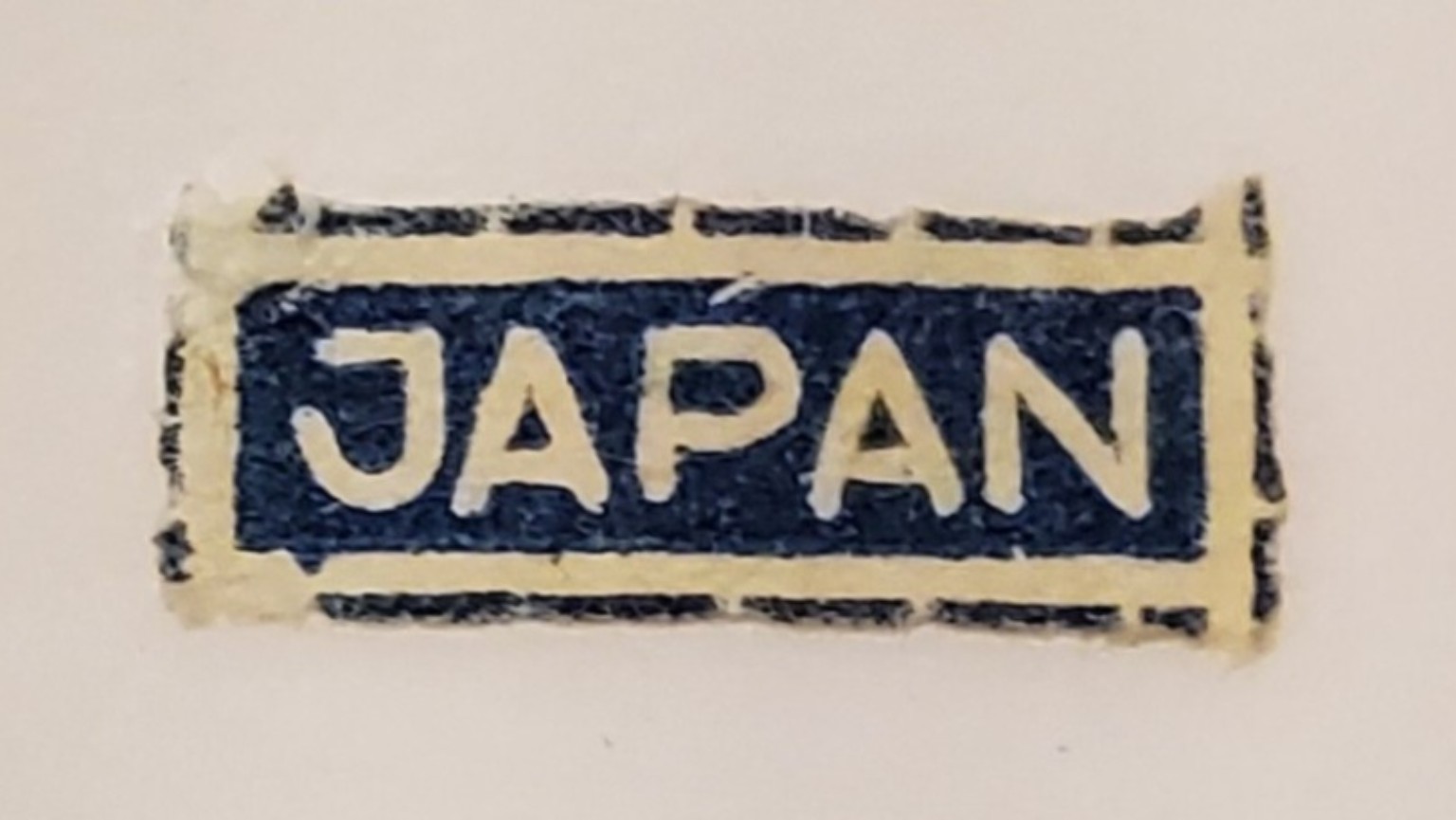
Both jars are unmarked except for a simple rectangular Japan paper label found on the underside of the Jam ’n Jelly example. No importer, manufacturer, or catalog documentation has yet been identified, leaving the origin of the series unknown.
Research & Discoveries
Only the Jam ’n Jelly and Mustard jars have been documented to date. Given the prevalence of Jam ’n Jelly, Ketchup, and Mustard three-piece condiment sets during the late 1950s and early 1960s, it seems likely that a matching Ketchup jar may also exist, although no example has yet been confirmed. If such a jar is eventually discovered, its color scheme remains impossible to predict, as the existing pair does not follow the color conventions normally associated with their contents.
The surviving rectangular Japan label provides only a country of origin and offers no clues regarding the importer or manufacturer. Until additional examples or period documentation surface, the Samurai jars remain among the more enigmatic figural condiment jars produced in Japan during the era.
Final Thoughts
Although these jars may never achieve the recognition of Holt Howard’s Pixieware or other well-known Japanese novelty ceramics, they remain an important part of the collecting landscape. Each represents another attempt by Japanese importers to capture the popularity of whimsical figural kitchenware during the late 1950s and early 1960s. As additional examples continue to surface, collectors will undoubtedly uncover new variations, identify previously unknown companion pieces, and perhaps even solve some of the mysteries that still surround these charming, largely anonymous creations.
The next section of the archive returns to Holt Howard, exploring a variety of the company’s other collectible lines beyond Pixieware. Some, such as Cozy Kittens, Coq Rouge, and Merry Mice, are among Holt Howard’s most recognizable creations, while others—including Crazy Clips, Applejack, Blueberry, Bucks County, Little Bo Peep/Peepin’ Tom & Tweetie, and the never fully produced Kitchen Cubs—offer a broader look at the remarkable creativity that made Holt Howard one of the most innovative names in mid-century American giftware.