Lipper & Mann Flower Girls
A tightly unified line of flowerpot-bodied condiment jars, cruets, shakers, and table pieces from Lipper & Mann.
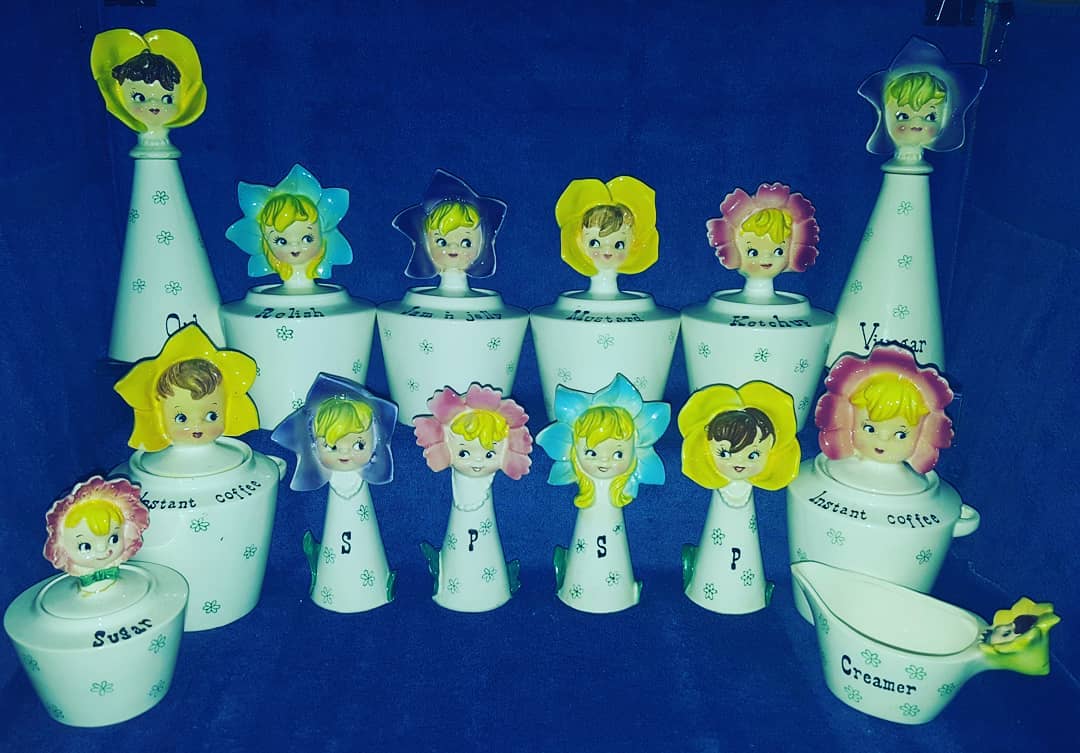
Lipper & Mann was organized in New York in 1946 by Hal Lipper and Seymour Mann as an importer of fine glass and ceramic items from Czechoslovakia and other European countries. The company operated from a showroom at 225 Fifth Avenue in New York, selling imported giftware to department stores, independent shops, jewelry stores, and home-furnishing retailers.
In 1949, Lipper & Mann began importing porcelain and earthenware items from Japan, including figurines, teacups and saucers, tea kettles, dinnerware sets, and other tableware. The company's Flower Girls condiment line belongs to this postwar period of Japanese novelty ceramics, when American importers were commissioning whimsical kitchen and tableware lines for the gift market.
The Flower Girls are among the most cohesive of the competitor lines documented in this section of the Archive. Each piece uses a white flowerpot-like base decorated with small green six-petaled daisies, while the lids take the form of girls' faces framed by oversized flower bonnets. The result is a line that does not imitate Holt Howard Pixieware directly, but clearly belongs to the same broader world of mid-century Japanese character ceramics.
Research & Discoveries: Correct Pairings and Mixed-Up Tops
Because the Flower Girls line does not use strict color coordination between lids and bases, collectors sometimes place the flower-head lids on the wrong jars. The correct pairings shown in this Archive follow the documented Lipper & Mann line and are confirmed by comparison across the complete set.
This is especially important because several jars share the same basic body mold, and the red ink numbers identify the ceramic form rather than a unique condiment. The flower bonnet, facial design, lettering on the base, and overall product context all need to be considered together when matching tops and bases.
Standard Condiment Jars
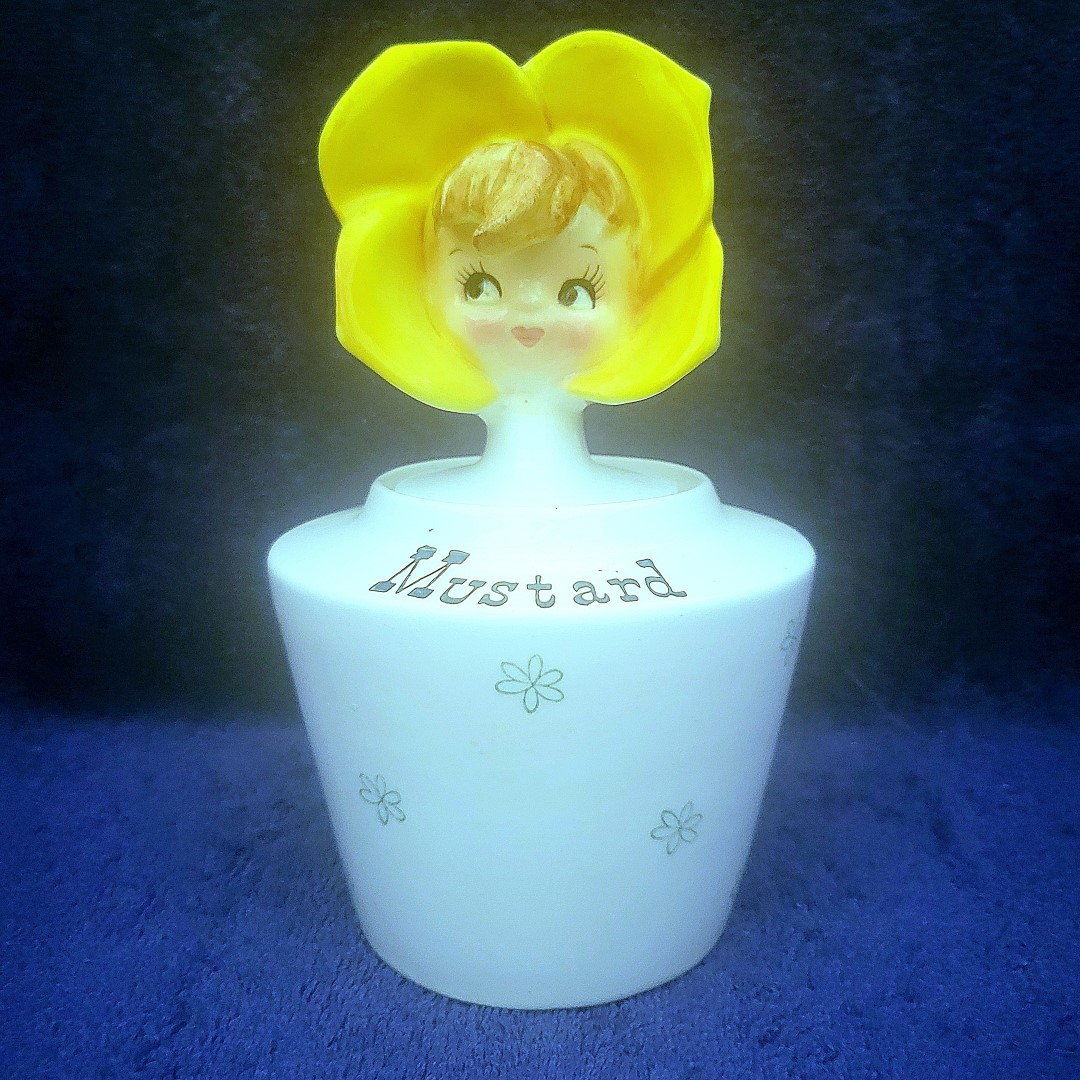
Mustard
Ms. Mustard has a four-petaled yellow flower bonnet and a built-in ceramic spoon beneath the lid. Like several of the standard condiment jars, she uses the same flowerpot body mold as other pieces in the line while varying the front lettering and flower-head design.
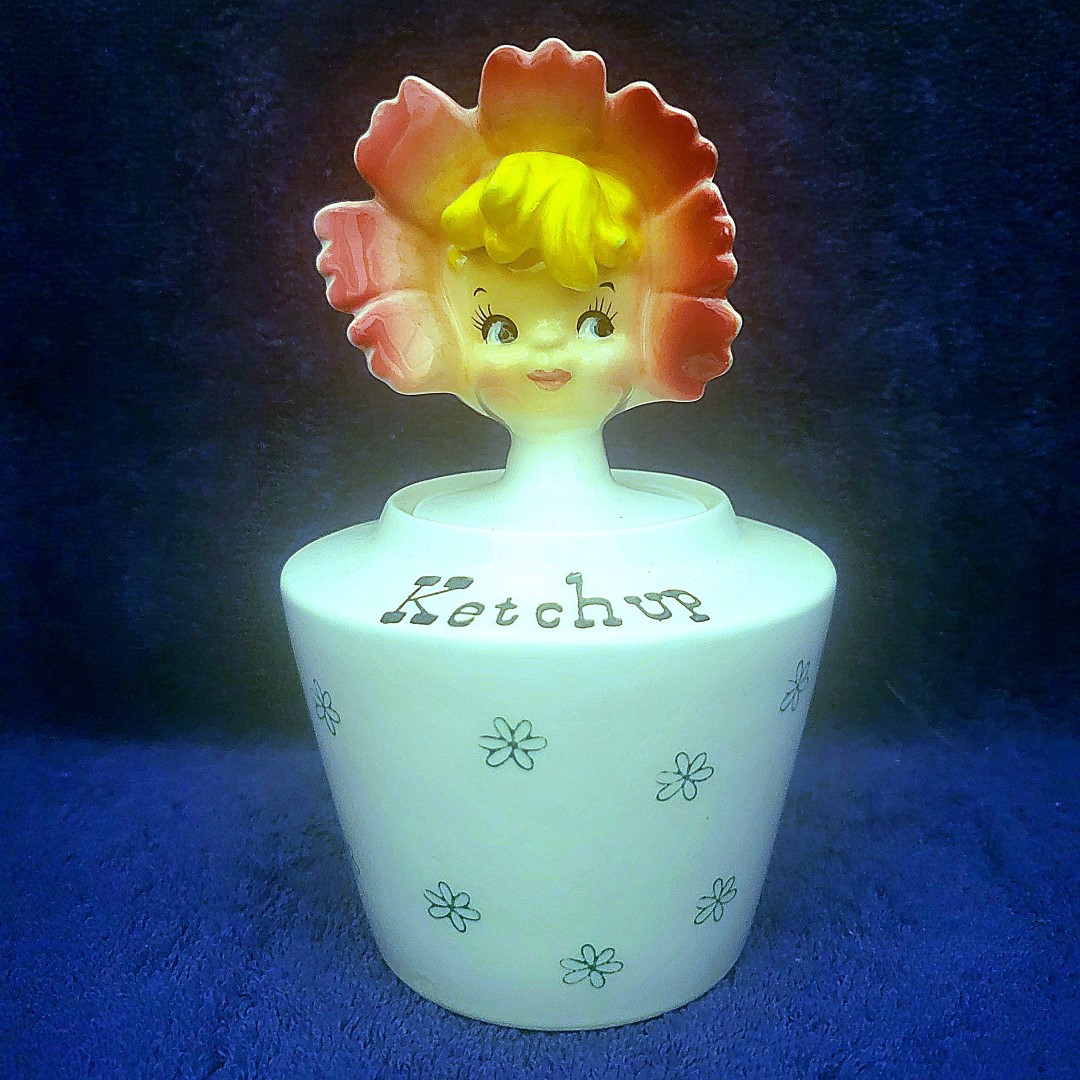
Ketchup
The Ketchup jar is a companion to Mustard and uses the same general body form, spoon arrangement, and red ink mold-form number. Her seven-petaled pink flower bonnet gives her a distinct personality while preserving the shared family look of the line.
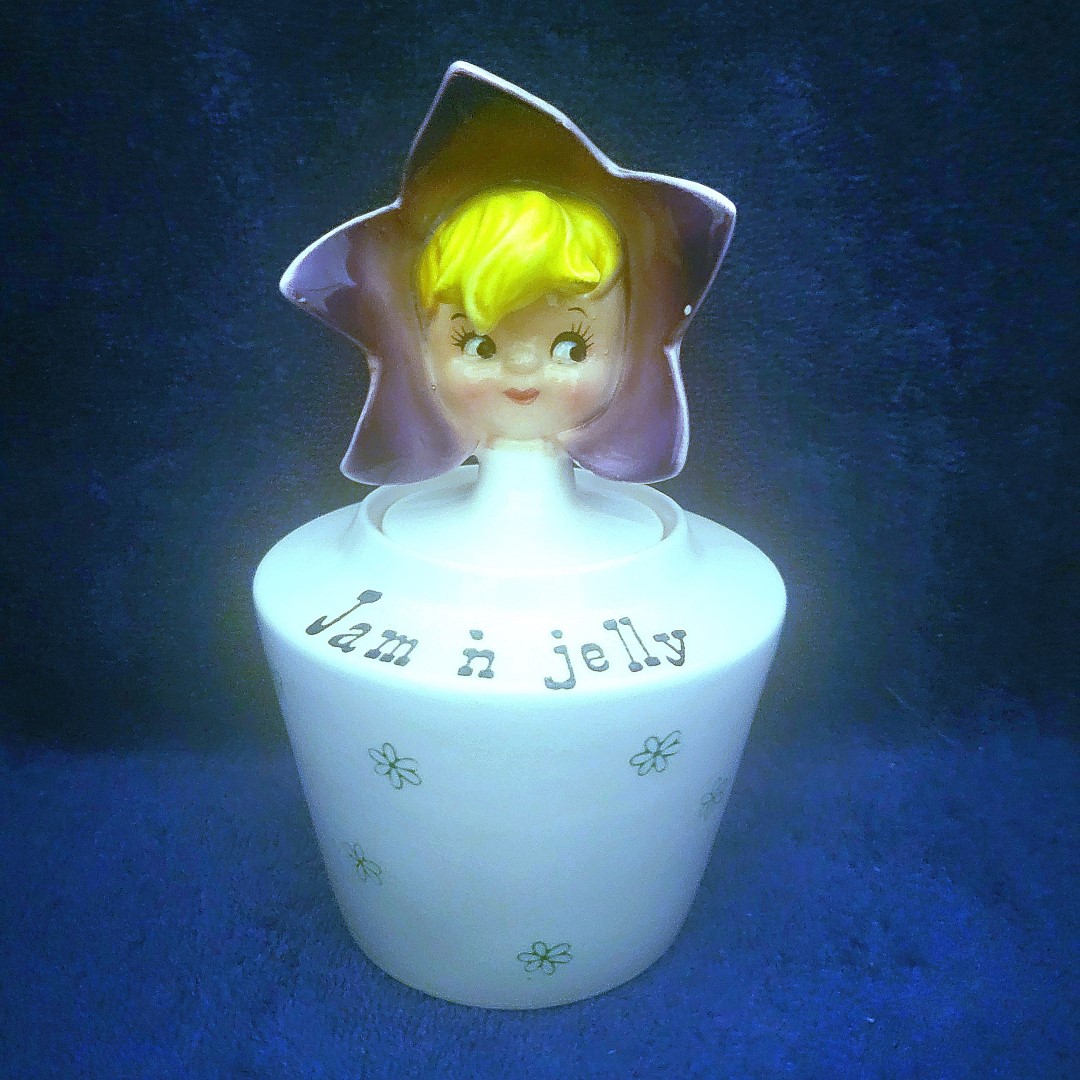
Jam 'n Jelly
Ms. Jam 'n Jelly wears a five-petaled purple flower bonnet. Although the product name differs from Mustard, Ketchup, and Relish, the jar shares the same basic body mold and the same red ink 23/71 number.
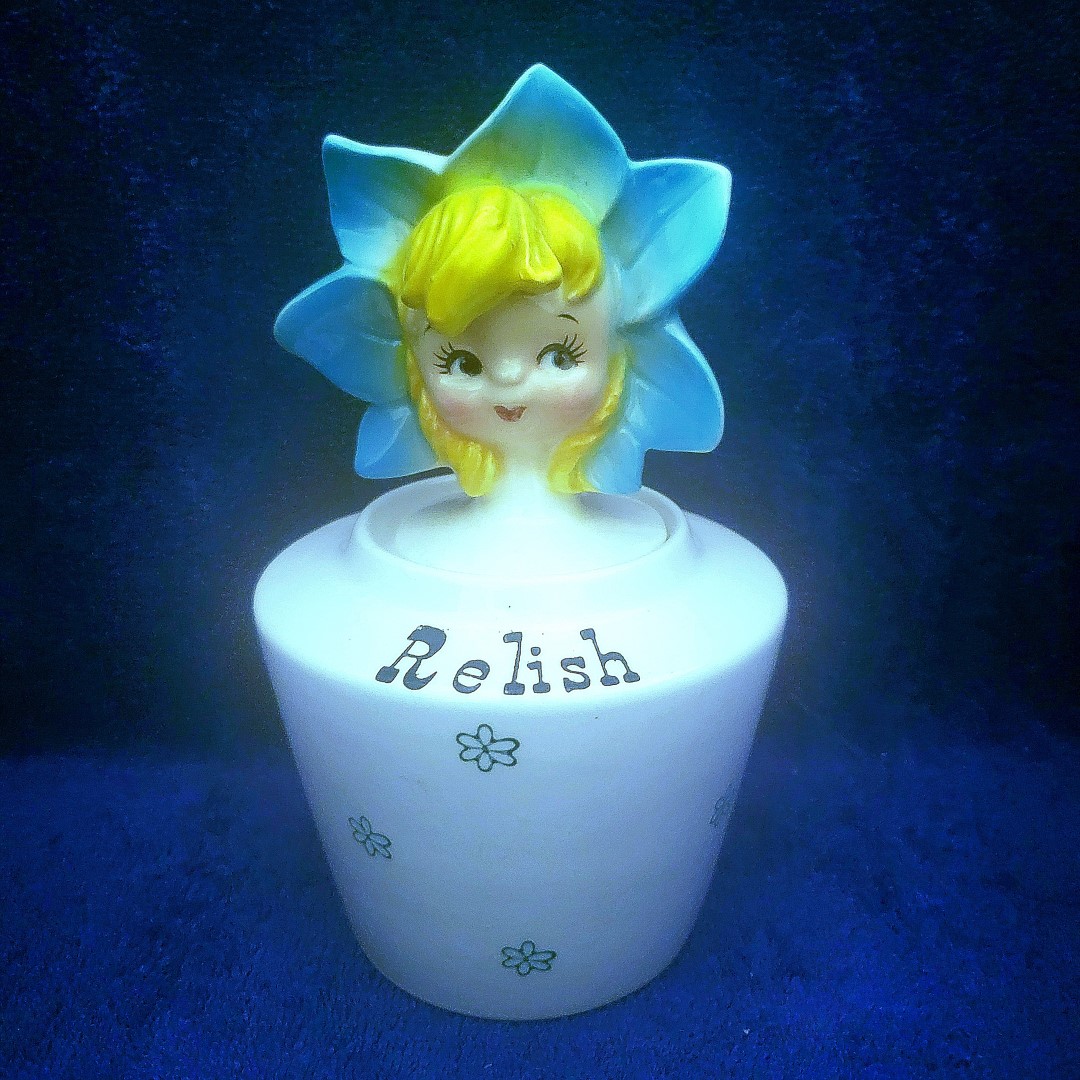
Relish
The Relish girl wears a vibrant seven-petaled blue flower bonnet. She belongs to the same 23/71 mold-form group as Mustard, Ketchup, and Jam 'n Jelly, further demonstrating Lipper & Mann's reuse of shared ceramic forms across different condiment labels.
Table and Serving Pieces
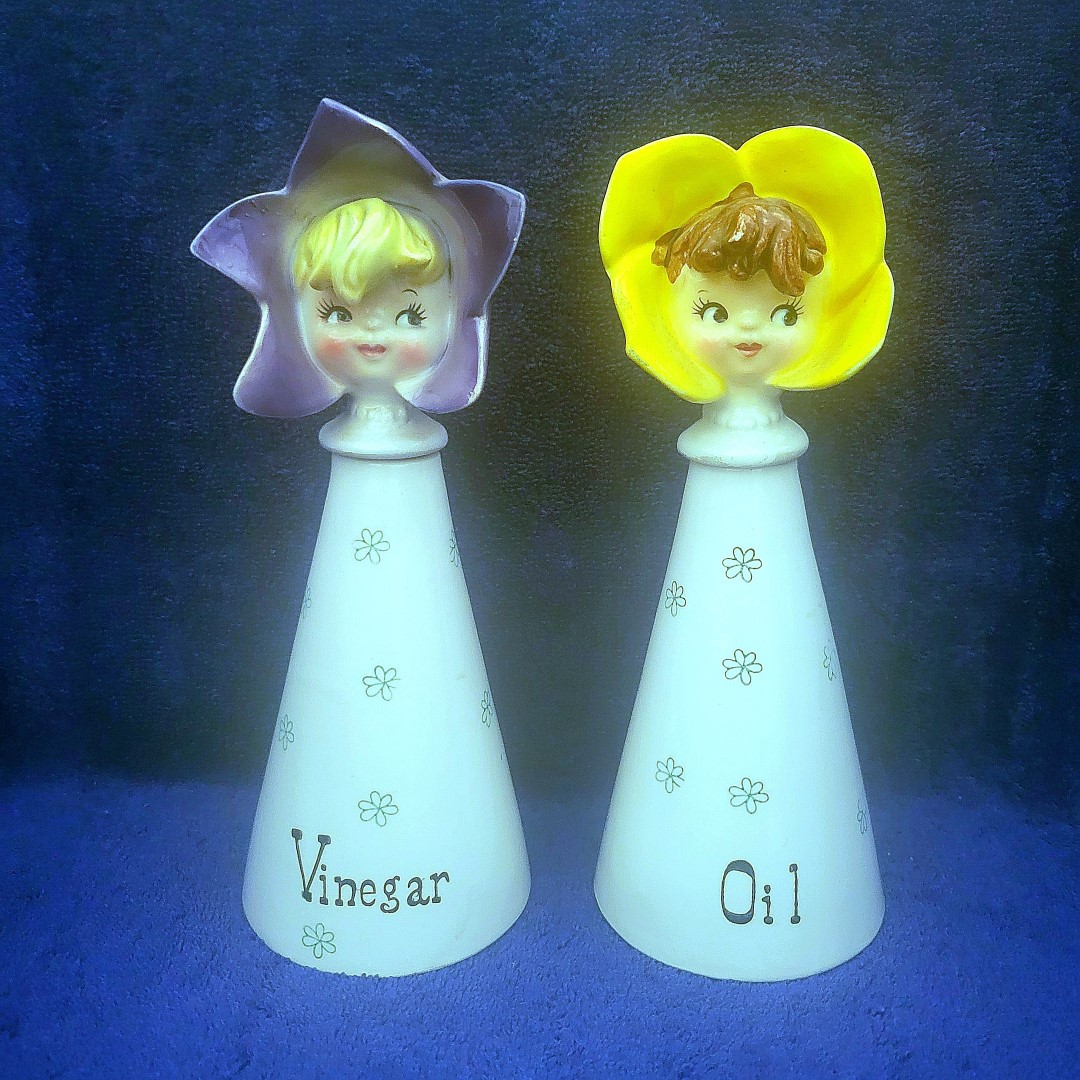
Oil & Vinegar
The Oil and Vinegar girls are taller and more elongated than the standard condiment jars. Each has a white beaded necklace and a cork beneath the flower-head lid to seal the cruet. Oil uses a yellow flower bonnet, while Vinegar uses a purple flower bonnet, visually echoing one of the Salt & Pepper pairings.
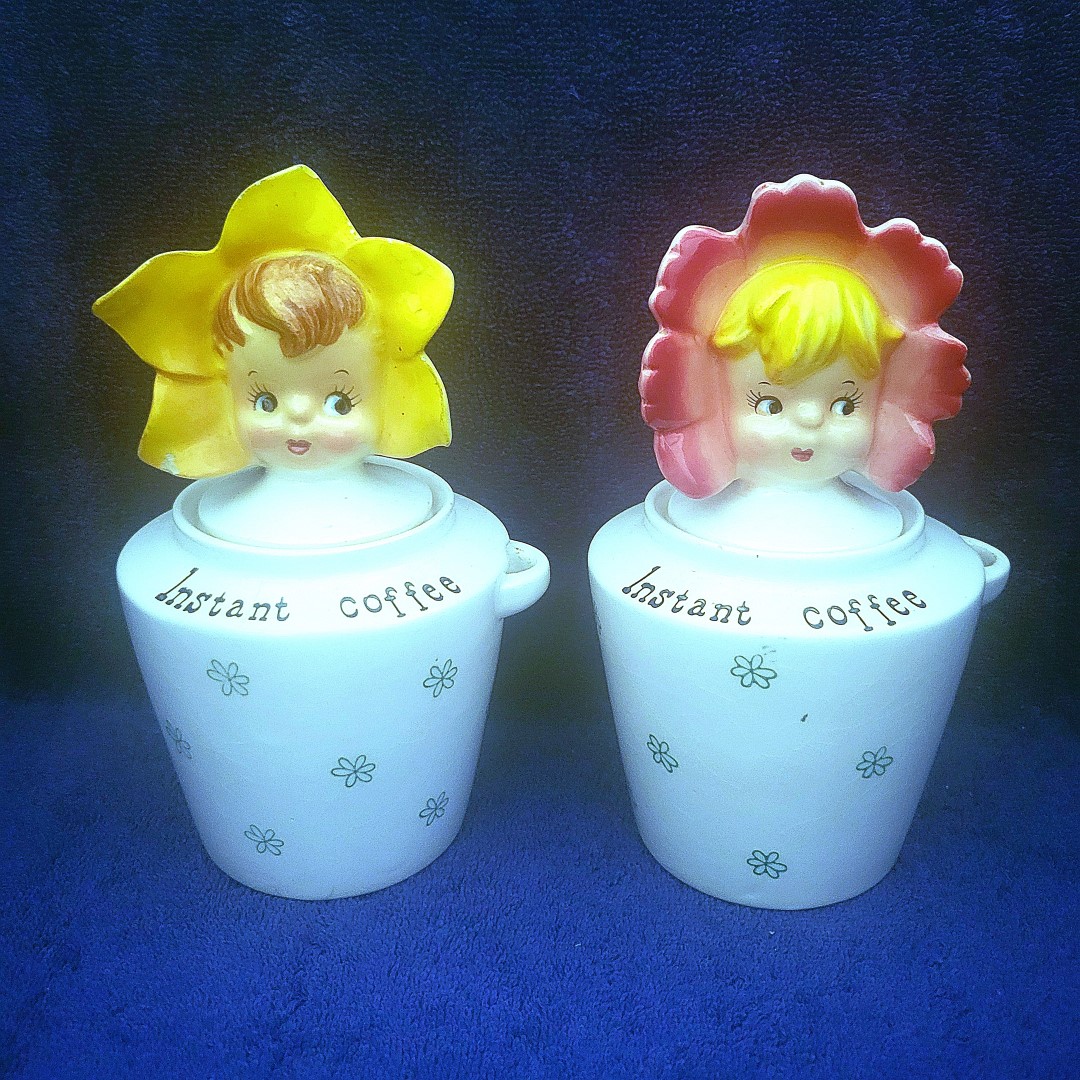
Instant Coffee Variants
The Instant Coffee jars are larger than the standard condiment jars and were designed differently to preserve freshness. Instead of a built-in spoon under the lid, the jars have a spoon holder on the side, and the flower-head lids use cork around the base to create a tighter seal.
Two lid variations are known. One features a pink/red multi-petaled flower bonnet, while the other has a yellow multi-petaled flower bonnet. Aside from these decorative differences, the jars appear to share the same body form and mold-form number.
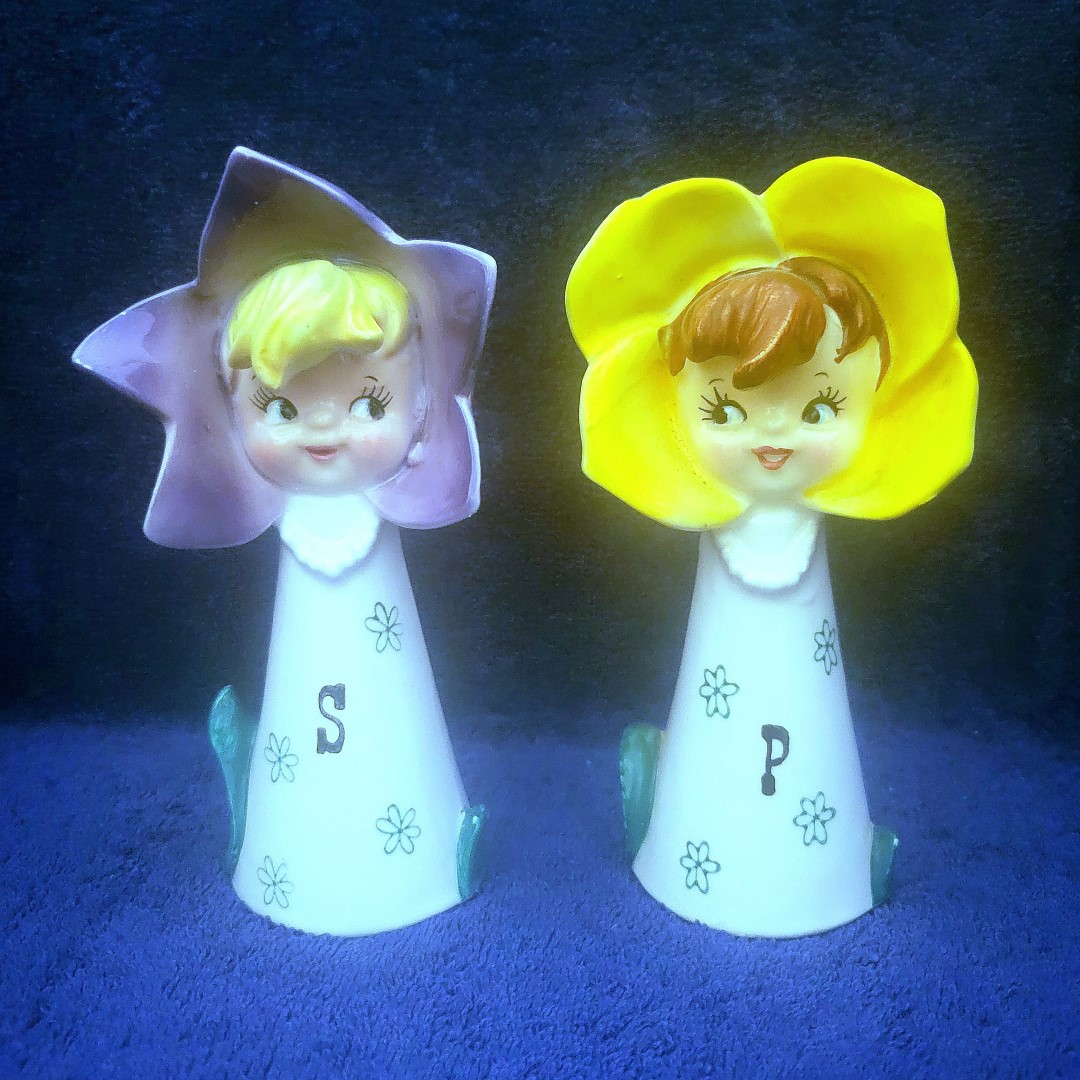
Salt & Pepper Sets
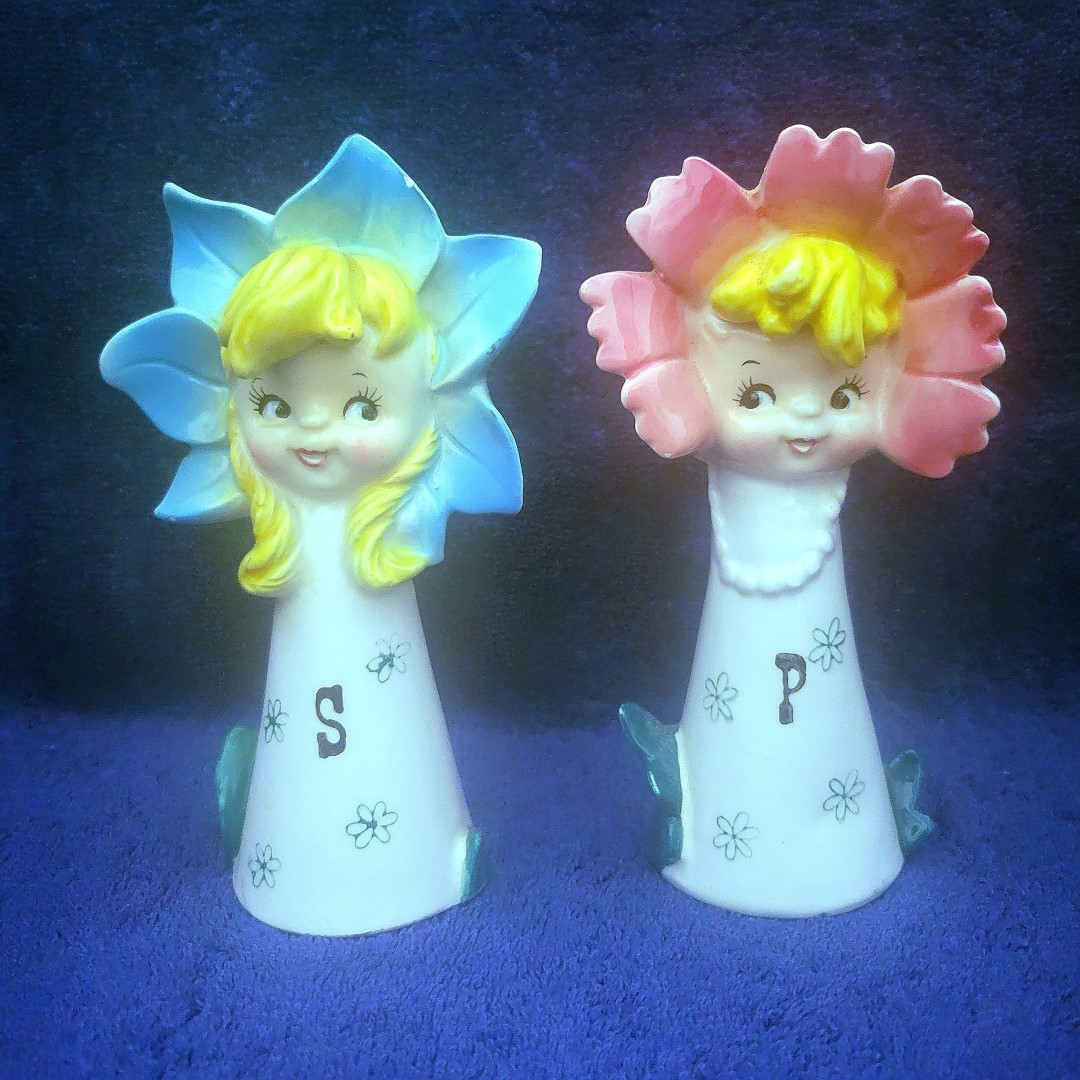
The Salt & Pepper shakers provide clear evidence that Lipper & Mann produced more than one decorative version of some Flower Girls forms. Two color pairings are documented: purple/yellow and blue/pink. In each pair, the shakers face one another when placed side by side.
The color pairings mirror other pieces in the Flower Girls line. The purple-and-yellow shakers echo the Oil and Vinegar cruets, while the blue-and-pink shakers echo the Relish and Ketchup jars.
These pieces are also structurally distinct from the rest of the line. They are the only Flower Girls pieces with green leaves decorating the bottom of the base, and each shaker has seven green daisies on the flowerpot body rather than the 12 or 15 used on other pieces.
Cream & Sugar
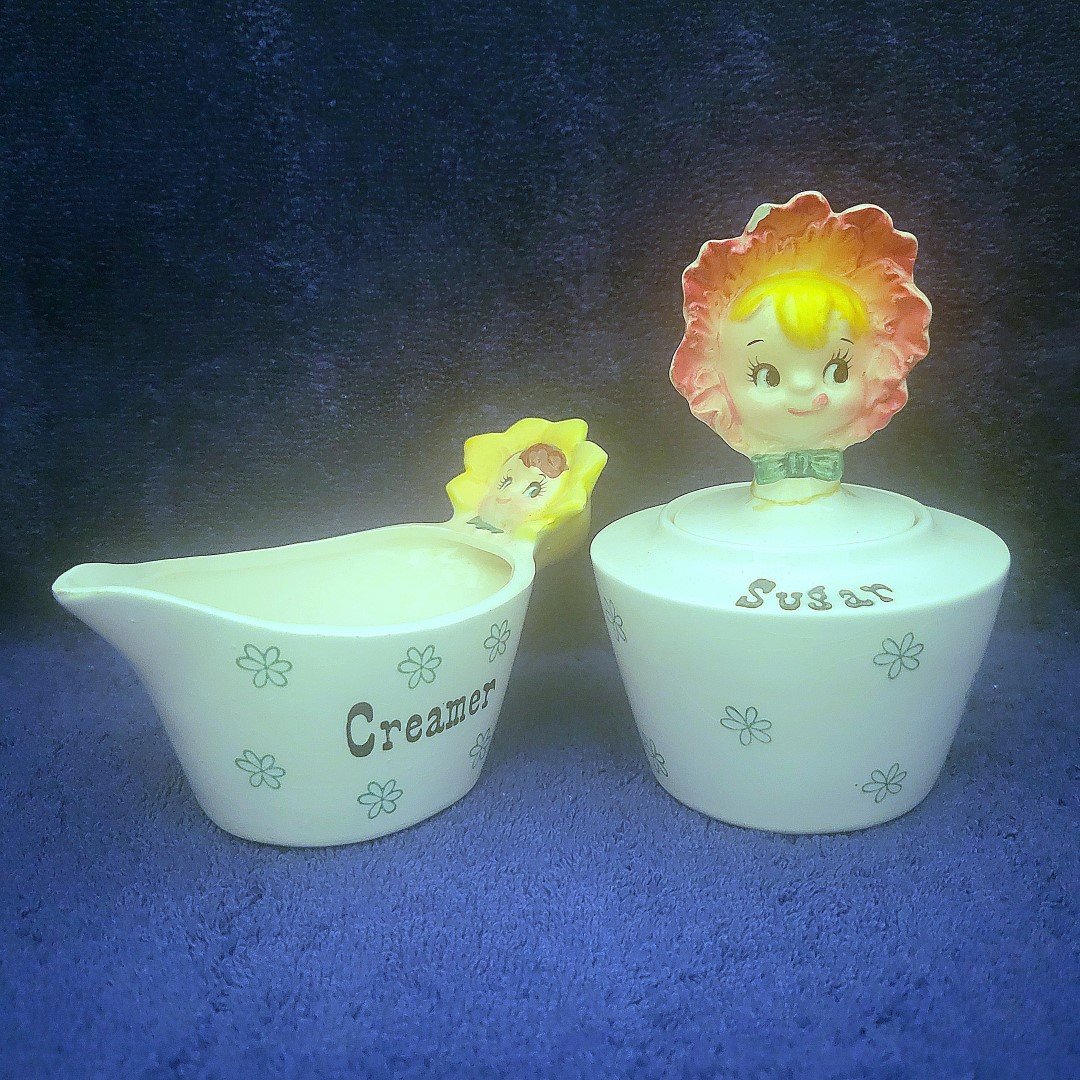
The Cream and Sugar set appears miniature compared with the rest of the Flower Girls line. The sugar bowl has a pink/red flower bonnet and a small green leaf bow beneath her chin, while the creamer shows a yellow-bonneted flower girl peeking over the back handle edge of a small open pitcher.
Known examples of the sugar are unnumbered, while the creamer carries the 23/74 red ink number.
Research & Discoveries: Mold-Form Numbers, Not Product Numbers
Earlier collector references described the red ink numbers on the undersides of Lipper & Mann Flower Girls as identification numbers. Looking across the complete line, however, these numbers appear to function more precisely as mold-form identifiers rather than unique product or catalog numbers.
The clearest evidence is the standard condiment mold. Mustard, Ketchup, Jam 'n Jelly, and Relish are different products with different lettering and different flower bonnets, yet all share the same red ink number: 23/71. The same pattern appears elsewhere in the line, with the Oil and Vinegar cruets both numbered 23/72, the Instant Coffee variants both numbered 23/73, and the Salt & Pepper shakers numbered 23/70.
This pattern strongly suggests that Lipper & Mann used the red ink numbers to identify the ceramic body form rather than the finished retail product. That distinction is useful for collectors because two pieces with the same number may still represent different condiments or decorative variants.
Identifying Marks
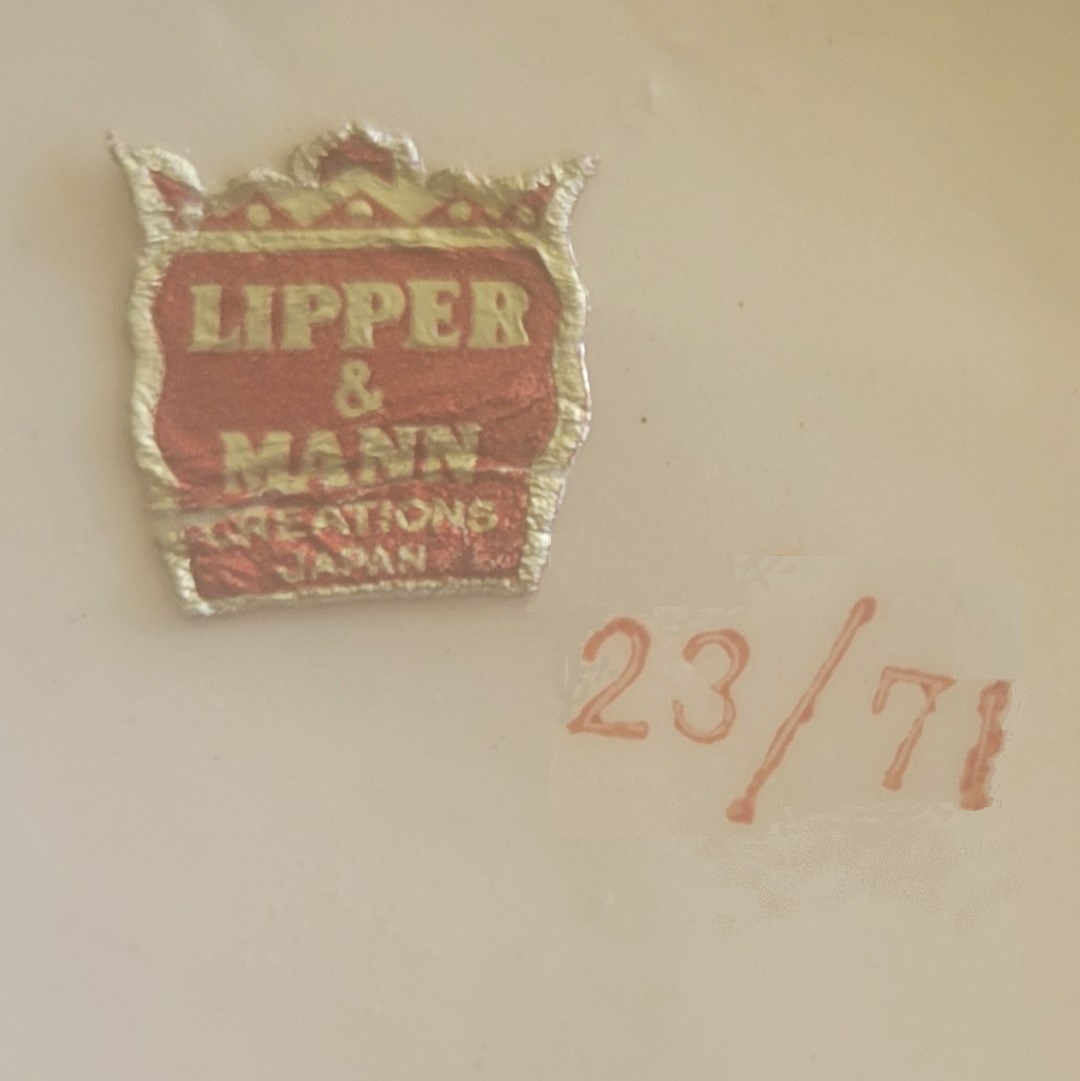
Lipper & Mann Flower Girls are not molded or incised with a company name. Surviving examples may retain a red-and-gold foil label reading “Lipper & Mann Creations Japan”, along with a red ink number stamped on the underside of the base.
Walter Dworkin described the foil label as being shaped like a condiment jar, but the surviving label is better described simply as a distinctive red-and-gold Lipper & Mann foil label. Its silhouette more closely resembles a stylized crowned head or crest than the ceramic jars themselves.
The red ink numbers should be read with care. They are useful for identifying related body forms, but they should not be treated as unique product numbers.
Lipper & Mann's Place in the Competitor Landscape
The Flower Girls line represents one of the most visually unified competitor groups in the broader world of mid-century Japanese novelty ceramics. Rather than imitating Holt Howard's Pixieware directly, Lipper & Mann created a related but distinct product family built around flowerpot bases, green daisies, and expressive flower-bonneted girls.
Although collectors today may know Lipper & Mann primarily for charming mid-century imports such as the Flower Girls, the company continued to evolve after the 1950s. In 1963, Hal Lipper purchased Seymour Mann's interest in the company and the business became Lipper International. Its product line gradually shifted away from imported novelty ceramics toward wooden tabletop items, serving accessories, housewares, and home-organization products. More than seventy-five years after its founding, Lipper International remains in business in Wallingford, Connecticut, still operating as a family-owned importer and wholesaler — a remarkable legacy for a firm whose mid-century creations continue to delight collectors decades after they first appeared.