Starry-Eyed Santa
One Santa, two eye styles, and a surprisingly complicated story hiding in plain sight. What looks at first like a single whimsical Christmas design turns out to be a web of variations, production changes, and product forms that reward much closer study.
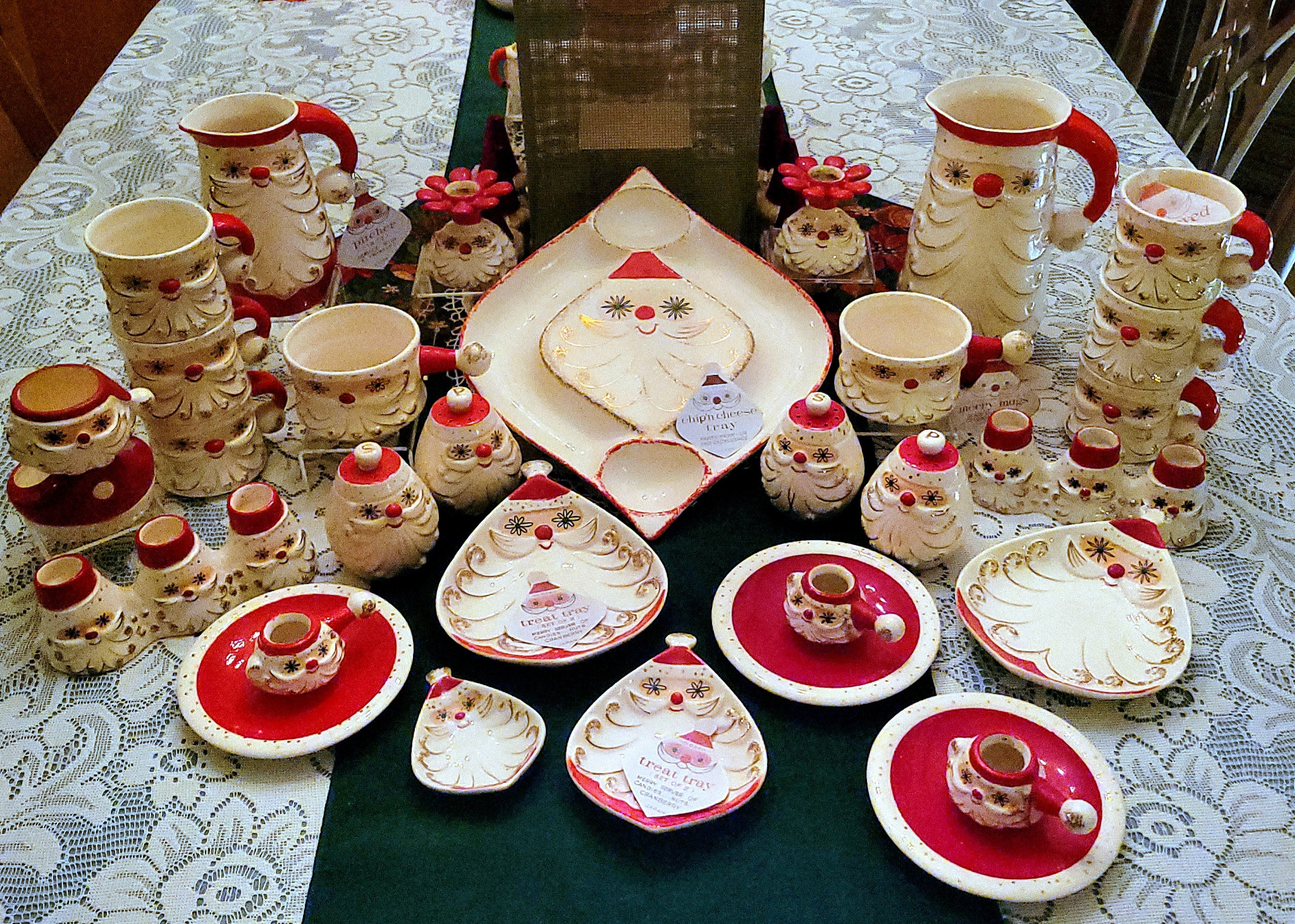
Starry-Eyed Santa is one of Holt Howard’s most distinctive Christmas designs and one of the company’s most complex groups to document. Surviving examples show the same basic Santa face adapted across serving pieces, pitchers, mugs, shakers, candleholders, and other forms, but with several different eye treatments that changed during production.
The surviving evidence points to the Daisy-eye treatment as the earlier style, followed by the Atomic-eye treatment. Most documented pieces carry 1959 copyright dates, while a smaller number of Atomic-eye examples are dated 1960. Because the surviving forms do not all appear with the same eye styles—or in the same proportions—the variation patterns themselves provide useful clues to how the line developed over time.
Documented Eye-Style Variations
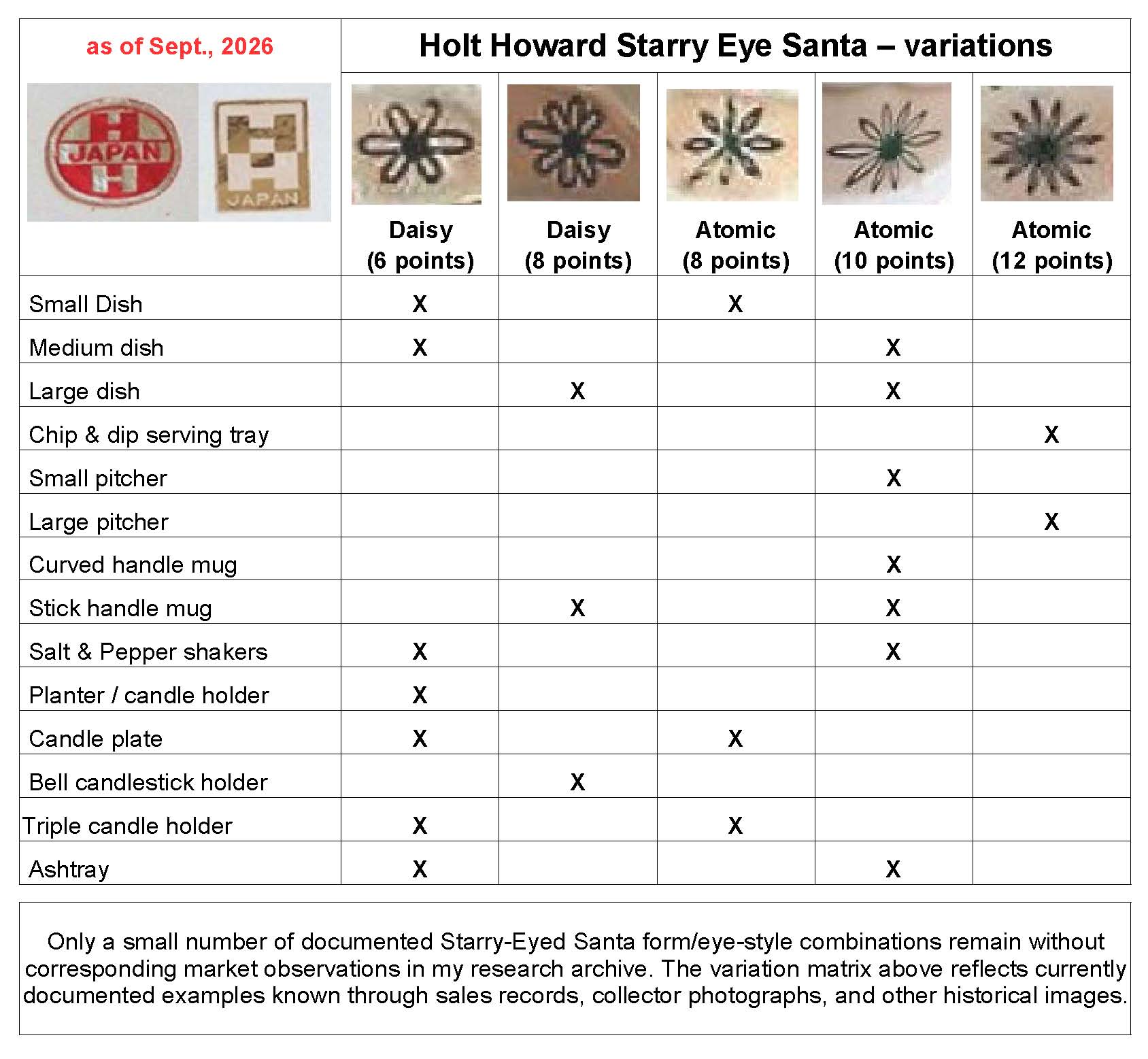
The chart below summarizes the Starry-Eyed Santa forms currently documented by the Archive and the eye-style variants known for each. It provides a quick visual reference for which Daisy-eye and Atomic-eye treatments have been observed across the line.
Starry-Eyed Santa Dishes
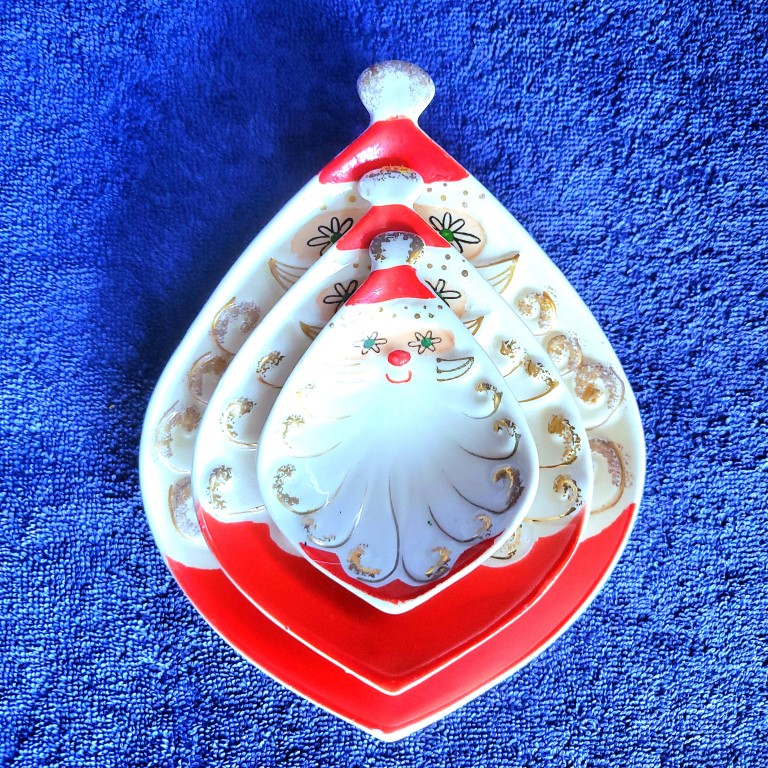
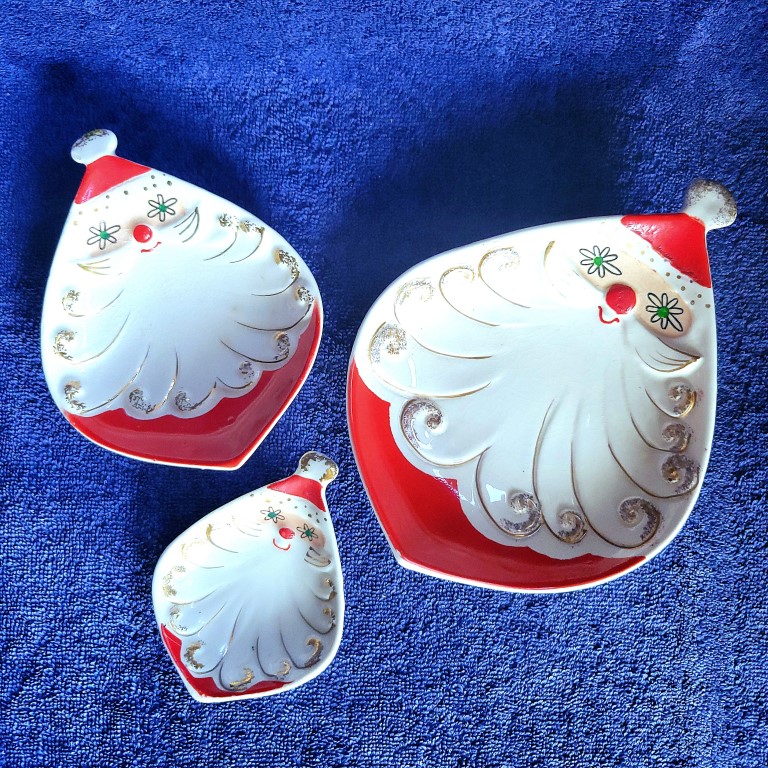
The three leaf-shaped dishes are the most complicated part of the Starry-Eyed Santa group. Each survives in both Daisy-eye and Atomic-eye versions, but the relative frequency of the two styles differs substantially by size. For consistency throughout this page, the Daisy-eye version is presented first whenever both eye treatments are known.
Small Dish
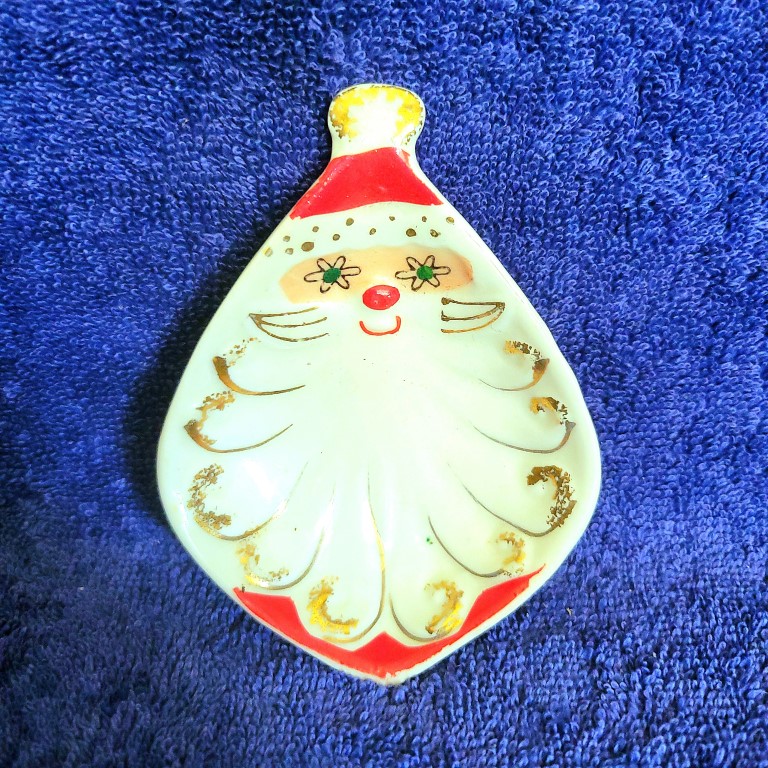
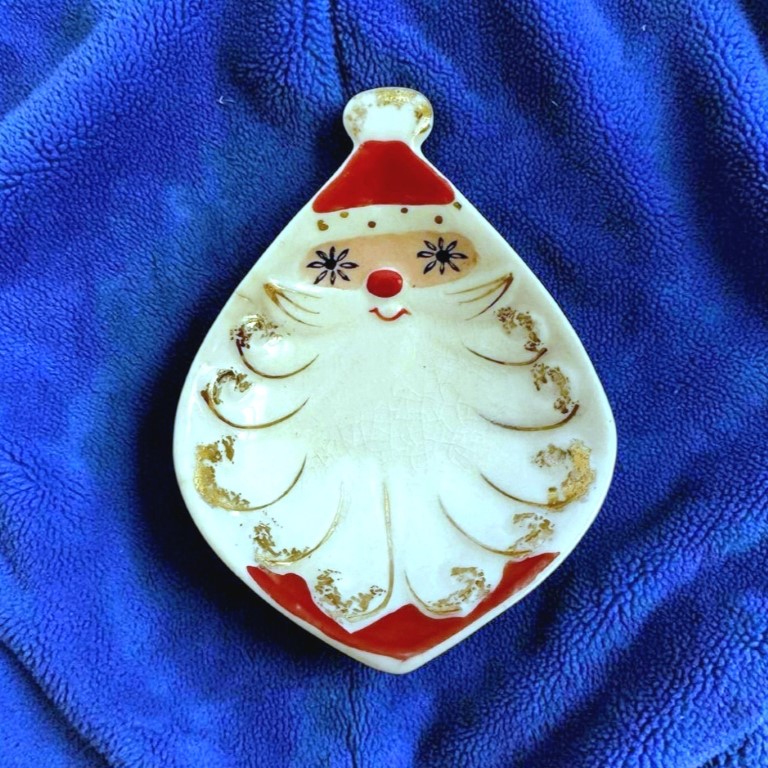
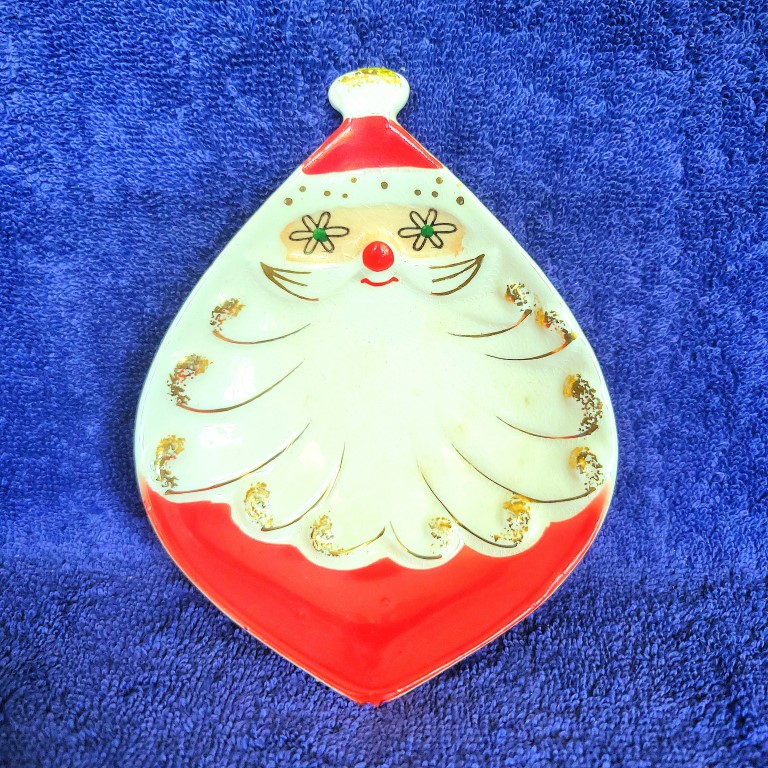
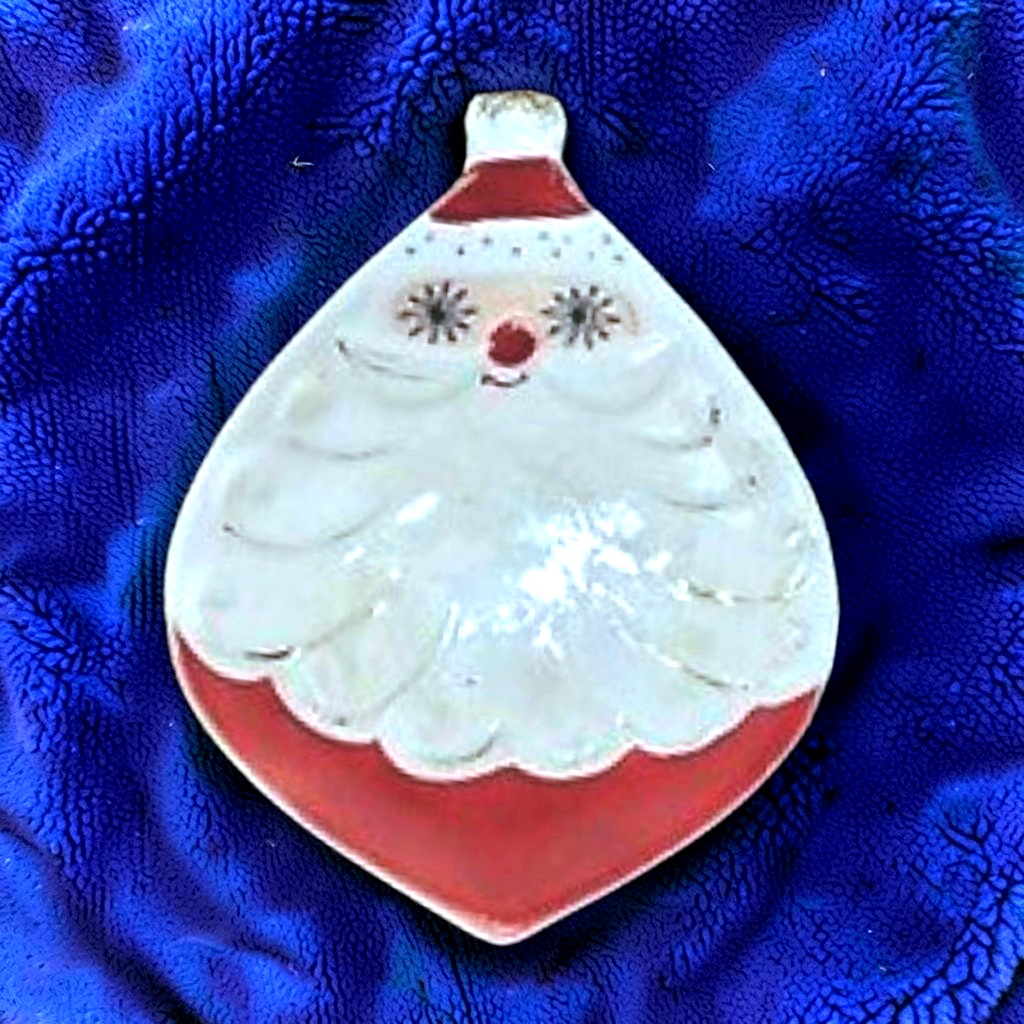
The Small Dish is the easiest of the three sizes to recognize in photographs when scale is unclear because there is relatively little red area at the bottom of the dish. The body is noticeably more compact than the Medium and Large versions while retaining the same pointed leaf-shaped outline and Santa-face treatment.
Both Daisy-eye and Atomic-eye examples are documented, although the Daisy-eye version is overwhelmingly more common in the surviving market record. In the Archive’s survey, approximately 90–92% of Small Dishes used Daisy-style eyes, while only about 8–10% used the Atomic style.
Medium Dish
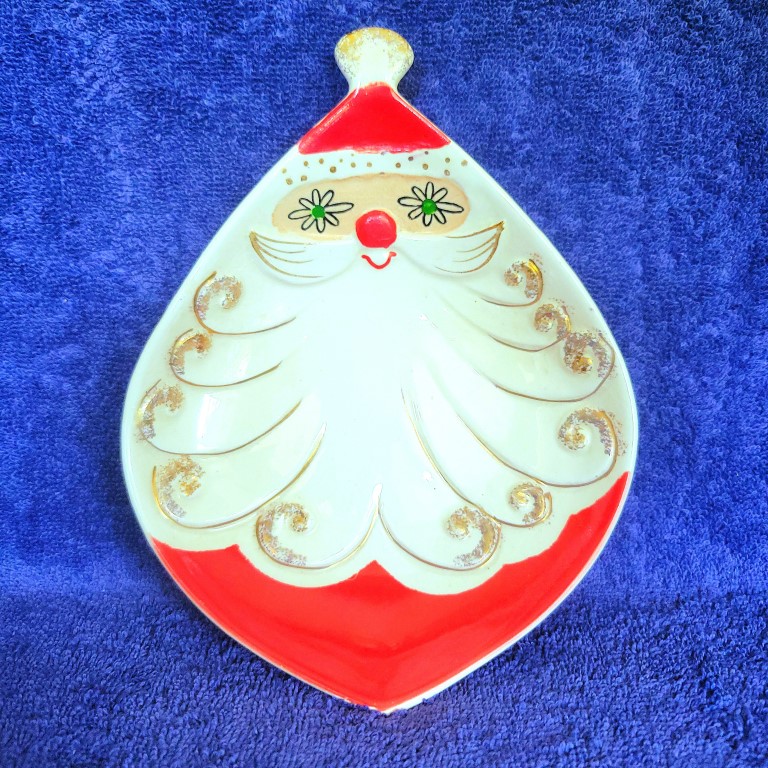
Distinguishing the Medium Dish from the Large Dish can be more subtle when measurements are unavailable. On the Medium Dish, Santa’s beard forms three distinct tufts on each half of the dish, providing a useful visual diagnostic even when the overall scale cannot be judged from a photograph.
Daisy-eye examples are more common than Atomic-eye examples, accounting for roughly 60–65% of the Medium Dishes observed in the Archive’s survey. All observed Daisy-eye examples carry 1959 copyright dates. Among Atomic-eye examples, about 85% are dated 1959 and approximately 15% are dated 1960.
Large Dish
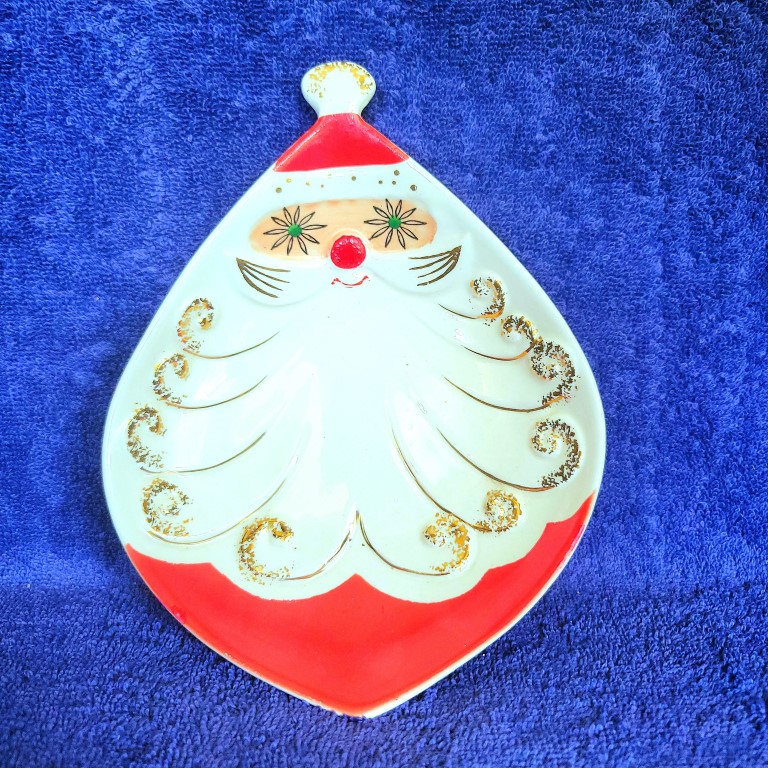
The Large Dish closely resembles the Medium Dish in photographs, but the beard pattern provides a reliable distinguishing feature: the Large Dish has two beard tufts on Santa’s left side and three on the right. Its broader lower field also makes the red area beneath the beard more prominent.
The surviving examples are divided approximately evenly between Daisy-eye and Atomic-eye versions. All observed Daisy-eye examples are dated 1959. Among Atomic-eye examples, roughly 80–85% carry a 1959 copyright date, while approximately 15–20% are dated 1960.
Collector Research Note: Eye-Style & Date Distribution
A survey of more than 400 surviving Starry-Eyed Santa listings—most involving the three dish sizes—shows a clear progression in the frequency of the two eye treatments. These figures describe the surviving market record documented by the Archive; they are not factory production totals.
| Dish size | Daisy vs. Atomic | Observed dating pattern |
|---|---|---|
| Small Dish | About 90–92% Daisy / 8–10% Atomic | 1959 only in the surveyed examples |
| Medium Dish | About 60–65% Daisy / 35–40% Atomic | Daisy: 1959. Atomic: about 85% 1959 / 15% 1960 |
| Large Dish | About 50% Daisy / 50% Atomic | Daisy: 1959. Atomic: about 80–85% 1959 / 15–20% 1960 |
The pattern is consistent with the Daisy-eye treatment preceding the Atomic-eye style during 1959, followed by continued production of at least some Atomic-eye forms into 1960. The differing proportions among the three sizes also suggest that individual dish forms did not move through the transition at identical rates.
Period Terminology: “Treat Tray”
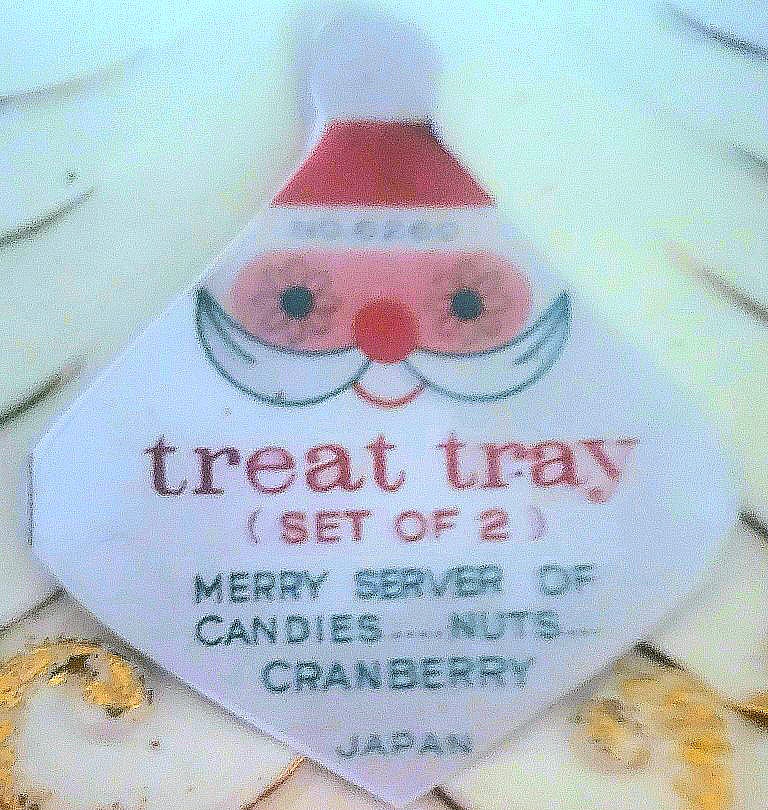
A surviving Holt Howard hang tag identifies a “Treat Tray (Set of 2)”, establishing that Holt Howard itself used the word tray for at least one two-piece configuration. The surviving tag does not identify which two dish sizes made up the set.
Collector and reference terminology has varied over the years, with these forms described as dishes, trays, nut dishes, sweet trays, and—in the case of the smallest form—even teabag holders. For clarity and consistency, this Archive uses Small Dish, Medium Dish, and Large Dish as the primary names.
Serving & Beverage Pieces
Chip & Cheese Tray
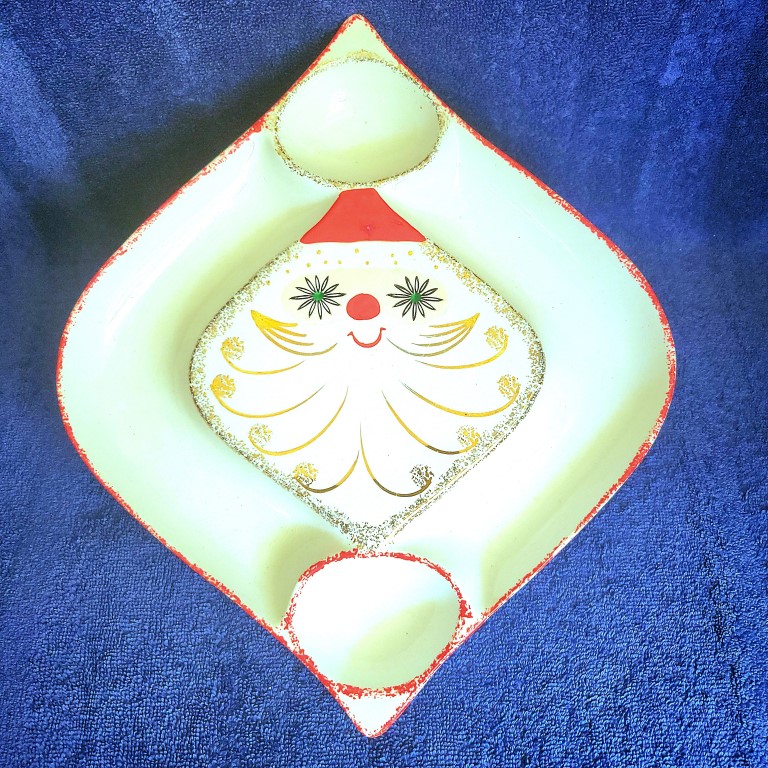
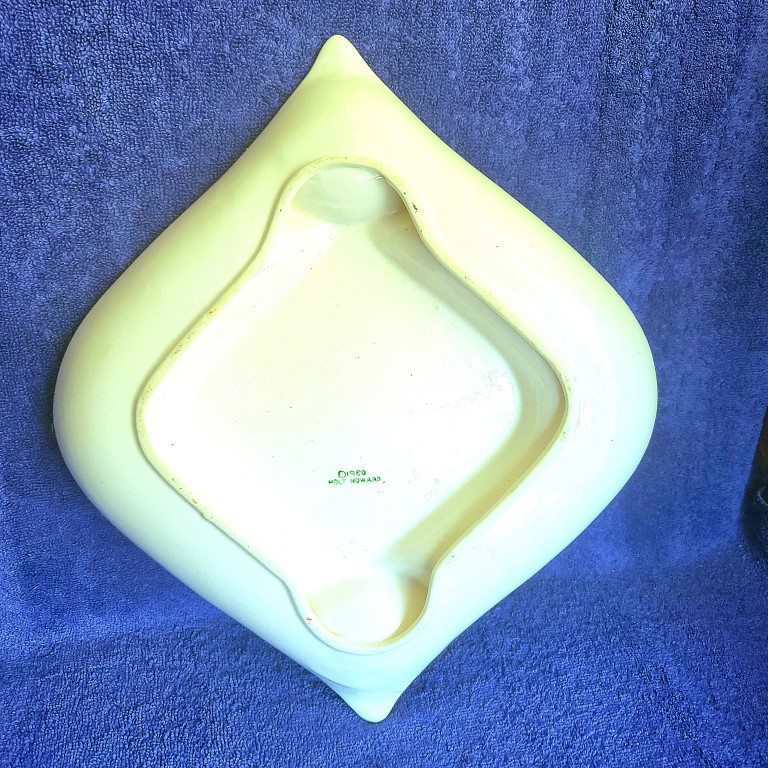
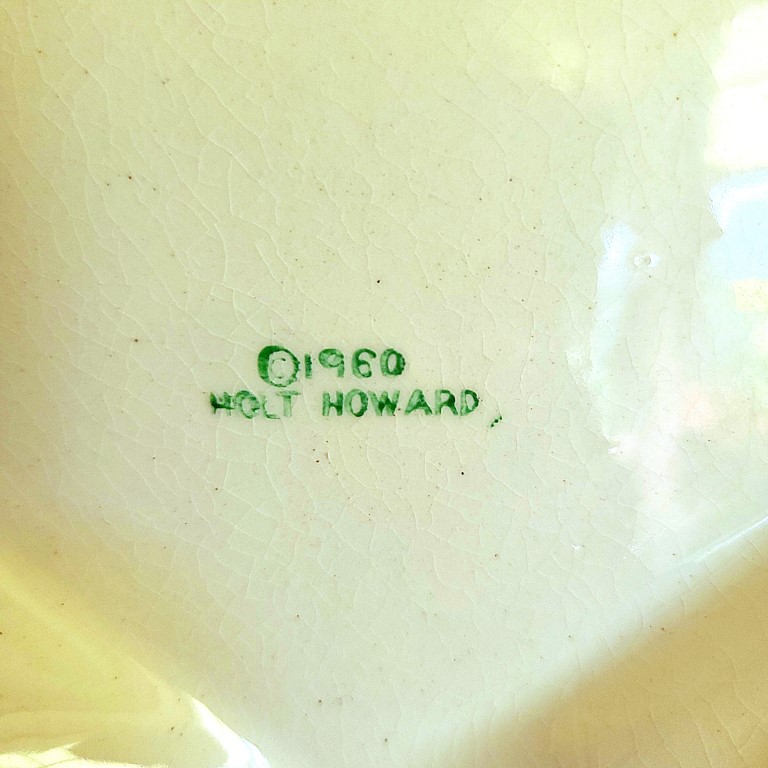
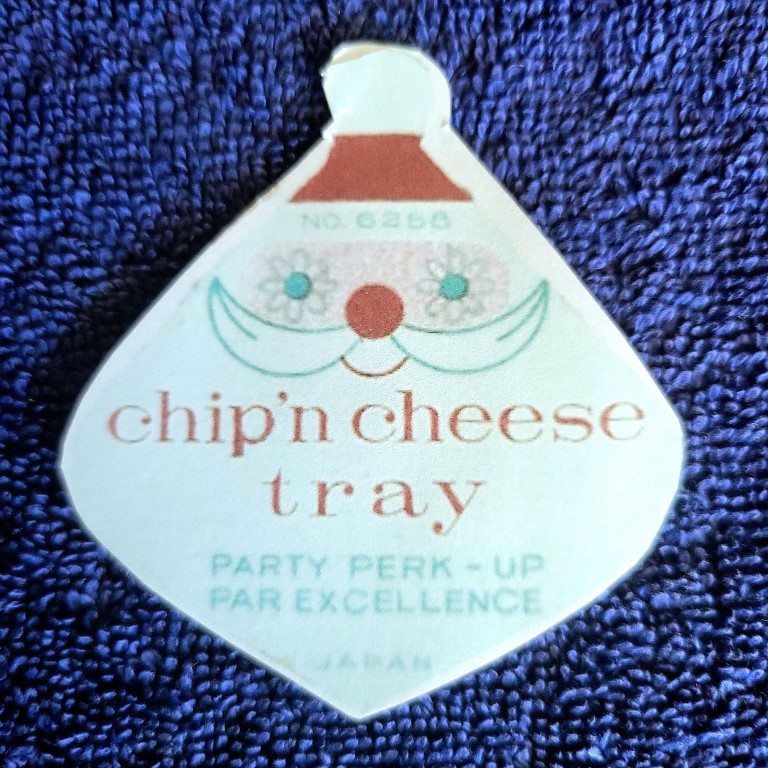
This large diamond-shaped serving piece places Starry-Eyed Santa at the center, with separate recessed wells at the top and bottom for accompanying dips or condiments. Gold detailing outlines Santa’s beard and accents the rim, while the overall form turns the familiar Santa-face motif into one of the largest serving pieces in the line. Its Atomic-style eyes have 12 points.
The example illustrated here is backstamped 1960. Period reference material identifies the piece as a chip-and-cheese or chip-and-dip serving tray.
Small Pitcher
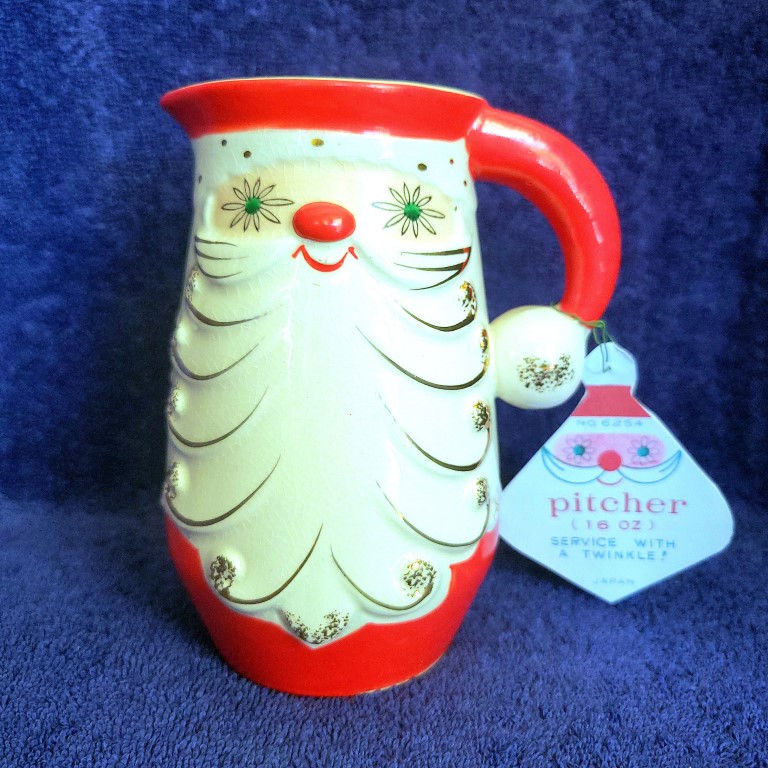
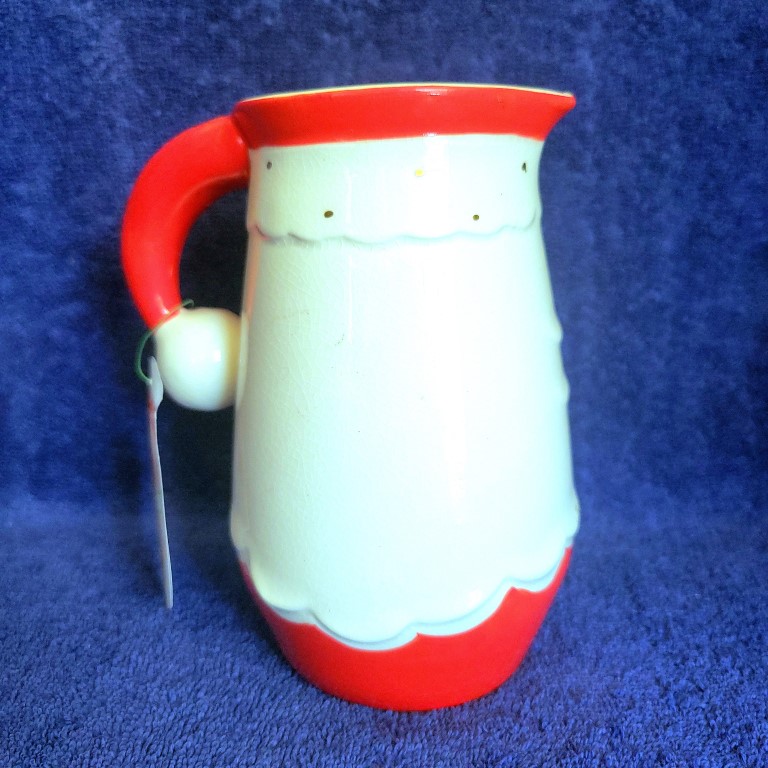
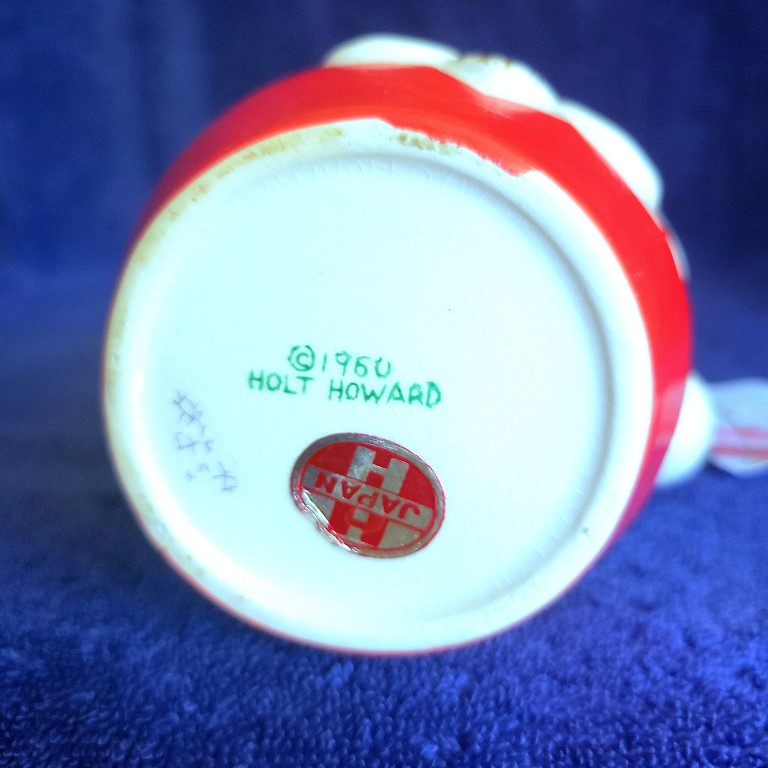
The smaller of the two documented Starry-Eyed Santa pitchers carries the full Santa face and beard treatment onto a compact 16-ounce form. A red handle arcs down to the familiar white pom-pom terminal, while the lower red field continues the color scheme used throughout the line. Its Atomic-style eyes have 10 points, which provides the easiest way to distinguish the Small Pitcher from the Large Pitcher when scale is not apparent in a photograph.
The example illustrated here is backstamped 1960. The attached hang tag is a reproduction created by the Archive from photographs of an original Holt Howard tag.
Large Pitcher
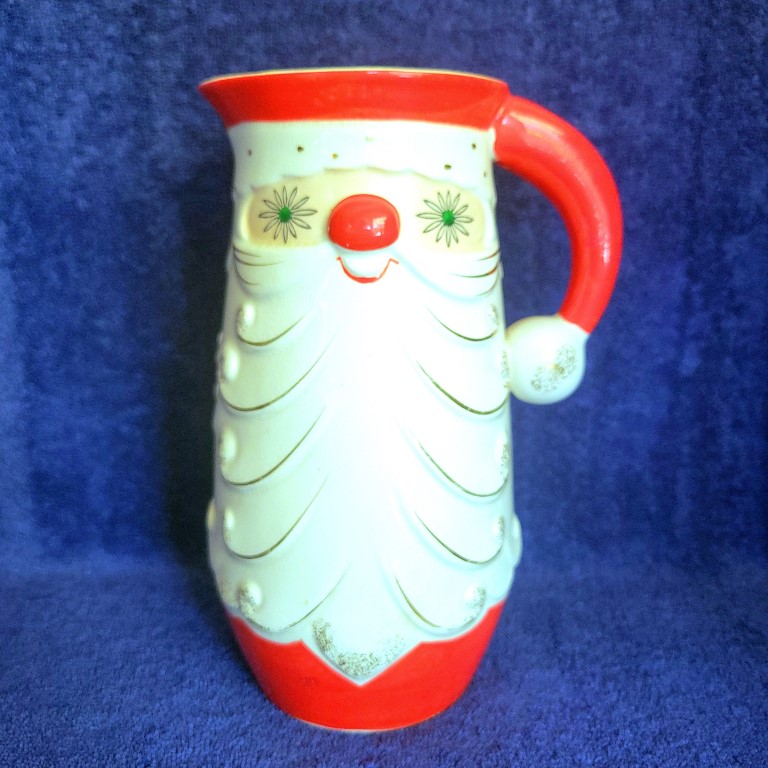
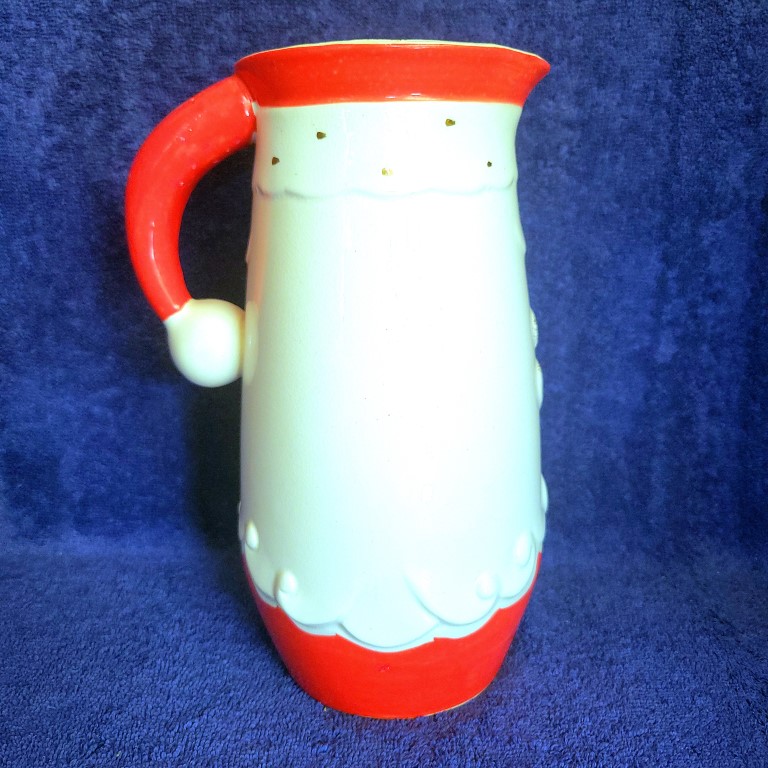
The 44-ounce Large Pitcher uses the same basic sculptural vocabulary as the smaller form but stretches Santa’s beard across a much taller body. The elongated proportions give the piece a particularly strong vertical presence while preserving the red handle, white pom-pom terminal, gold beard detailing, and Starry-Eyed facial treatment. Its Atomic-style eyes have 12 points; in photographs where scale is unclear, the 12-point eyes identify the Large Pitcher, while the 10-point eyes identify the Small Pitcher.
The example illustrated here is backstamped 1960.
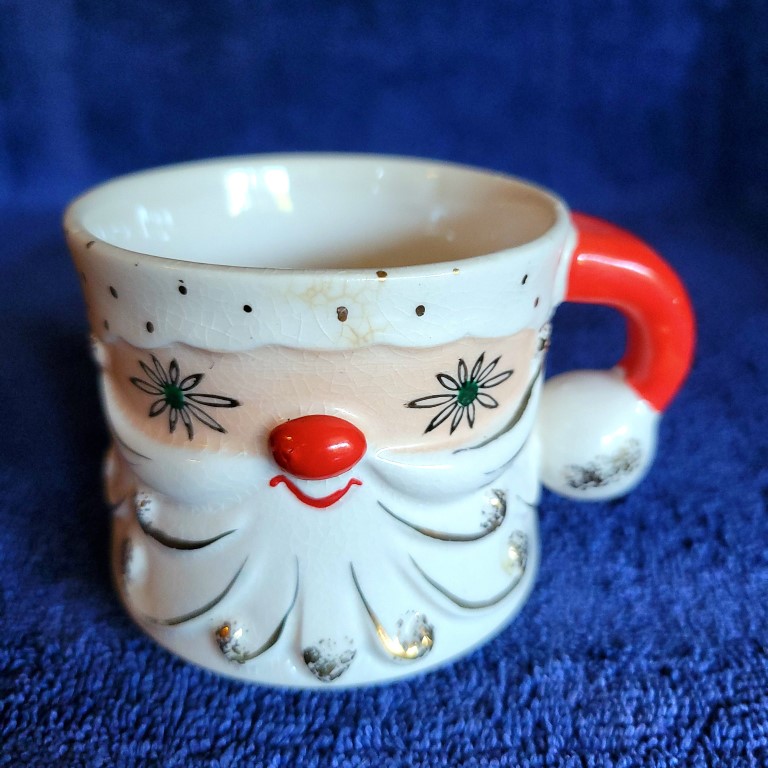
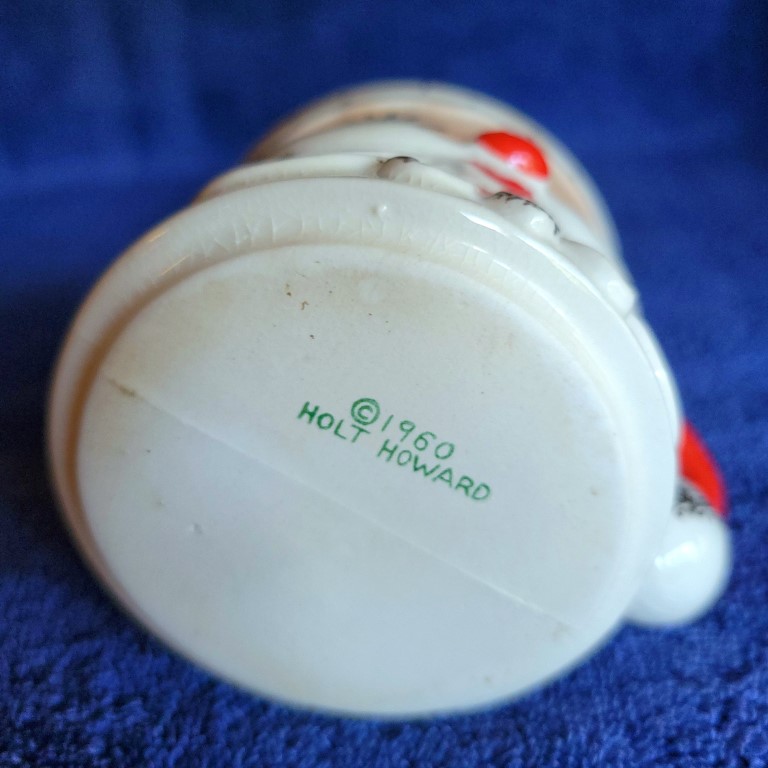
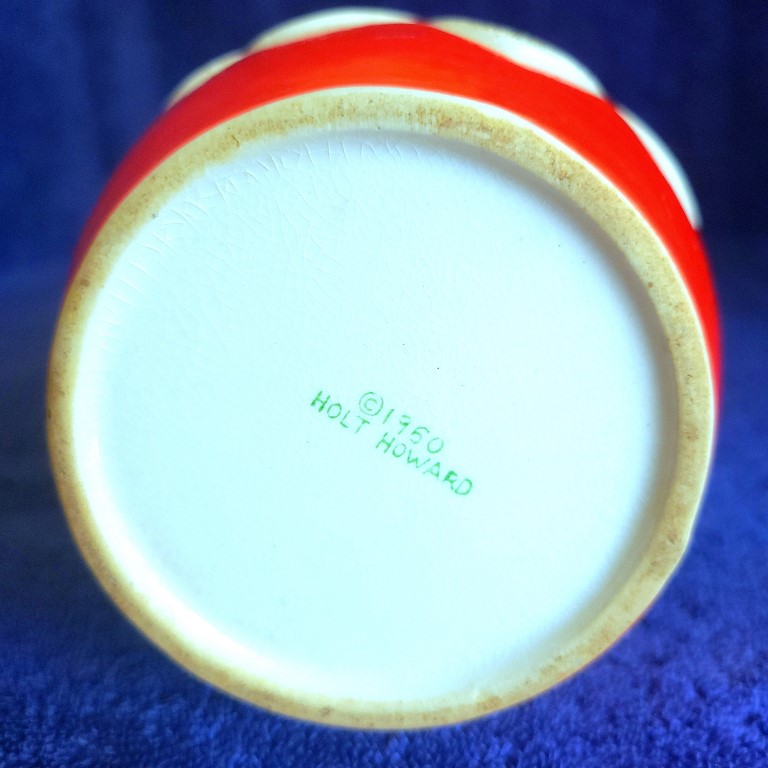
Curved Handle Mug
The Curved Handle Mug gives Starry-Eyed Santa a compact, almost mask-like presence, with the broad face and curling beard compressed into a small drinking vessel. The sweeping handle reads as an extension of Santa’s hat, arcing outward from the side of the mug and balancing the large white beard and gold detailing. Its 10-point Atomic-style eyes give the face its sharpest visual punch.
The example illustrated here is backstamped 1960.
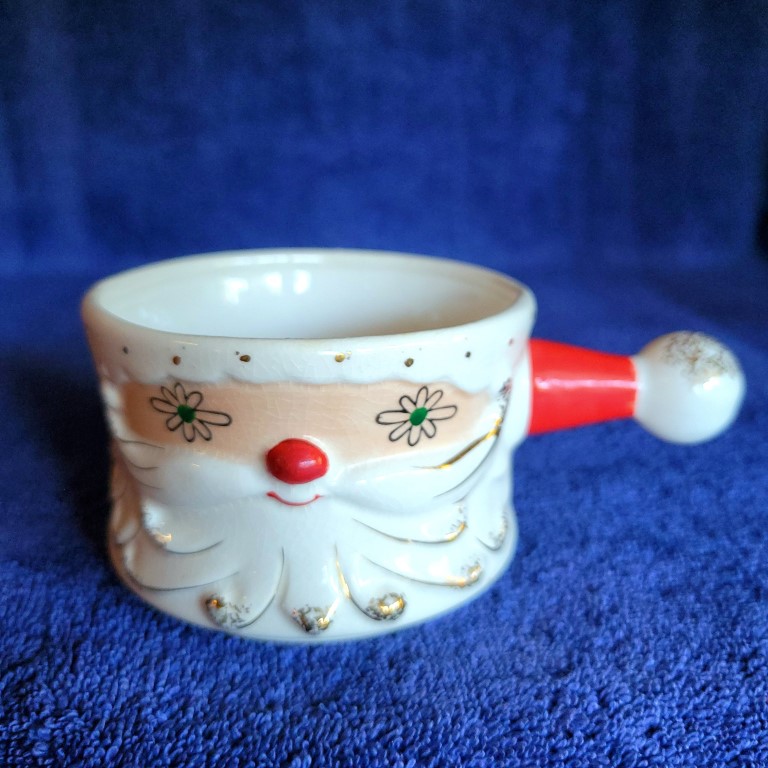
Stick Handle Mug
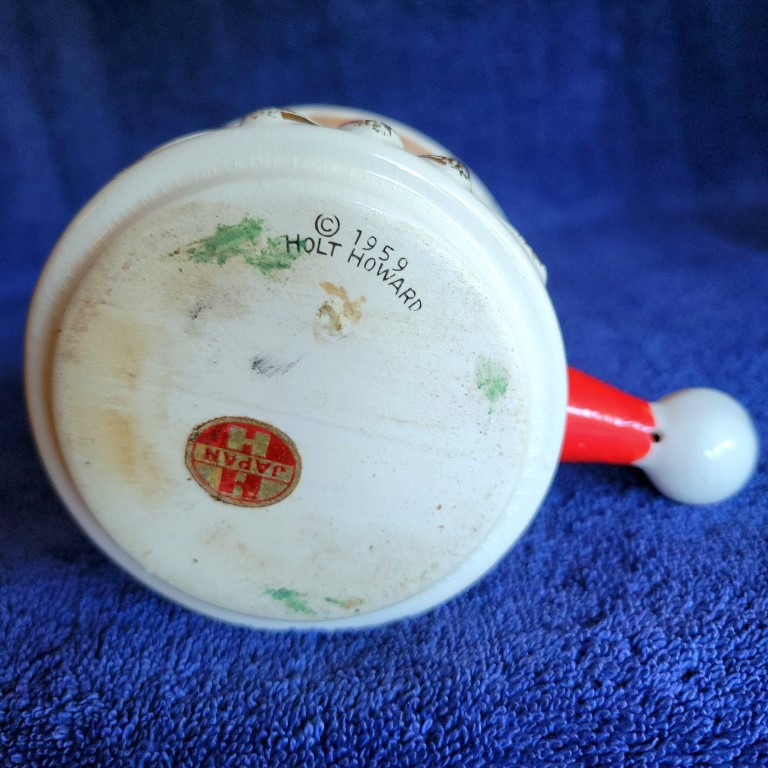
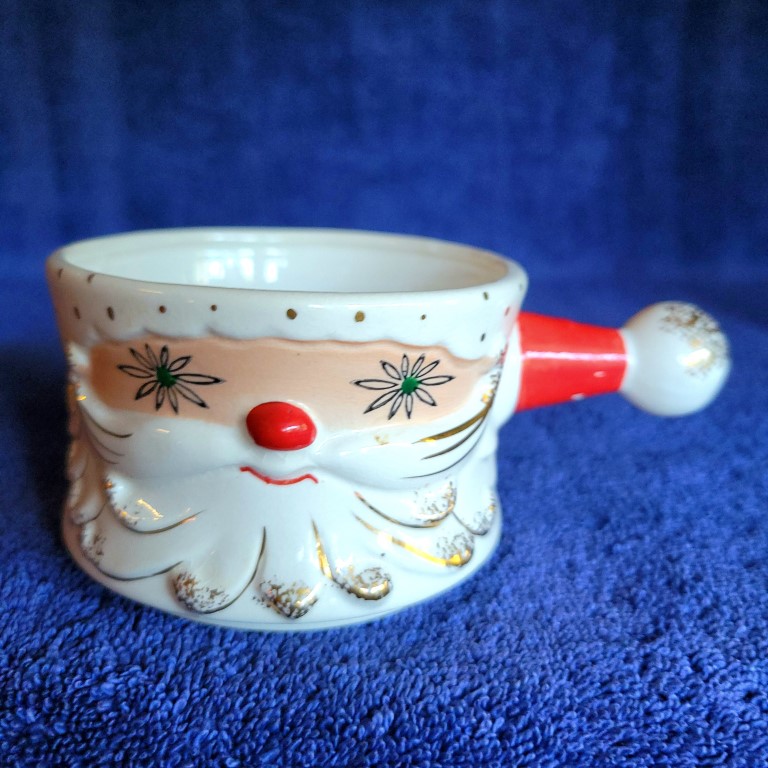
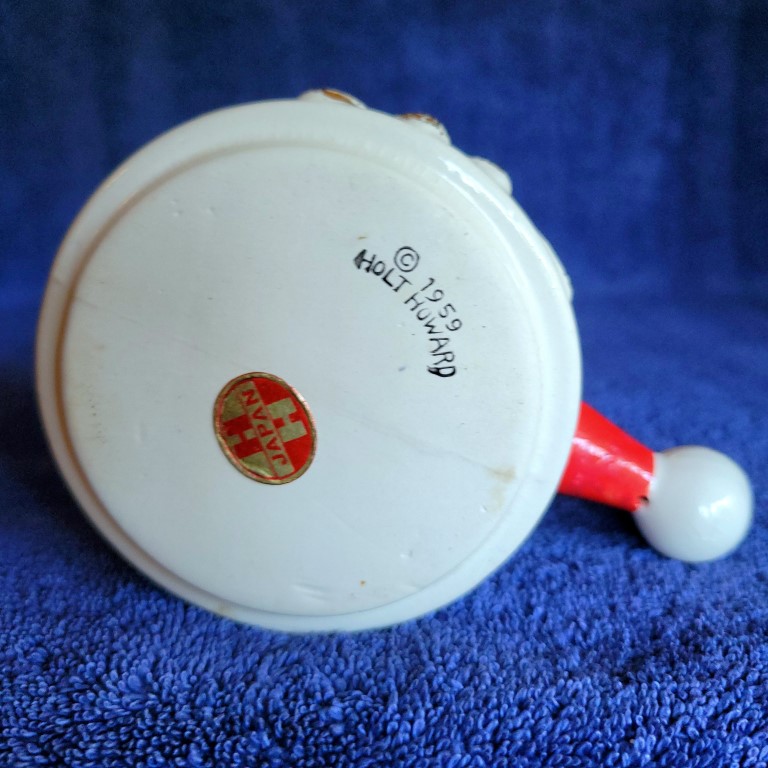
The Stick Handle Mug has a playful, elongated silhouette, with Santa’s face framed by the white beard and the straight projecting handle functioning as a stylized continuation of Santa’s hat. That strong horizontal extension gives the mug its distinctive asymmetrical profile. It was produced in both major eye treatments: the earlier 8-point Daisy-eye version and the later 10-point Atomic-eye version, which give the same basic form noticeably different expressions.
Both examples illustrated here are backstamped 1959.

Salt & Pepper Shakers
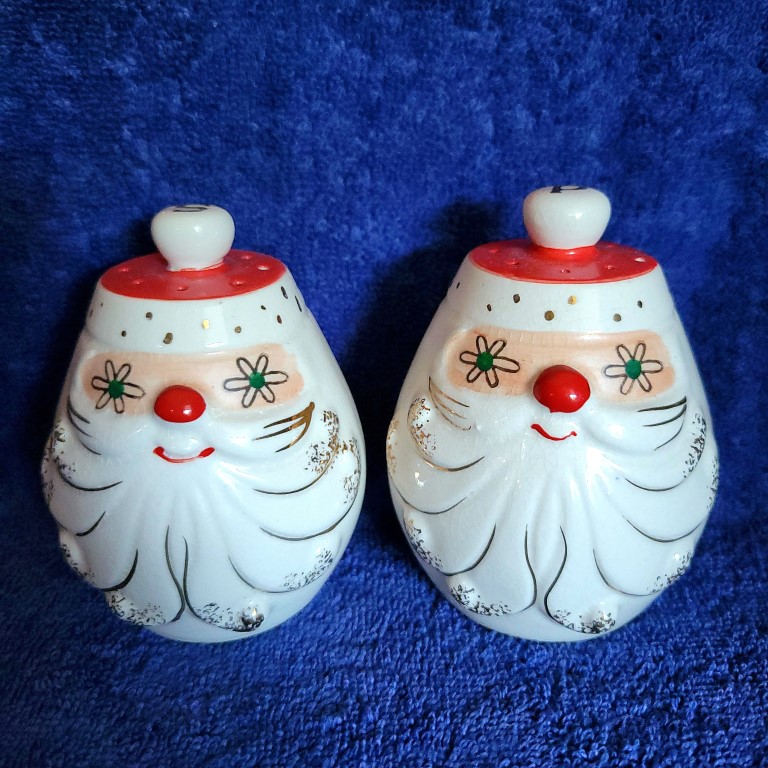
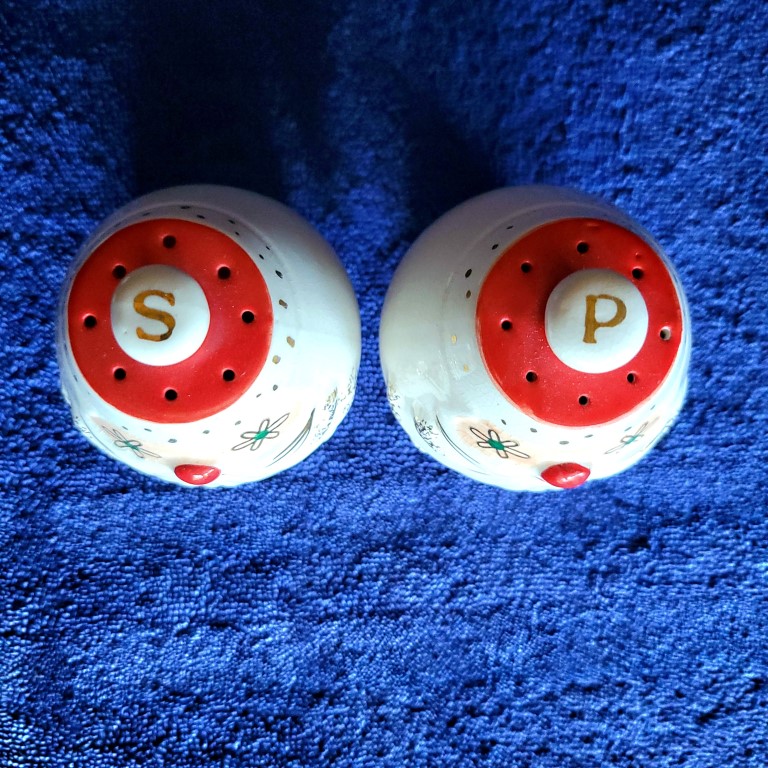
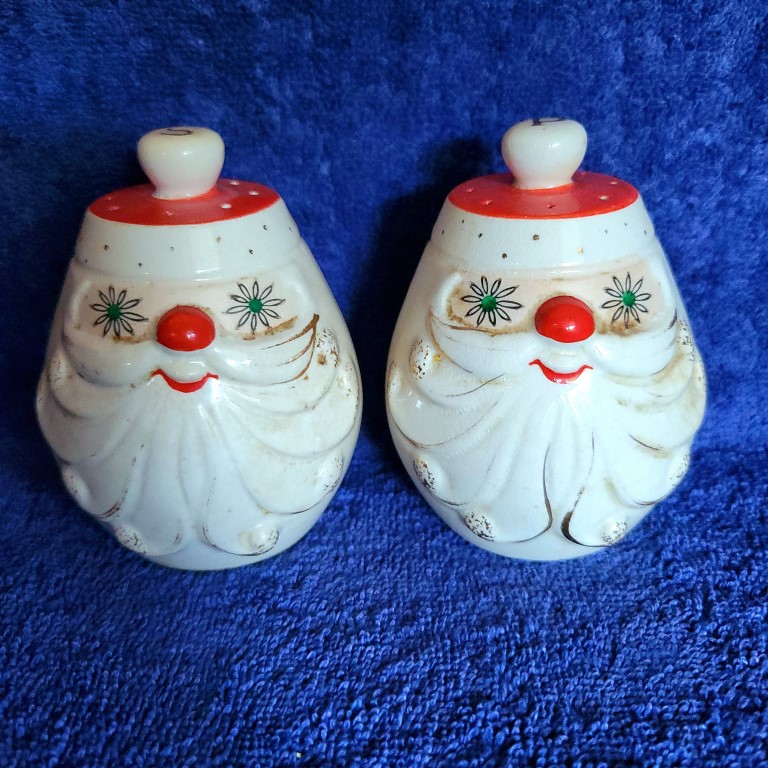
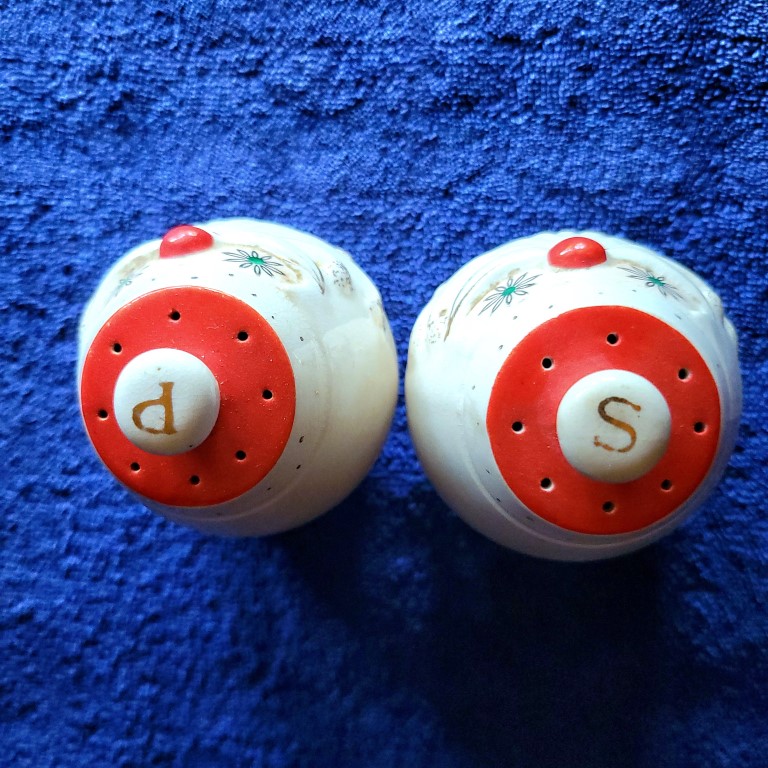
The Starry-Eyed Santa salt & pepper shakers translate the line’s familiar face into a compact pear-shaped form, with Santa’s beard sweeping down the rounded body. The red top and white lettered S or P knob are designed to read as Santa’s hat and pom-pom, turning the functional dispensing mechanism into part of the figure itself.
The set was produced in both principal eye treatments. The earlier version uses 6-point Daisy-style eyes and is backstamped 1959. The later version uses 10-point Atomic-style eyes and is backstamped 1960; in an Archive survey of surviving examples, no Atomic-eye set was found with any other date. On both variations, each shaker has eight dispensing holes arranged evenly around the lettered knob.
Candleholders & Accessory Pieces
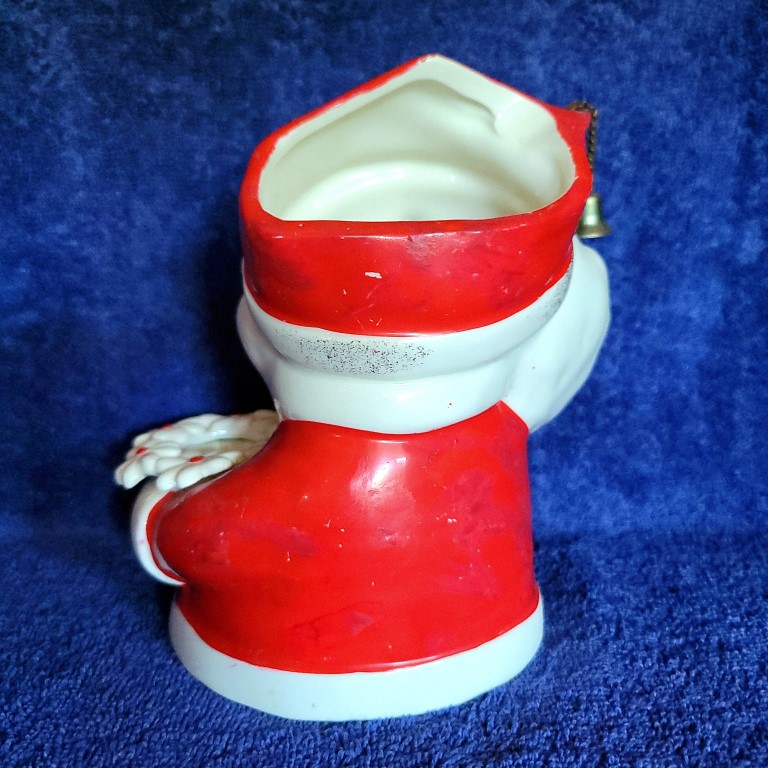
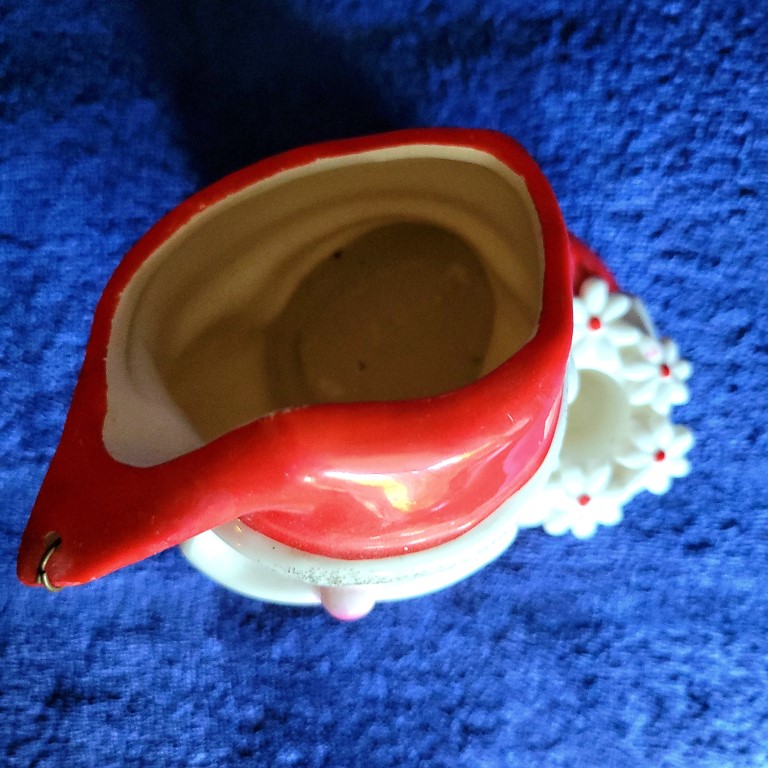
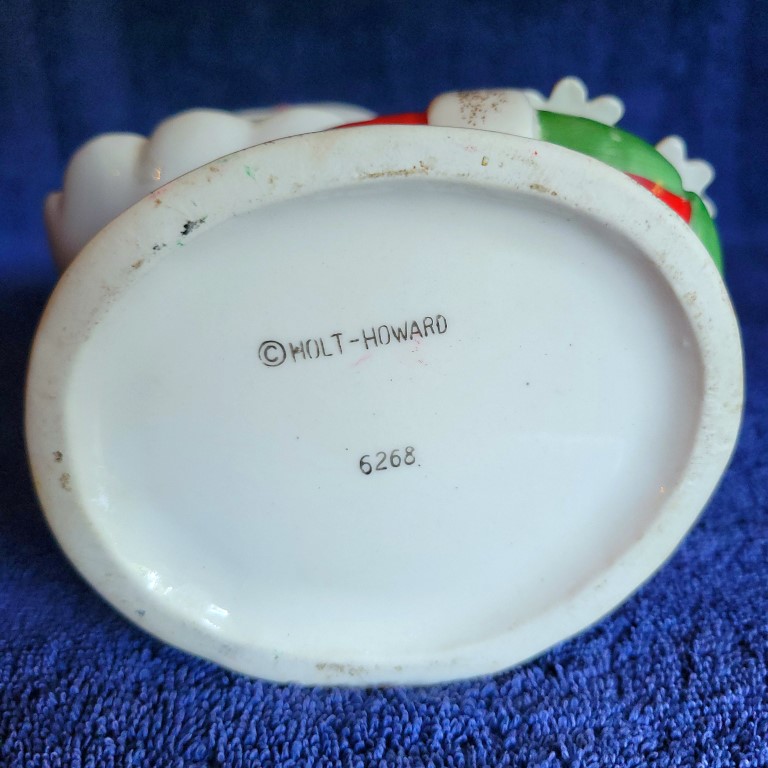
Planter / Candle Holder
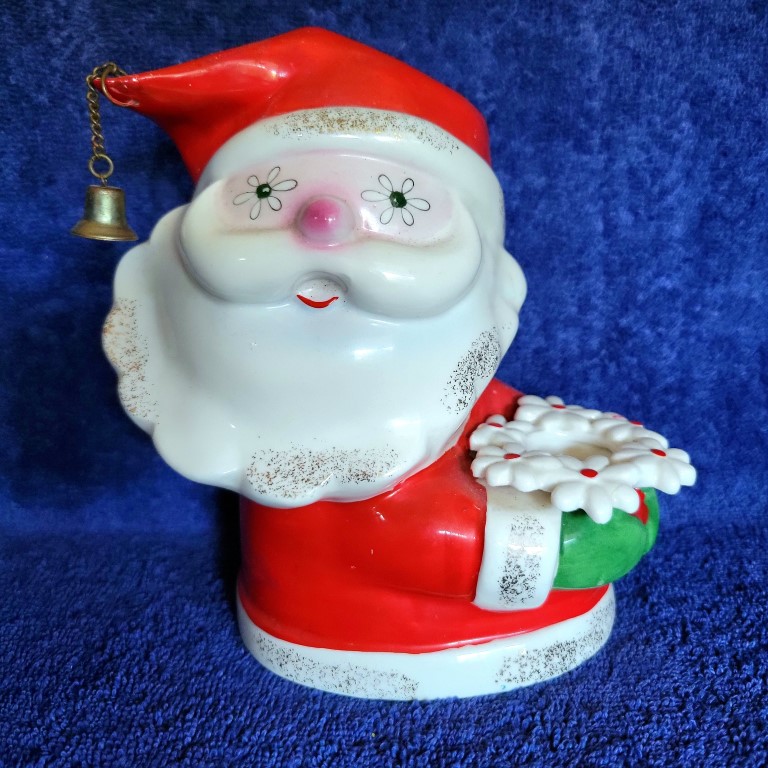
This unusual Starry-Eyed Santa piece combines two functions in one sculptural form. Santa’s hollow cap opens into a small planter cavity, while the flower-shaped form cradled in his arms contains an opening for a candle. A small metal bell hangs from the tip of the cap, adding movement and sound to one of the line’s most elaborate designs.
The form uses 6-point Daisy-style eyes. Unlike most Starry-Eyed Santa pieces, the base is not dated; instead, it is marked with the Holt Howard name and catalog number 6268.
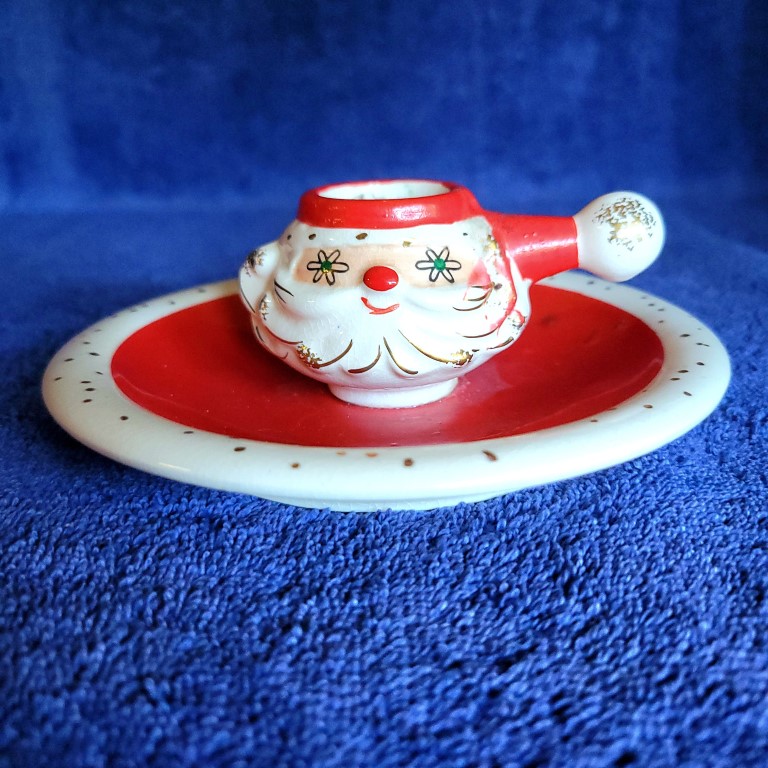
Candle Plate
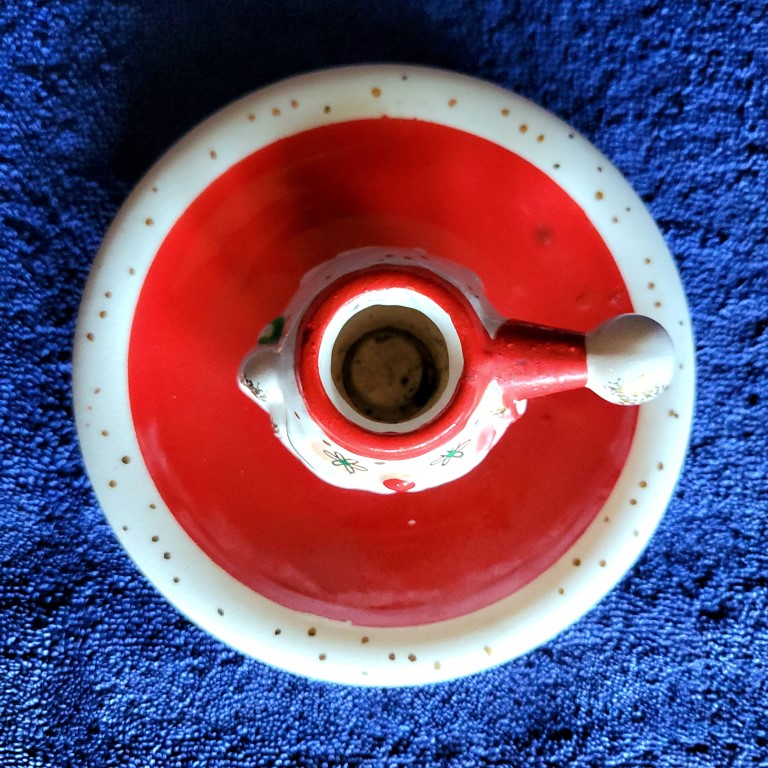
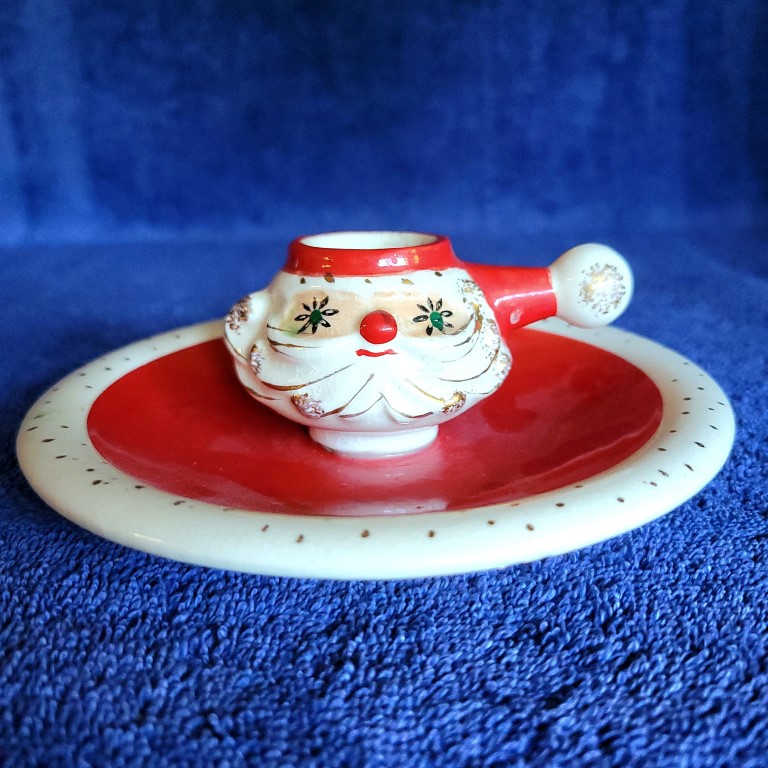
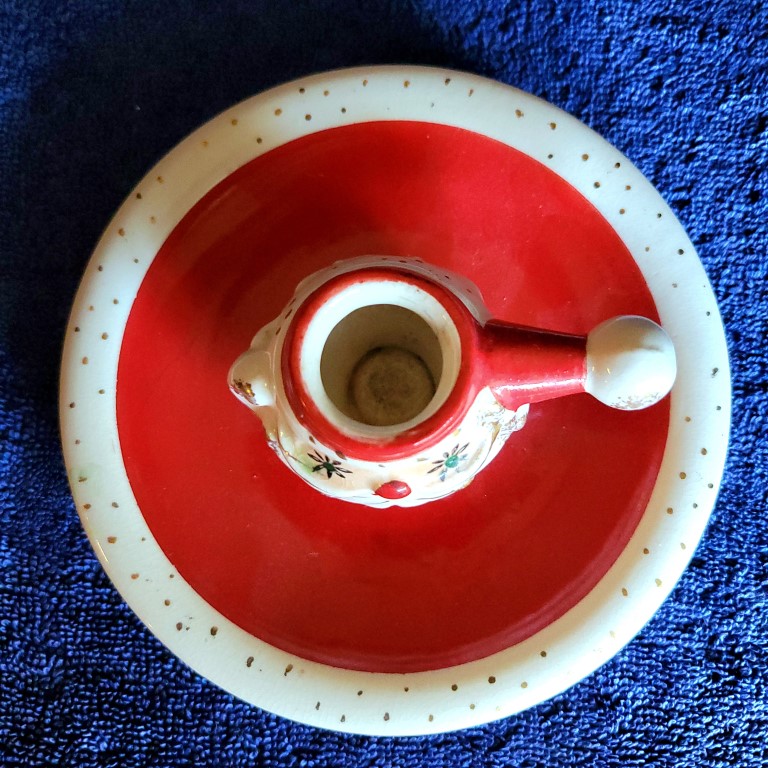
The Starry-Eyed Santa Candle Plate combines a broad red saucer with a sculpted Santa candle cup at the center. The straight projecting handle reads as an extension of Santa’s hat, while the dotted cream rim and gold beard accents give the plate a festive, graphic finish that visually ties it to the mugs and other serving pieces in the line.
The earlier version uses 6-point Daisy-style eyes and is found with a 1959 backstamp. The later version uses 8-point Atomic-style eyes and appears with both 1959 and 1960 backstamps, following the same late-1959 transition pattern seen elsewhere in the Starry-Eyed Santa line.
Bell Candlestick Holder
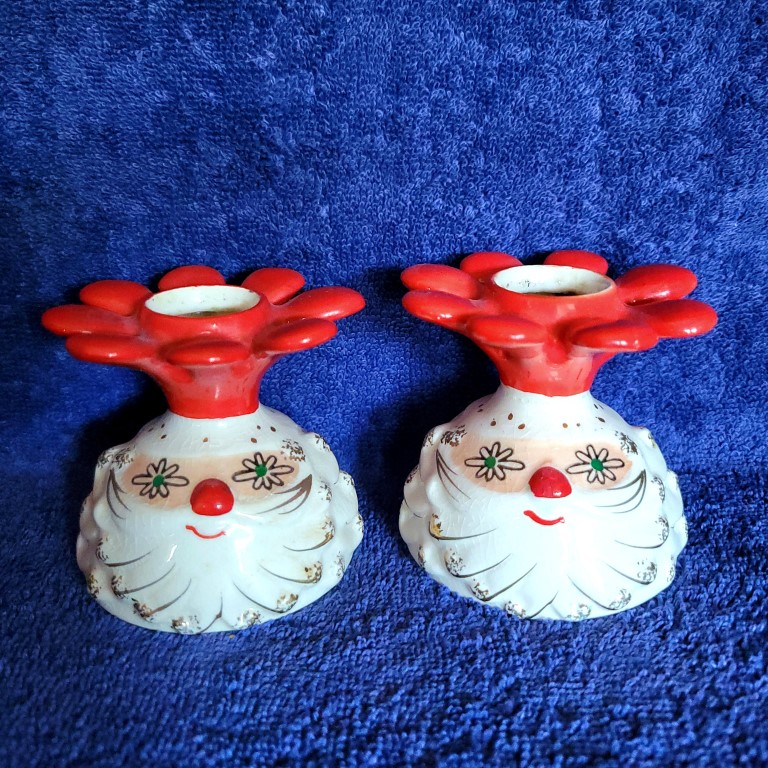
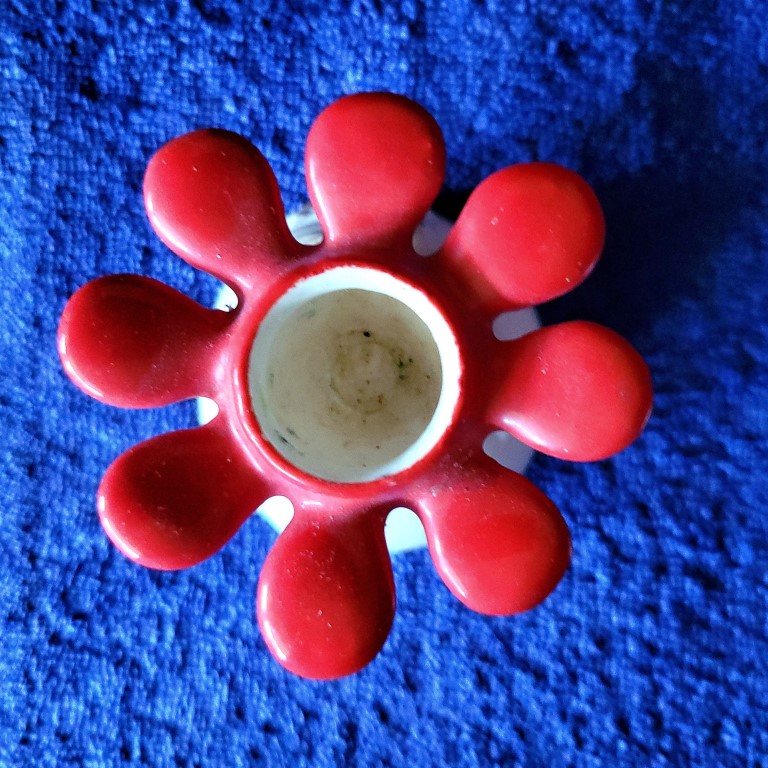
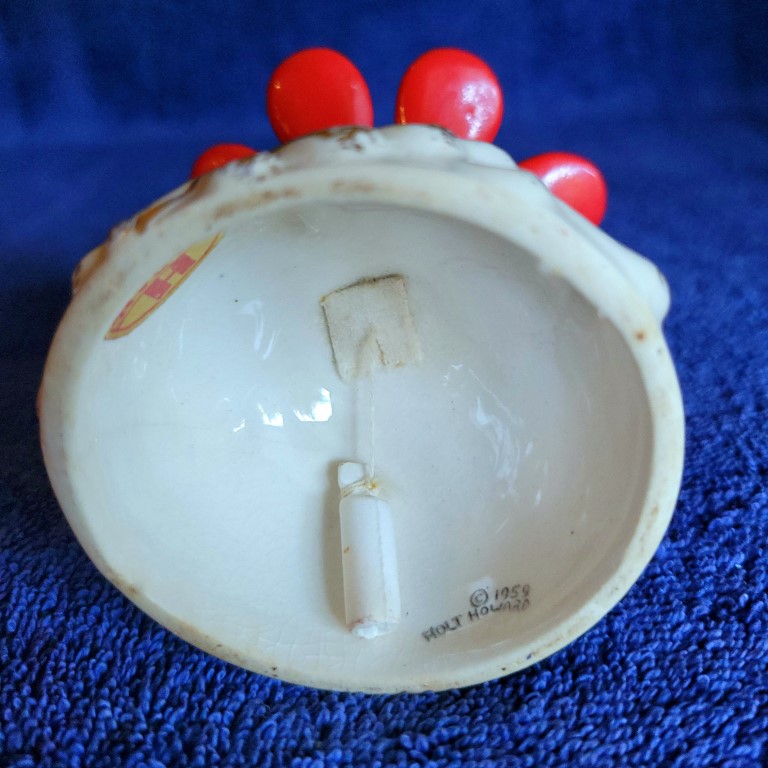
The Bell Candlestick Holder turns Santa into a compact pedestal, with his rounded beard forming the bell-shaped base and a broad red flower-like cup rising above his head to hold a candle. The exaggerated petals give the piece an especially sculptural silhouette, while the familiar red, white, gold, and green palette keeps it firmly within the Starry-Eyed Santa family.
Known examples use the Daisy-eye treatment and carry a 1959 backstamp, placing the form in the earlier phase of Starry-Eyed Santa production.
Triple Candle Holder
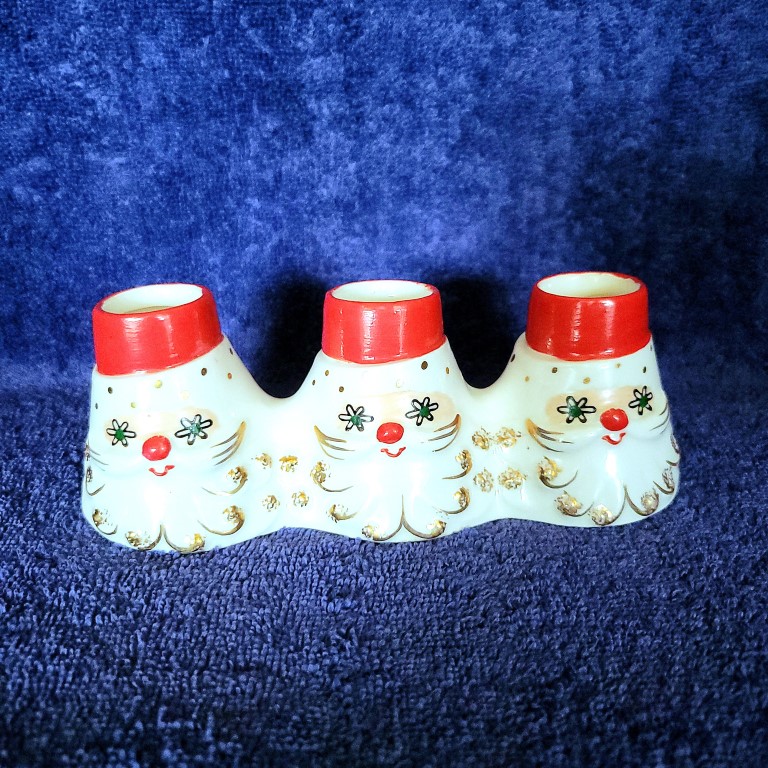
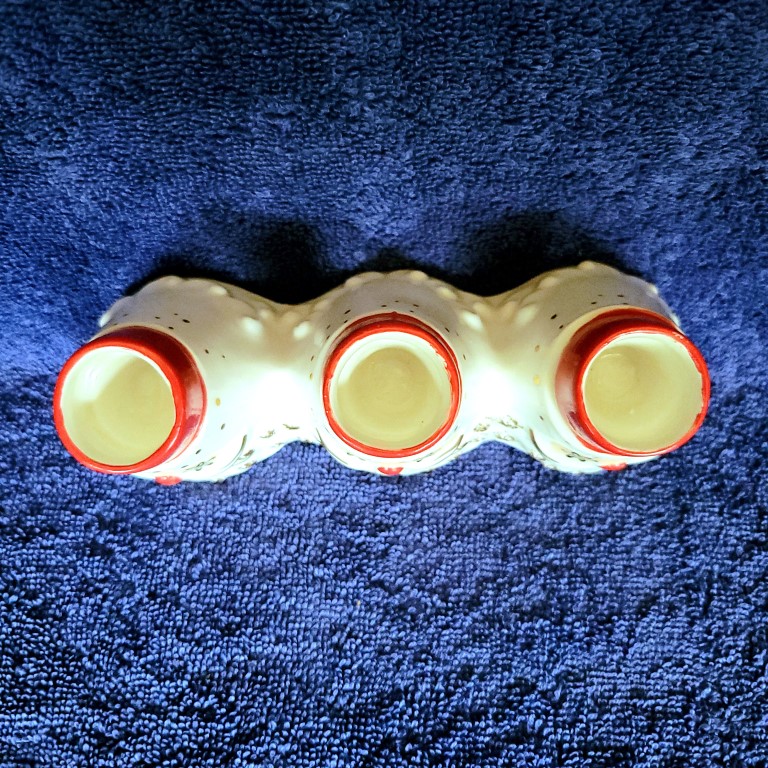
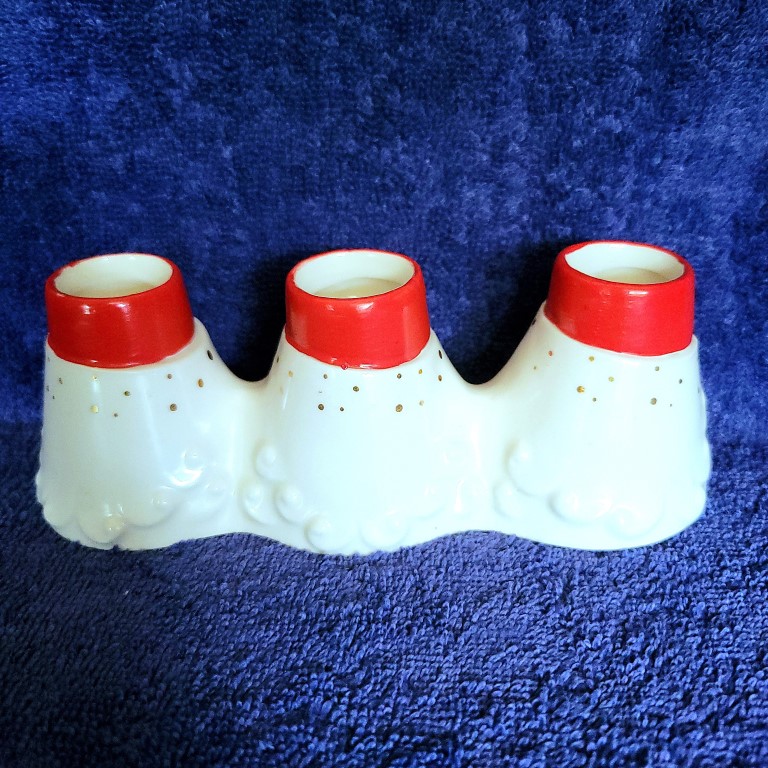
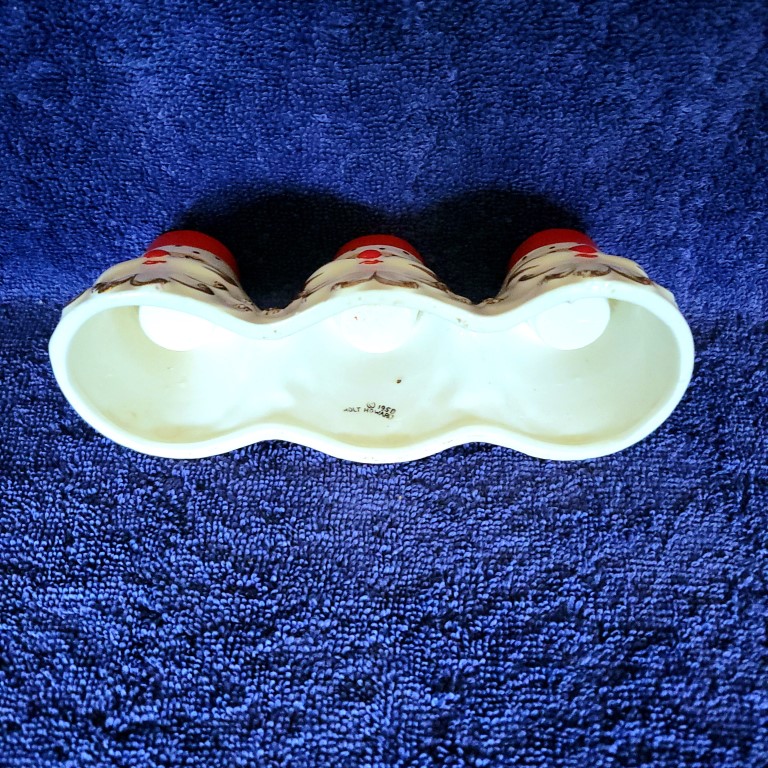
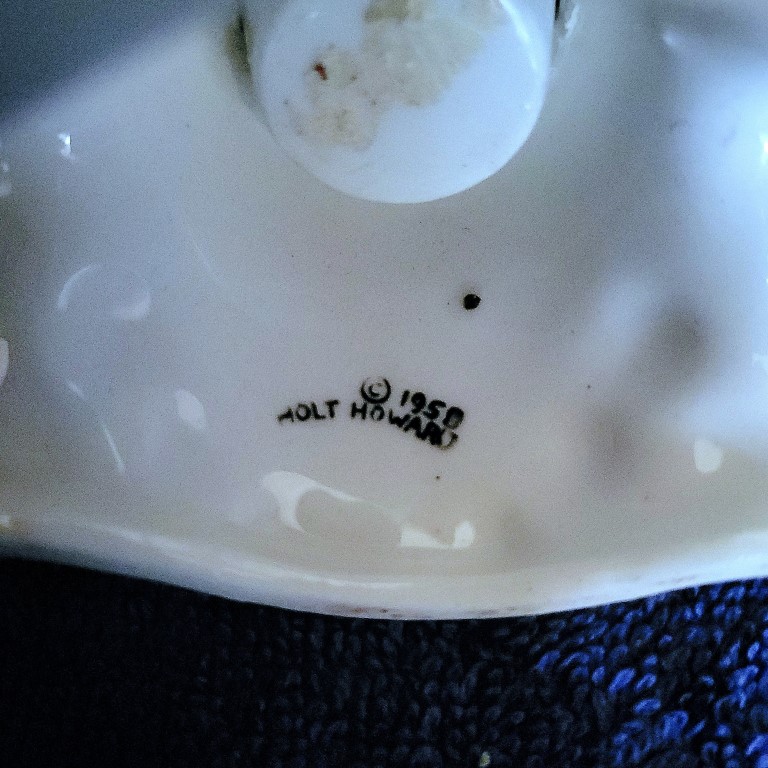
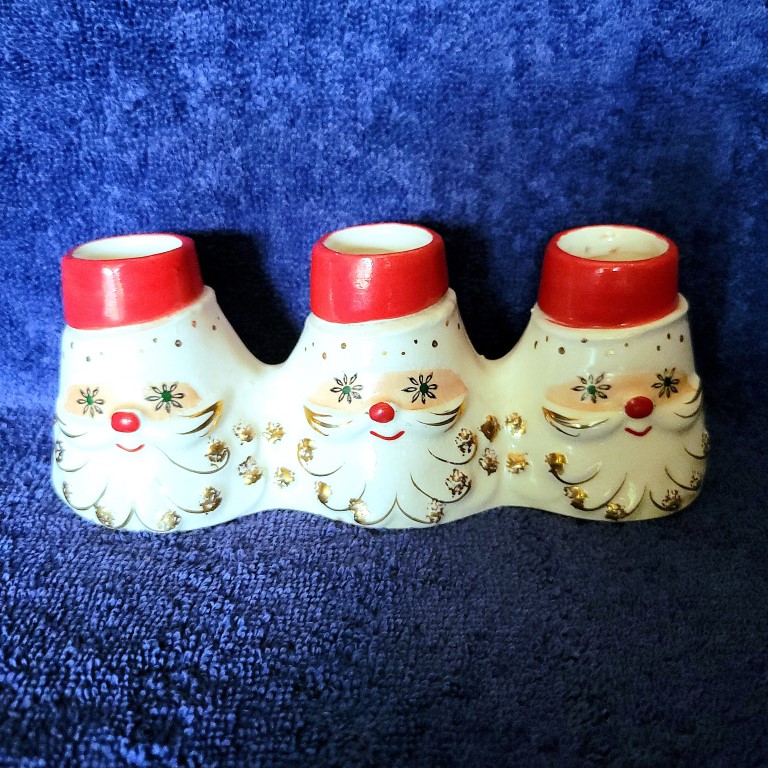
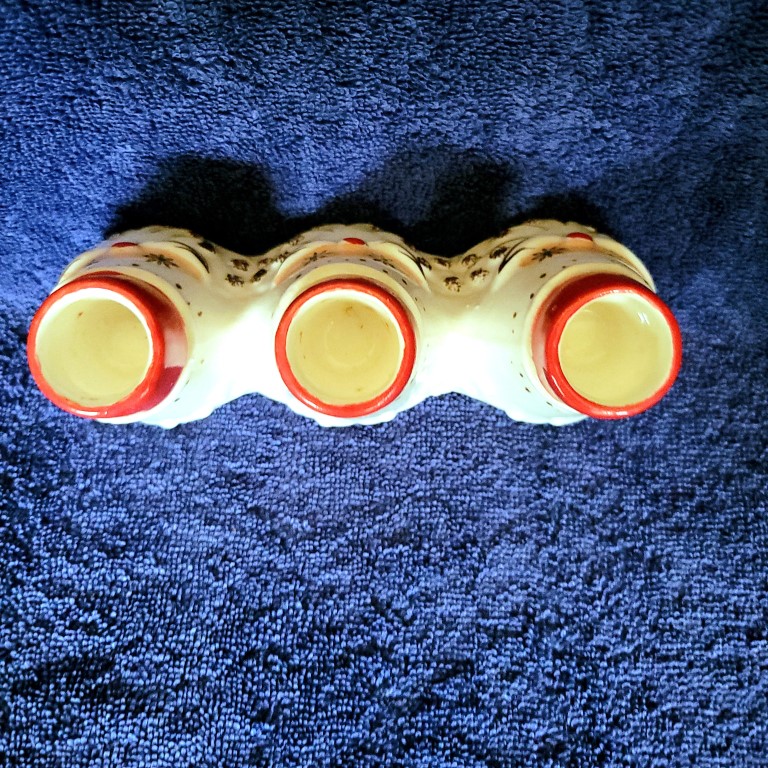
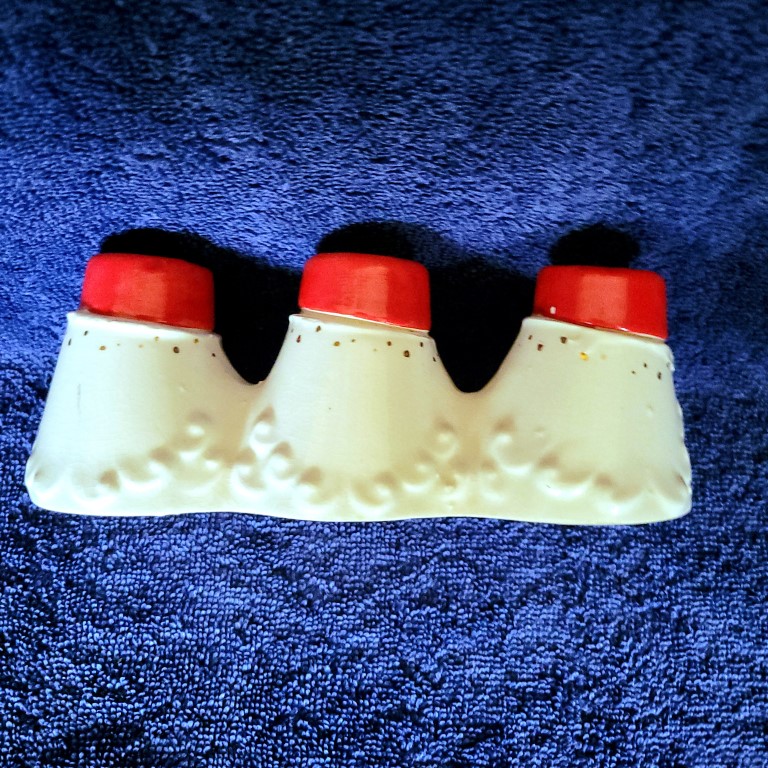
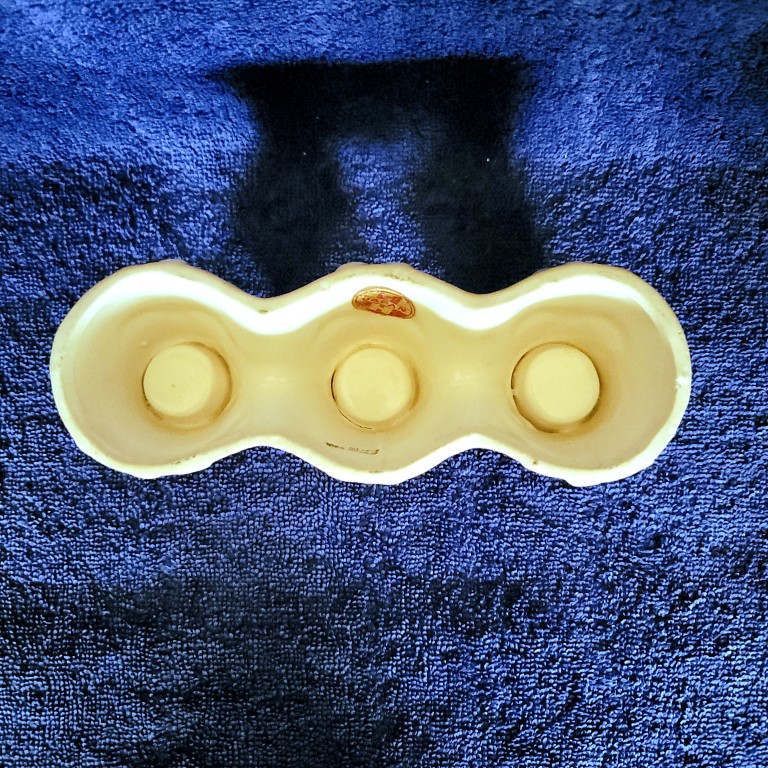
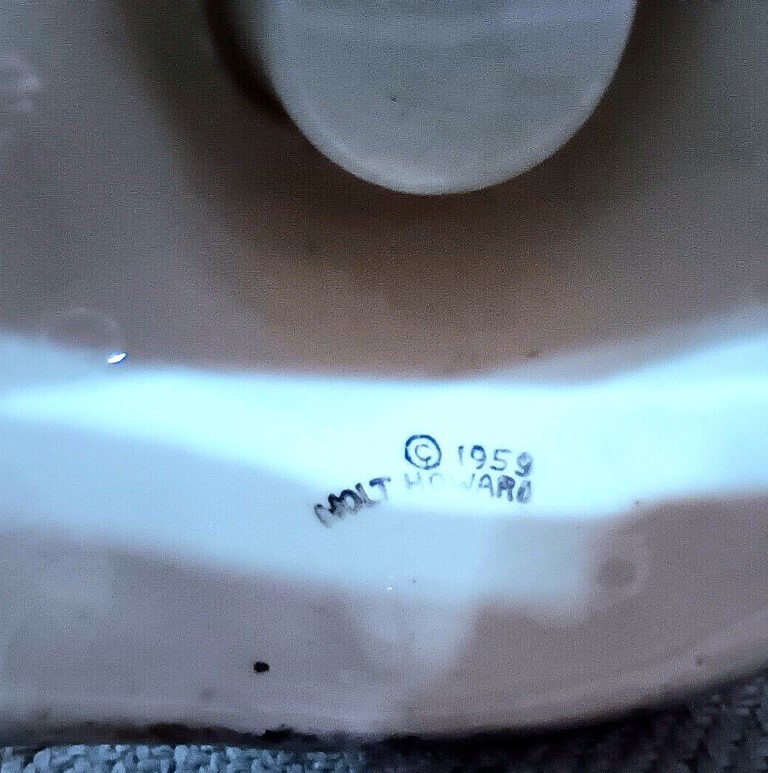
Three Santa faces are joined into a single low, sculptural candleholder, each topped by its own red candle cup. The repeated faces create a rhythmic, almost architectural form, while the continuous white beard mass visually ties the three figures together. Unlike most of the Starry-Eyed Santa forms, the Triple Candle Holder is not illustrated or listed in any of the known Holt Howard collector guides, making surviving examples especially important for documenting the piece.
Both major eye treatments are known. The earlier version uses 6-point Daisy-style eyes; the later version uses 8-point Atomic-style eyes. Both examples shown here carry 1959 backstamps, placing the eye-style change for this form within the same transition year seen elsewhere in the line.
Ashtray / Match Holder
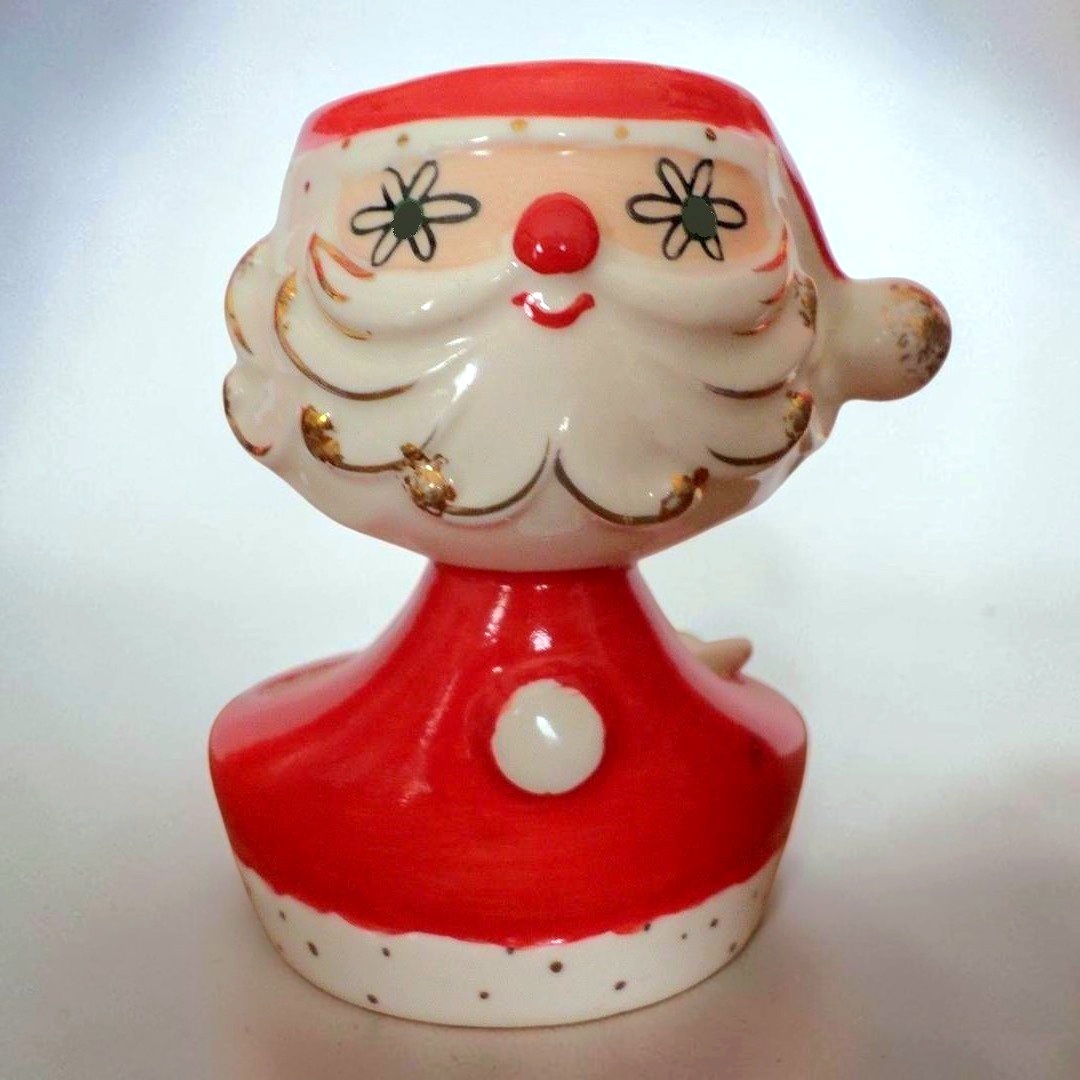
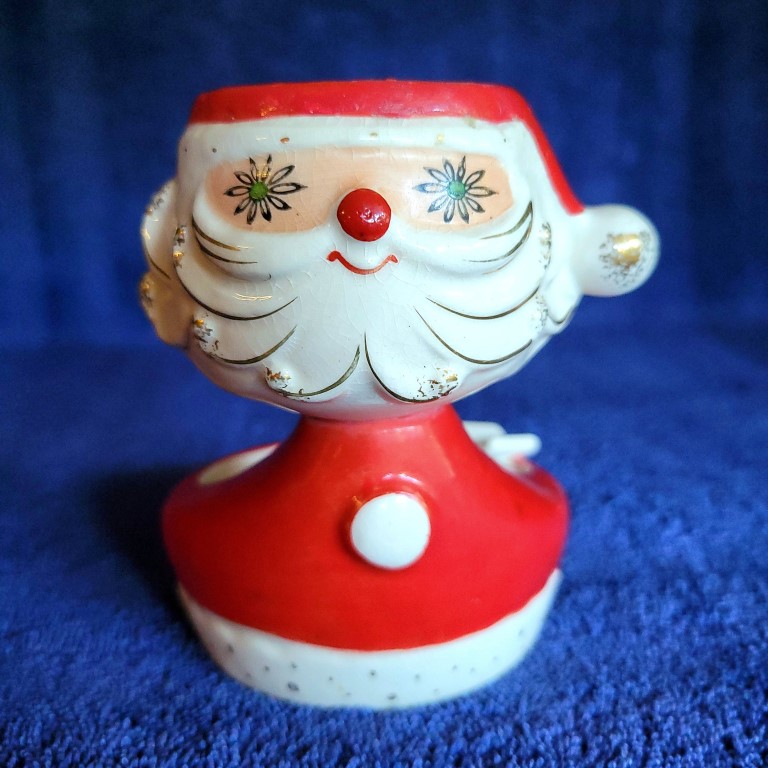
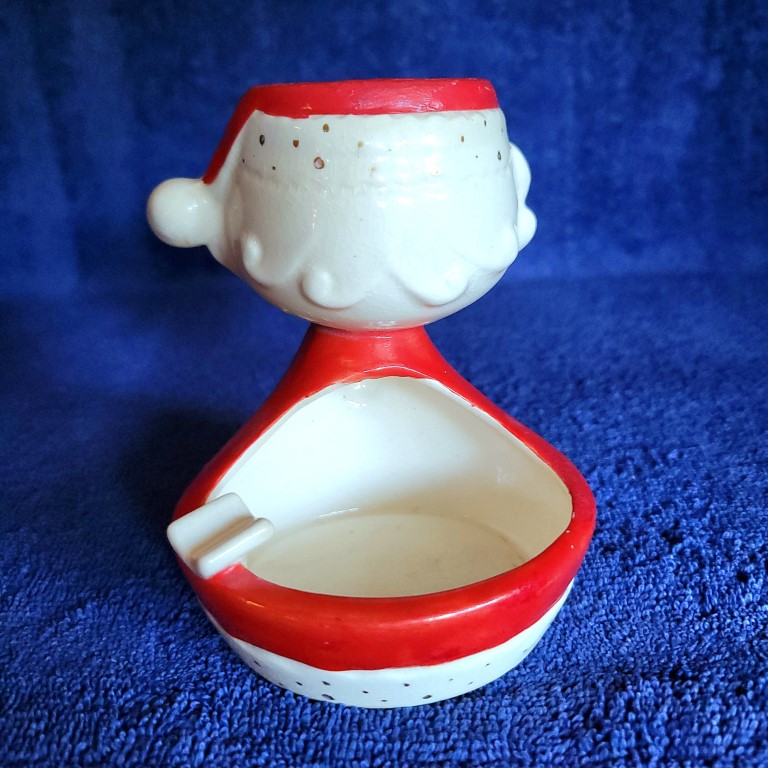
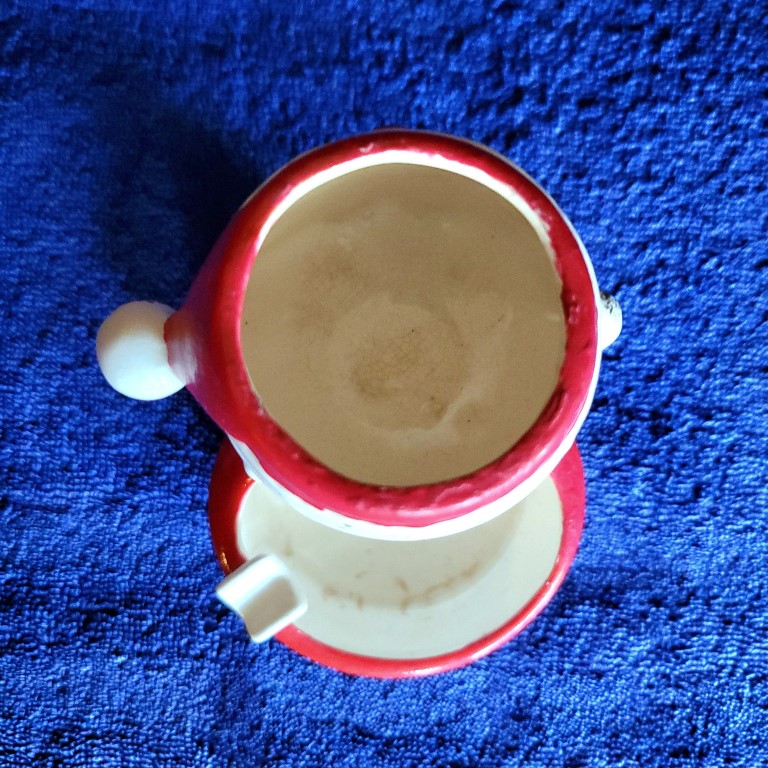
One of the most unusual Starry-Eyed Santa forms combines a hollow Santa head above a deep ashtray basin, with a small molded rest at the rim for a cigarette. The result is unmistakably of its period: a novelty smoking accessory transformed into a Christmas character piece, complete with Santa’s red coat, white trim, sculpted beard, and projecting hat pom-pom.
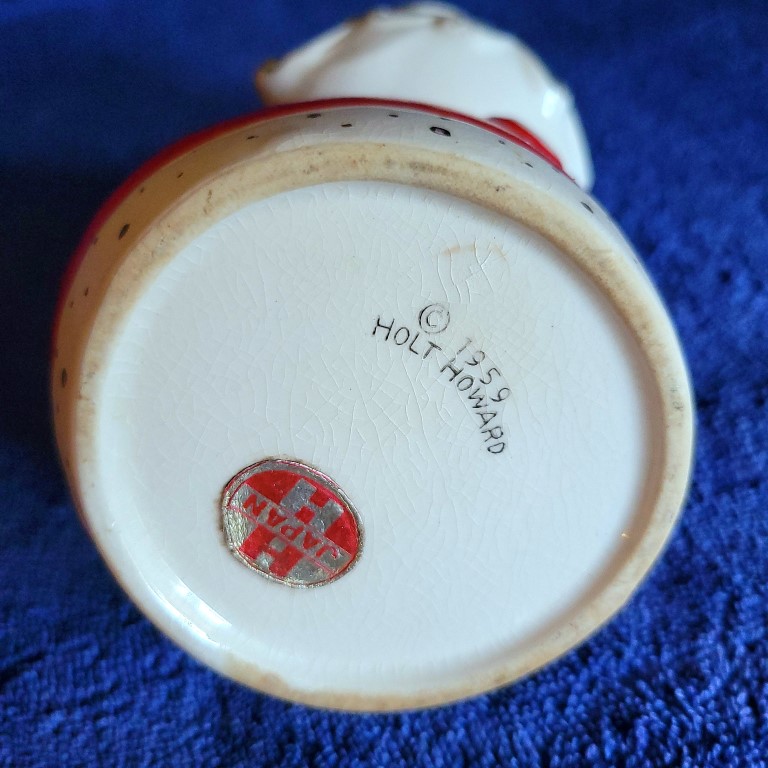
Both Daisy-eye and Atomic-eye versions are known, but the surviving record is overwhelmingly weighted toward the Atomic style. All surveyed examples, regardless of eye treatment, carry a 1959 backstamp.
Seeing Stars
Starry-Eyed Santa rewards the kind of close looking that turns a familiar holiday design into a much richer production story. Across dishes, pitchers, mugs, shakers, candleholders, serving pieces, and the ashtray, the same basic Santa face appears in forms that were introduced, revised, or discontinued at different points within a remarkably short span.
The eye treatments provide the clearest thread through that story. The surviving record consistently places the Daisy-eye style first in 1959, followed by the Atomic-eye treatment later that year. Some forms appear only with Daisy eyes, others survive in both treatments, and a smaller number continue into 1960 with Atomic eyes. Taken together, those patterns make the Starry-Eyed Santa line one of the clearest examples in the Archive of how small design changes can reveal production chronology even when factory records are incomplete.
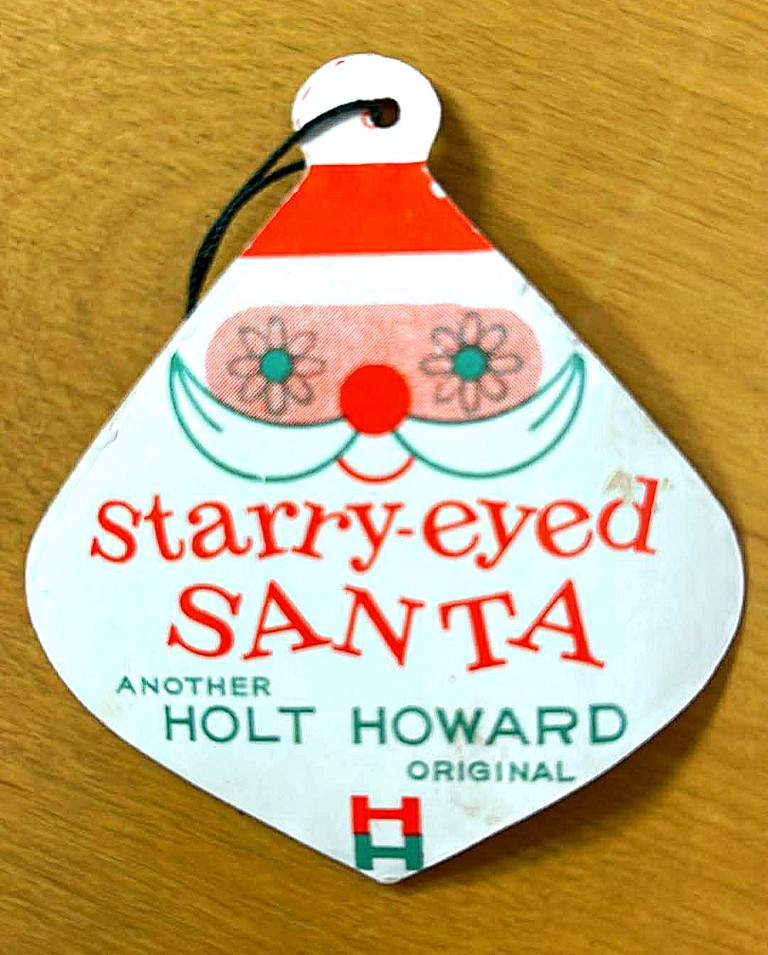
The surviving hang tags add another layer. Their fronts advertised the entire Starry-Eyed Santa line with the same cheerful graphic identity, while the backs identified the individual product and catalog number. They are a reminder that Holt Howard was not simply selling isolated novelty pieces, but a coordinated Christmas collection designed to be recognized as a family.