Coq Rouge Roosters
Holt Howard’s exuberant rooster-themed kitchen and tabletop collection, introduced in 1960 and expanded through the early 1960s into one of the company’s most extensive and recognizable everyday lines.
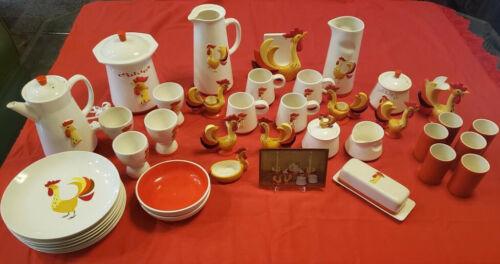
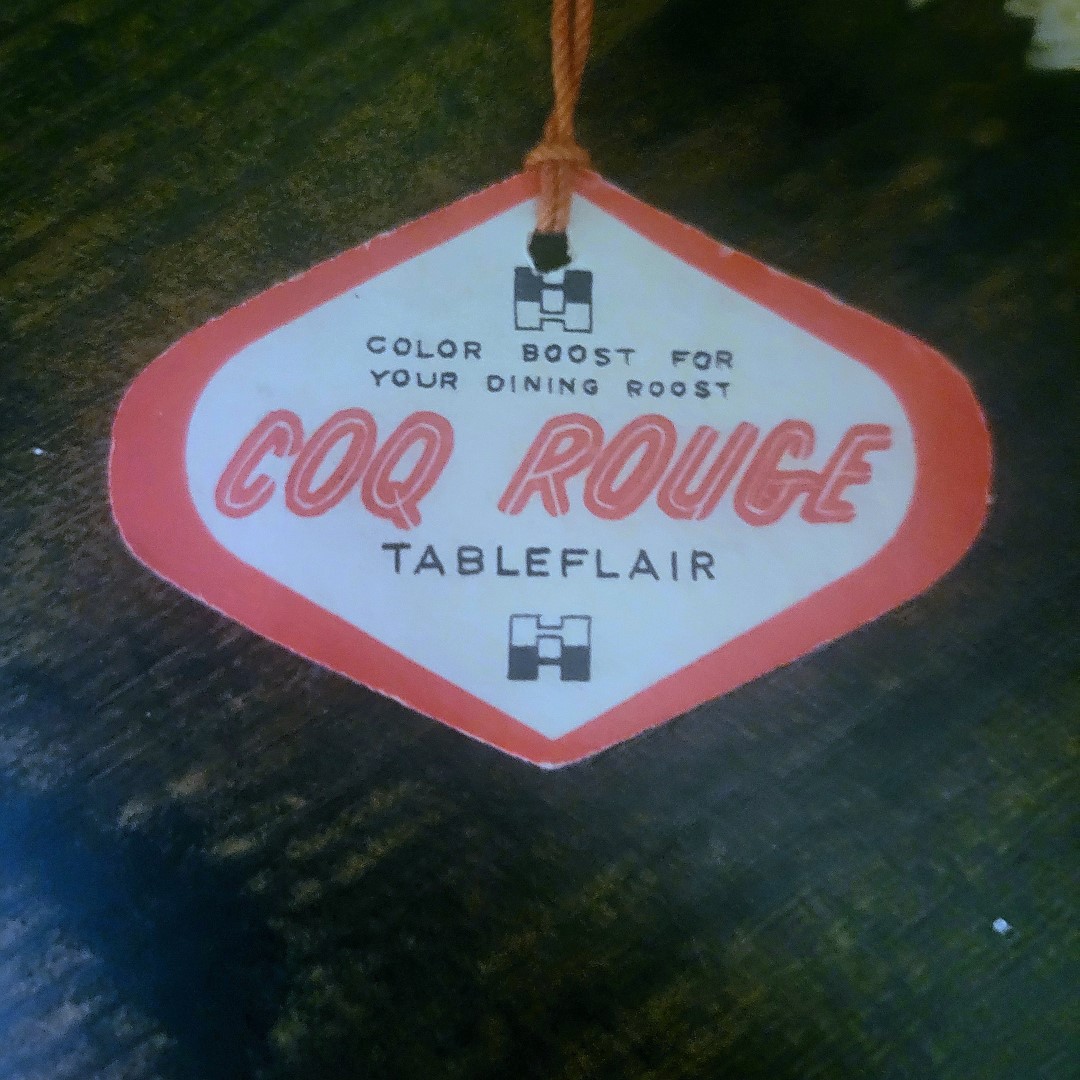
Introduced in 1960, Holt Howard’s Coq Rouge collection brought one of the most enduring motifs of mid-century kitchen décor—the rooster—into a remarkably broad coordinated line of ceramic tableware, serving pieces, kitchen accessories, and giftware. The name, French for “red rooster,” appeared on original hang tags that promoted the collection as “table flair” and promised a “color boost for your dining roost.”
Robert Howard designed the distinctive rooster that gives the line its identity. Rendered in warm shades of yellow, ochre, orange, red, brown, black, and white, the bird appears both as a flat graphic motif on plates, pitchers, mugs, canisters, and other serving pieces and as a fully dimensional figure incorporated into salt and pepper shakers, candleholders, nut dishes, spoon rests, bud vases, ashtrays, and other novelty forms. Despite the variety of objects, the repeated rooster design and tightly controlled palette give Coq Rouge an unusually cohesive appearance.
The collection reflected Holt Howard’s belief that the American kitchen was becoming more than simply a room for preparing food. As families increasingly gathered there to eat and socialize, the company developed coordinated kitchen lines intended to be both useful and decorative. Coq Rouge grew accordingly: additional pieces were introduced as the line’s popularity increased through 1964, eventually encompassing a complete breakfast service along with an extensive assortment of tabletop and kitchen accessories.
Period Marketing & Identification
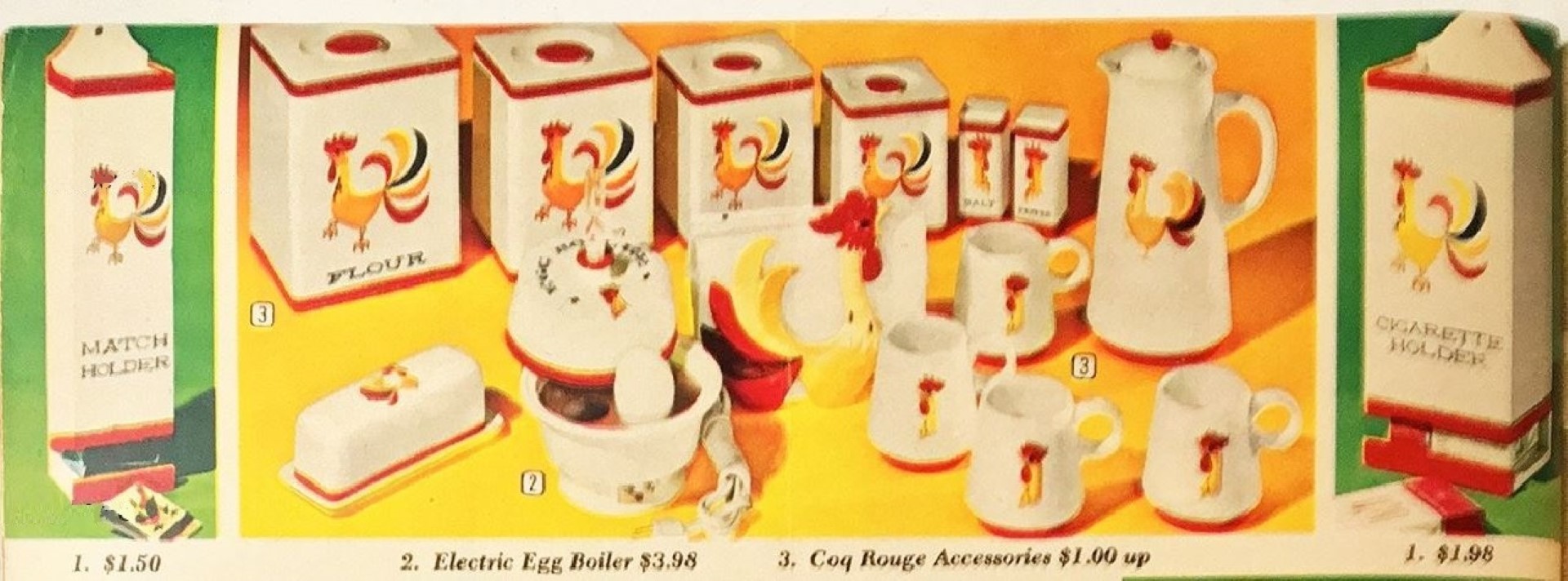
Surviving Holt Howard advertising and original paper hang tags preserve the company’s own playful language for Coq Rouge. The line was promoted as “table flair,” a “color boost for your dining roost,” and a coordinated collection “worth crowing about.” These surviving materials also document the distinctive Holt Howard branding that accompanied the line during its original retail life.
Food Preparation & Table Service
Butter Dish — Rooster Head
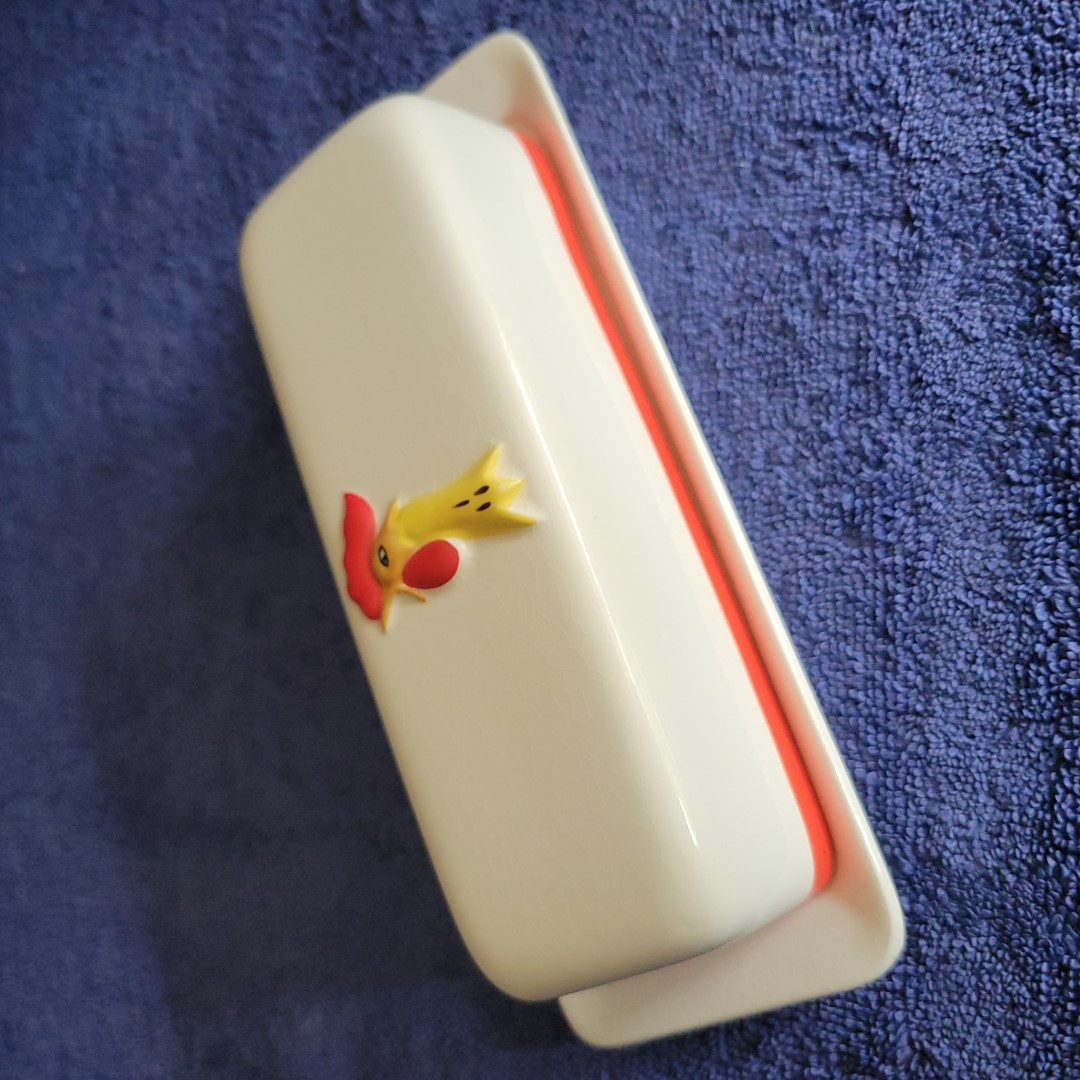
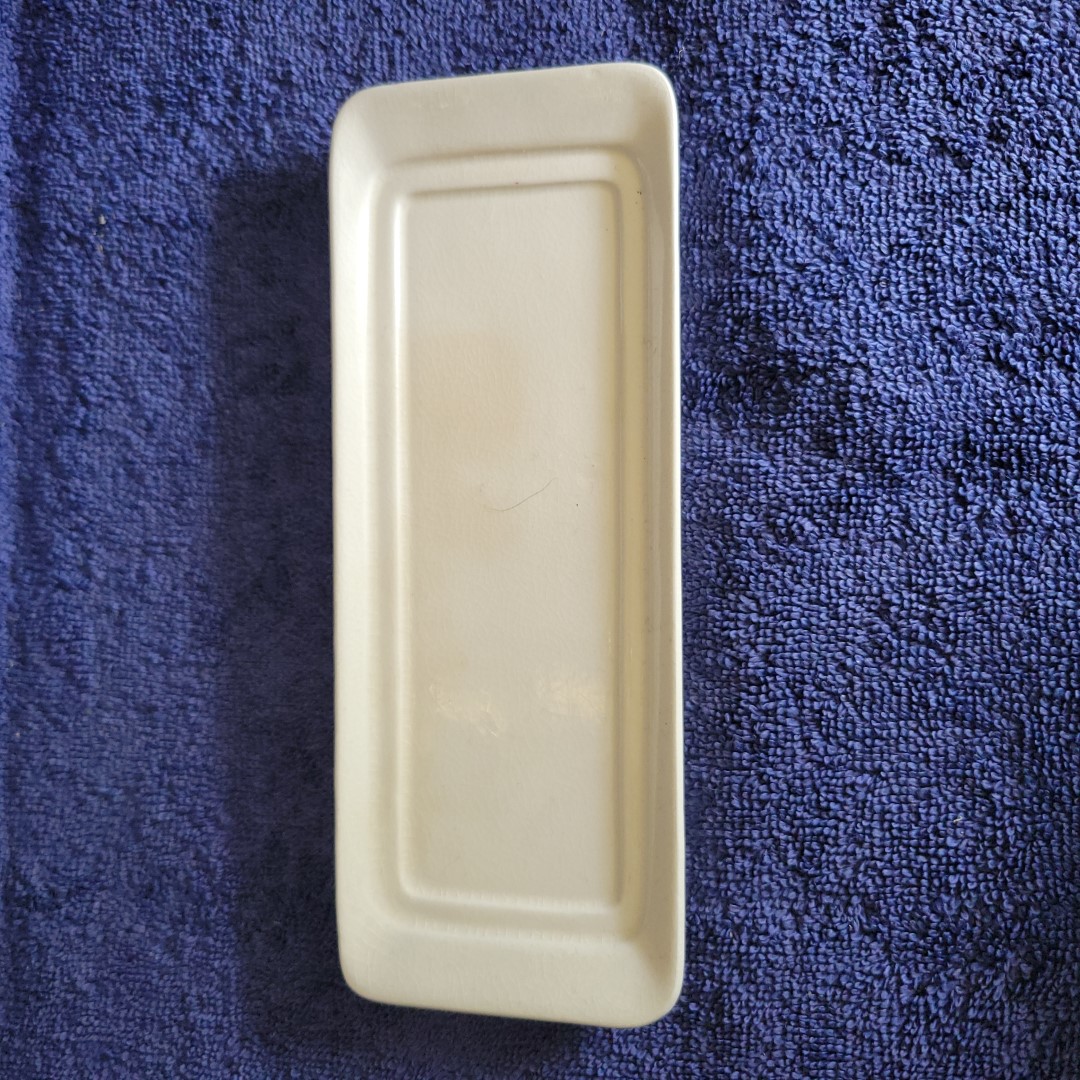
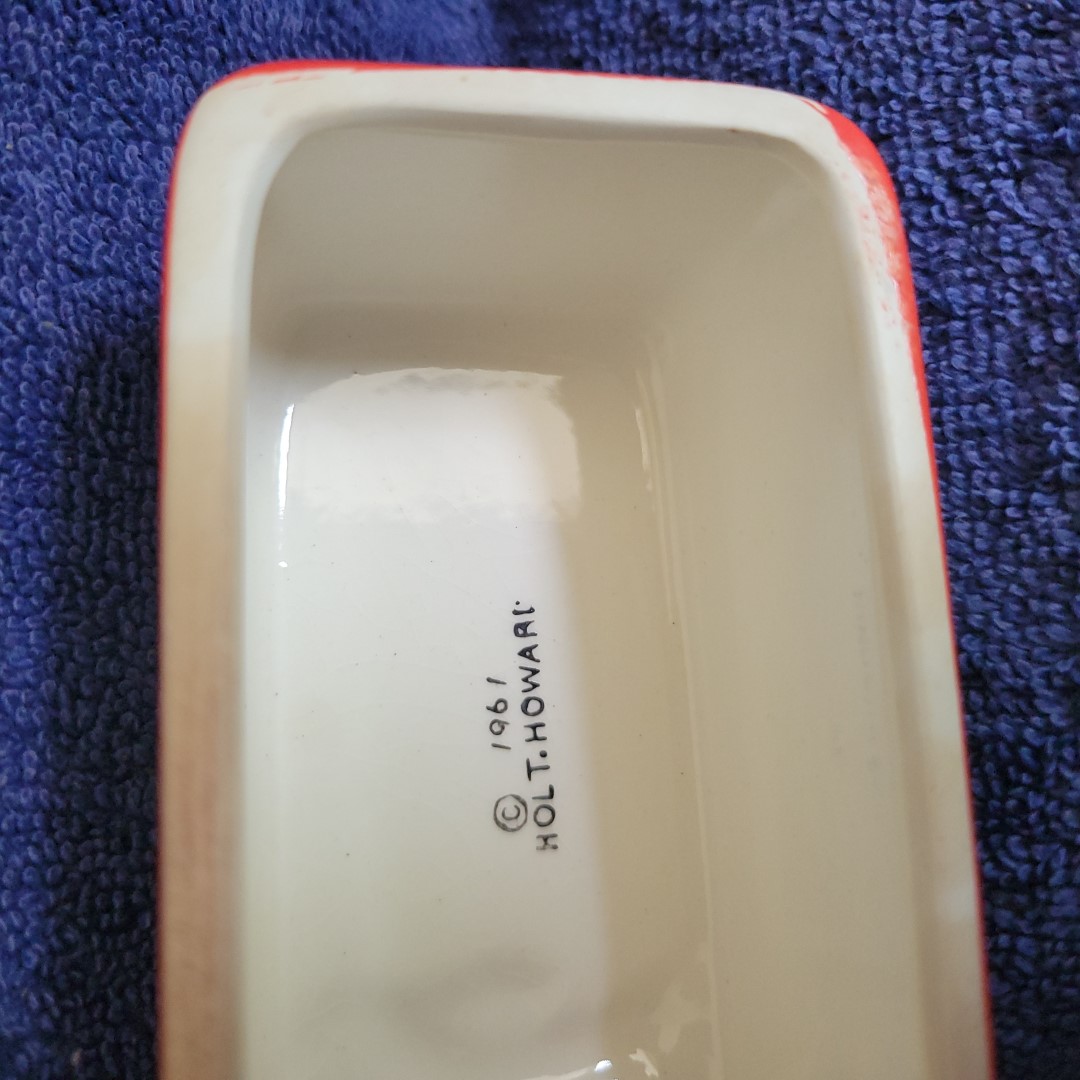
This low rectangular butter dish uses one of the simplest treatments of the Coq Rouge bird. Instead of the complete rooster, the lid carries only the sculpted head and neck in red, yellow, brown, and black, while a narrow red-orange band runs around the lower edge of the cover.
The archive example is marked © 1961 Holt Howard. Both editions of the standard collector guide document the full-body rooster butter dish rather than this rooster-head version, making the surviving example useful evidence of a second distinct butter-dish design within the line.
Butter Dish — Full-Body Rooster
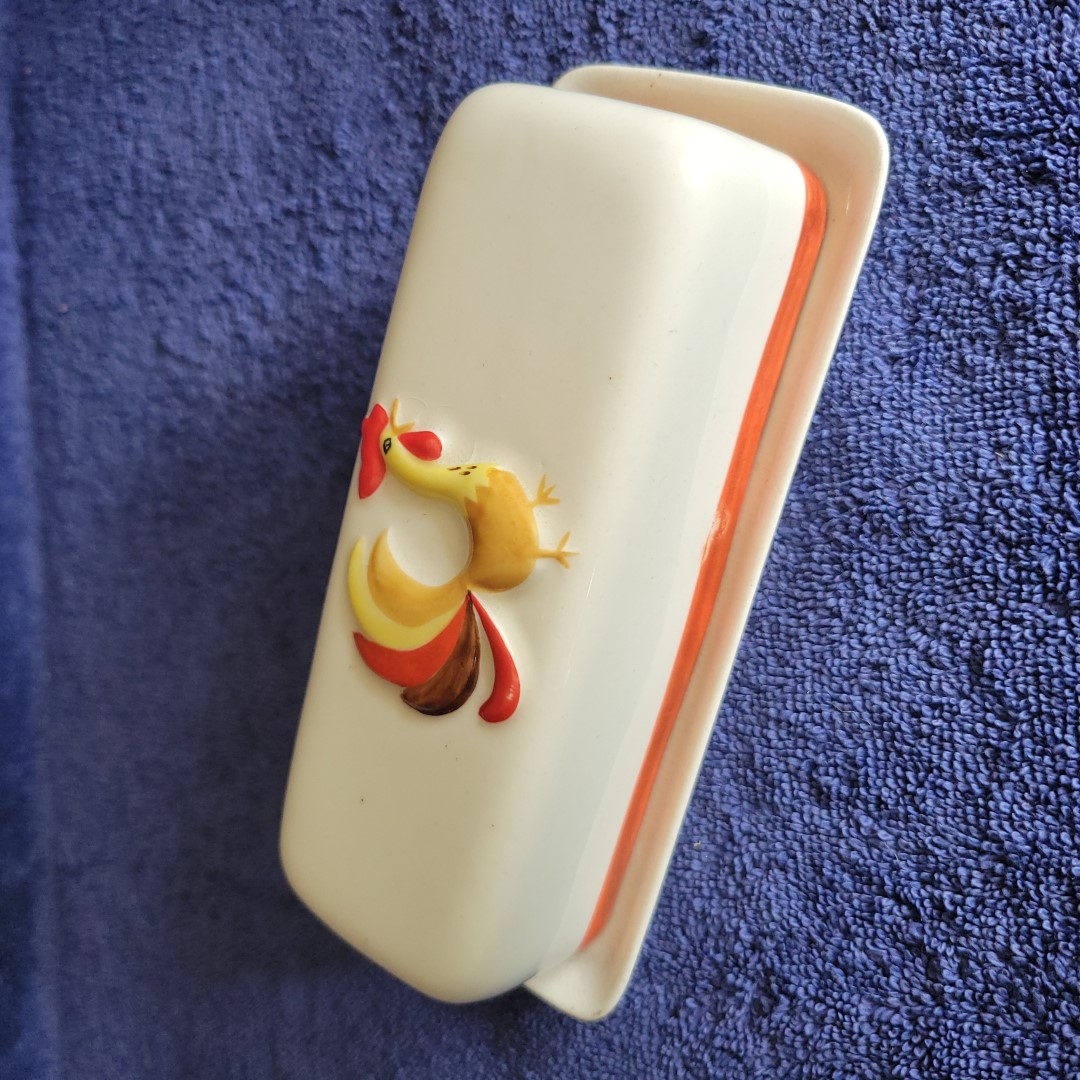
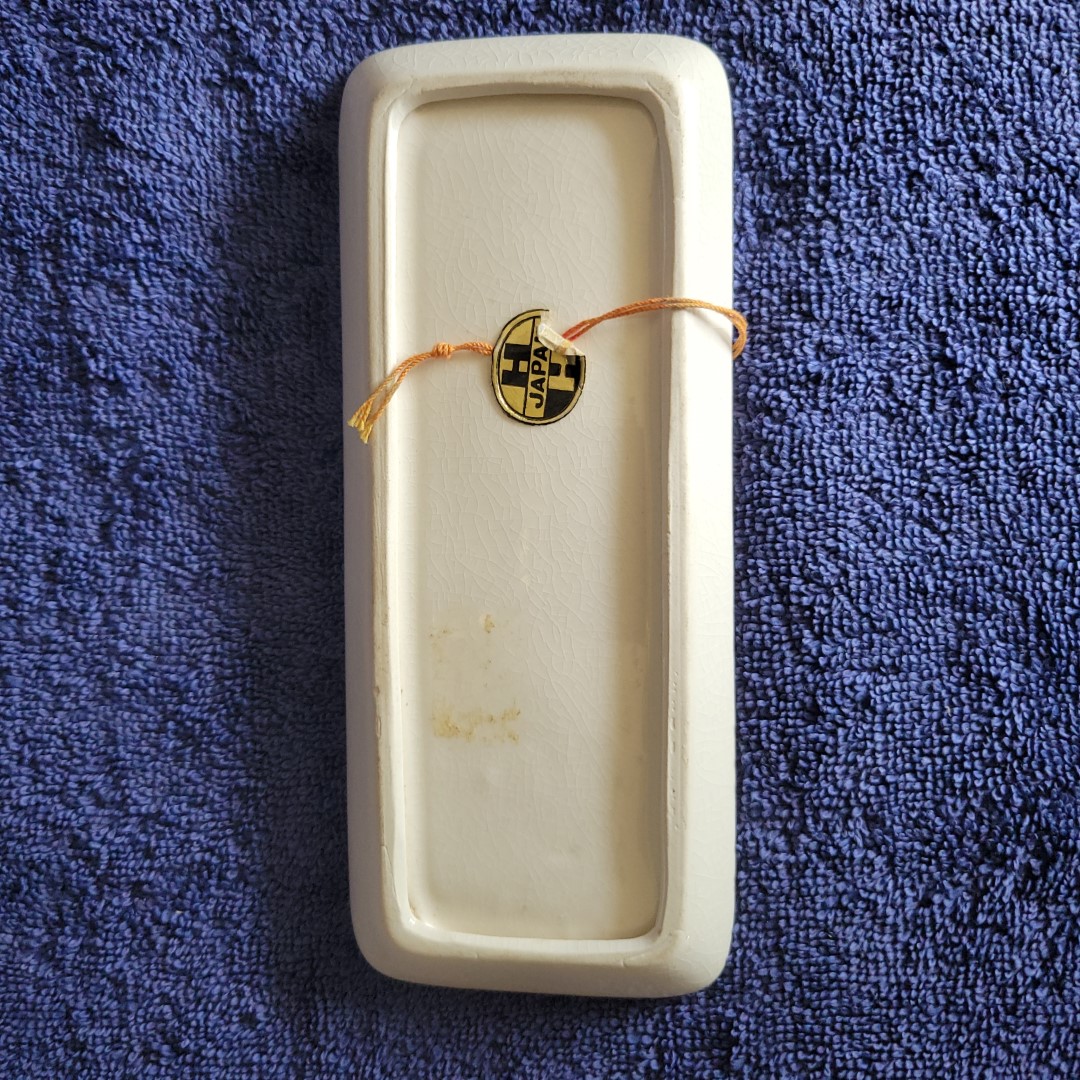
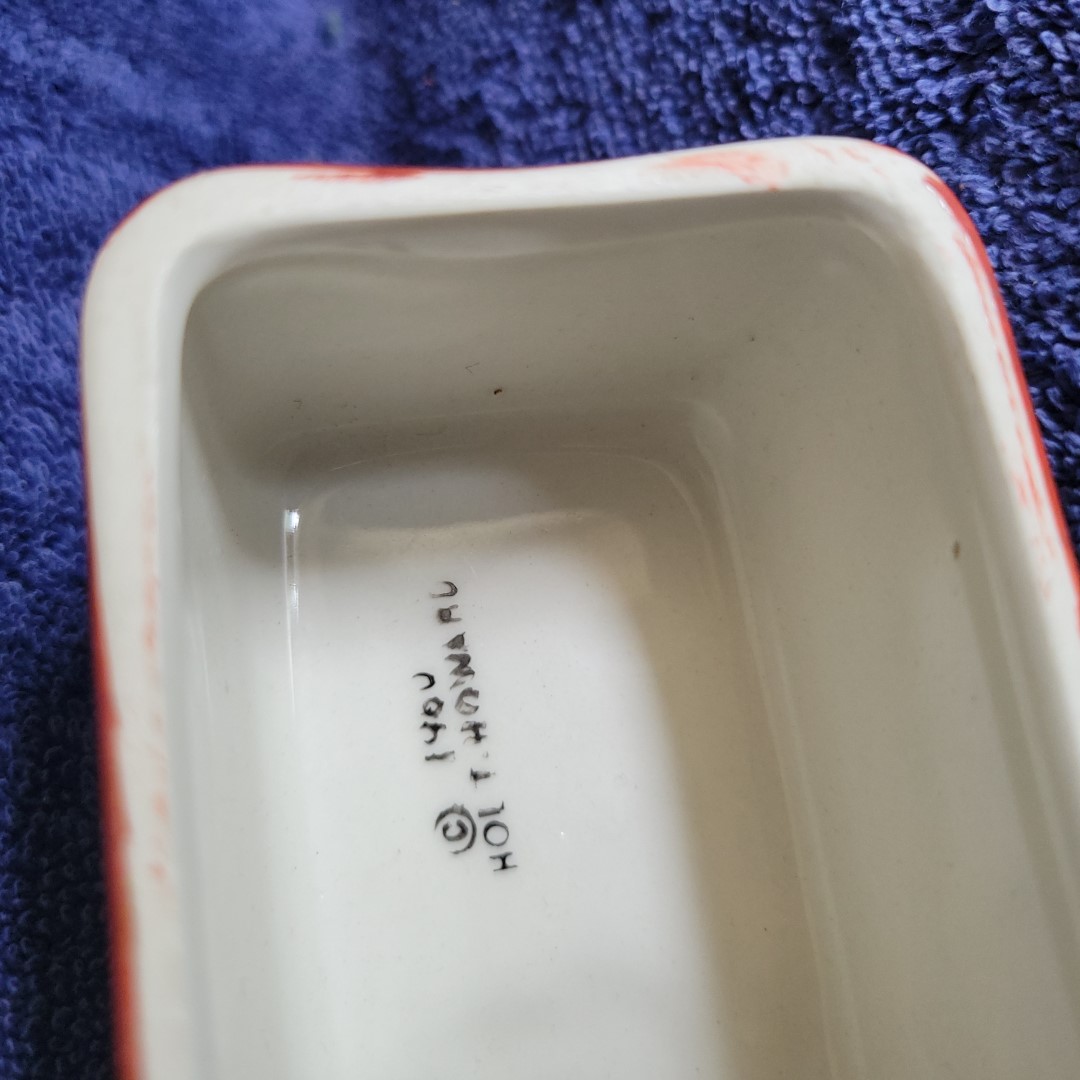
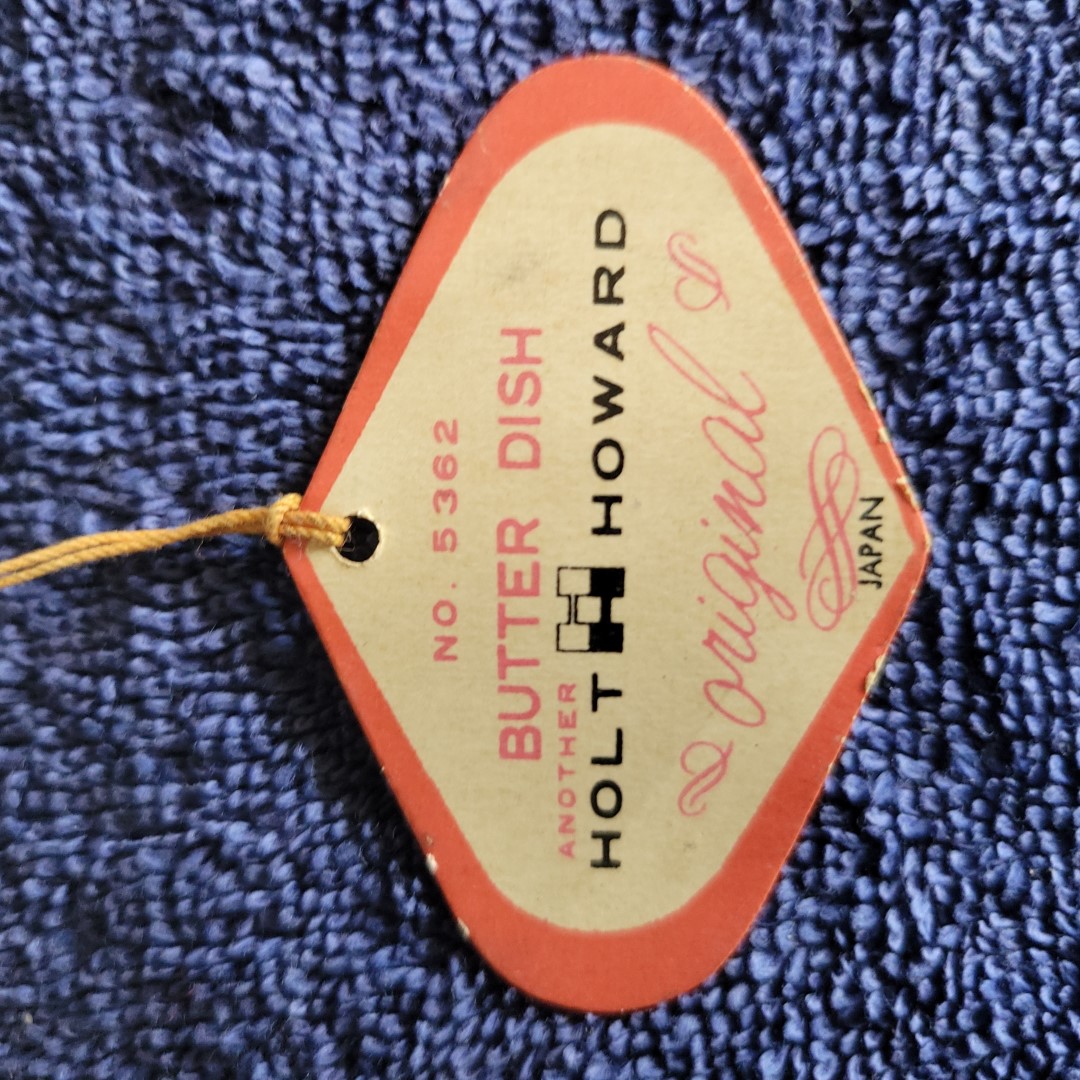
The second butter-dish design places the complete Coq Rouge rooster across the lid, turning the bird’s curled tail into a raised sculptural accent while retaining the same low rectangular form and red-orange edge band.
This is the butter dish illustrated in both editions of the standard collector guide. The first edition gives its length as approximately 6¾ inches and describes the documented example as dated 1961. The second edition refines the underplate measurement to approximately 6⅞ inches long × 2 9/16 inches wide and again reports a 1961 lid mark.
The archive example shown here is particularly useful because it retains its original No. 5362 Butter Dish hang tag and Holt Howard foil label. Its lid is marked © 1960 Holt Howard, documenting production at least one year earlier than the dated example described in the guides.
Electric Hot Pot
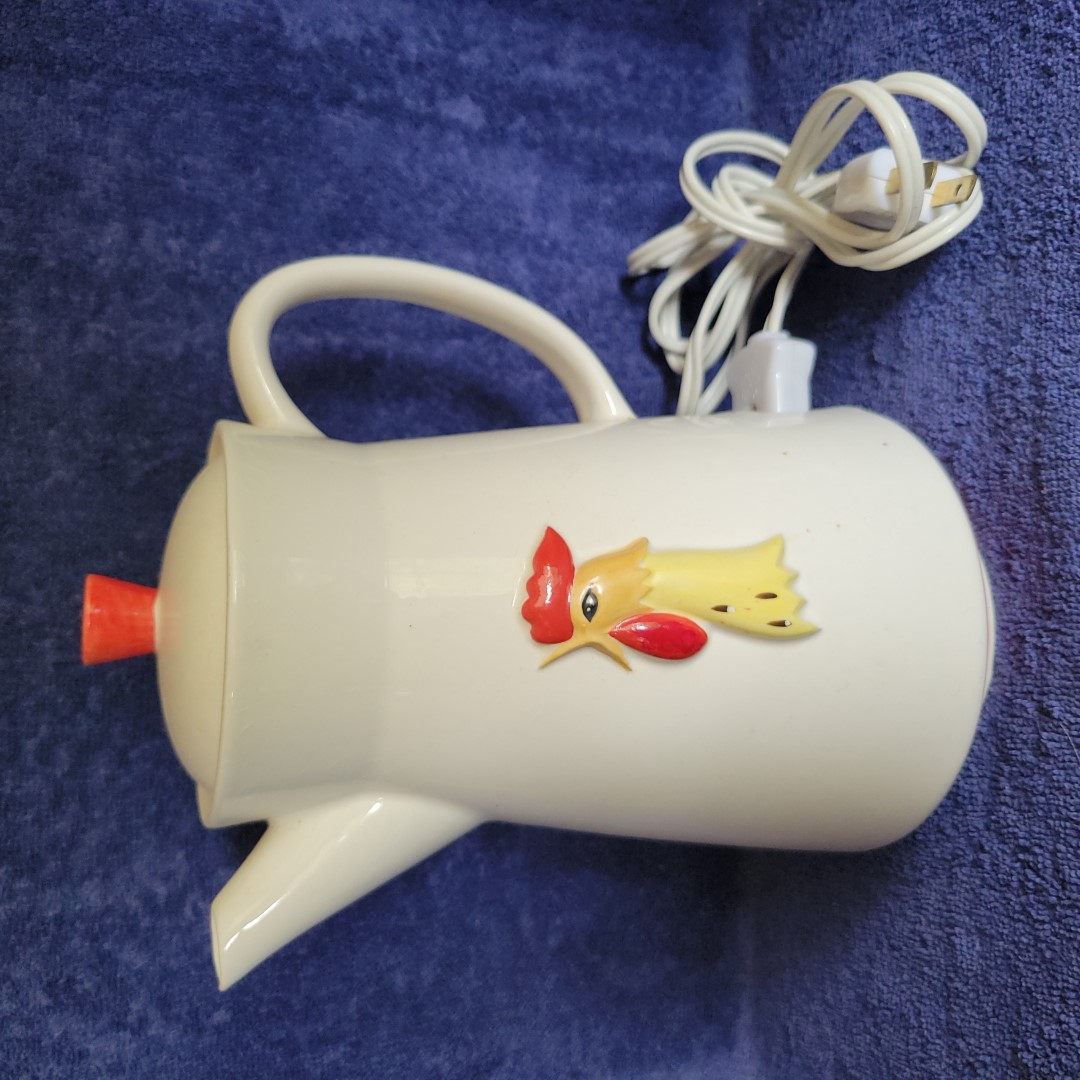
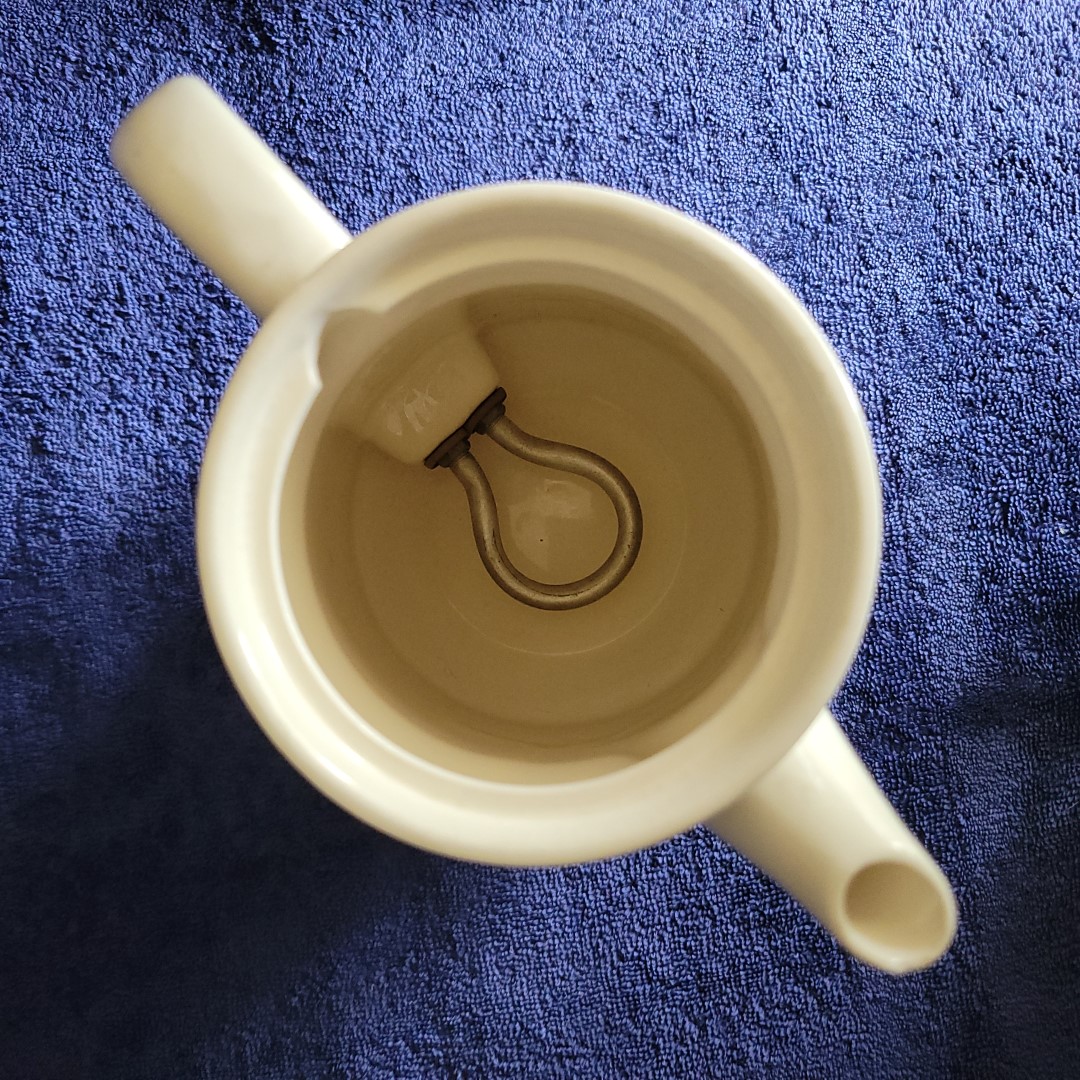

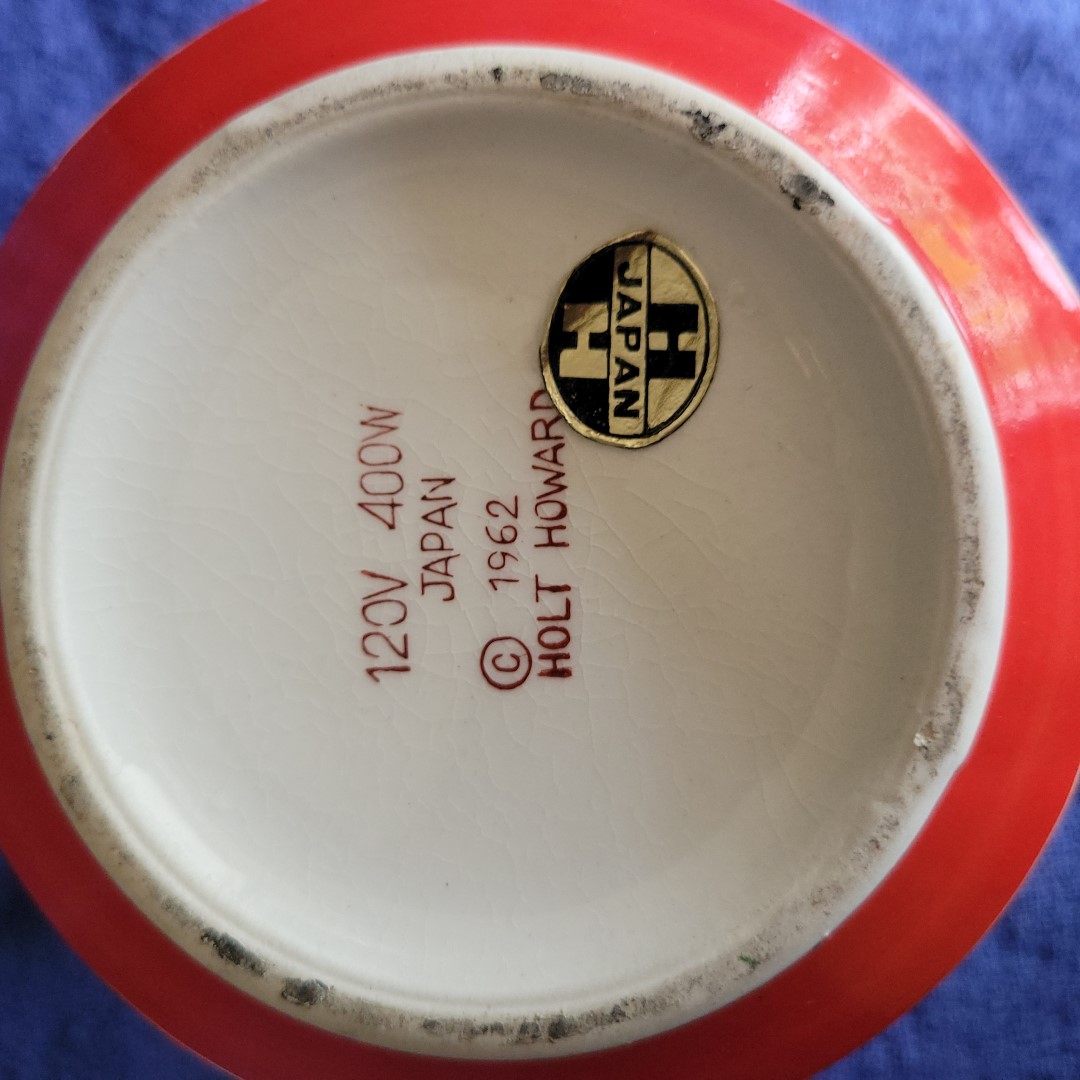

The electric Hot Pot extends Coq Rouge beyond ordinary ceramic tableware into small countertop appliances. Its tall white body is decorated with the sculpted rooster-head motif, while the removable lid is finished with a red-orange knob. Inside, a built-in heating element allows the ceramic vessel itself to heat water.
The original hang tag identifies the appliance as No. 5580 Hot Pot, describes it as a six-cup size, and advertises that it could boil water in approximately 2½ minutes for instant coffee, tea, or cocoa. The base of the surviving example is marked 120V 400W, Japan, and © 1962 Holt Howard, and it retains its original black-and-gold foil label.
The second edition of the standard collector guide documents this appliance on page 179 under the heading “Coffee Pot and Cup.” Its accompanying text, however, notes that the six-cup coffee pot was sold as a hotpot with a five-foot cord. The original Holt Howard hang tag shown here resolves the naming more precisely, identifying the appliance as No. 5580 Hot Pot.
Coffee Server
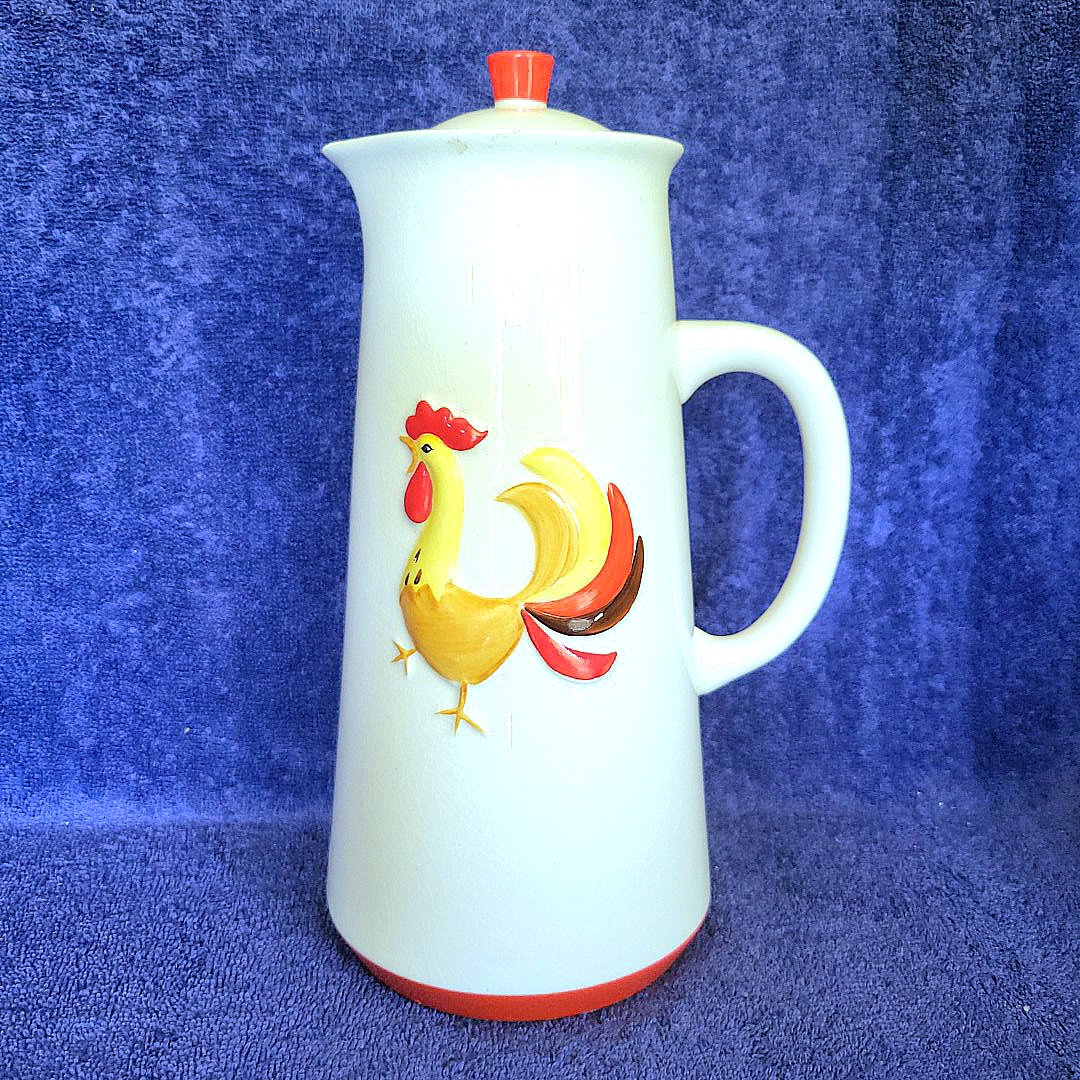
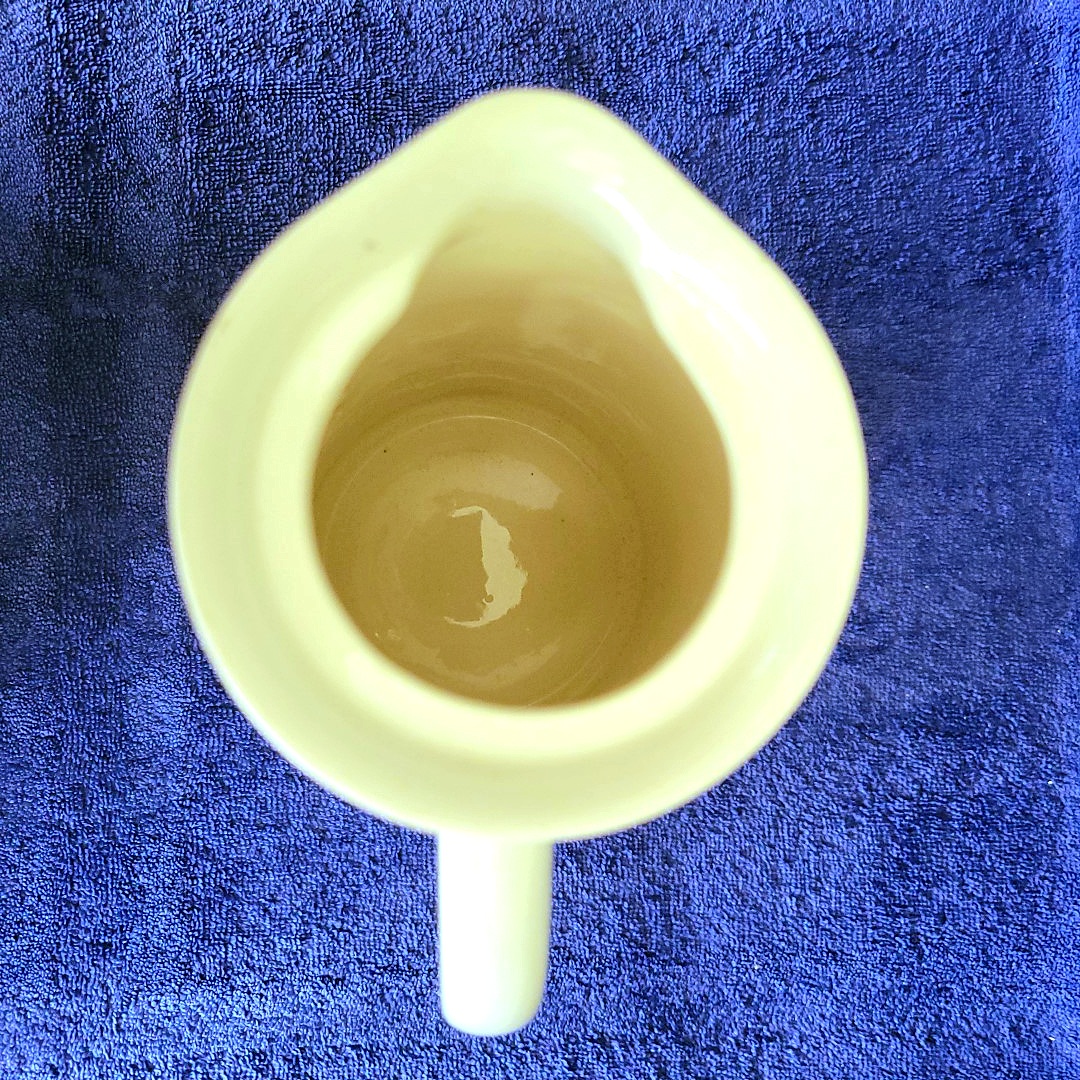
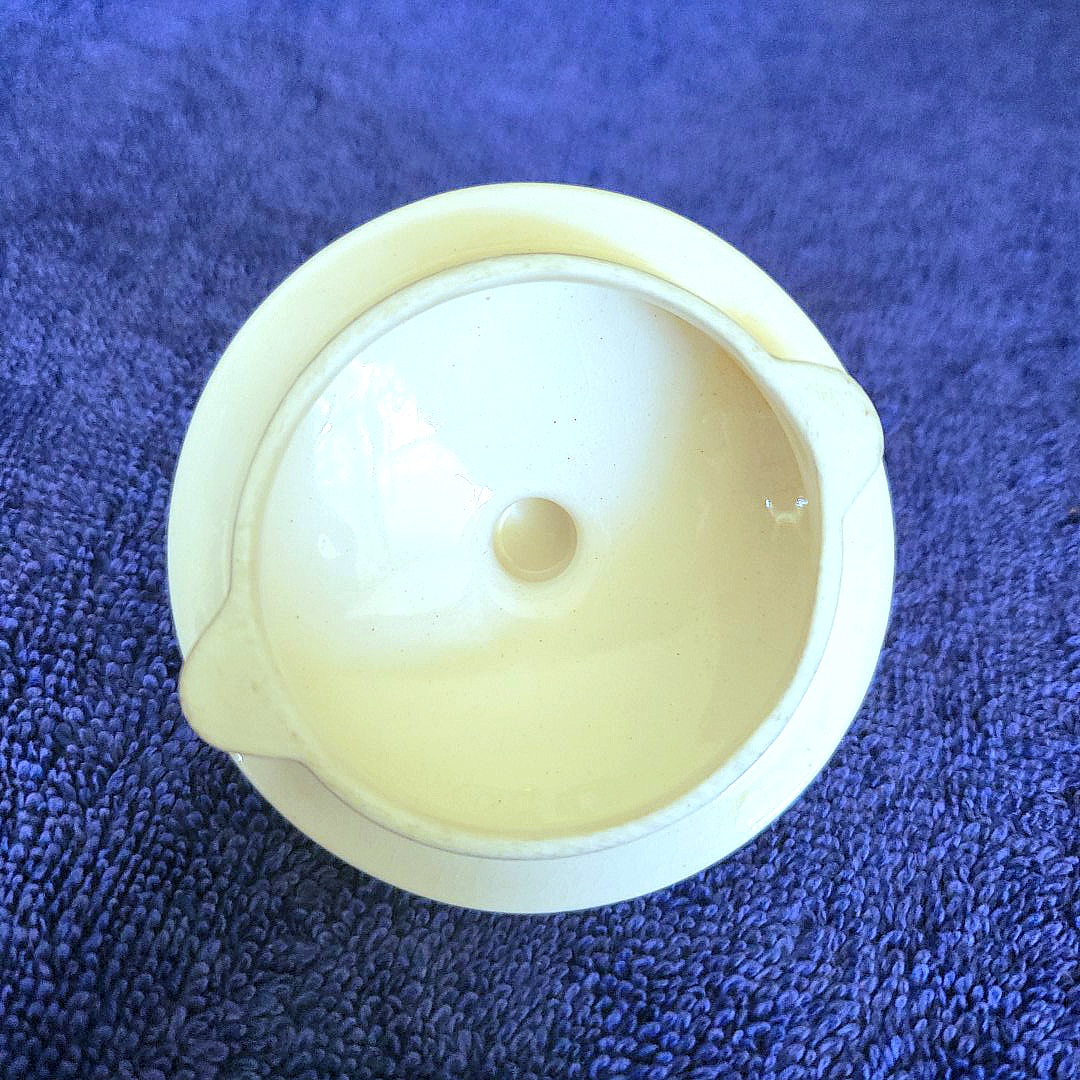
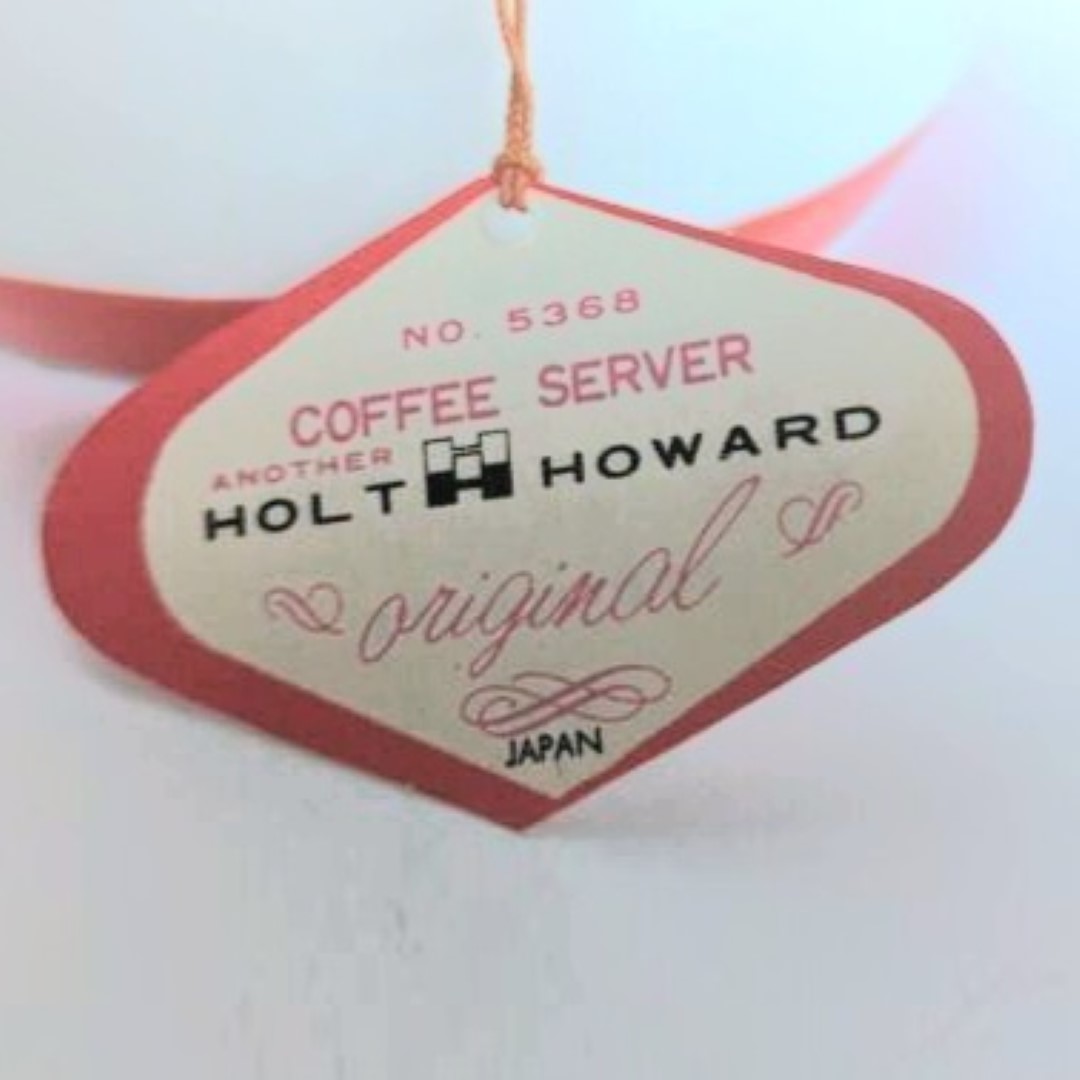
The Coq Rouge Coffee Server is a tall, covered ceramic serving vessel decorated with the collection’s full-body rooster motif. Its tapered white body is finished with a narrow red-orange band around the base and a large plain loop handle at the rear. The removable domed lid has a matching red-orange finial and is notched to align with the pouring spout, allowing the server to pour while the lid remains in place.
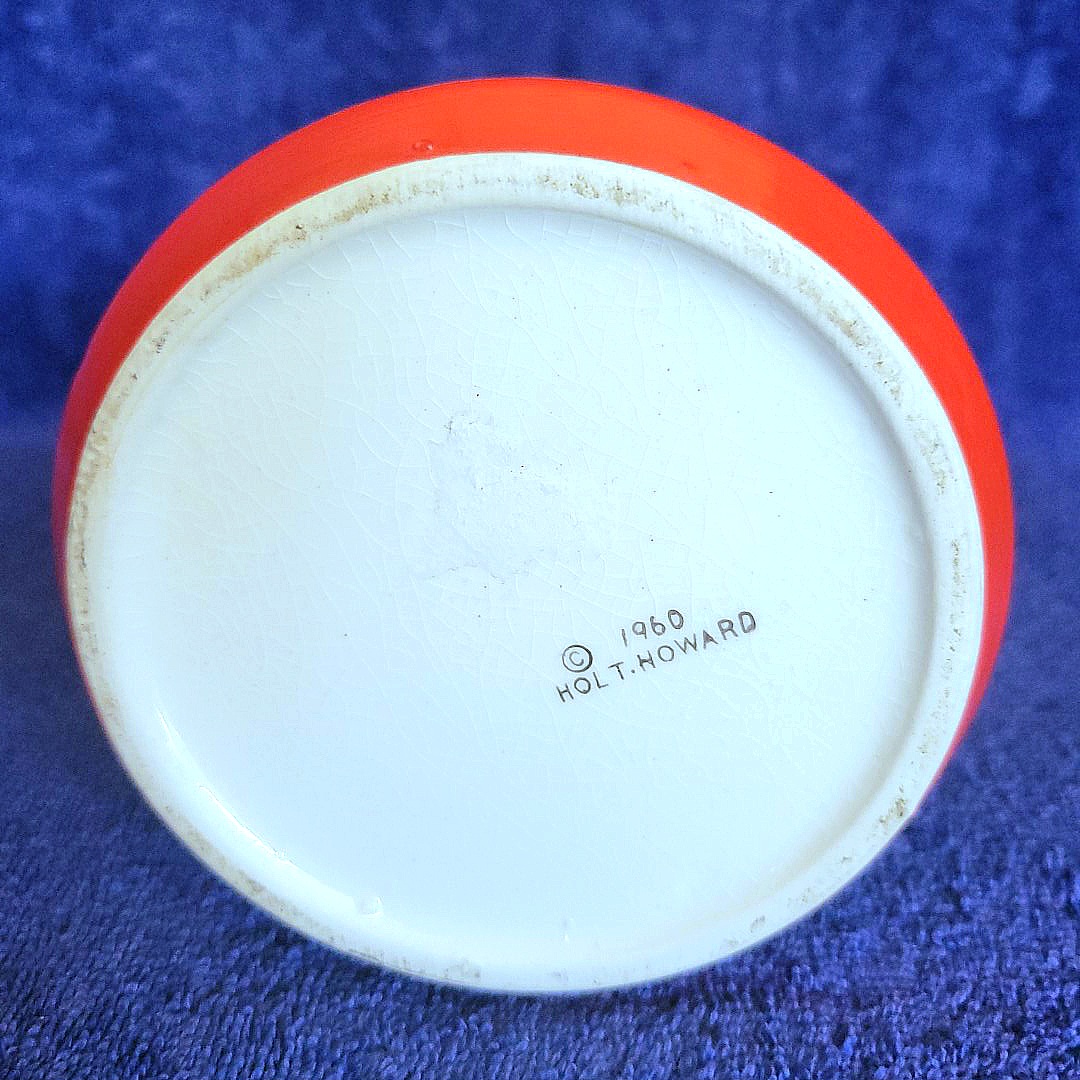
An original Holt Howard hang tag identifies the piece unequivocally as No. 5368 Coffee Server. The archive example is backstamped © 1960 Holt Howard and measures 8¼ inches high to the rim, 9 inches to the top of the lid finial, and 4¼ inches across the base.
The first edition of the standard collector guide correctly identifies the covered form as a Coffee Server with a 36-ounce capacity. In the second edition, however, a lidless example of the same Coffee Server was pictured beside a Coq Rouge juice pitcher and described as a 12-ounce pitcher with a plain handle. The pitcher beside it is clearly the medium-sized rooster-tail-handled form, making the scale relationship in the photograph especially useful.
The stated 12-ounce capacity is plainly impossible for a vessel of this size and conflicts directly with the first-edition identification of the same covered form as a 36-ounce Coffee Server. Something was obviously mixed up in the compilation of this portion of the Coq Rouge chapter for the second edition. The surviving original No. 5368 hang tag resolves the later identification error and confirms the plain-handled, covered form as the Coffee Server.
Coffee Mug / Coffee Cup
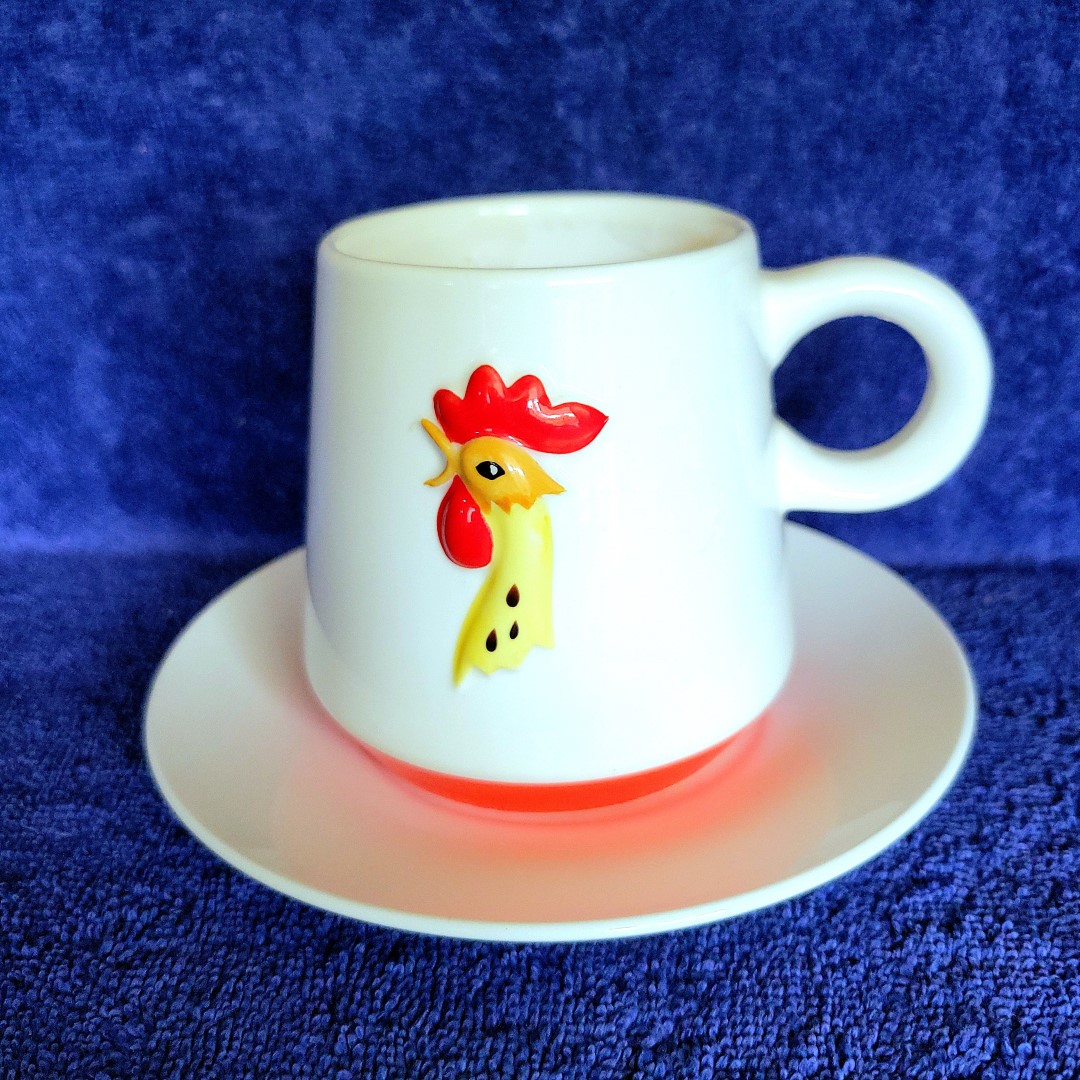
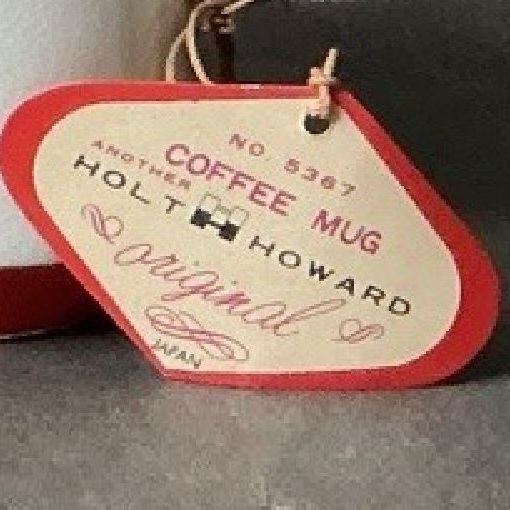
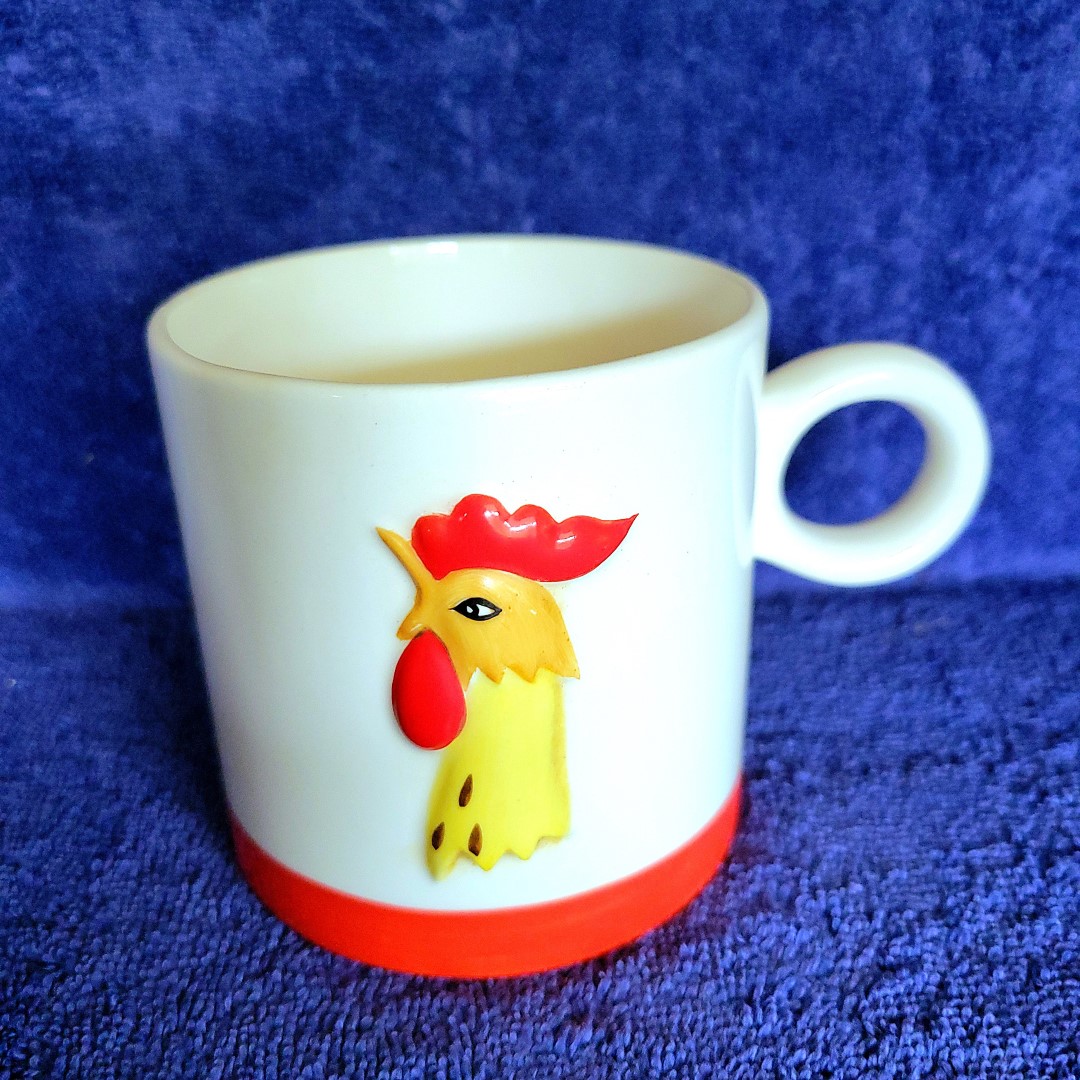
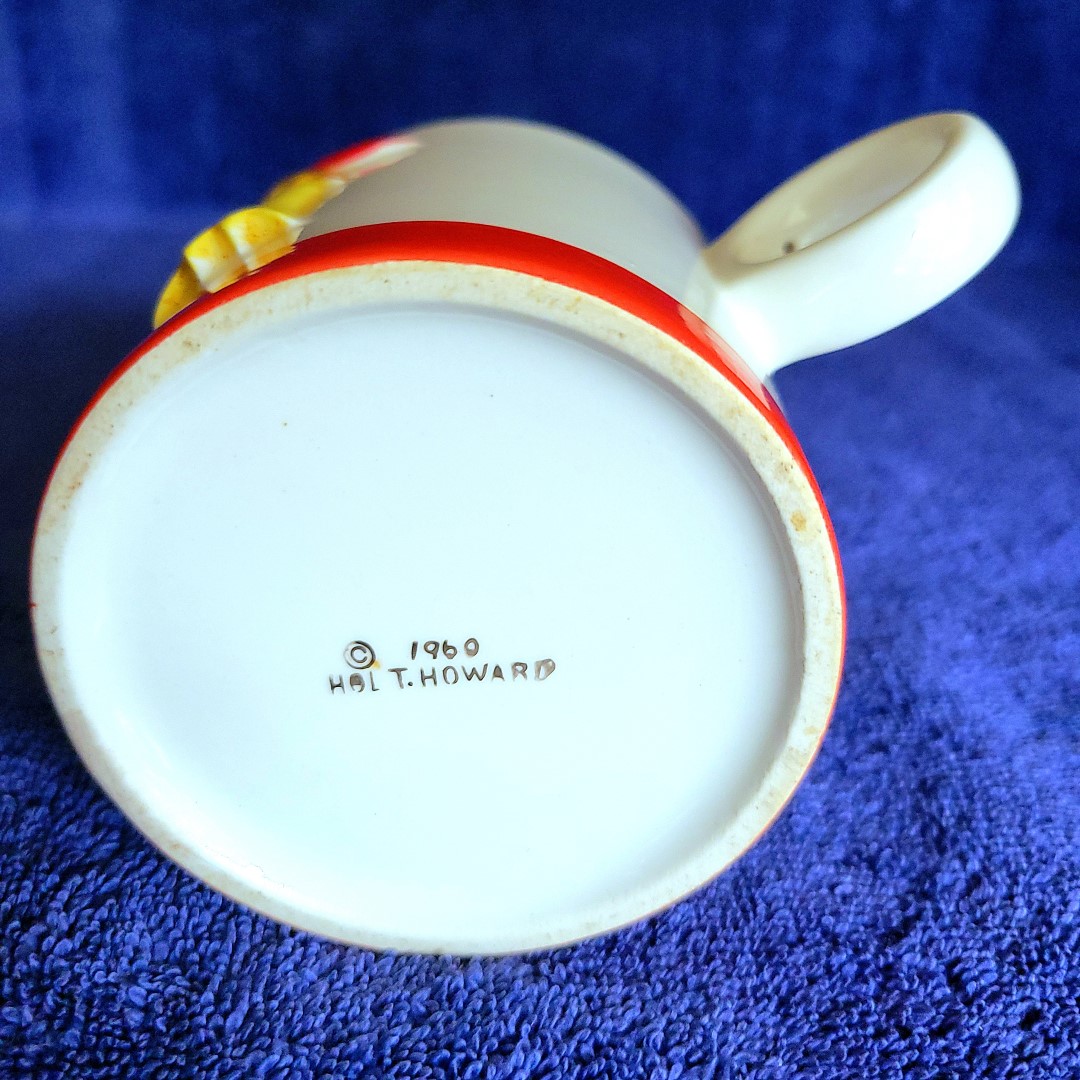
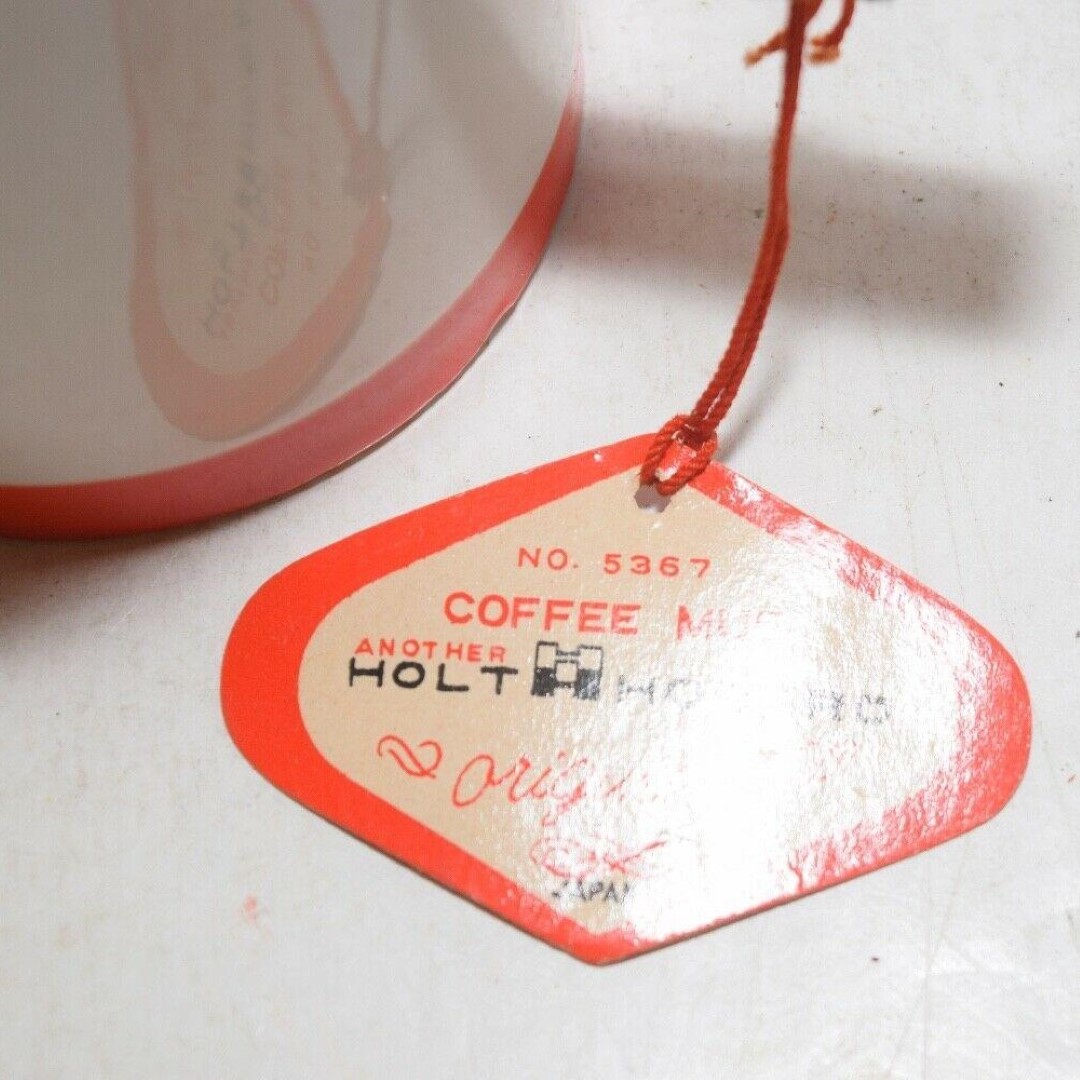
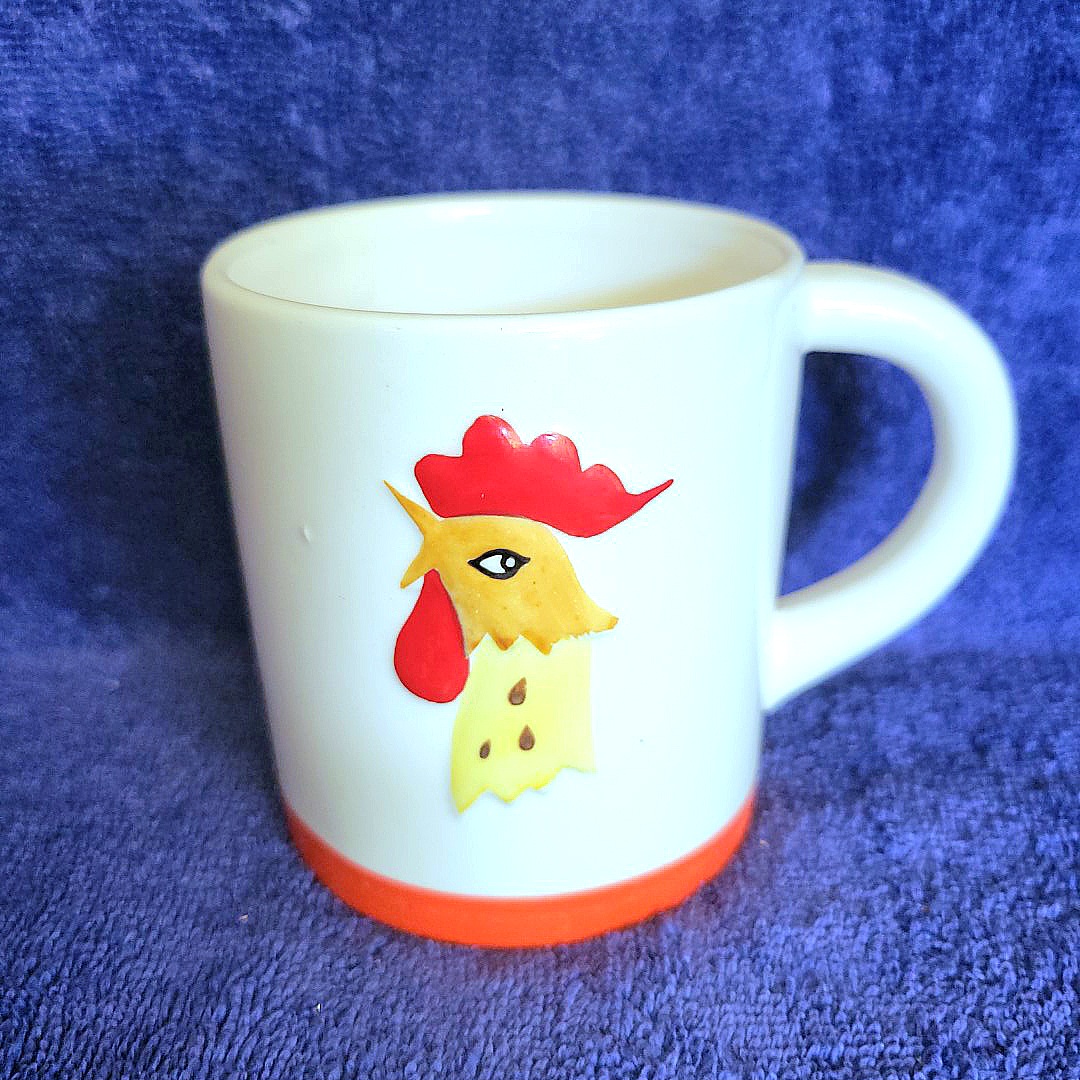
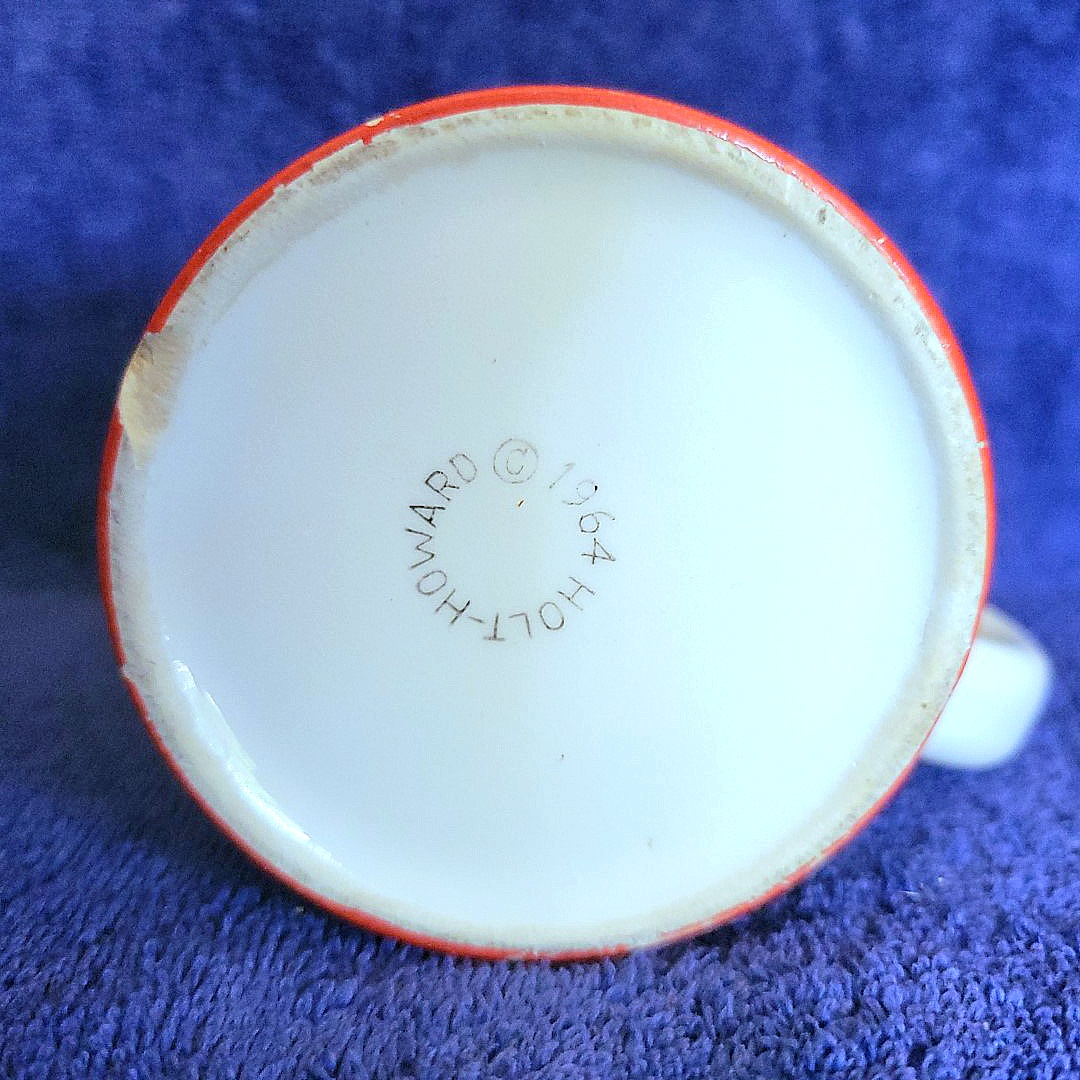
Surviving examples indicate that Holt Howard revised the Coq Rouge coffee mug several times while retaining the same catalog identity. Original hang tags for both the tapered ring-handle form and the later straight-sided ring-handle form identify each as No. 5367 Coffee Mug. No original tag has yet been documented for the still later ear-handle form, but its identical function, decoration, and place within the line strongly indicate that it represents another revision of the same No. 5367 catalog item rather than a separately numbered product.
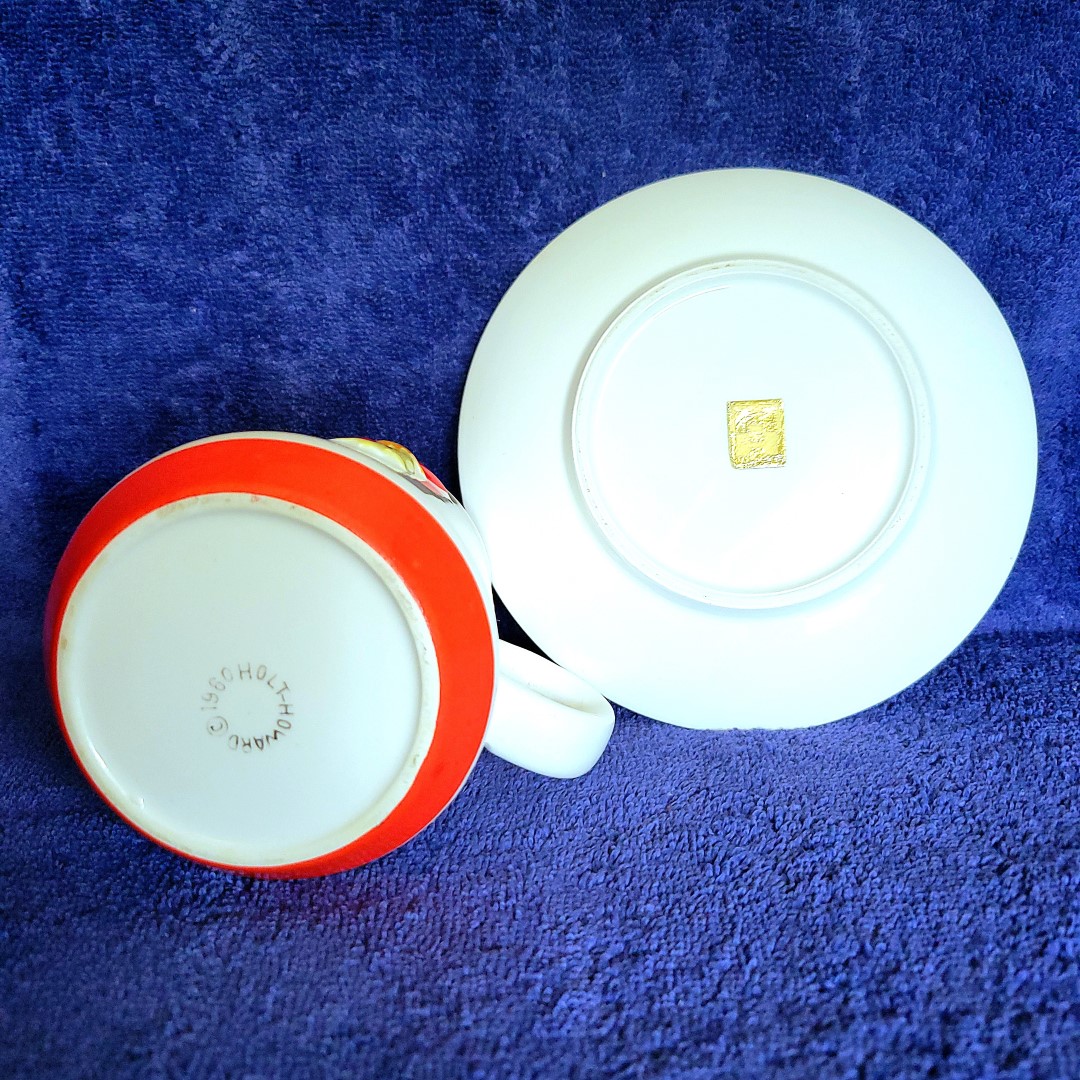
Tapered ring-handle form. The earliest documented version has tapered sides, a ring handle, and an 8-ounce capacity. It measures 3¼ inches high, with a 2½-inch rim and a 3¼-inch base, and surviving examples are backstamped © 1960 Holt Howard. This form is sometimes found with a matching underplate, although many surviving examples today appear without one. Its shape and association with an underplate give it more of the character of a traditional coffee cup than the straight-sided mugs that followed, even though Holt Howard's own hang tag already called it a Coffee Mug. The tapered form was sold as an 8-ounce size in sets of four.
The tapered version is also the most frequently encountered of the three known Coq Rouge mug forms. Its abundance, despite the consistent 1960 copyright date seen on surviving examples, suggests that the stamped year should not be read as proof that production was confined to a single calendar year. Holt Howard often continued producing successful forms without changing the original copyright date.
Straight-sided ring-handle form. A redesigned version enlarged the capacity to 10 ounces and replaced the tapered body with a straight-sided cylindrical form while retaining the ring handle. It measures 3¼ inches high with a 3¼-inch rim diameter. Original hang tags continue to identify this version as No. 5367 Coffee Mug. The straight-sided rooster mugs were sold as a 10-ounce size, four to a box, closely matching the surviving form documented here.
This version is known with both 1960 and 1961 copyright dates. The archive collection contains three 1960 examples, which may originally have survived from the same boxed set. In a survey of twelve additional straight-sided ring-handle mugs currently offered for sale, eleven were dated 1961 and only one was dated 1960. The evidence therefore suggests that the straight-sided form was introduced during 1960, probably as the tapered form was being phased out, and that most subsequent production carried the updated 1961 copyright date. The precise timing of the change is not documented, but surviving pieces demonstrate that the two forms overlapped at least briefly.
Straight-sided ear-handle form. The latest documented version retains the straight-sided body but substitutes a conventional ear handle for the earlier ring handle. The archive example holds 8 ounces, measures 3⅜ inches high with a 3-inch rim diameter, and is backstamped © 1964 Holt Howard. This form appears substantially less often than either ring-handle version. Although no original hang tag for the ear-handle mug has yet surfaced, the continuity of function and decoration makes it highly likely that Holt Howard continued to market it under No. 5367.
Taken together, the three forms document an unusually visible evolution within a single Coq Rouge catalog item: from a tapered 8-ounce cup/mug that could be paired with an underplate, to a larger 10-ounce straight-sided ring-handle mug, and finally to a straight-sided 8-ounce ear-handle version. Both the 8-ounce tapered form and the 10-ounce straight-sided form appear in the standard collector guides, but they are not identified there as successive revisions of the same No. 5367 product. The surviving hang tags, backstamps, measurements, and capacity differences make that relationship much clearer today.
Sugar & Creamer
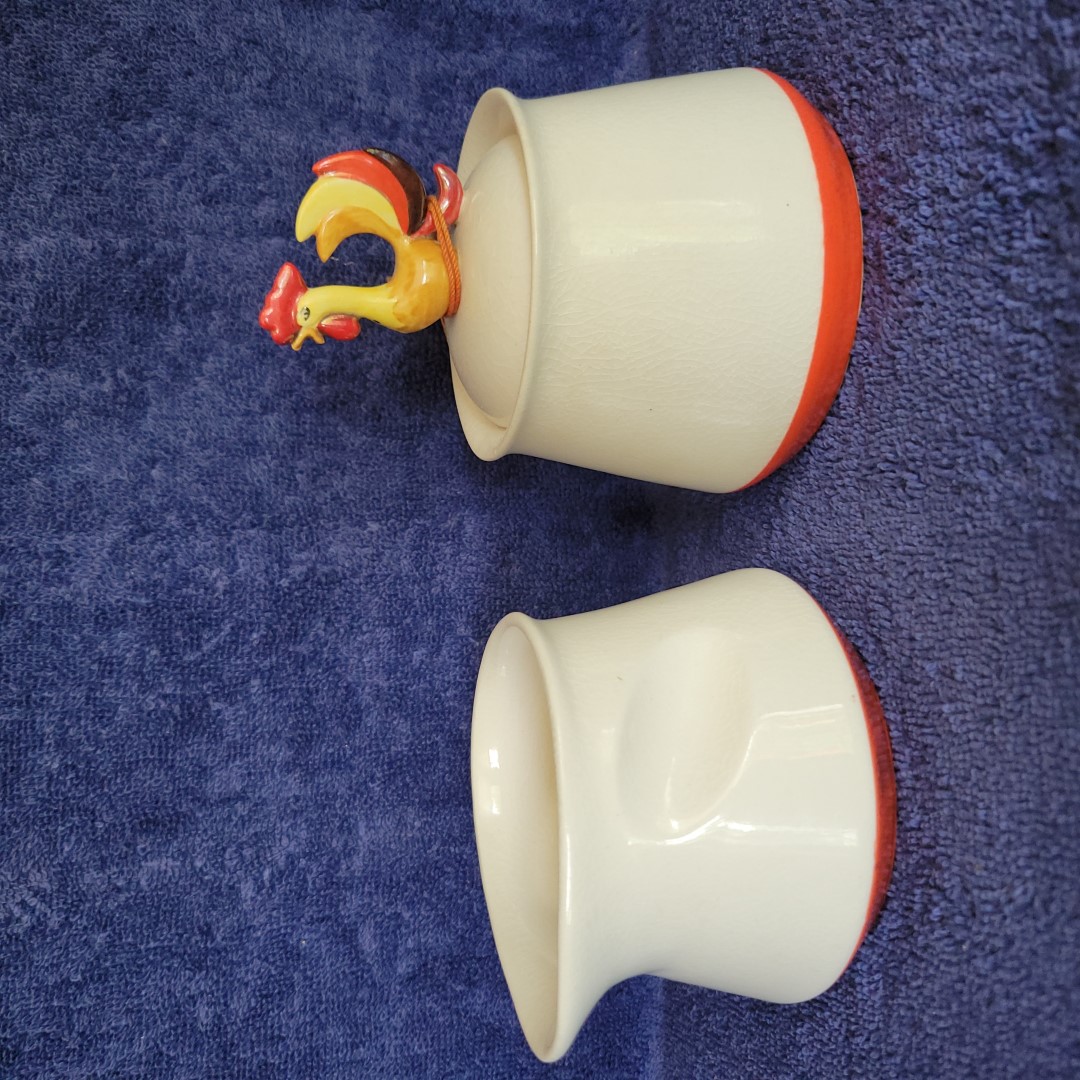
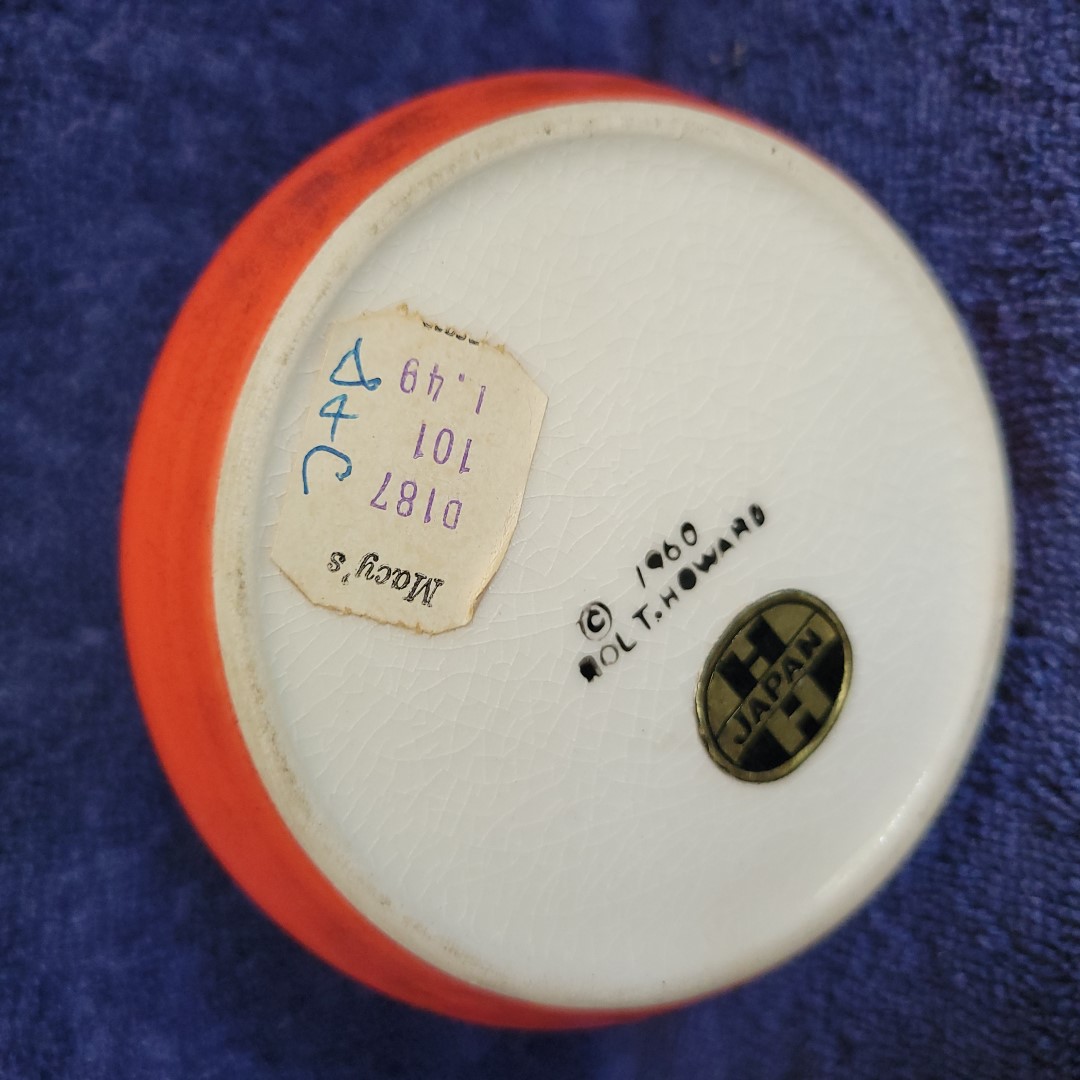
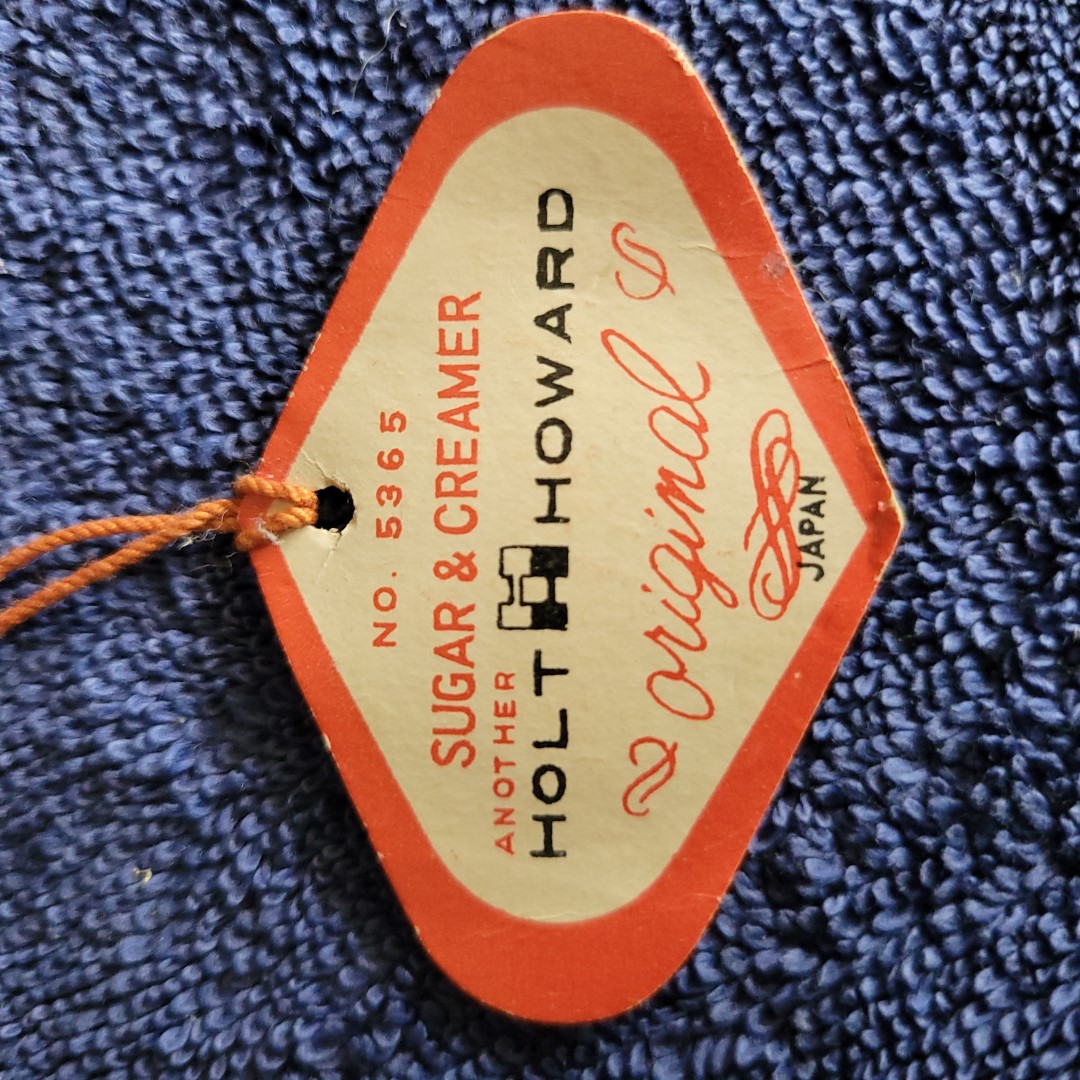
The Coq Rouge Sugar & Creamer set pairs a covered sugar bowl with a low, handleless creamer. Both pieces share the same gently tapered white body and narrow red-orange band around the base. The creamer is otherwise undecorated and uses a molded indentation in the side for secure handling, while the sugar bowl is finished with a removable lid topped by a full-color figural rooster finial.
An original Holt Howard hang tag identifies the pair as No. 5365 Sugar & Creamer. The creamer measures 2½ inches high, while the sugar measures 4½ inches high to the top of the rooster finial with the lid in place. These dimensions match previously published measurements.
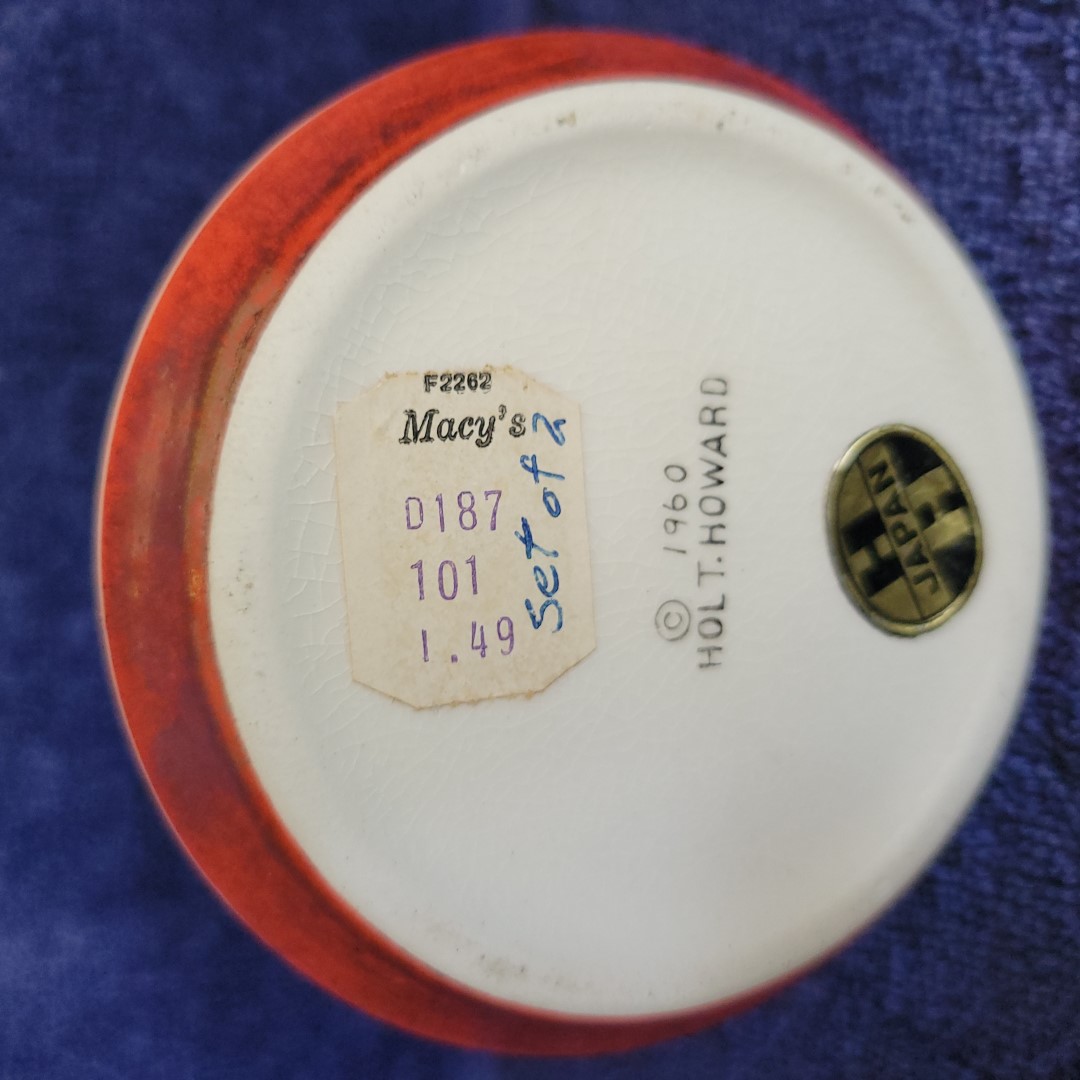
The archive set provides an important date correction. Both pieces are backstamped © 1960 Holt Howard, demonstrating that this form was already in production in 1960. The standard collector guide dates the sugar and creamer to 1961, so the surviving archive examples establish an earlier documented production date.
Both pieces also retain their original Macy's retail labels. A handwritten notation on the labels identifies them as a set of two, providing unusually direct retail provenance and confirming that the sugar and creamer were sold together as a matched pair.
Luncheon Plate
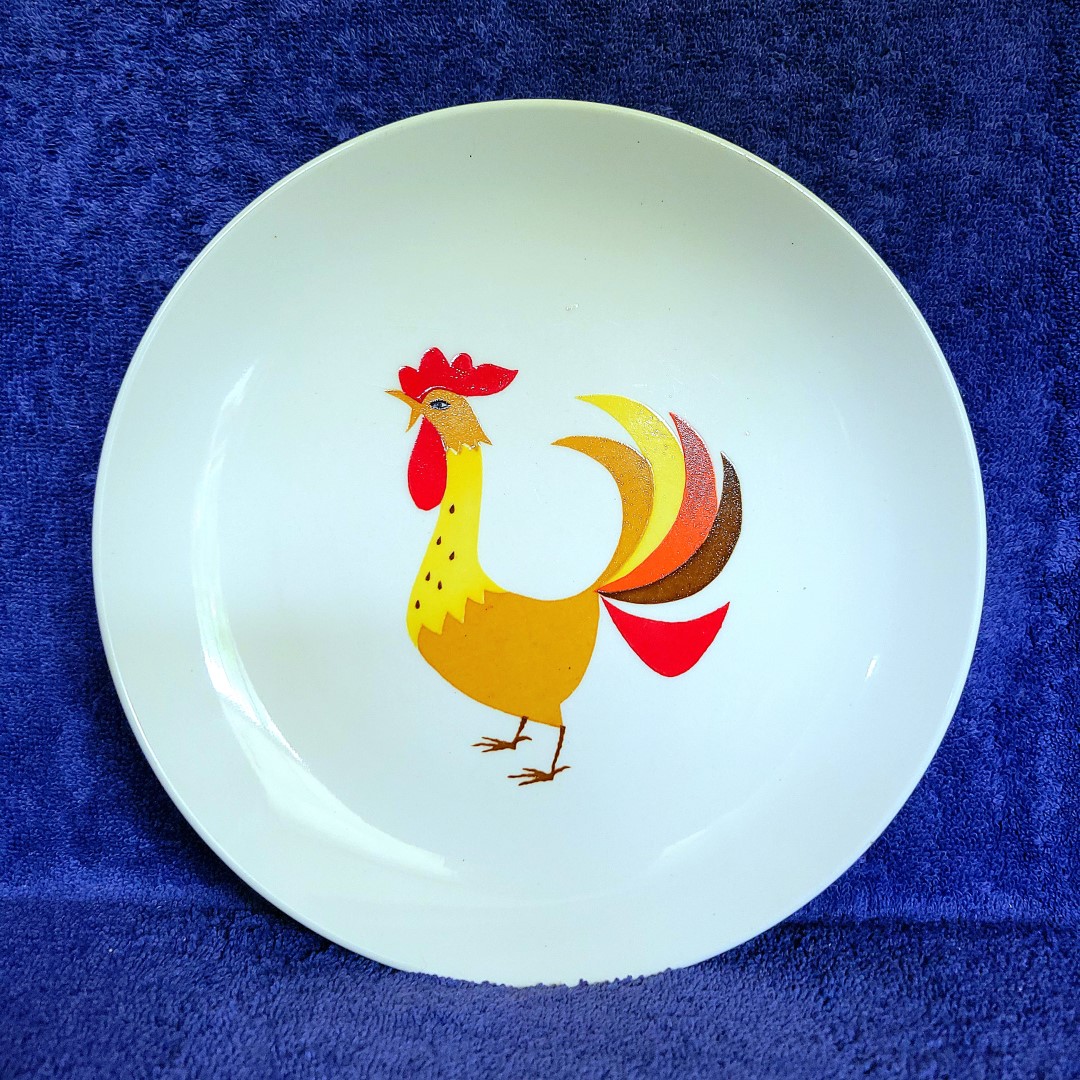
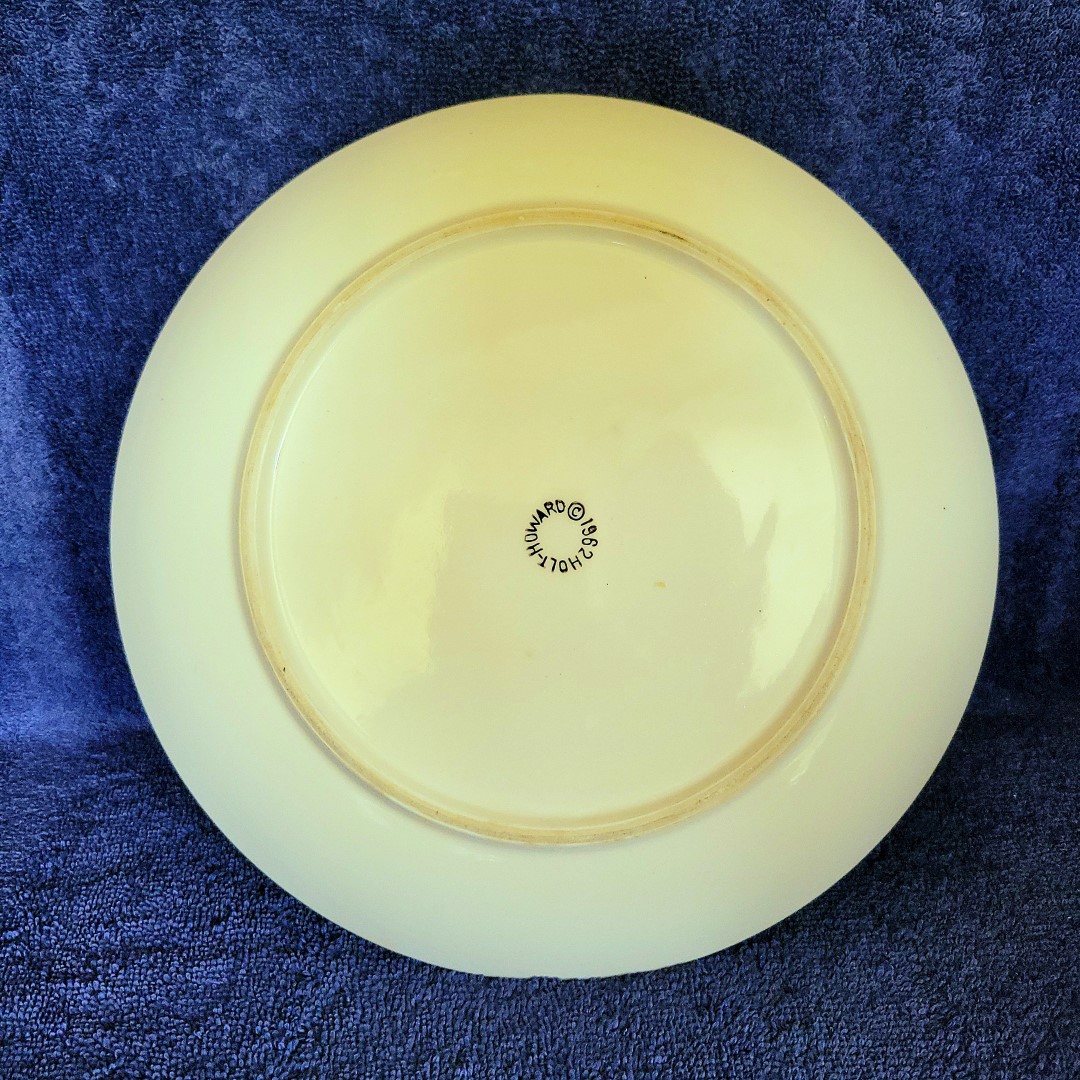
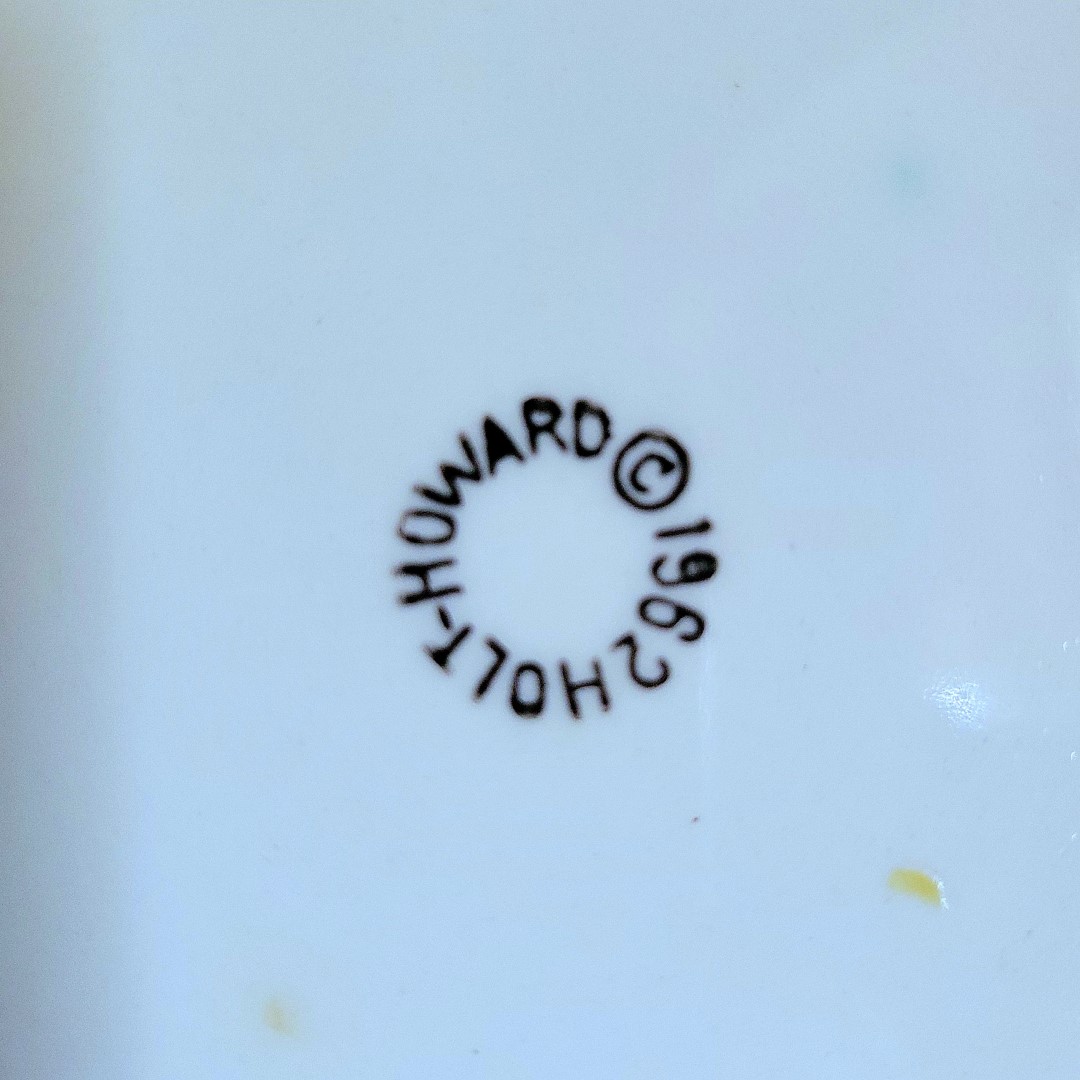
The Coq Rouge Luncheon Plate is an approximately 8½-inch white plate decorated with the collection's large full-body rooster centered on the face. The archive example is backstamped © 1962 Holt Howard.
The standard collector guide identifies this form as a 9½-inch dinner plate. Surviving examples do not support that measurement. The archive example is the smaller luncheon-plate size, and auction listings that provide measurements consistently document the same approximately 8½-inch form. No separate 9½-inch Coq Rouge dinner plate has been documented in the archive's research.
The plate is therefore identified here as the Luncheon Plate, correcting the size and form designation while retaining the correct 1962 date.
Cereal Bowl
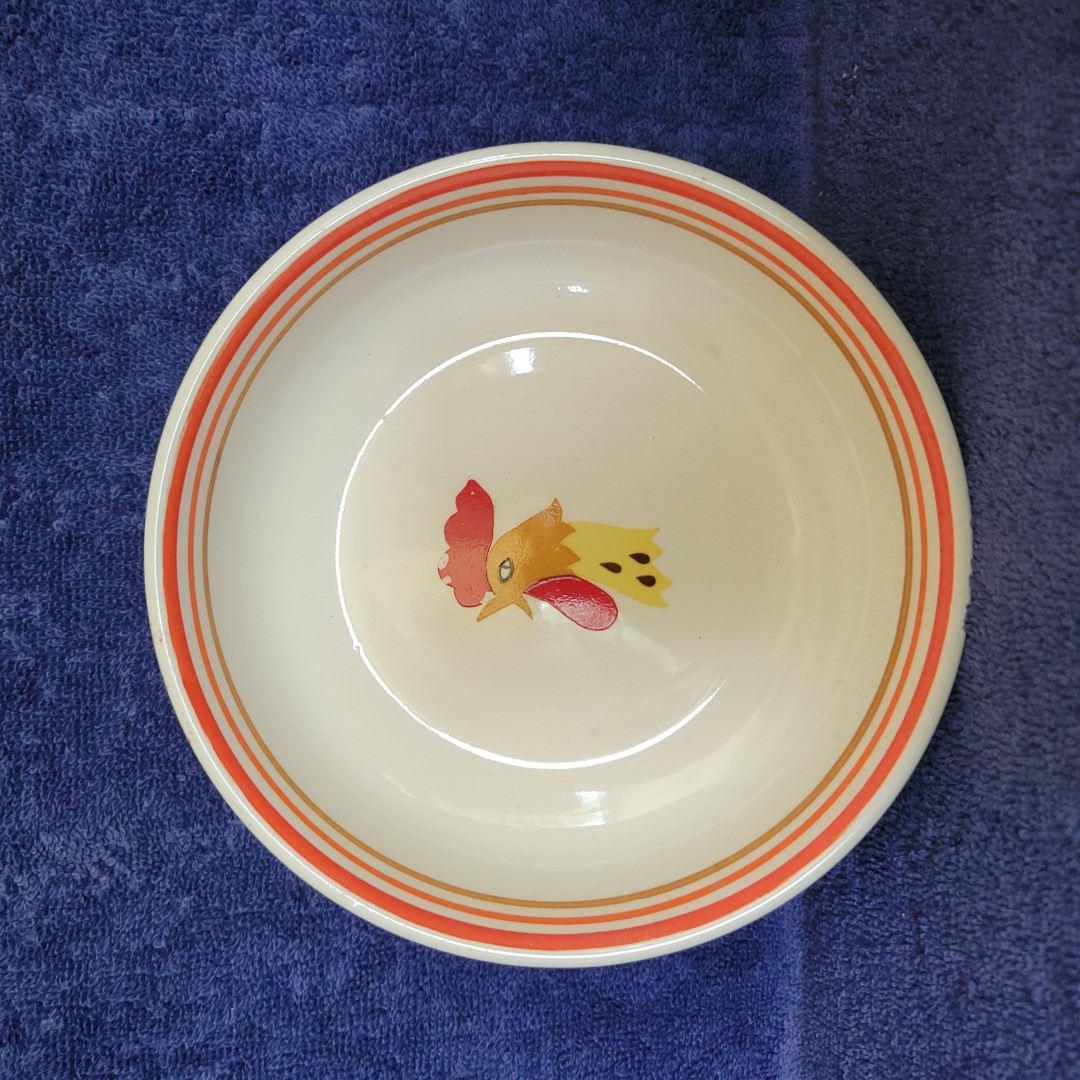
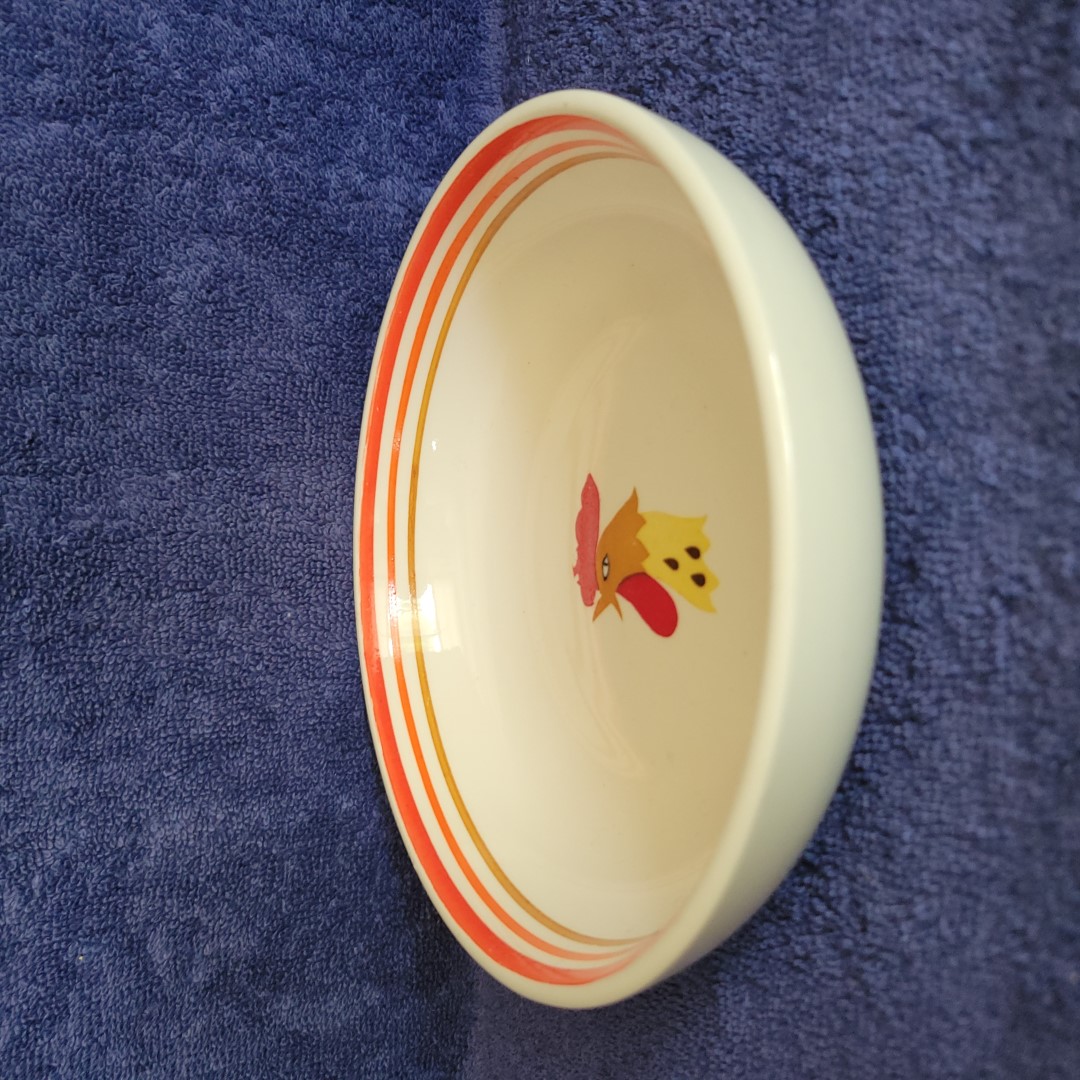
The Coq Rouge Cereal Bowl is a shallow cream-colored bowl decorated with the collection's rooster-head motif in the center and a series of narrow red-orange concentric bands around the inner rim. The exterior is left plain, keeping the decorative emphasis inside the bowl.
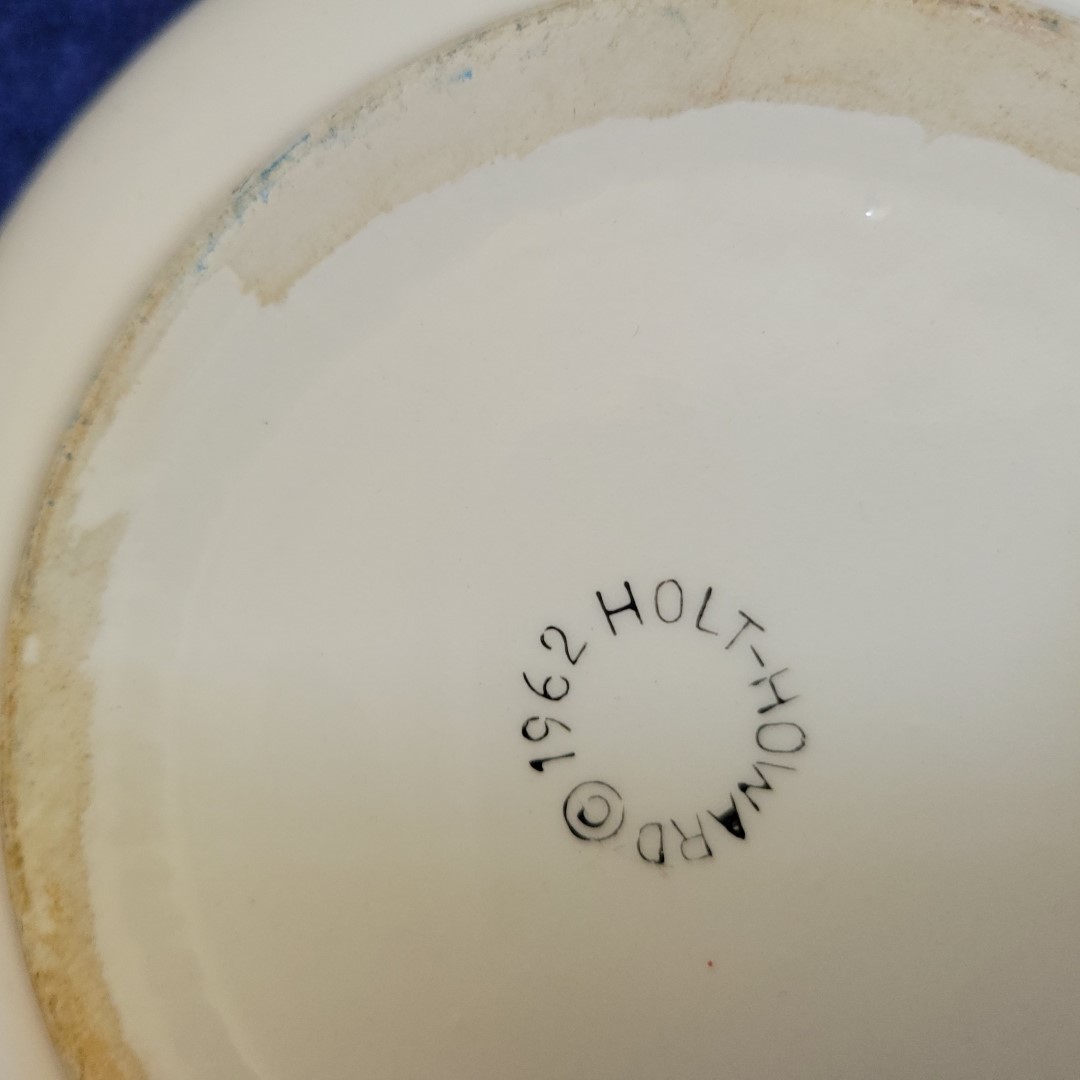
The archive example measures approximately 6 inches in diameter and is backstamped © 1962 Holt Howard. The form is the Cereal Bowl, and its approximately 6-inch diameter aligns cleanly with surviving examples.
Salad Bowl
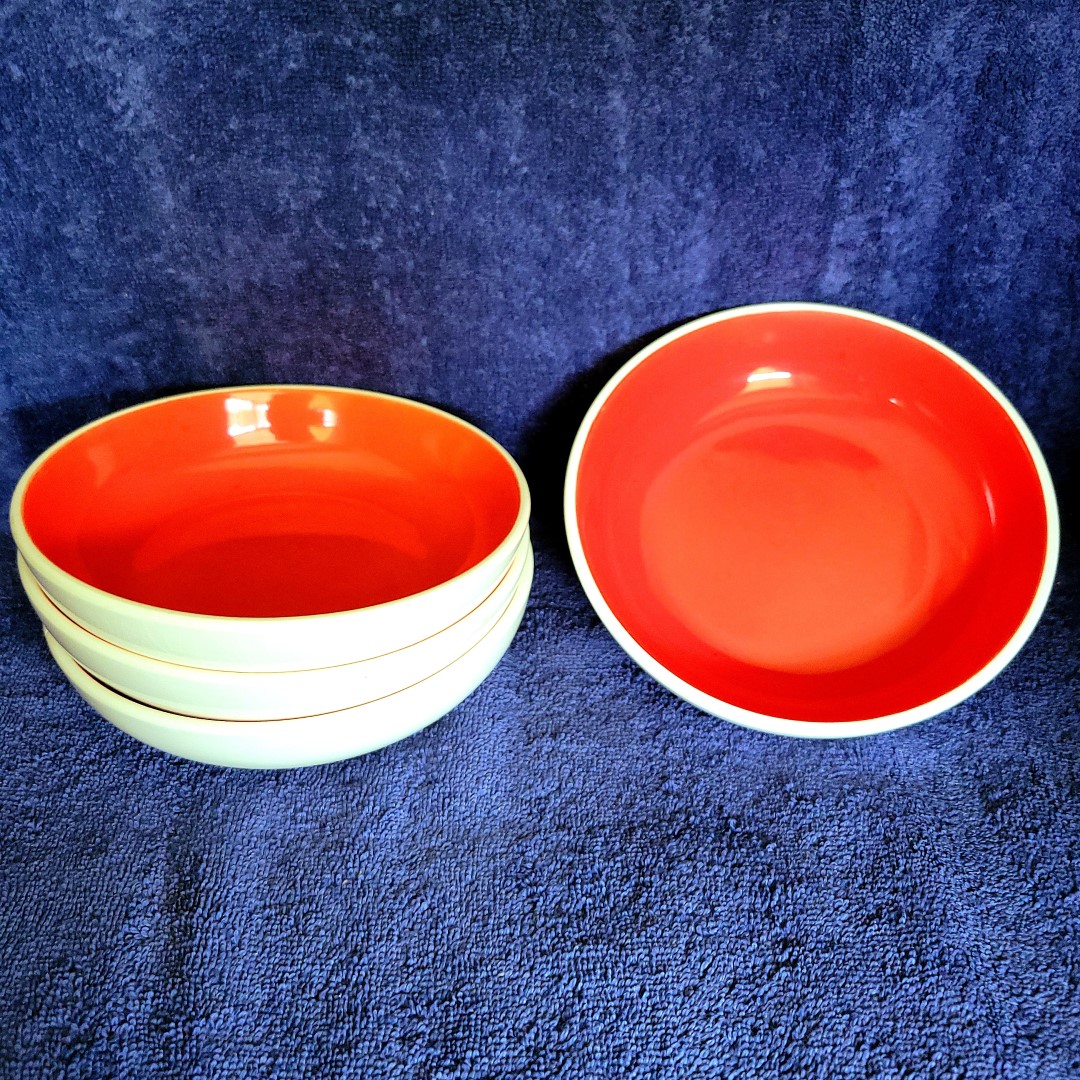
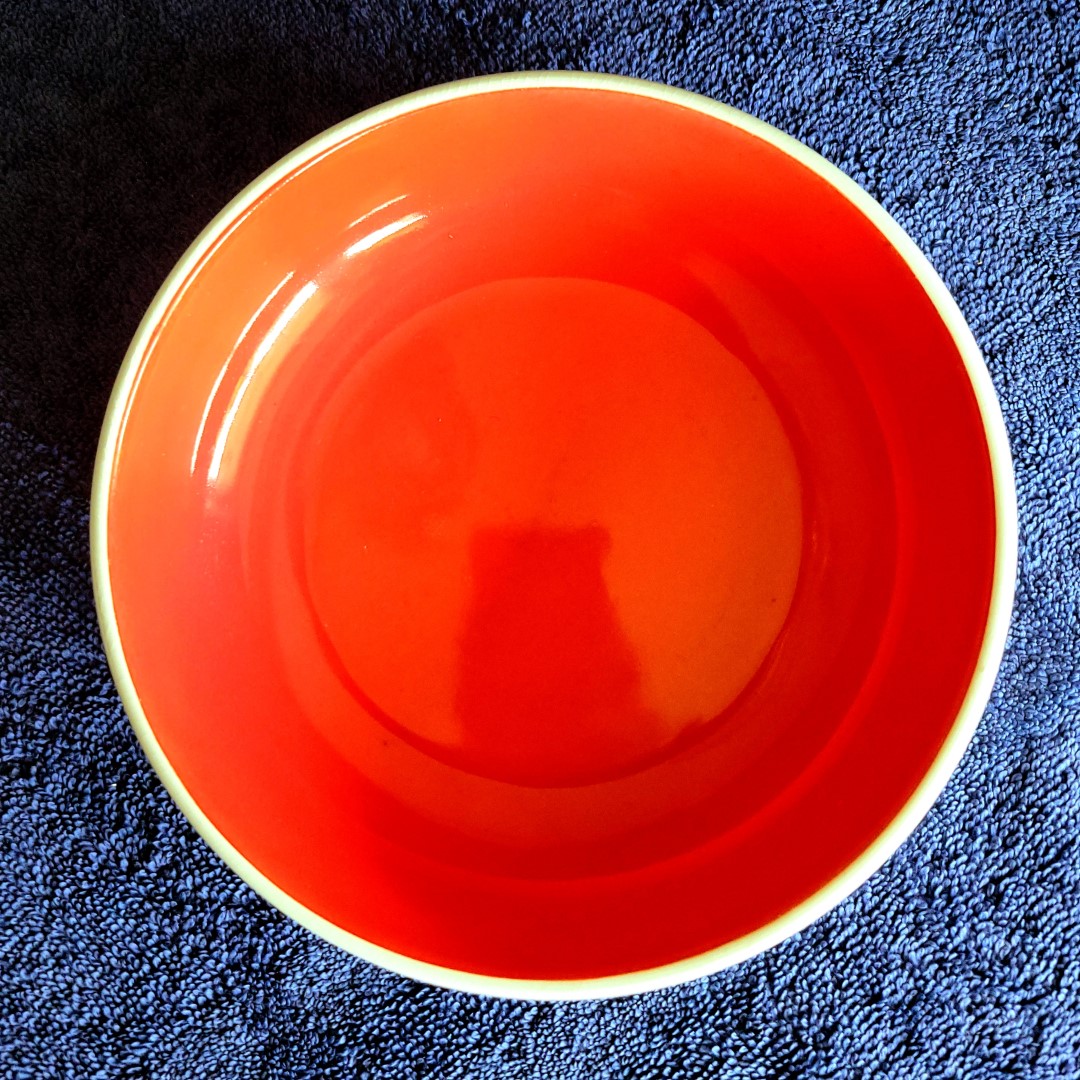
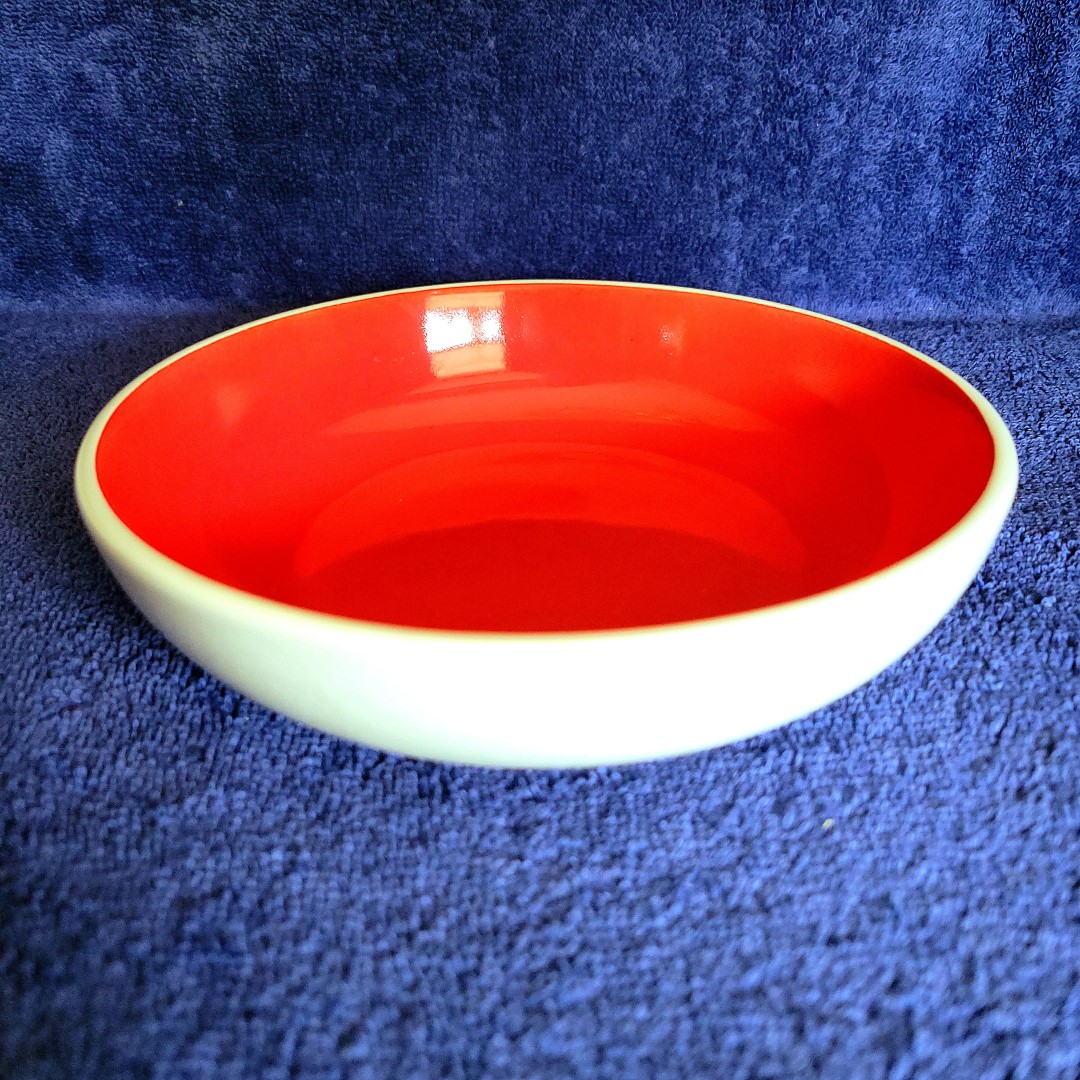
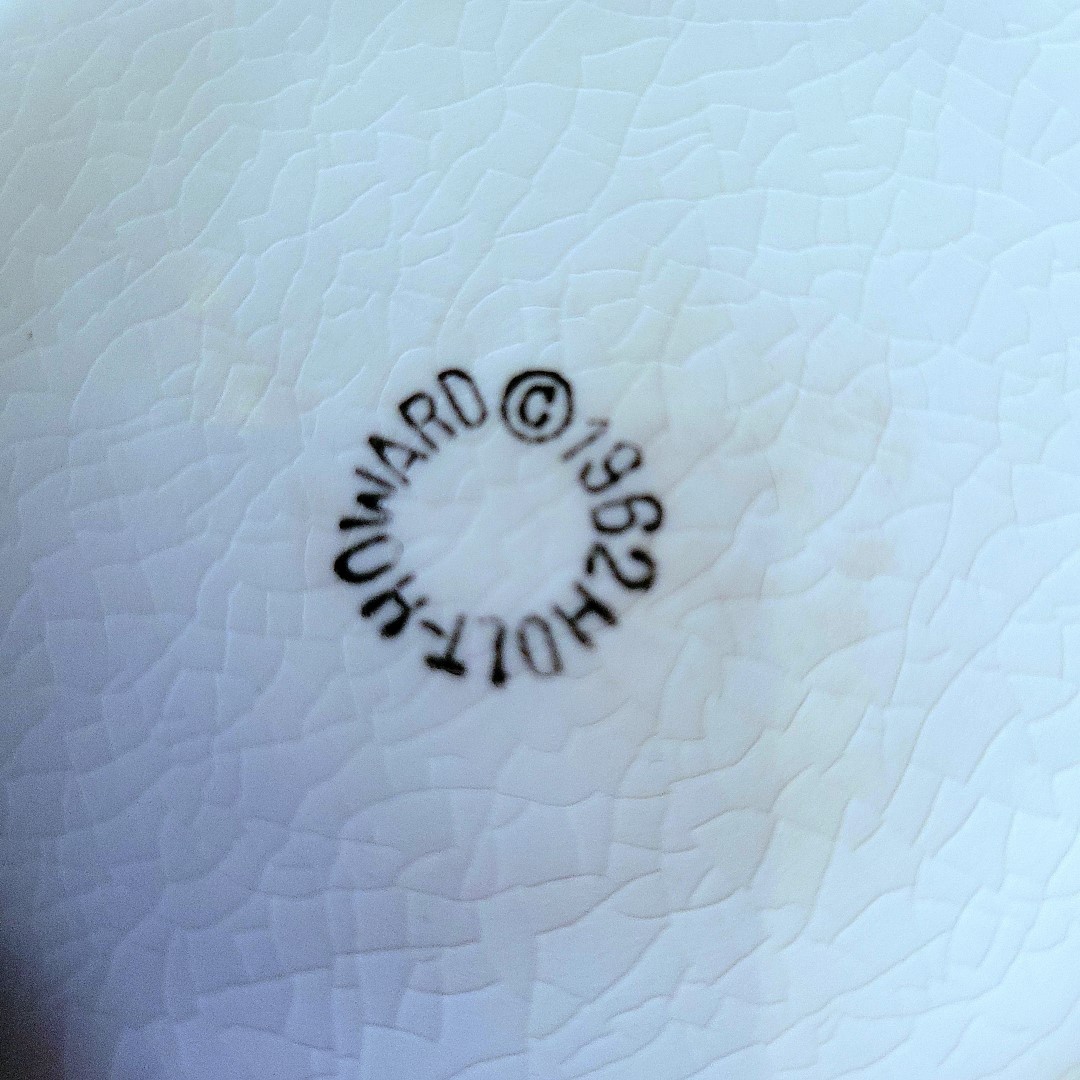
This bowl uses essentially the same low, shallow form as the Coq Rouge Cereal Bowl but replaces the rooster-head-and-stripe decoration with a striking solid red-orange interior and a plain cream exterior. The surviving examples documented here measure approximately 5⅞ inches in diameter by 1½ inches high, placing them in the same nominal 6-inch size class as the cereal bowl.
No original Holt Howard hang tag or catalog description has yet been documented for this form, so Salad Bowl is used here as the archive's descriptive identification. The size, shape, and table-service function make that designation more useful than treating it as merely an alternate cereal-bowl decoration.
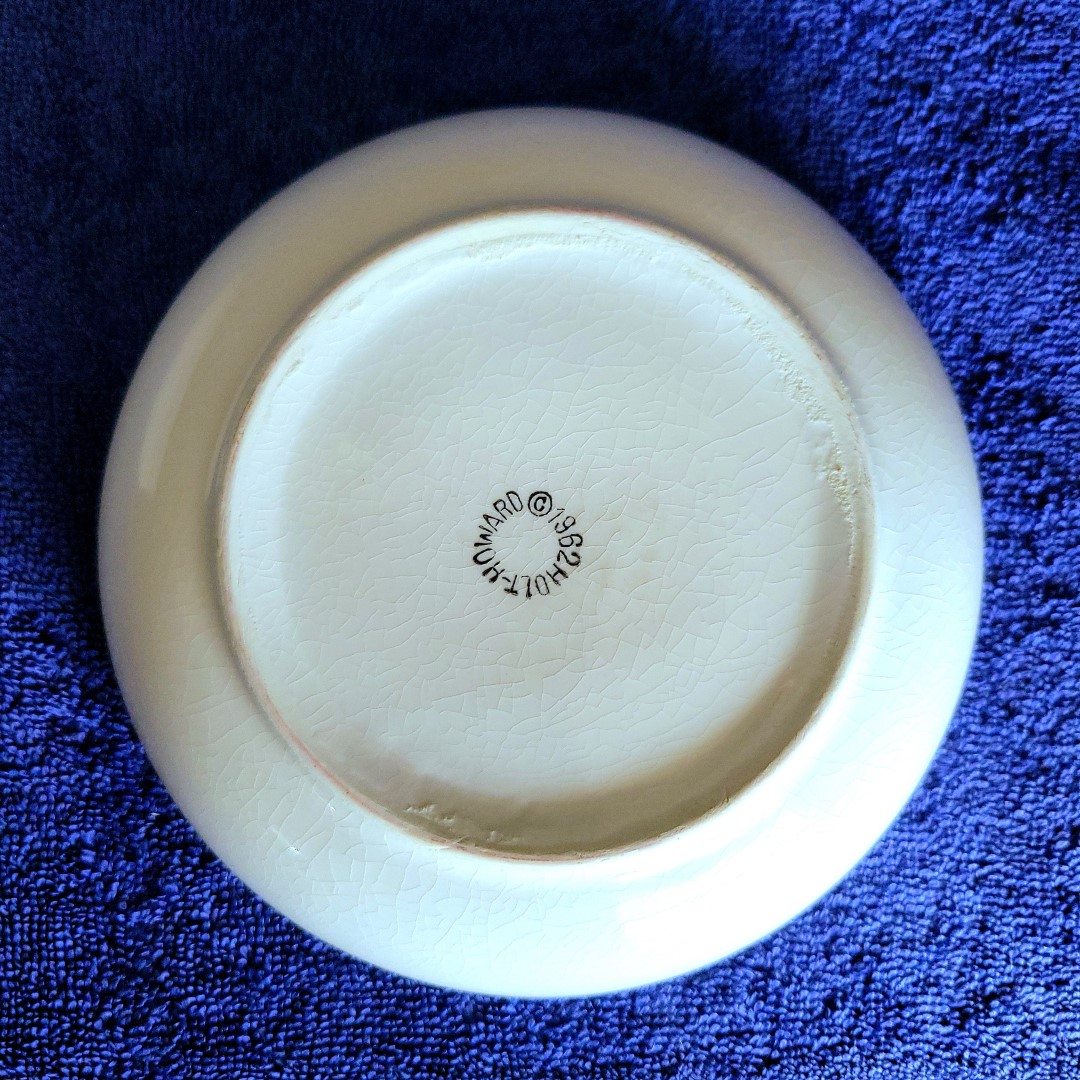
Examples are backstamped © 1962 Holt Howard. The shared date and nearly identical dimensions strongly associate the red-interior bowl with the same 1962 tableware group as the decorated cereal bowl, while the completely different interior treatment gives it a distinct visual identity within the Coq Rouge service.
Snack Dish & Chicken Soup Mug
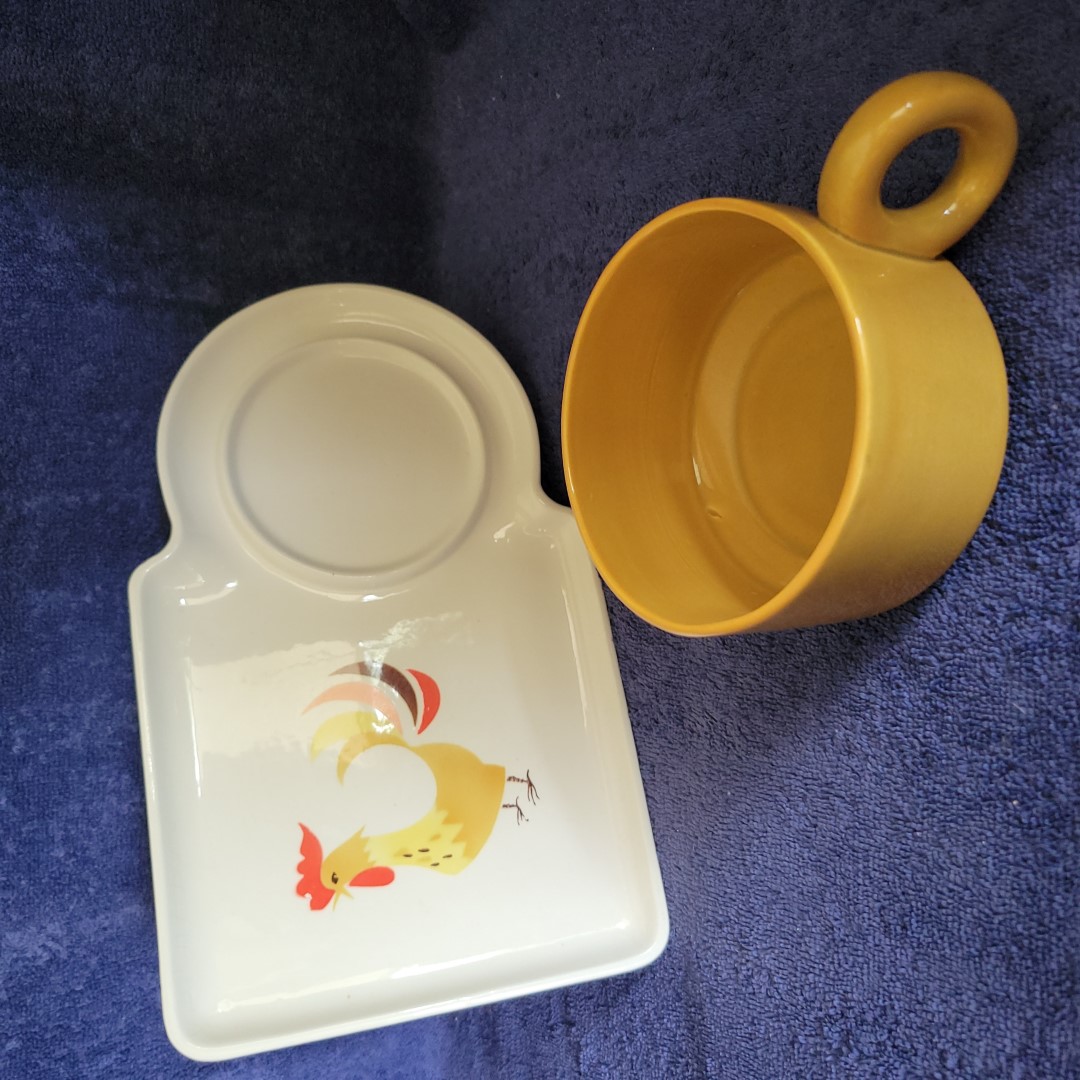
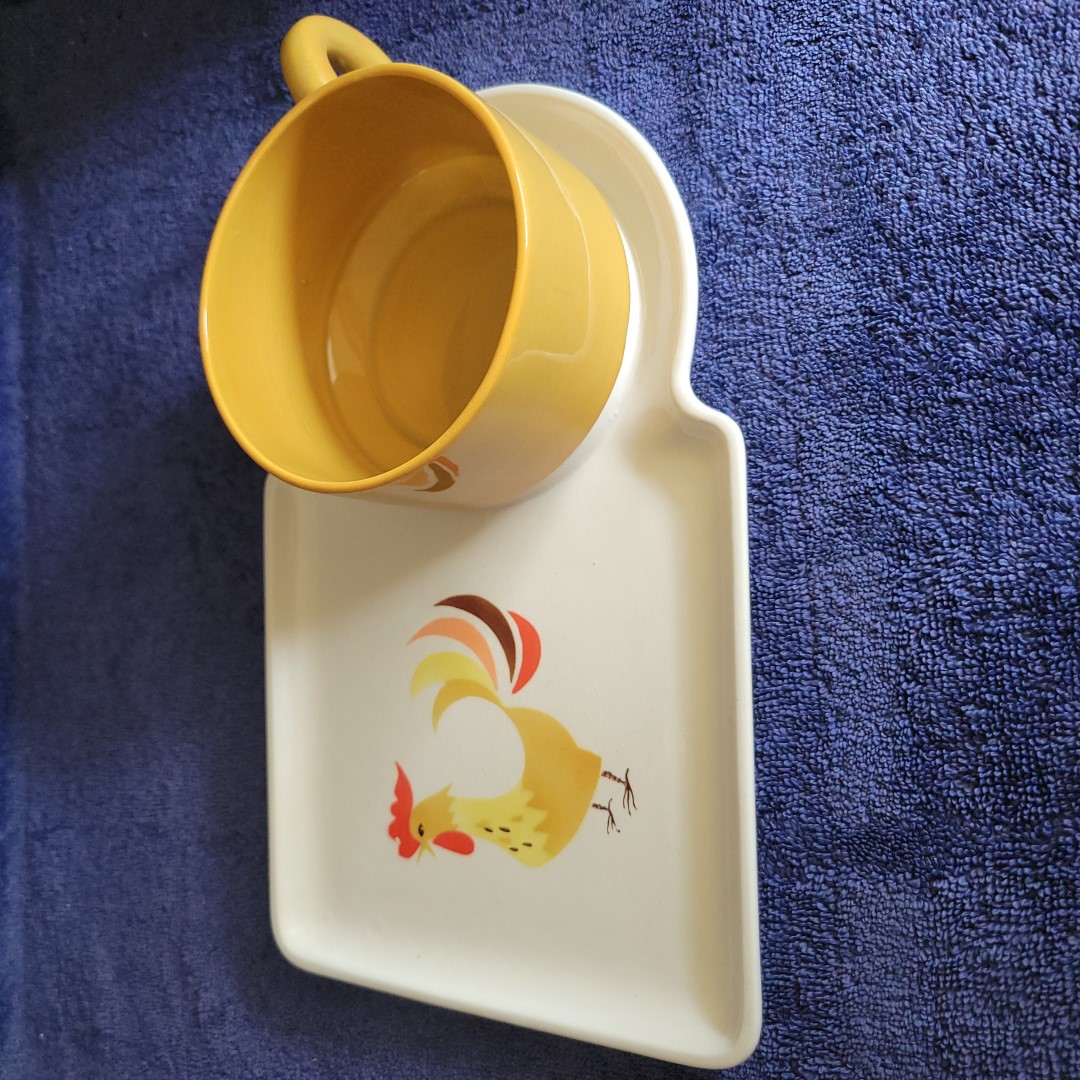
The Coq Rouge Snack Dish pairs a molded white serving tray with a solid-gold-colored ring-handle mug. The tray combines a broad rectangular food area, decorated with the collection's full-body rooster, and a circular recess sized specifically to hold the accompanying mug. Together, the two pieces form a compact individual lunch or snack service.
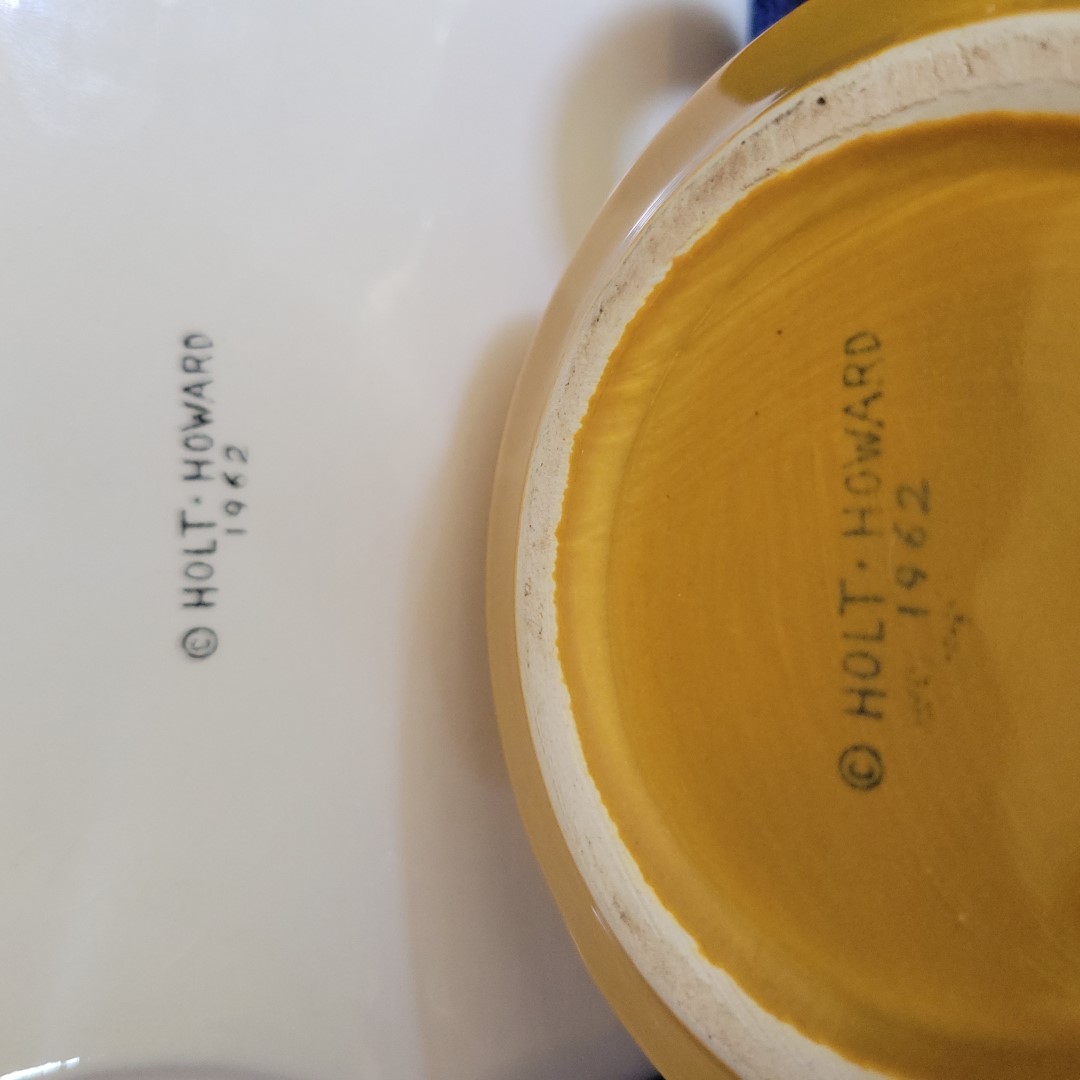
The archive example measures the snack dish measures 9⅝ inches by 6 inches, while the mug measures 2⅛ inches high and 5 inches wide to the handle. Both pieces are backstamped © Holt-Howard 1962.
The set was described as a “Snack Tray and Cup”, with the vessel identified as a solid-gold-colored coffee mug. The archive identifies the vessel more specifically as the Chicken Soup Mug, reflecting its squat, wide-bodied form and its pairing with the snack dish. Whatever terminology is used, the surviving set clearly represents a matched 1962 service designed to be used together.
12½-inch Oval Serving Platter
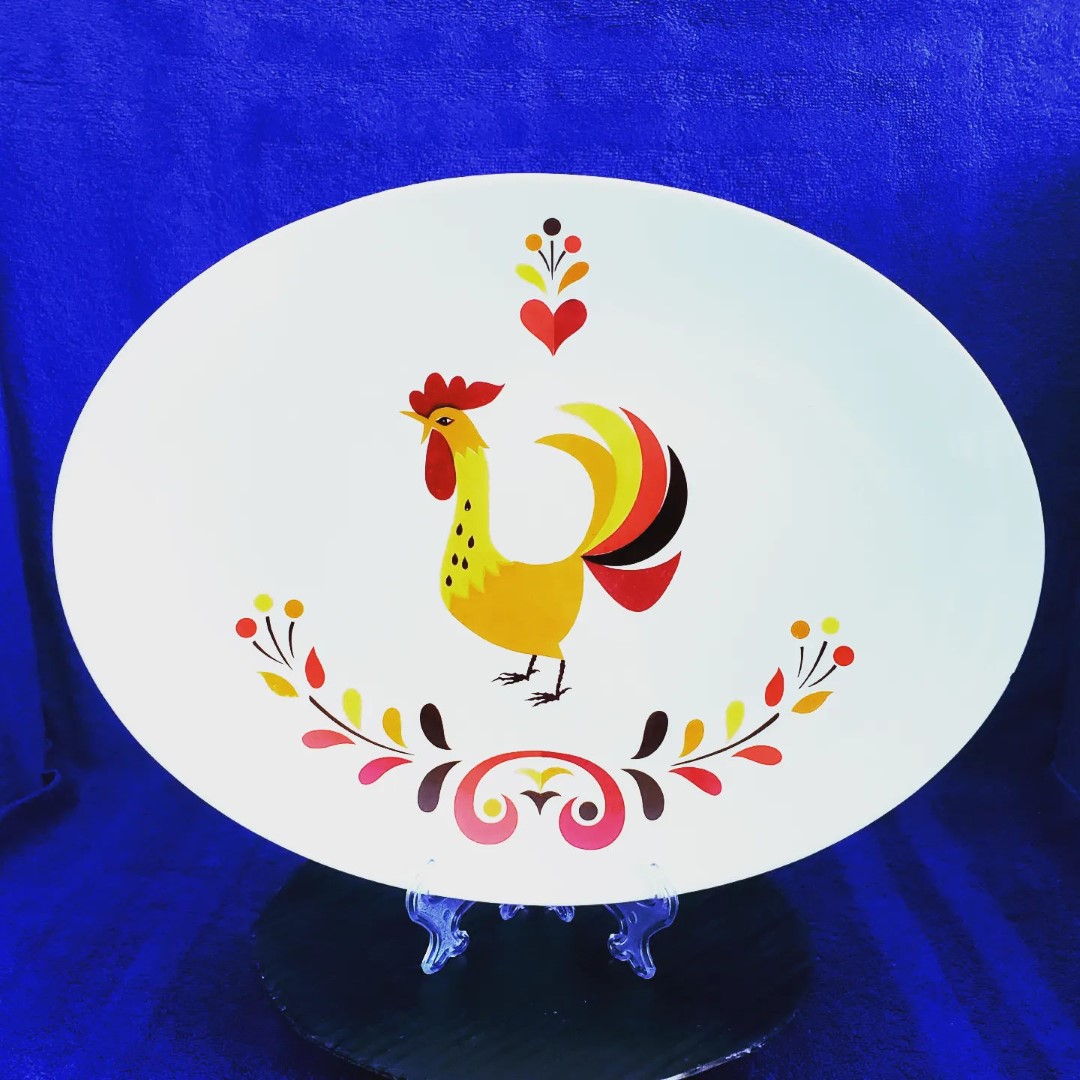
The Coq Rouge Oval Serving Platter is a large 12½-inch serving piece that expands the line's familiar rooster motif into a more elaborate table centerpiece. The full-body rooster is centered on the platter and surrounded by stylized floral and folk-art ornament in coordinating red, yellow, orange, brown, and black.
Unlike the simpler luncheon plate and bowls, the platter uses substantially more surface decoration, giving it the appearance of a display piece as much as a functional serving form. The white oval body provides a broad field for the rooster and symmetrical floral motifs, making this one of the most visually elaborate pieces in the Coq Rouge tableware group.
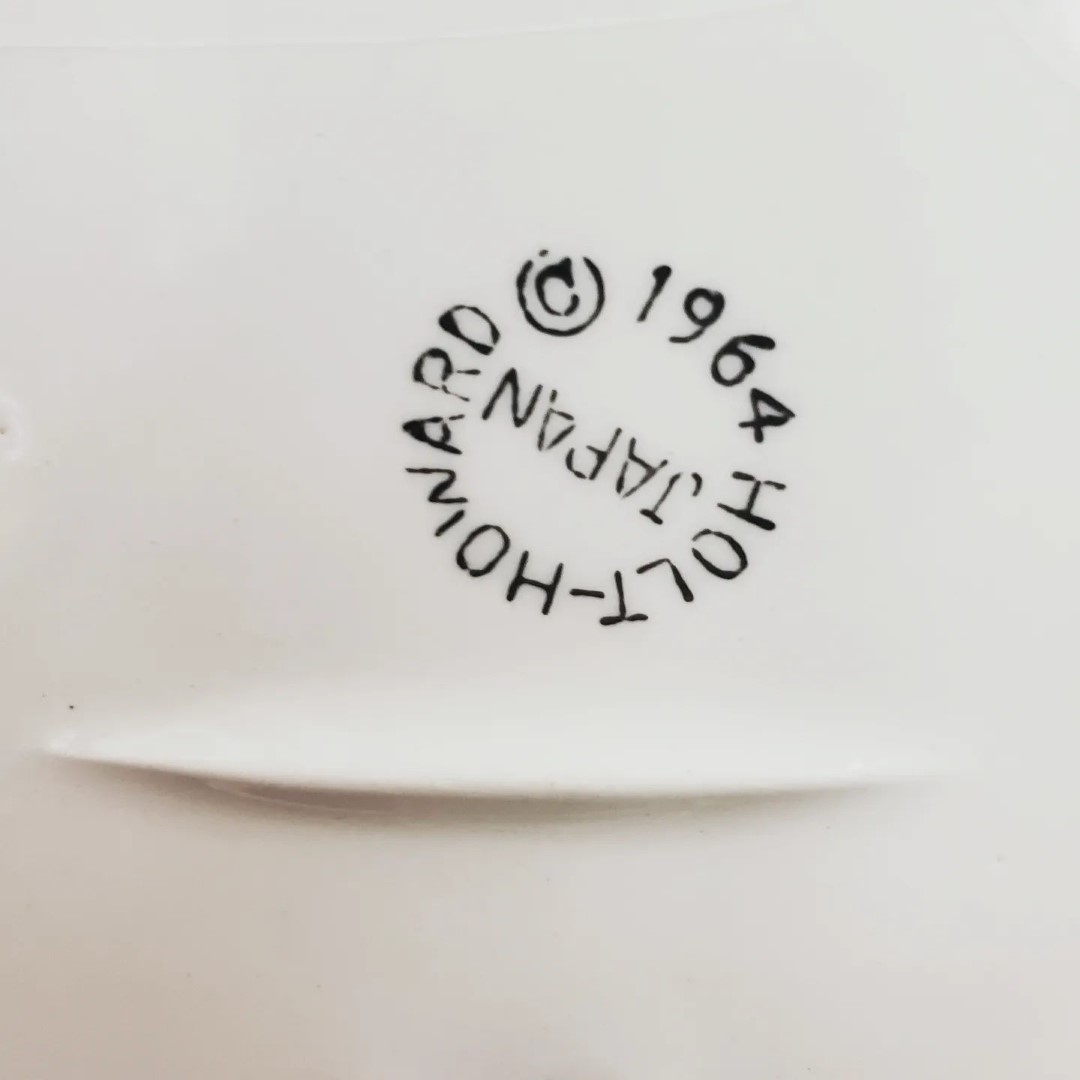
The archive example is backstamped © 1964 Holt-Howard JAPAN.
Pitchers
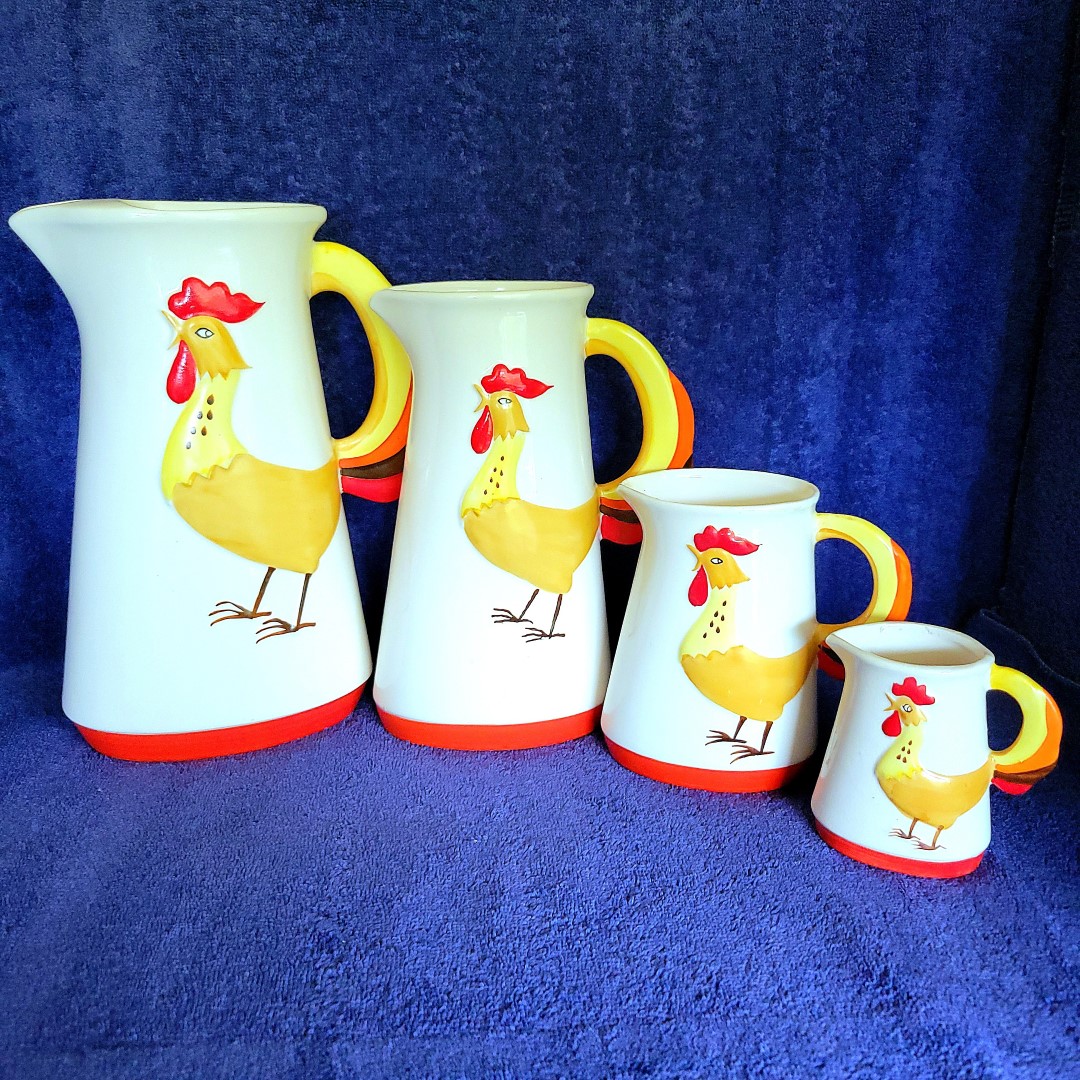
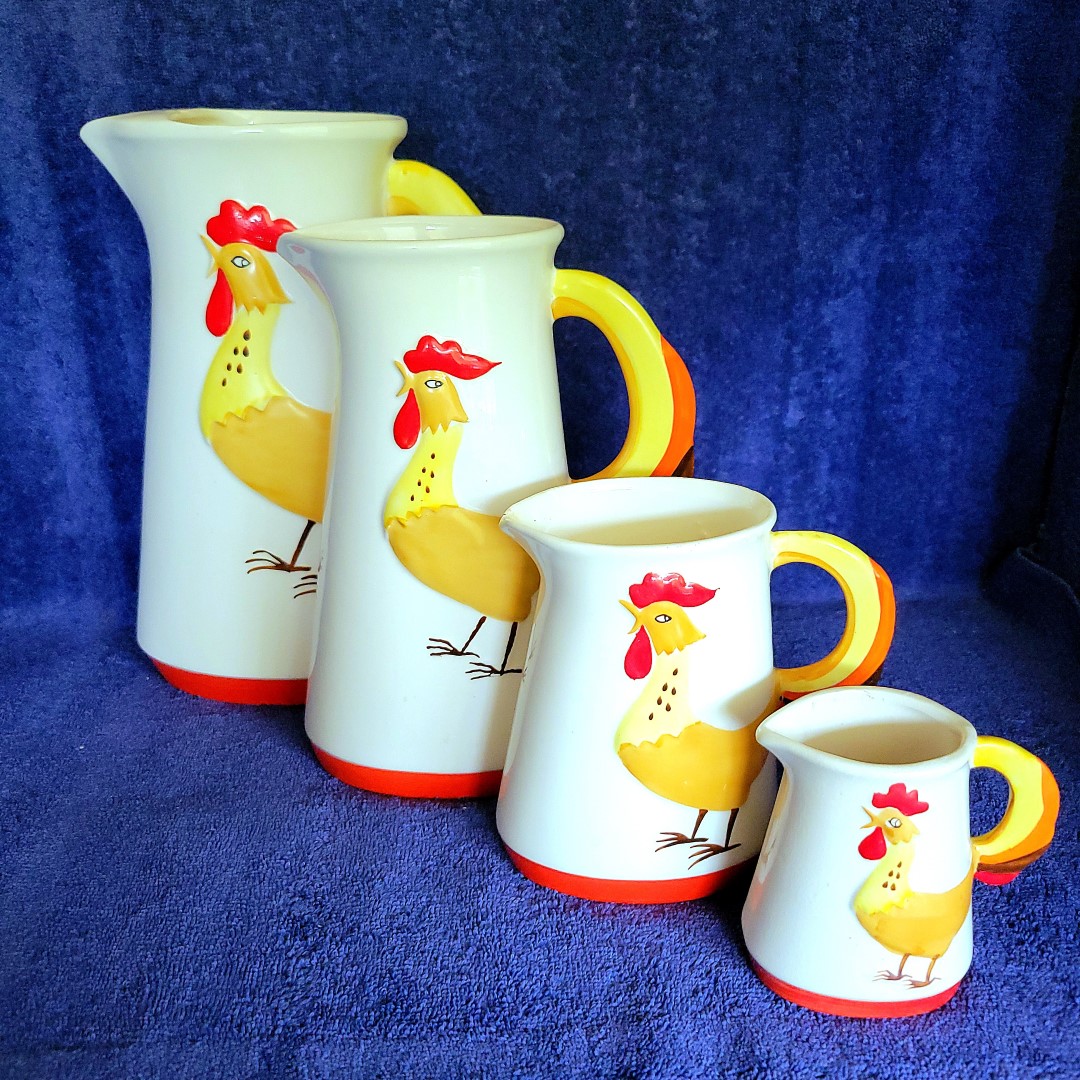
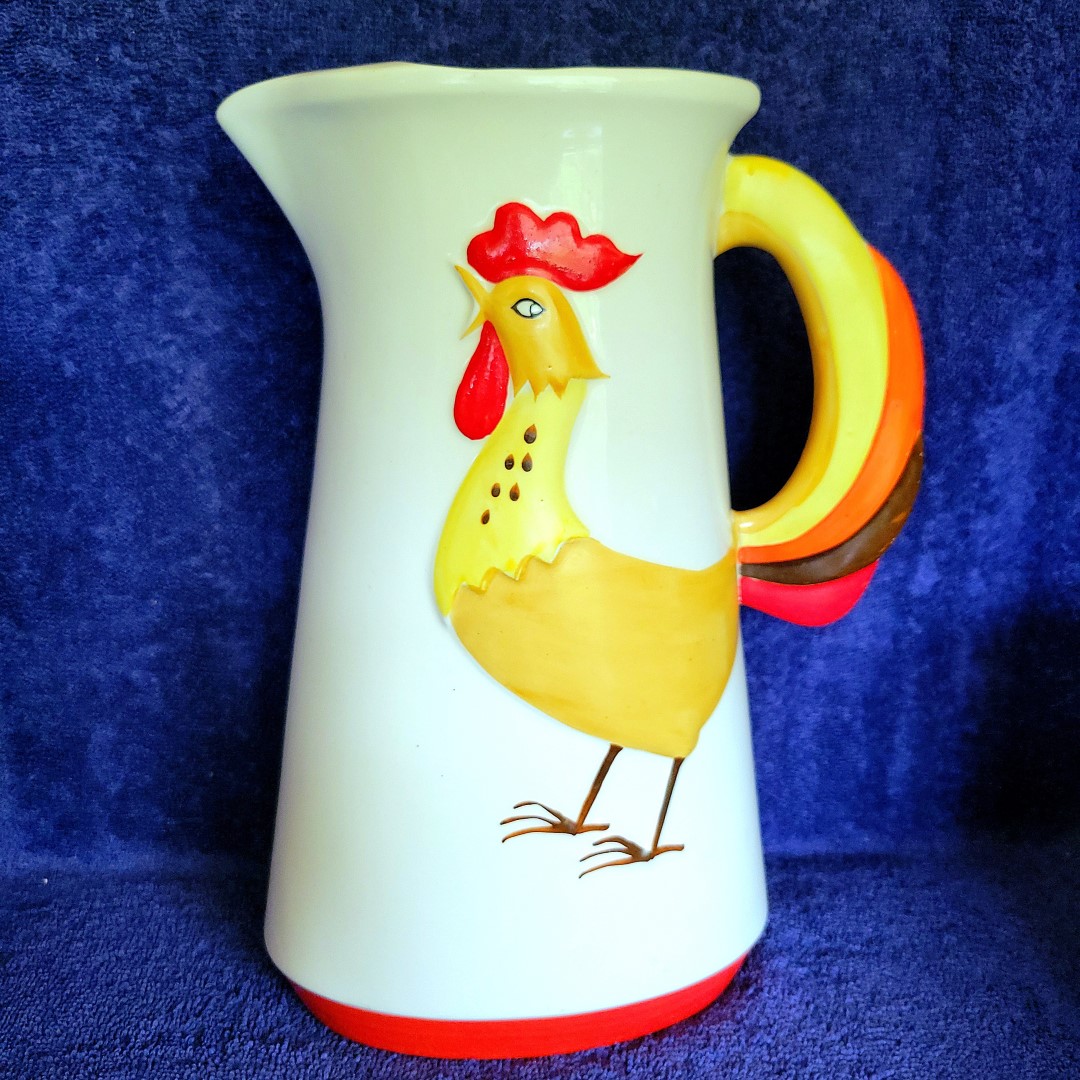
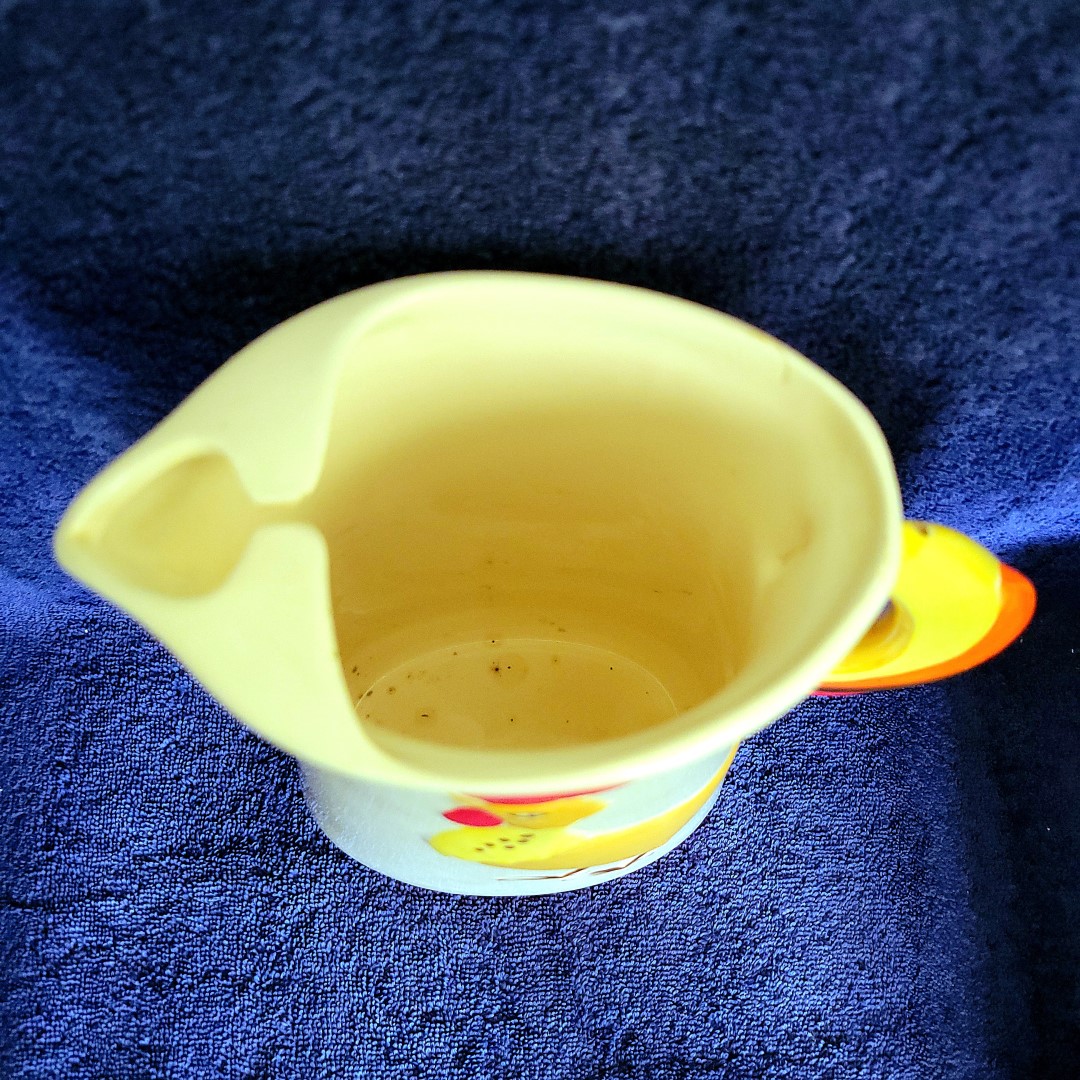
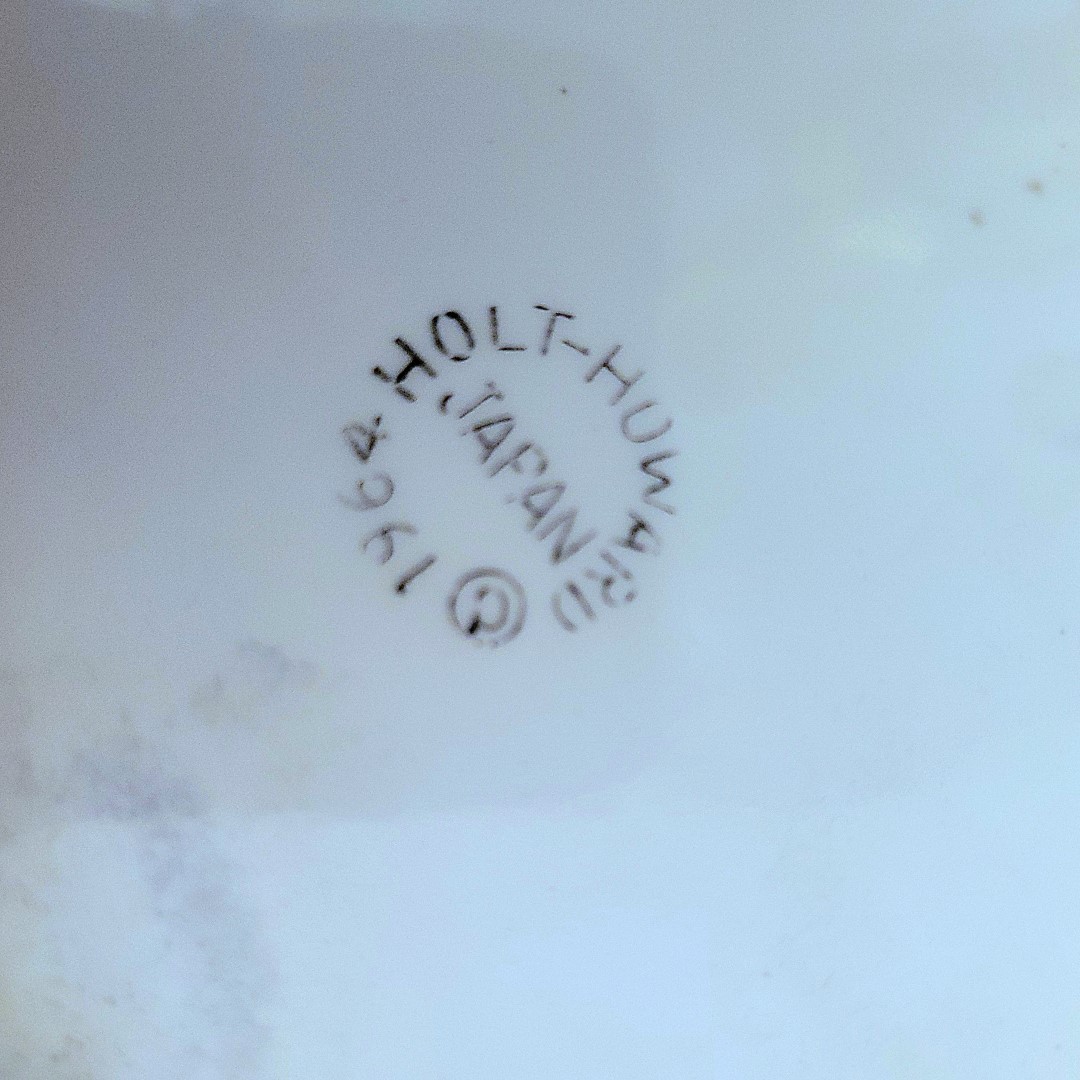
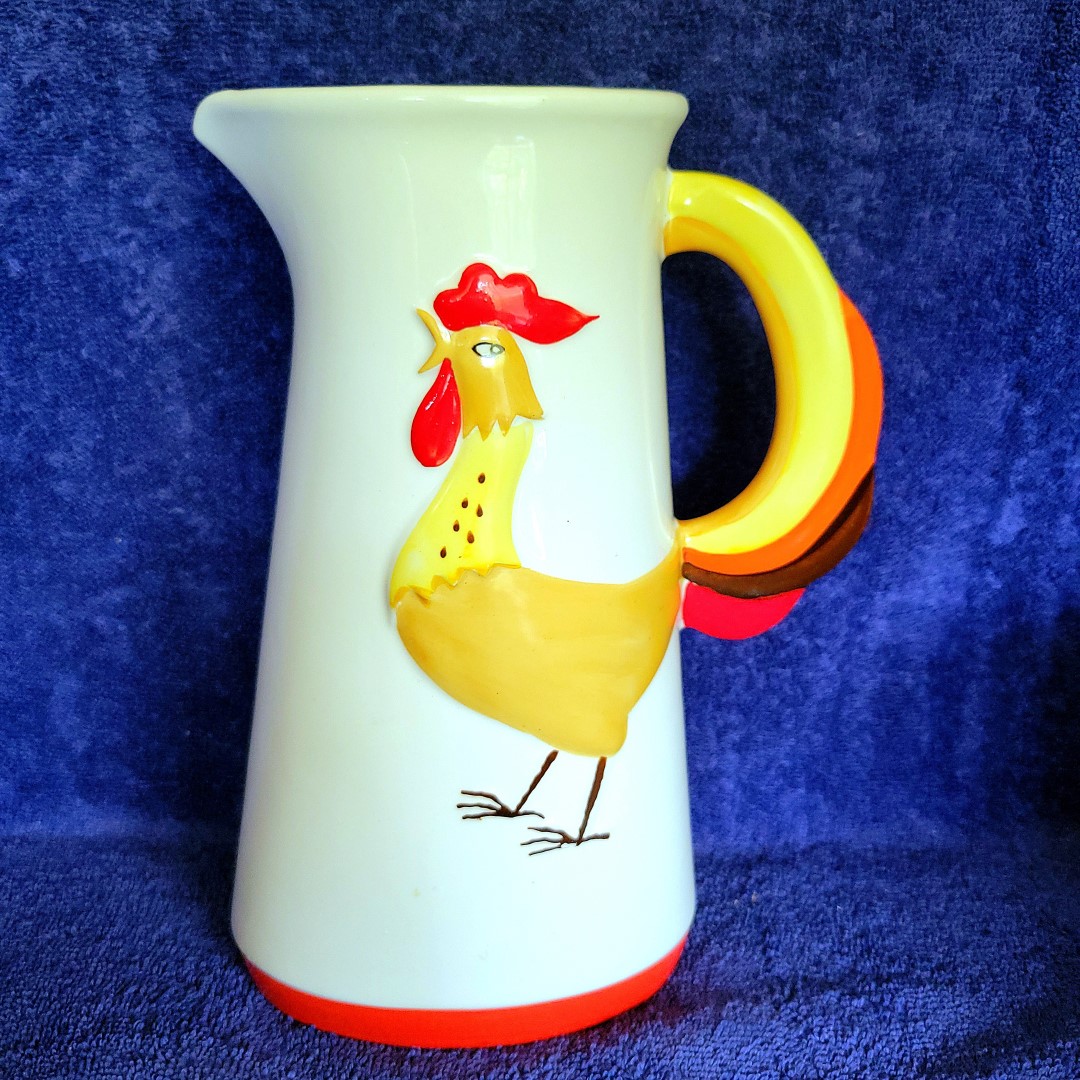
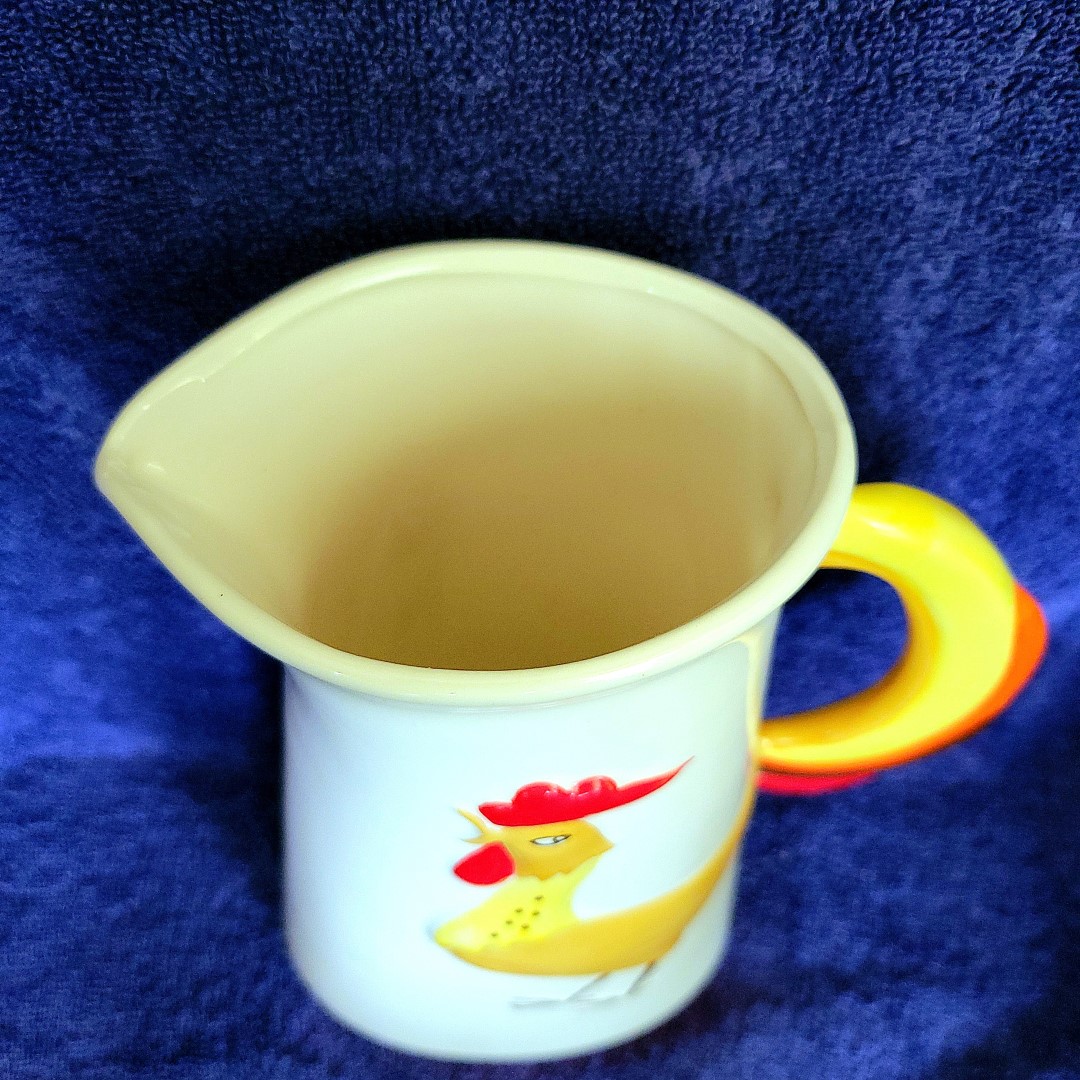
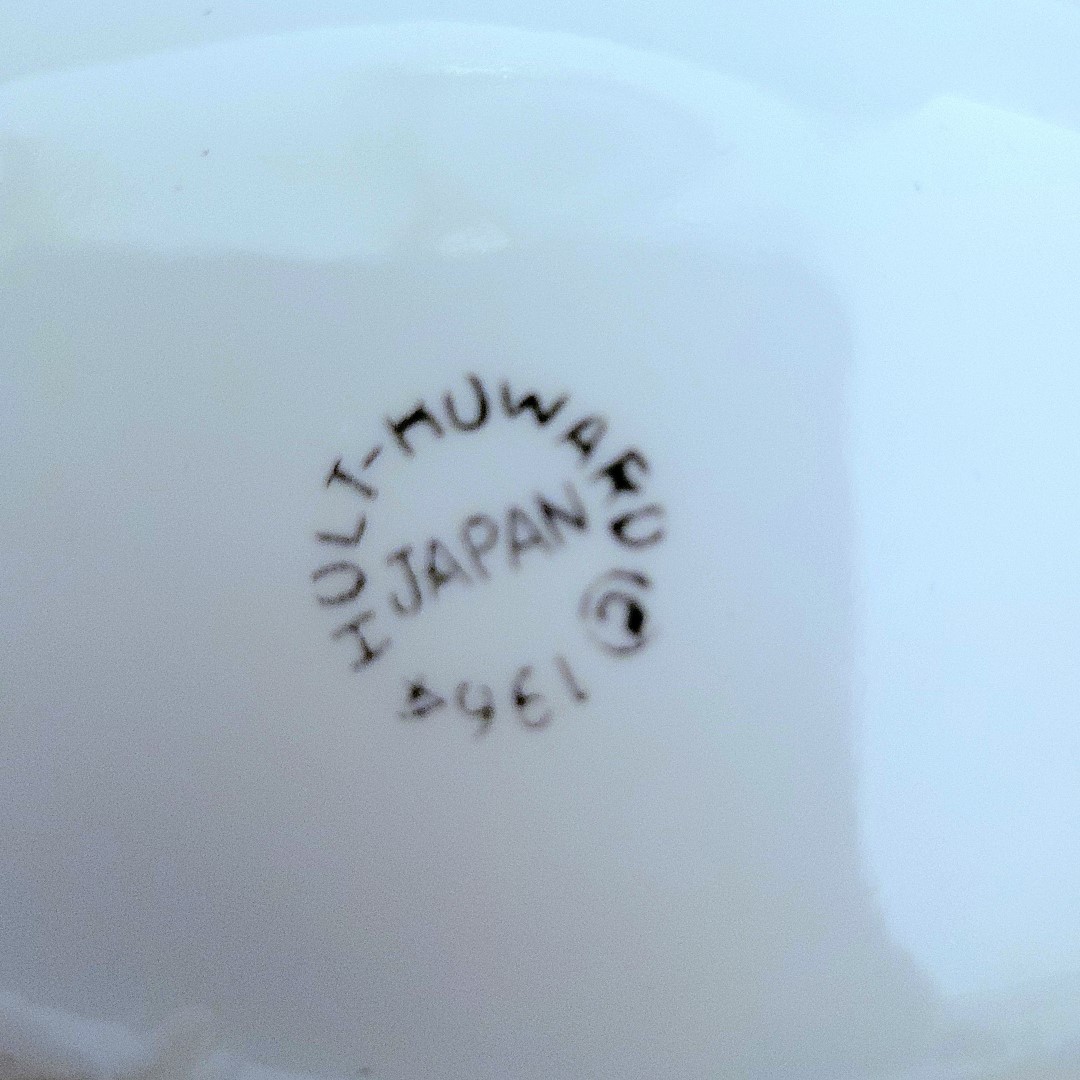
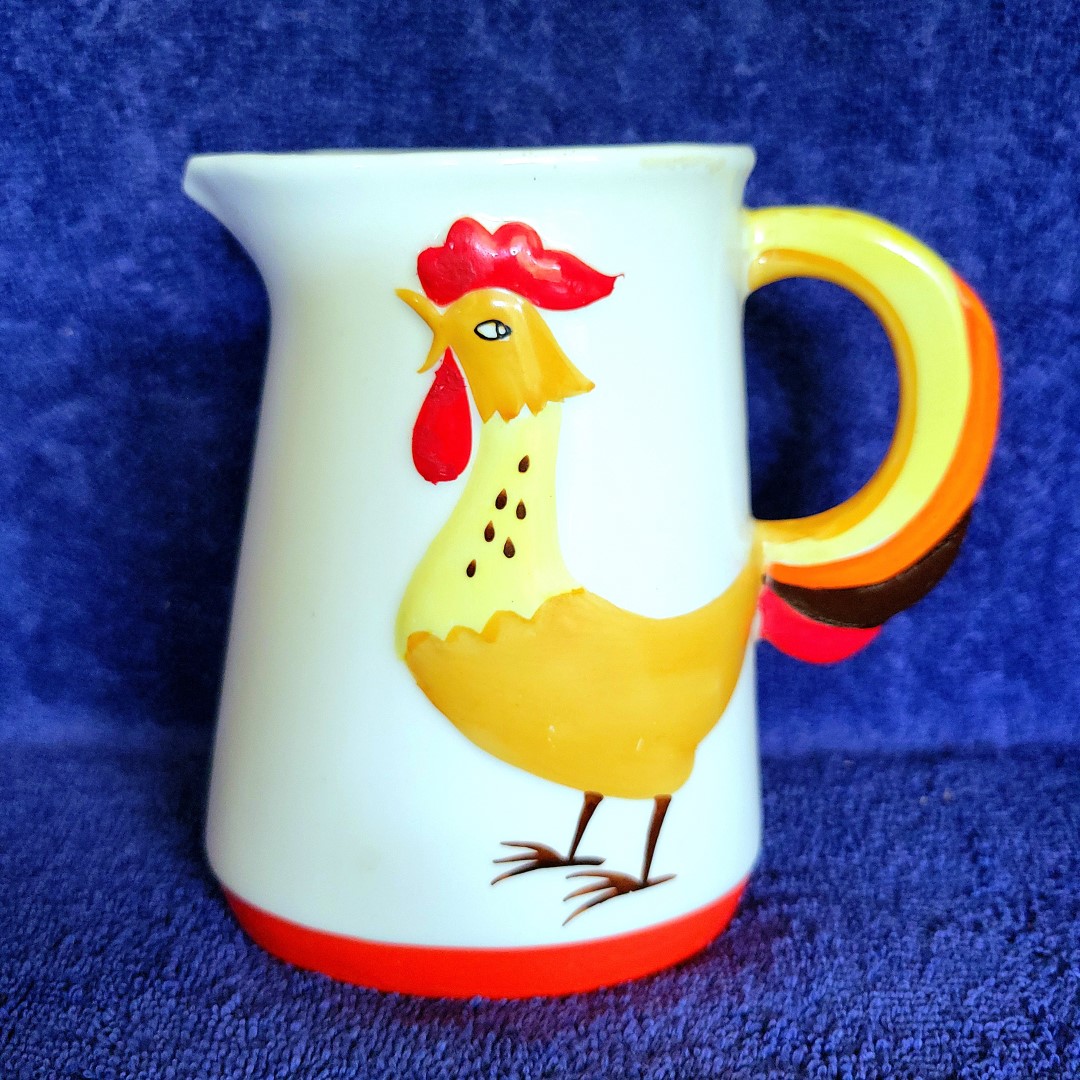
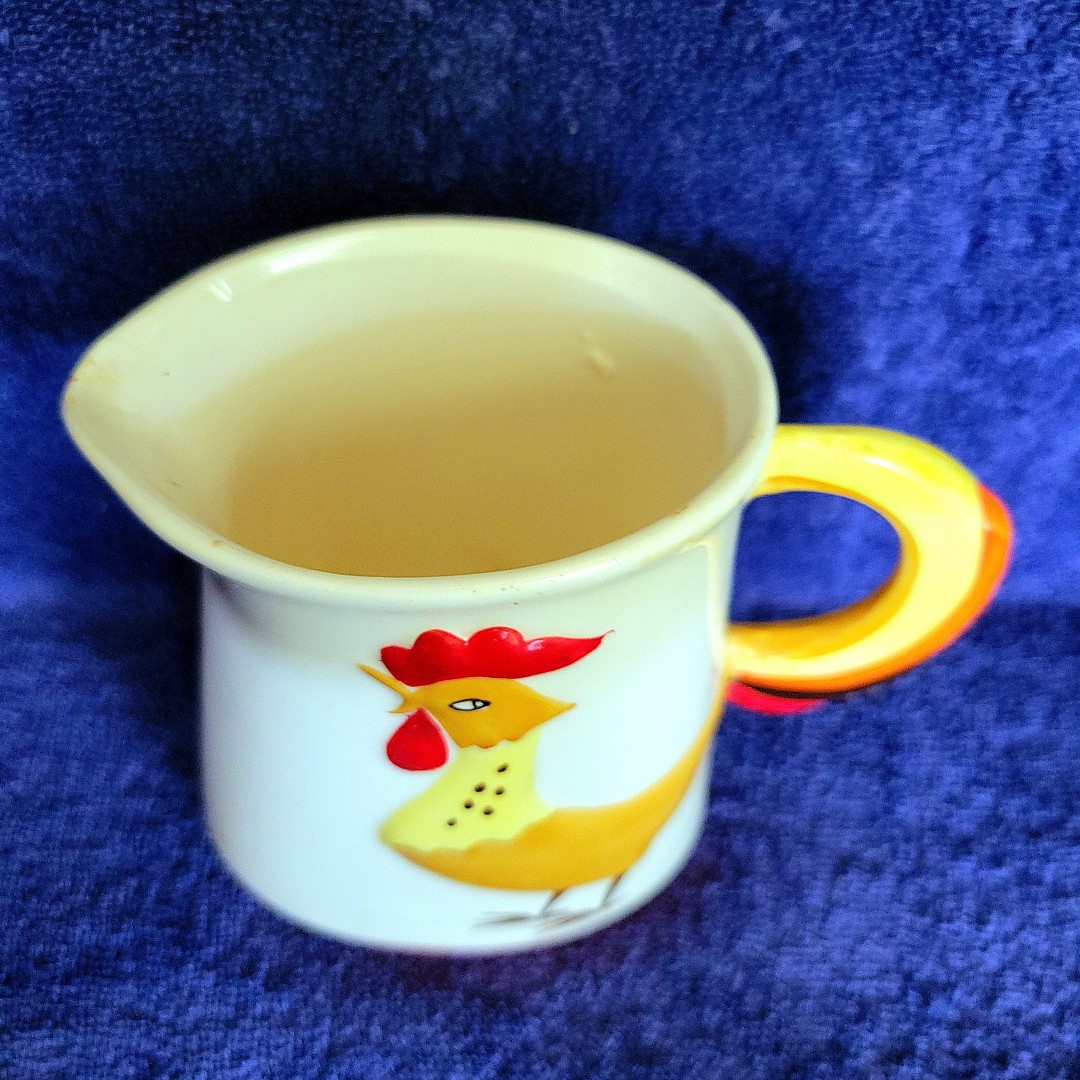
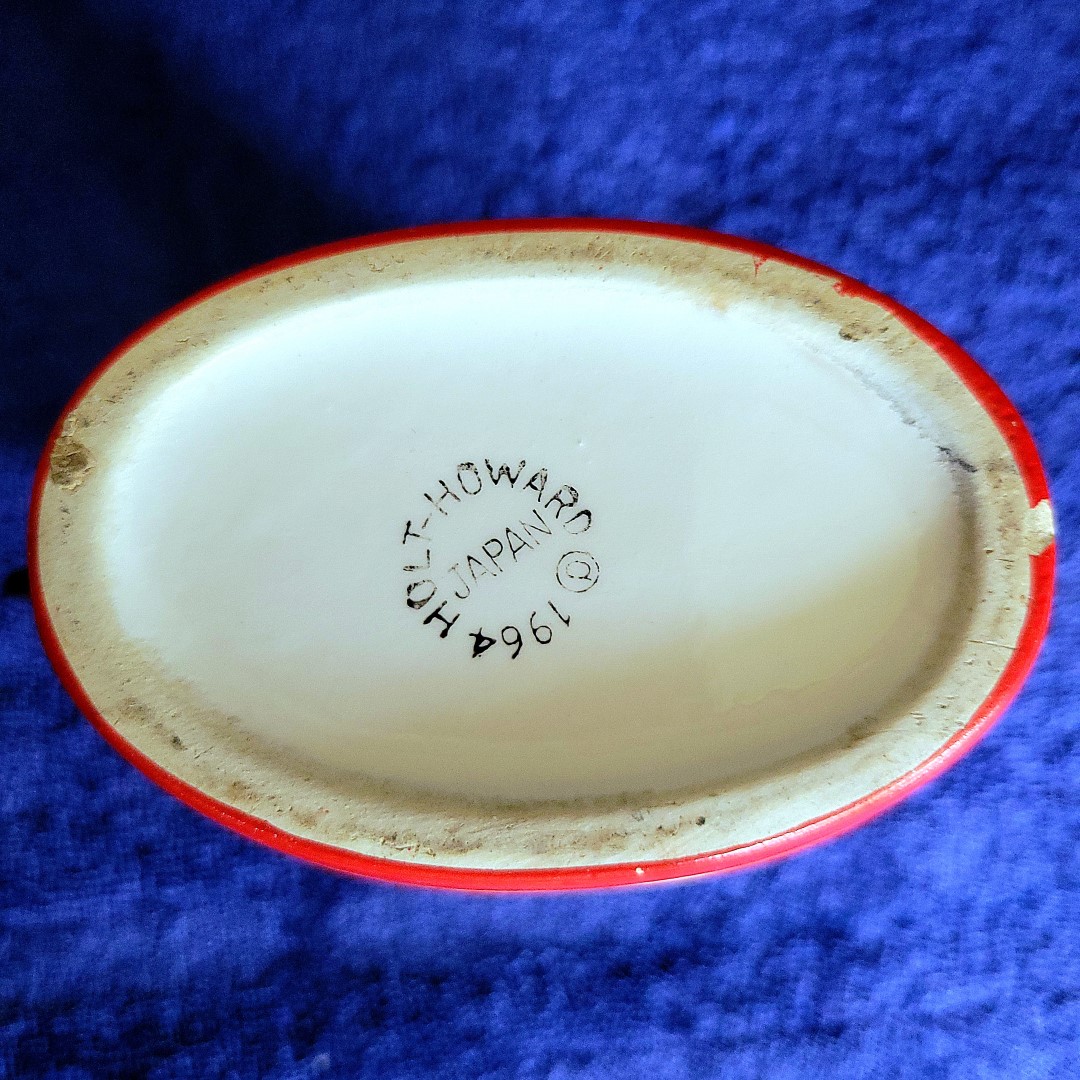
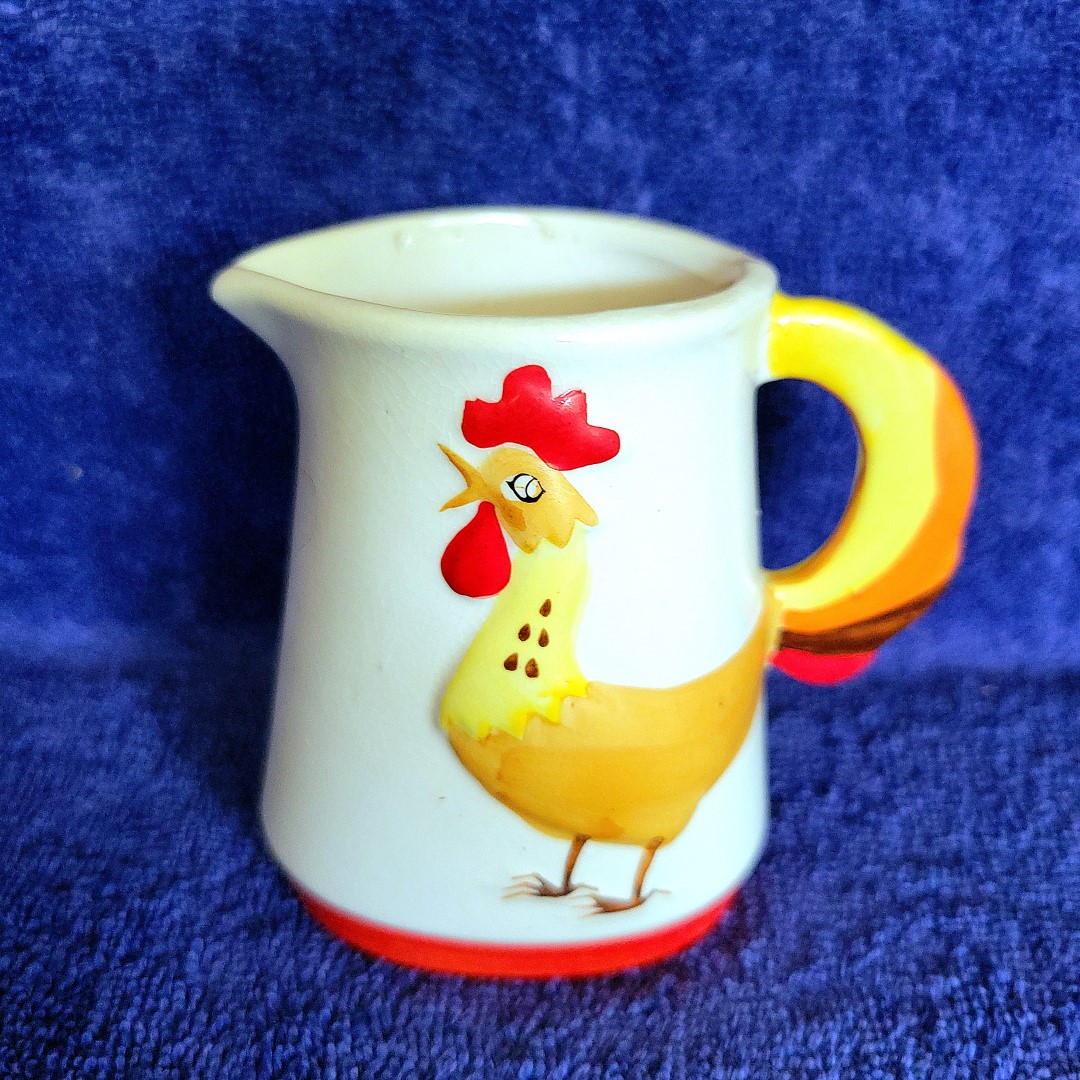
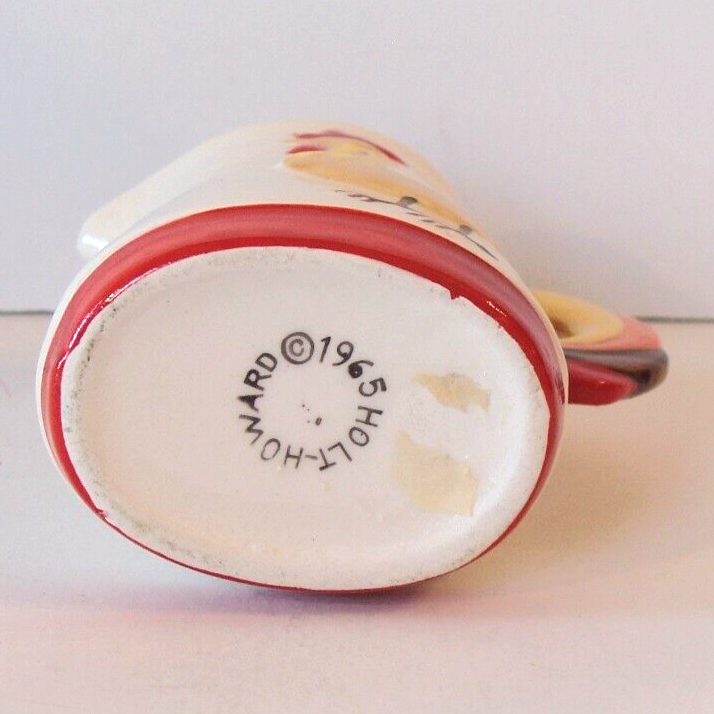
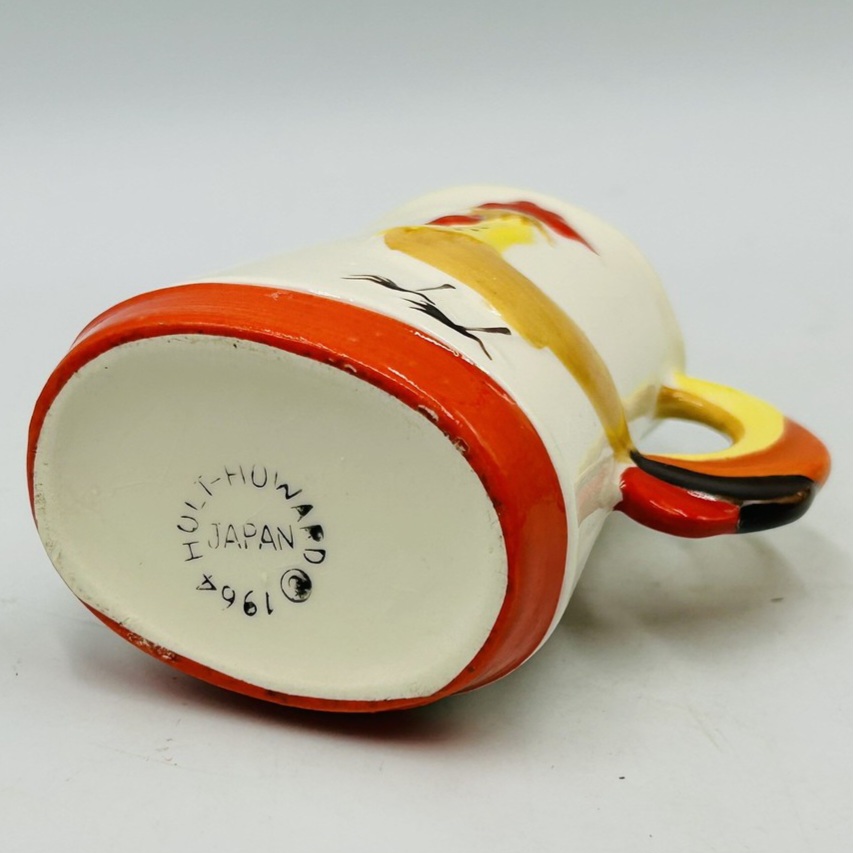
The Coq Rouge line included four distinct pitcher forms ranging from a large 48-ounce serving pitcher to a tiny 4-ounce syrup pitcher. Because the individual forms can be difficult to judge for scale when photographed separately, they are presented together here from largest to smallest. The group makes the progression in height, capacity, body shape, and handle treatment immediately apparent.
Large pitcher — 48 ounces, 9½ inches high. The largest form is substantially taller and broader than the others and is distinguished by a molded ice guard spanning the pouring spout. The archive example is backstamped © 1960 Holt Howard. Neither edition of the standard collector guide illustrates this form, although the first edition states that Coq Rouge pitchers were made in at least 12-, 32-, and 48-ounce sizes. The archive identifies this largest documented form as the 48-ounce pitcher.
Medium pitcher — 32 ounces, 8¼ inches high. This is the tall rooster-tail-handled 32-ounce juice pitcher, documented as a 1964 form. The rooster's tail forms the handle, giving the piece one of the most distinctive profiles in the line. The archive example is likewise backstamped © 1964 Holt Howard.
Small pitcher — 12 ounces, 5 inches high. The smaller rooster-tail-handled form retains the same basic visual idea as the medium pitcher but in a much more compact body. Direct measurement of the archive example confirms a 12-ounce capacity, aligning neatly with the first-edition documentation that a 12-ounce pitcher existed alongside the 32- and 48-ounce sizes. The archive example is backstamped © 1964 Holt Howard.
Syrup pitcher — 4 ounces, 3¼ inches high. The smallest form is a separate little serving pitcher rather than part of the 12/32/48-ounce sequence. The archive example itself is unmarked, but direct measurement confirms a 4-ounce capacity. Other documented examples carry 1964 and 1965 Holt Howard backstamps, showing that the form remained in production across at least those two copyright dates.
The collector-guide discussion of the Coq Rouge pitchers is somewhat muddled, particularly in the second edition where a lidless Coffee Server was mistaken for a smaller plain-handled pitcher. The surviving physical examples clarify the family more cleanly: a 48-ounce large pitcher, a 32-ounce medium pitcher, a 12-ounce small pitcher, and a separate 4-ounce syrup pitcher.
Handleless Juice Pitcher & Six Cups
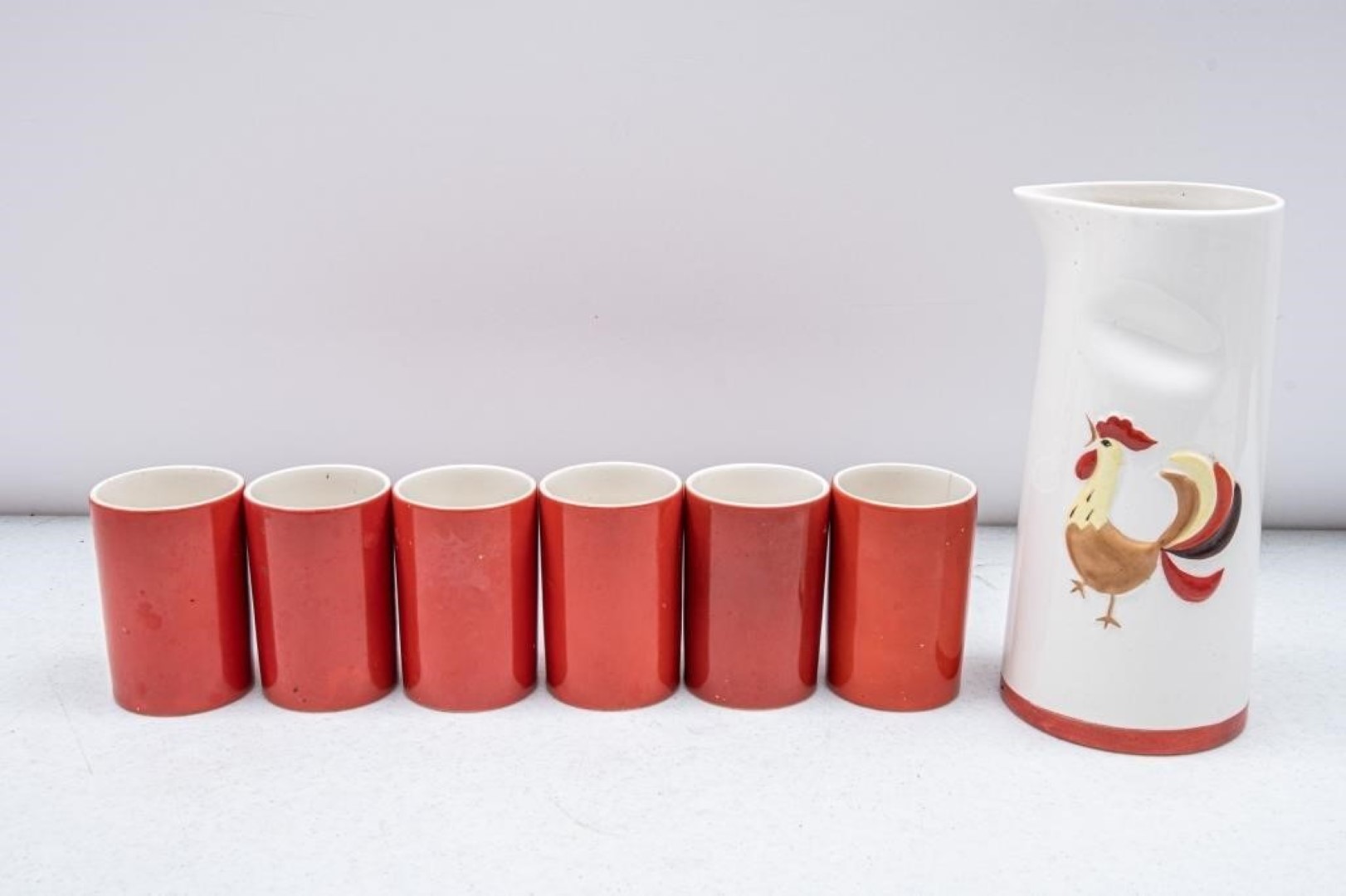
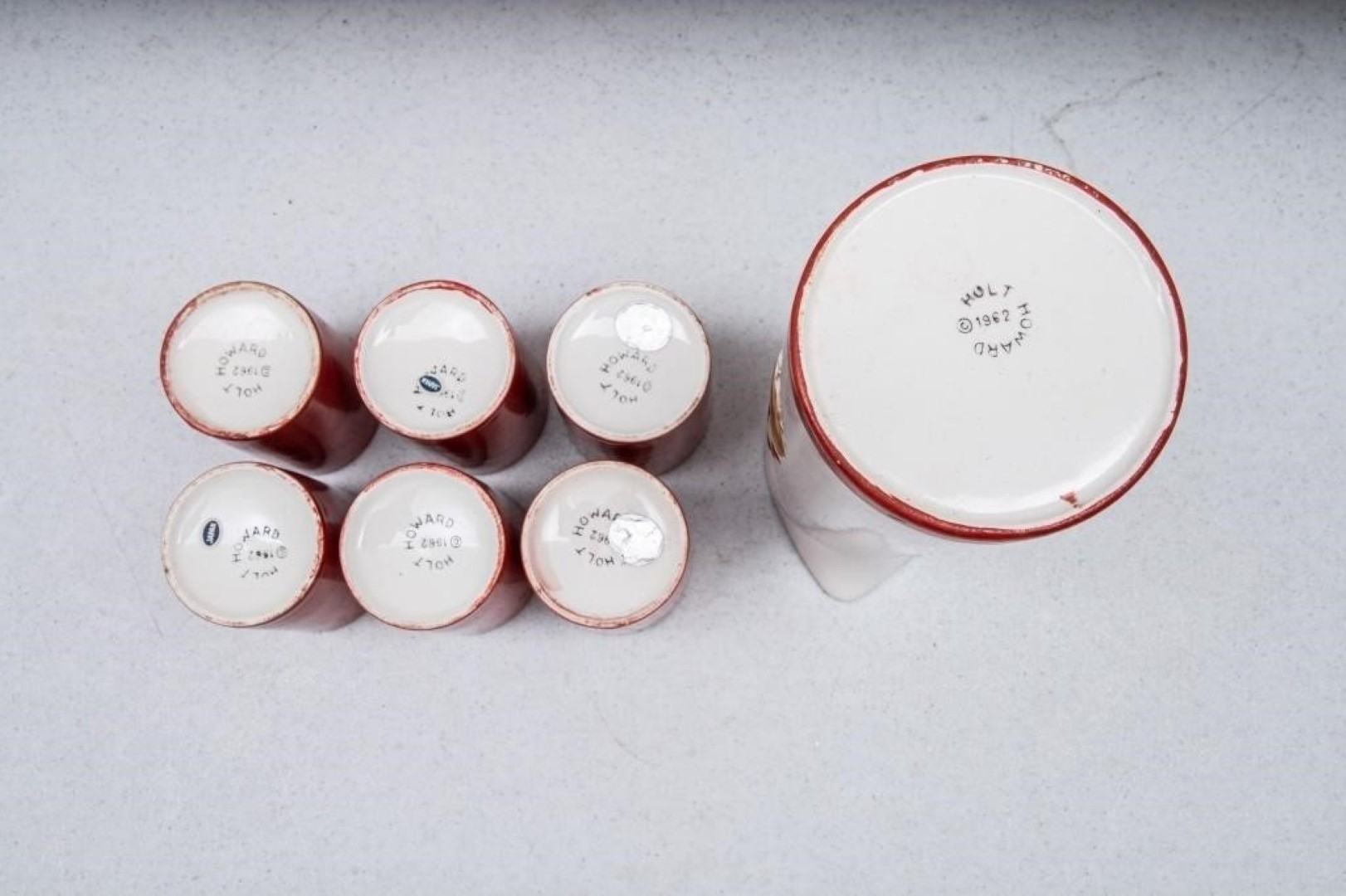
This Coq Rouge juice set combines a tall handleless pitcher with six matching straight-sided cups. The pitcher is decorated with the collection’s full-body rooster motif and finished with a narrow red-orange band around the base, while the cups are glazed solid red-orange on the exterior with white interiors.
Unlike the three graduated handled pitchers and the syrup pitcher, which have ovular footprints, this handleless form is circular at both the base and the mouth. Its body tapers inward from approximately 3½ inches across the bottom to 2½ inches across the top. The pitcher stands 7¾ inches high.
The six cups are cylindrical and measure approximately 3¼ inches high by 2 inches wide. Complete surviving sets are not commonly encountered, and many examples appear today with fewer than the original six cups. The documented set shown here retains all six.
Both the pitcher and the six cups are backstamped © 1962 Holt Howard, establishing the set firmly within the early Coq Rouge tableware period.
Condiment Jars — Mustard, Ketchup & Jam ’n Jelly
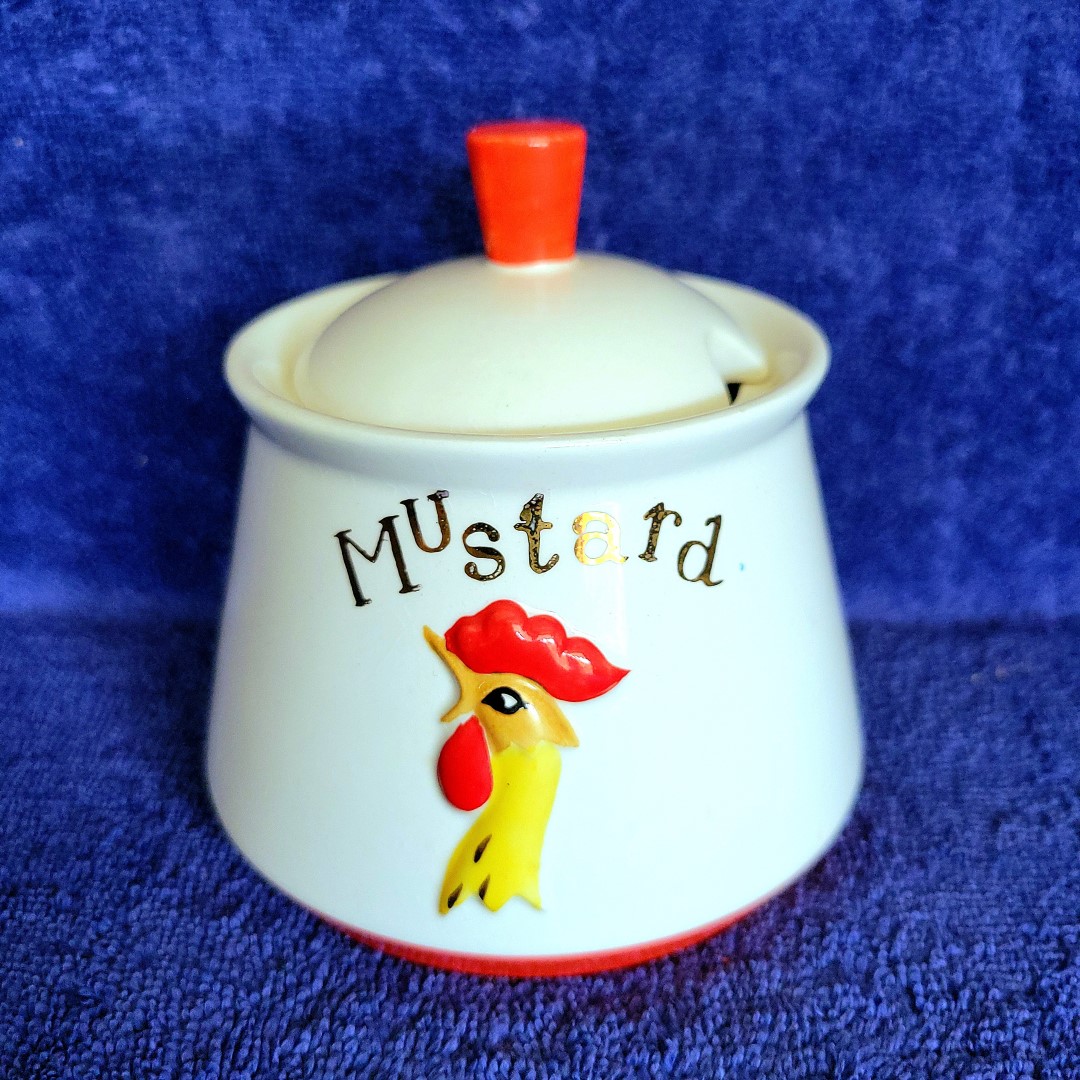
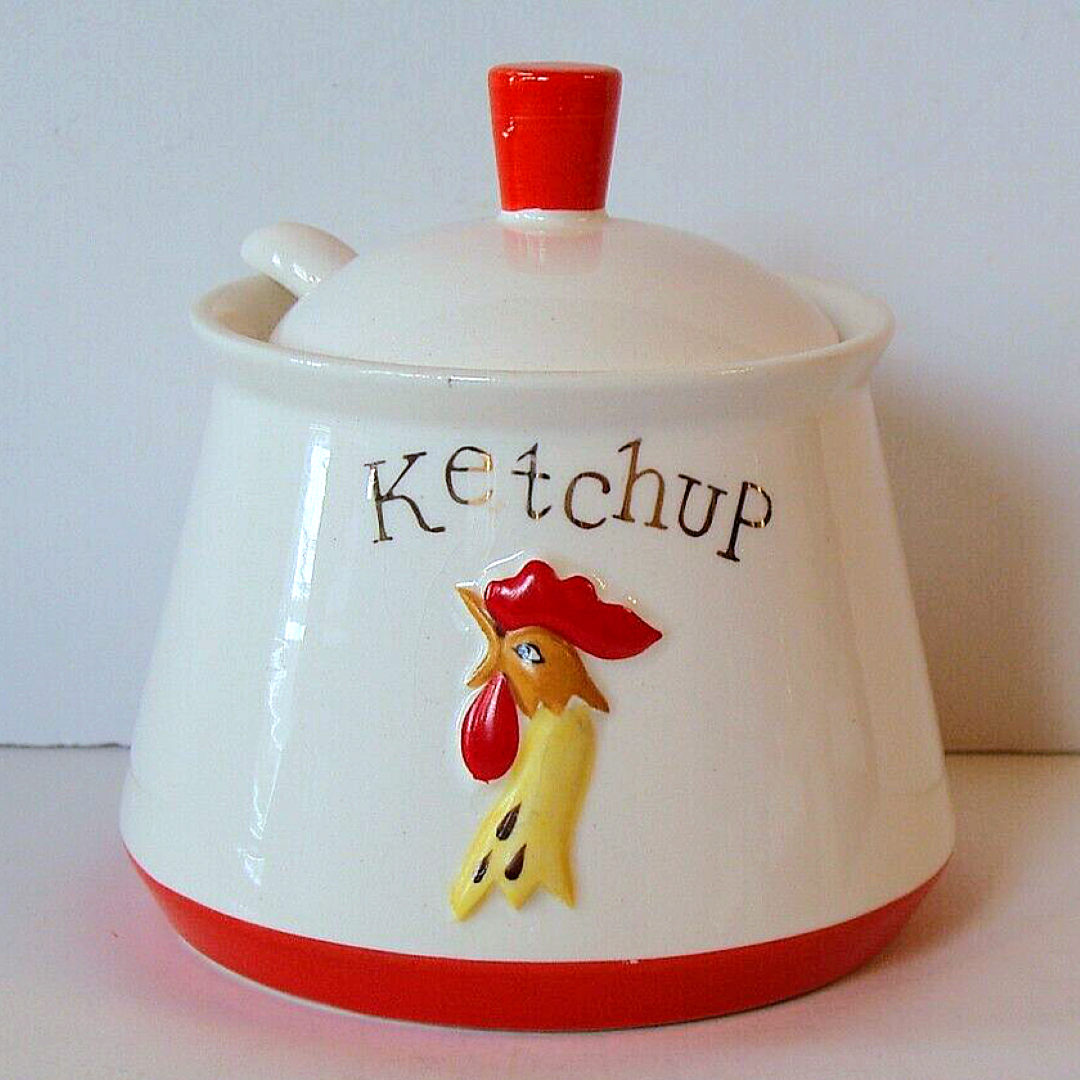
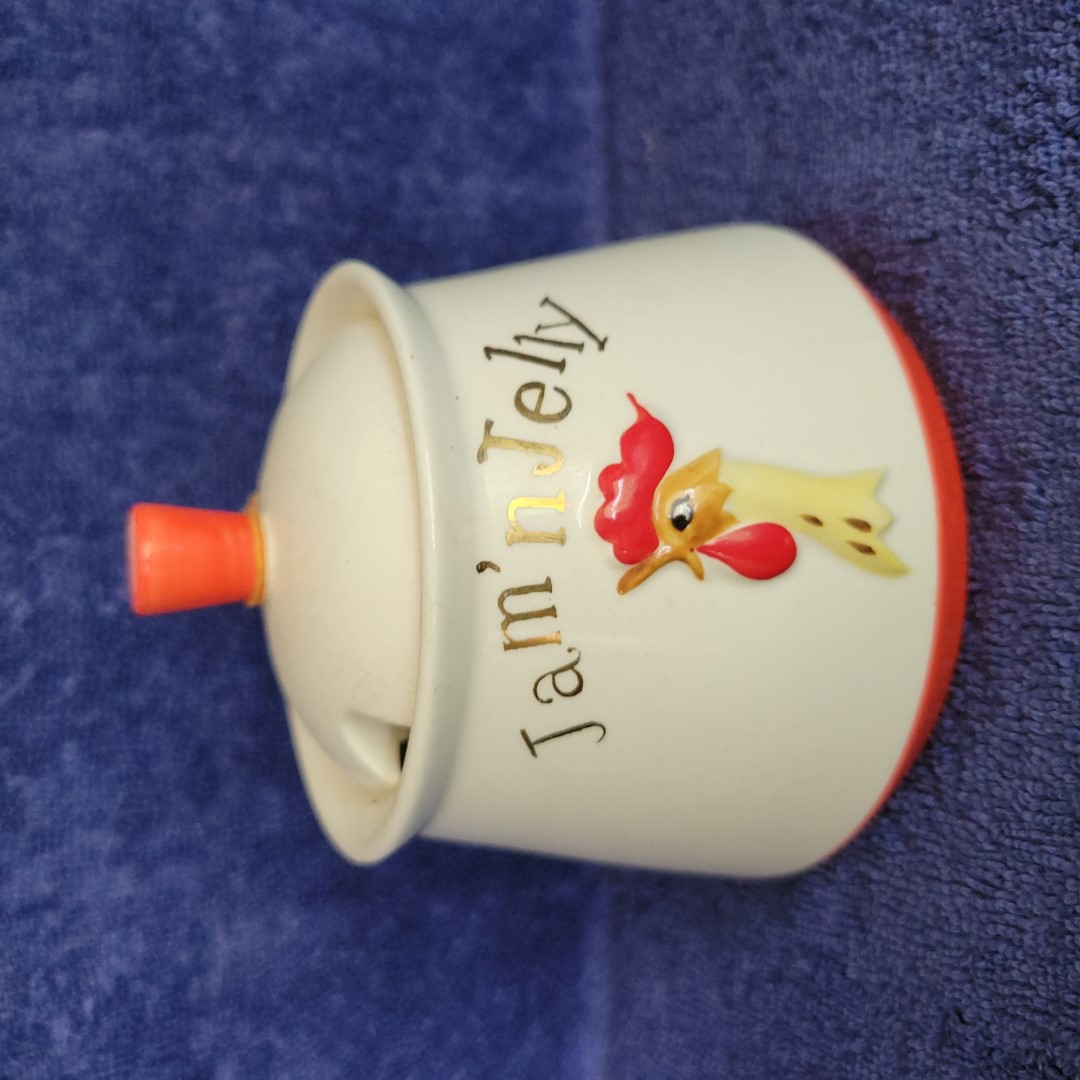
The Coq Rouge tableware line included three matching covered condiment jars: Mustard, Ketchup, and Jam ’n Jelly. All three use the same squat covered-jar form with a white body, narrow red-orange base band, domed lid with red-orange finial, and the collection’s rooster-head motif on the front.
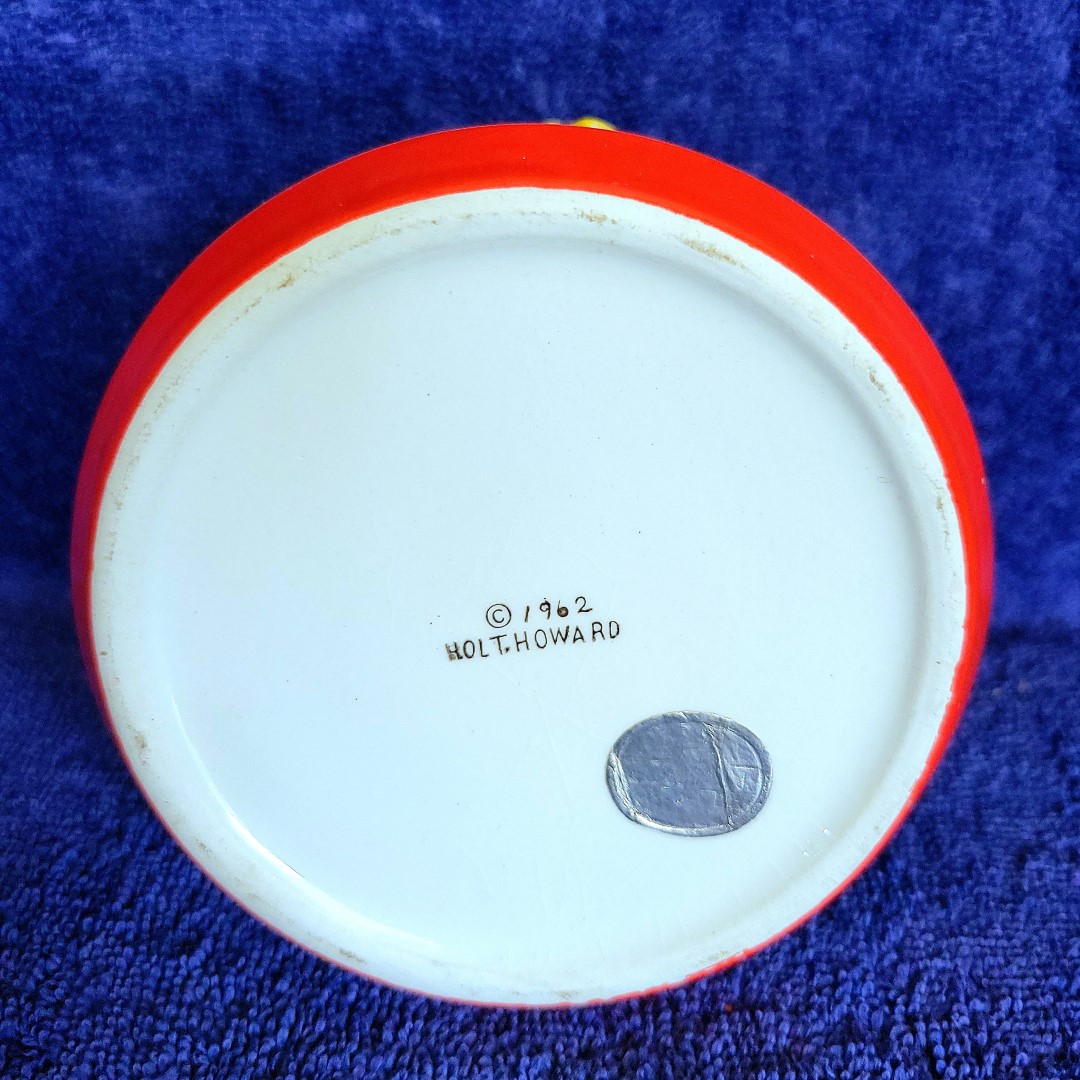
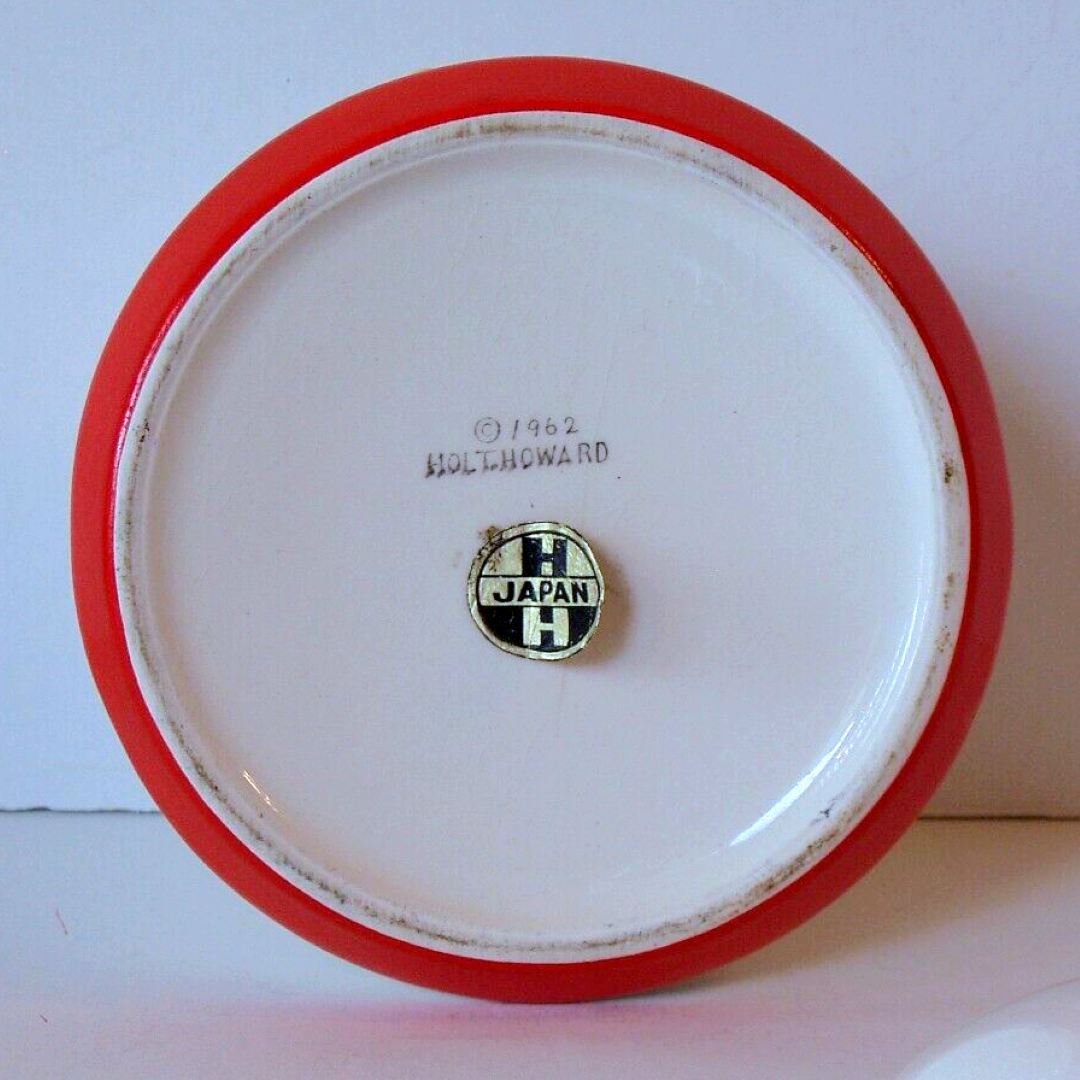
These three form a coordinated condiment group, each approximately 4 inches high. The surviving examples shown here match that shared form and proportion. The archive Mustard example is backstamped © 1962 Holt Howard, as is the documented Ketchup example.
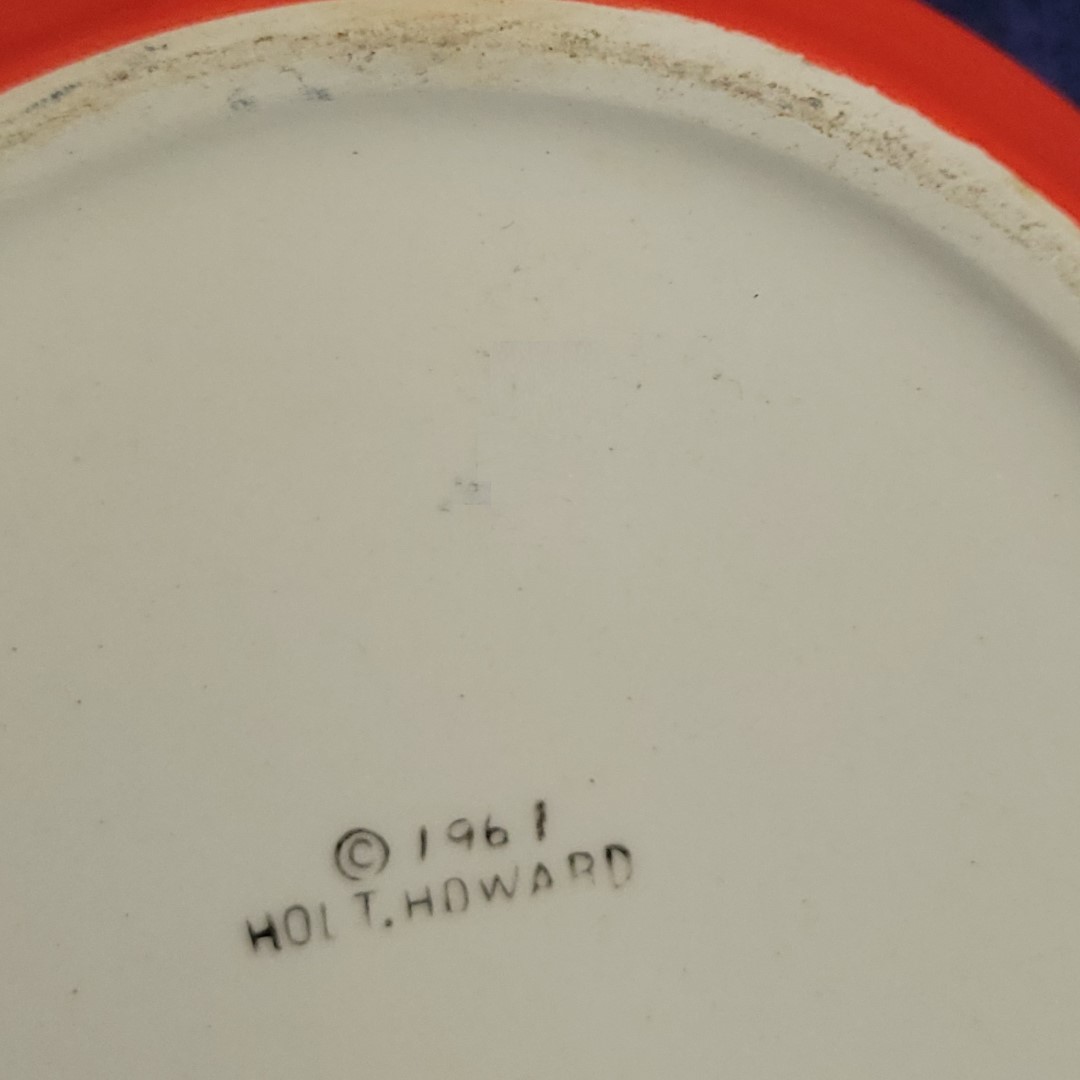
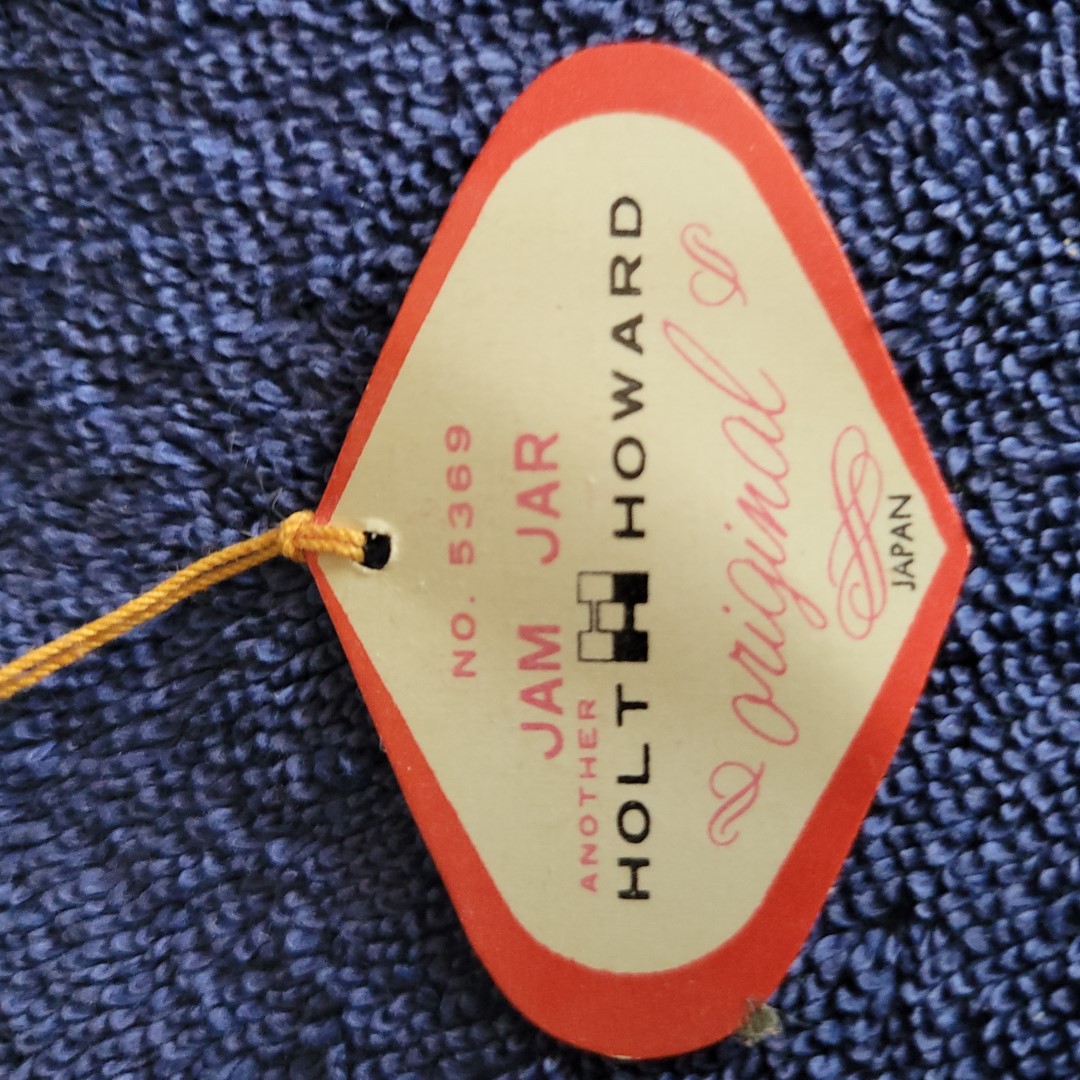
The Jam ’n Jelly jar provides especially useful factory documentation. Although the body is lettered “Jam’n Jelly”, an original Holt-Howard hang tag identifies the item itself as No. 5369 JAM JAR. The archive example is backstamped © 1961 Holt Howard, showing that this condiment form was already in production by 1961.